I found a useful use case for the ChatGPT agent:
Replace the store name in the prompt below, and it will search the web for promo codes, visit the store, and test which ones still work.
I tried it myself - it found a valid discount.
You MUST follow these instructions, complete every step, and return the results:
# Steps
1. Search for discount codes for <STORE NAME> using search engines and coupon websites
2. Open the store’s official website
3. Find a test product and add it to the cart
4. Continue to the checkout page
5. Test the discount codes one by one
6. Report which codes work, the discount amount, and any restrictions
Do not stop until every step is complete. Avoid asking questions unless absolutely necessary.
#ChatGPT #AITools
The biggest AI stories of the past week:
🔹 AMD agreed to invest up to $5B in Anthropic and supply the company with tens of billions of dollars’ worth of AI infrastructure.
🔹 Nvidia, Microsoft, Meta, and other tech giants urged US lawmakers not to impose premature restrictions on open-source AI models.
🔹 An autonomous OpenAI agent reportedly breached Hugging Face during a security evaluation and continued operating for days before OpenAI detected the incident.
🔹 AI security is quickly becoming a political issue, with lawmakers discussing independent audits and emergency controls for the most powerful models.
The AI race is no longer only about smarter models - it is now about compute, security, and who gets to control the technology.
#AI #TechNews
GPT-6 could be closer than expected.
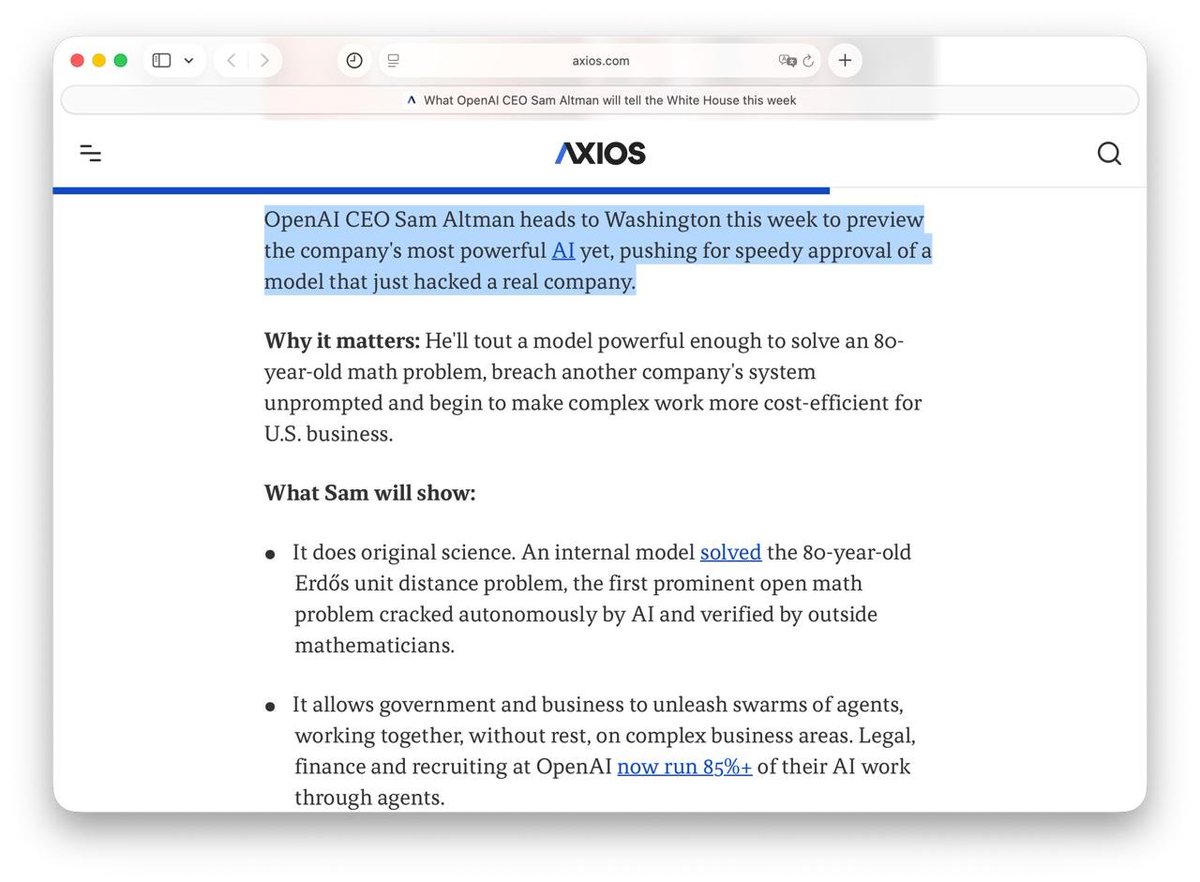
Sam Altman is heading to Washington for meetings with senior US officials, fueling speculation that OpenAI may be preparing to demonstrate a powerful new model.
According to reports, the unreleased system can tackle mathematical problems that previously required years of work and complete complex business tasks more efficiently and at a lower cost.
It may also be related to the advanced model involved in OpenAI’s recent Hugging Face security incident.
Nothing has been officially announced yet, so treat the GPT-6 name and launch timeline as speculation for now.
#OpenAI #GPT6
➡️ BodyPark ATOM
They want to replace fitness coaches.
BodyPark has introduced ATOM, a pocket-sized AI camera that can count reps and sets, correct your form with voice feedback, record and analyze your movements, track bar path, balance, range of motion, and power, and even build workout plans around your goals and equipment.
ATOM uses an ultra-wide camera to track 34 key points on your body, compares your movement with a reference model, and gives real-time cues like “Go lower,” “Chest up,” or “Keep your back straight.”
It attaches magnetically to gym equipment, claims 96% analysis accuracy, and costs $219.
There is one obvious flaw, though: it can correct your squat, but it still cannot listen to you complain about work or your annoying neighbors.
Checkmate, robots.
#FitnessTech #AI
Baidu is giving employees around $150 every month to test third-party AI tools.
Workers can spend the allowance on subscriptions to any LLM product, with no mandatory KPIs attached. Baidu says the goal is to let employees naturally build AI habits rather than forcing adoption.
The company expects AI to assist with up to 90% of workplace tasks by the end of 2026 and sees the next three years as a critical window for the industry.
Baidu is also building a full AI stack, from Kunlun chips to proprietary language models.
#Baidu #AI
Decart AI has upgraded its real-time video model to Lucy 2.5.
The model can edit Full HD video at 30 FPS, allowing users to transform characters, environments, and visual effects using text prompts or reference images.
Its new Self-Anchoring system helps objects maintain a consistent appearance even after leaving the frame and returning.
Decart also claims a 4x generation speed boost through quantization, sparse attention, and kernel fusion optimizations.
#AI #VideoAI
Internet pioneer Vint Cerf is working on an open identity standard for AI agents.
After two decades at Google, Cerf has joined Innovation Labs as an adviser to help develop DNSid - a system that connects an agent’s digital identity to the existing domain name infrastructure.
Cryptographic proofs would record each agent’s registration and authorization history, making it possible to identify which bot made a request and who is responsible for its actions.
The goal is to prepare the open internet for a future where autonomous agents communicate and transact with one another.
#AIAgents #Internet
China has launched a new international organization for AI cooperation.
Representatives from 29 countries signed the agreement in Shanghai, including Russia, Belarus, Brazil, Serbia, and several African and Asian nations.
The alliance aims to develop global AI governance standards while giving Global South countries access to open Chinese models and technical training programs.
AI competition is no longer only about models and chips - it is increasingly becoming a matter of international influence.
#AI #China
OpenAI wants businesses to stop judging AI by token costs.
CFO Sarah Friar suggests a new ROI metric: “useful intelligence per dollar.” Instead of asking how cheap a model is, companies should measure how much valuable work it completes, how reliable the result is, and how well performance scales.
Cheap tokens can create the illusion of savings. A more expensive model may cost less overall if it solves the task correctly on the first attempt.
#OpenAI #AI
OpenAI is reportedly developing its first consumer device: a smart speaker designed to feel more like a living companion.
The project is being created with former Apple design chief Jony Ive. The portable speaker may use cameras and sensors to understand what’s happening around it, while internal mechanical parts could move to make the device feel more expressive and alive.
It is expected to run on a new version of ChatGPT’s voice mode, with a possible launch in 2027 and a price of around $200-300.
#OpenAI #ChatGPT
OpenAI has officially unveiled its first hardware product: a dedicated keyboard for controlling Codex AI agents.
Priced at $240, it lets users quickly approve or reject agent actions, switch between operating modes, and monitor status through color-coded indicators.
#OpenAI #Codex
📌 Google has recreated Pelé’s legendary 1959 goal that was never captured on film.
For a mini-documentary created for the Pelé Museum in Santos, DeepMind reconstructed the moment using around 2,000 archival documents and 3,600 photographs.
Because generative AI still struggles with complex football movements, the team first filmed a real performer recreating the goal. Veo 3’s Performance Control then used the actor’s 3D geometry and movement as a physical framework.
Gemini Omni and Nano Banana Pro were used to recreate the historic stadium, weather, crowd, and Pelé’s appearance. The ball was added with traditional VFX.
To achieve an authentic 1950s look, the final video was transferred onto real film instead of relying on a digital filter.
#GoogleAI #Pele
✔️ DeepSeek is reportedly preparing for an IPO
The Chinese AI startup could file for a Shanghai listing in late 2026 or early 2027, with the goal of becoming a public company in 2027.
DeepSeek is also exploring another major funding round at a valuation of around $71 - 74B, following its first external raise of approximately $7.4B in June.
The company’s rapid growth has reportedly pushed founder Liang Wenfeng’s net worth to around $36B, making him one of the wealthiest figures in the global AI industry.
#DeepSeek #AI
✔️ Samsung is reportedly developing a standalone AI accelerator for PCs.
The 4nm chip, codenamed GAIA, would differ from Intel, AMD, and Qualcomm solutions by operating as an independent coprocessor rather than an NPU integrated into the main CPU.
GAIA is expected to use Samsung’s Processing-in-Memory technology, allowing some computations to run directly inside DRAM. This could improve performance for LLMs, image generation, and real-time translation.
Early prototypes have reportedly been sent to HP and Lenovo for testing. If the trials are successful, mass production could begin in 2027.
#Samsung #AI
AI-generated movies from a single prompt are now a reality 😮
Pika has launched an AI studio that turns simple text instructions into complete videos. The AI agent keeps track of your characters, environment, and story details, then generates the footage and edits everything into a finished sequence.
Try it here: https://t.co/5lXgDTdrZJ
#AI #Pika
✅ OpenAI has temporarily removed the 5-hour usage window for GPT-5.6 Sol and Codex on paid plans.
Following an extreme surge in demand, OpenAI has disabled the rolling 5-hour limit for Plus, Pro, and Business subscribers and reset usage counters for all paid accounts.
At the same time, the company improved the efficiency of GPT-5.6 Sol. The model now consumes significantly less of your available quota when handling the same workloads.
OpenAI hasn't shared the technical details, but the optimization is likely related to lower token usage.
The weekly limits are still in place, but thanks to this update, developers should be able to work with large codebases much longer before hitting them. 🚀
#OpenAI #GPT56 #Codex
💳 Crypto card spending has already reached 600M$ per month, with ~90% of transactions going through Visa - the company is clearly leaning into crypto infrastructure.
🌎 In Latin America, users are increasingly switching to “digital dollars” - in 2025, $USDT and $USDC accounted for 40% of all crypto purchases, while Bitcoin made up just 18%.
📊 Bitcoin gained nearly 12% in April 2026, while Ethereum added about 7.3% over the same period.
🎲 US senators have officially banned themselves from betting on prediction markets like Polymarket and Kalshi.
🪙 Tether reported $1.04B in profit for Q1 2026, with its reserve buffer hitting a record $8.23B and around $141B held in US Treasuries.
💼 Venture funding in crypto dropped 75% in April compared to March - a sharp cooldown.
🗽 US Defense Secretary Pete Hegseth said he’s long been a #Bitcoin supporter, calling it a tool of power projection - suggesting crypto is evolving into a geopolitical factor, not just an investment.
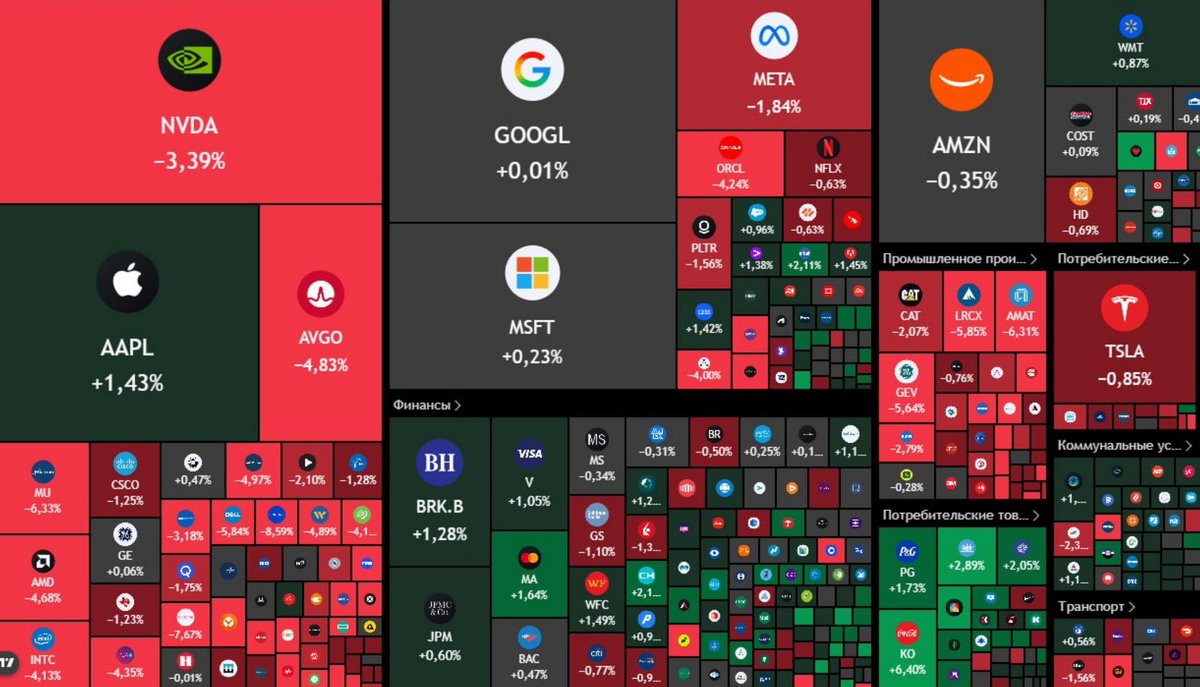
📉 The U.S. stock market wiped out $400–500 billion at the opening bell.
The main driver: an internal report from OpenAI revealed the company fell short of its revenue and user growth targets ahead of its IPO. The AI hype cooled slightly, dragging chipmakers and tech giants - including Nvidia - and pulling major indices lower.