Provides policy recommendations & research reports to govt’s, interfaith entities & related Int’l orgs on people of East Turkistan. العربية @CUyghurstudyAR
Today, the Center for Uyghur Studies (CUS) has released a comprehensive report documenting the Chinese Communist Party’s (CCP) sophisticated and systematic influence campaign in Southeast Asia. This campaign aims to conceal, deny, and justify the ongoing genocide, human rights abuses, and religious persecution of the Chinese government against the Uyghur people in East Turkistan (AKA the Xinjiang Uyghur Autonomous Region).
The report, titled “China’s Influence Campaigns in Southeast Asia & Plight of Uyghurs,” examines how Beijing fabricates false narratives, infiltrates institutions, exploits economic leverage, and suppresses dissenting voices to control the narrative surrounding its human rights abuses.
https://t.co/1eCfcbAkEr
The assault on Uyghur culture extends far beyond physical structures. In a chilling development, Human Rights Watch (HRW) revealed that Chinese authorities have been systematically changing the names of hundreds of villages across the Uyghurs’ homeland. Names rich with religious, historical, or cultural significance for Uyghurs are being replaced with generic terms reflecting Chinese Communist Party ideology. The village of “Imam Mazar” (Imam’s Shrine) becomes “Happiness Village.” “Sultan Kirishi” (Sultan’s Entrance) is now “Harmony Street.” With each name change, a piece of Uyghur history is erased, replaced by a sanitized version of reality approved by the state.
“The systematic destruction of Uyghur culture intensified in earnest in 2017, under the guise of Xi Jinping’s war on Uyghurs, “people’s war on terror” and a campaign of “sinicization“. What started as increased surveillance and restrictions on religious practices soon escalated into a full-scale assault on Uyghur identity. Mosques that had stood for centuries were razed to the ground; their intricate domes and minarets replaced by sterile government buildings. Ancient Uyghur cemeteries, once places of reverence and connection to ancestors, were bulldozed and paved over.”
https://t.co/BM4cspKT12
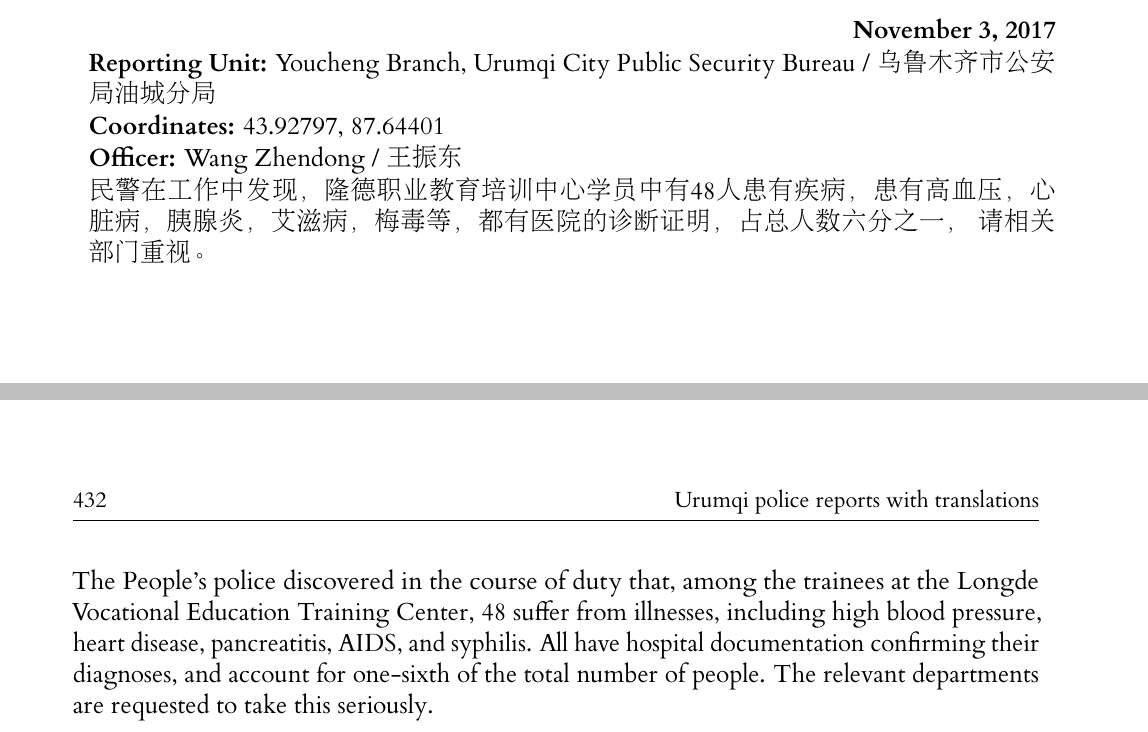
A police note from November 2017, showing that of the ~300 people held at the Longde camp in northern Urumqi (exact location unclear) at that time, around 50 had serious illnesses and with hospital documentation to prove it.
#BREAKING For the first time, China sanctions New Zealand MPs for visiting Taiwan, including IPAC Members Laura McClure MP and Duncan Webb MP.
Amidst a string of recent provocations, Beijing continues to escalate its campaign to shrink the world for Taiwanese diplomacy.
https://t.co/P2ESWEmrwZ
The article also highlights the rapid expansion of international hotel chains in the region, despite continuing concerns over forced labor, demolished religious sites, and state-led repression.
Economic opportunities should not blind companies to their human rights responsibilities. Operating in a region where millions have been subjected to mass detention, surveillance, and coercive policies requires far greater scrutiny and accountability.
The @FT reports that Beijing is launching a sweeping effort to transform the Uyghur homeland and Tibet through massive investments in infrastructure, tourism, energy, manufacturing, and trade.
But economic development is not replacing repression, it is being built on top of it. As the article notes, the surveillance apparatus and systems of social control remain firmly in place while Beijing seeks to integrate these regions more deeply into China’s economy and society.
https://t.co/oH8Q4X4ECb
“A key takeaway from the Financial Times investigation: Beijing’s strategy is not only about economic growth.
By making Xinjiang and Tibet central to global supply chains, tourism, energy production, and critical minerals, China aims to make international sanctions, boycotts, and human rights pressure increasingly difficult to sustain.
The message is clear: economic integration is being used to shield ongoing repression from international accountability.
Governments and businesses must not allow commercial interests to come at the expense of human rights.”
Tourism is becoming one of Beijing’s most powerful tools in East Turkistan.
According to the Financial Times, the Uyghur region received a record 323 million visitors last year. While tourists are shown scenic landscapes, cultural performances, and newly built attractions, the article notes that extensive surveillance and repression remain in place.
As one Uyghur advocate quoted by FT warned: “This all gives the picture that it’s quite ‘normal’, so China can show the world that nothing has happened.”
Tourism should not be allowed to whitewash crimes against humanity.
Today, CFU Executive Director @RushanAbbas, @Cuyghurstudy Executive Director @AHakimIdris, and @ziba116 had an important meeting at the Norwegian Foreign Ministry. We are grateful to all foreign governments who support human rights and stand up for the rights of Uyghurs.
"My sister is in China's jail right now"
@CUyghurs executive director Rushan Abbas shares how after she spoke out about China's treatment of Uyghurs, her sister got punished.
“With the arrival of Minister Wang Yi who is best known for his involvement with the policy that supported cultural erasure of the Uyghur peoples in China and his berating of a Canadian reporter who dared ask him and his government to be accountable he arrived in Ottawa to peddle more lies and promises….” Writes @DMCBaxendale via @Substack
https://t.co/5Y0G2nUM6E
“The EU’s Forced Labour Regulation is edging closer – and brands still relying on China as a key sourcing hub face mounting risk.” @adrianzenz has warned.
https://t.co/cc7sXr5FKm
Menurut kajian @adrianzenz, buruh paksa #Uyghur masih digerakkan di ladang2 kapas Turkistan Timur/xinjiang setakat musim luruh 2023. Pekerja-pekerja ini menanggung penindasan sistemik. Kira-kira 90% daripada kapas China hasil dari buruh paksa ini.
https://t.co/Agl4t6ezcU
Today, @DrRishatAbbas, President of Uyghur Academy, @AHakimIdris, Executive Director of the Center for Uyghur Studies, and @RushanAbbas, Executive Director of Campaign for Uyghurs and @UyghurCongress Executive Committee chair, attended a meaningful and productive meeting at the U.S. Department of State to address the Chinese Communist Party’s ongoing genocide against the Uyghur people and its escalating campaign of transnational repression targeting Uyghurs around the world.
Executive Director @AHakimIdris said,
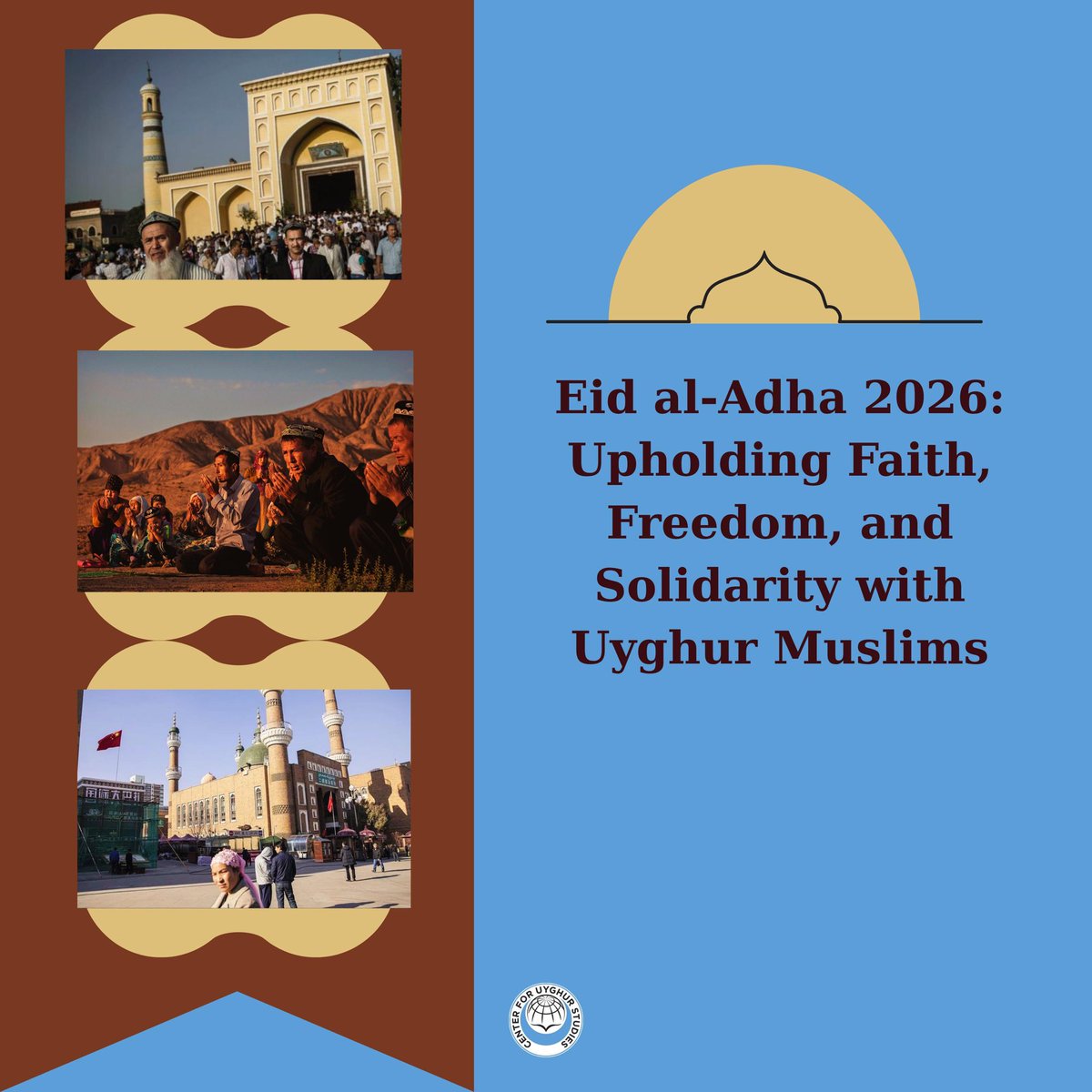
“Eid al-Adha teaches us the values of sacrifice, compassion, and standing with the oppressed. As Muslims around the world celebrate this sacred occasion in freedom, Uyghur Muslims remain deprived of even the most fundamental expressions of faith and family life.
It is deeply heartbreaking to see Muslim countries and religious figures being drawn into China’s propaganda efforts and even being used to help legitimize narratives that conceal the suffering of Uyghur Muslims. We call on governments, Muslim-majority countries, the Organization of Islamic Cooperation (OIC), and civil society organizations to uphold their moral responsibility and stand in solidarity with Uyghur Muslims.”
As Muslims around the world prepare to celebrate Eid al-Adha, a sacred occasion symbolizing sacrifice, devotion, compassion, and unity, the Center for Uyghur Studies (CUS) extends our heartfelt congratulations and best wishes to Muslims across the globe. While families gather in prayer and celebration during this blessed festival, millions of Uyghur Muslims in East Turkistan (AKA Xinjiang Uyghur Autonomous Region) continue to face separation, repression, and the denial of their most basic human rights and religious freedoms.
https://t.co/rx5Nk0ZTkL
Recent developments have once again highlighted the contradiction in China’s claims regarding religious freedom. Reports of the detention of Abdushukur Rahmatulla, a state-sanctioned imam, who had long served within the government-approved religious system and had been promoted as a model “ethnic minority religious figure”, demonstrate that even individuals who worked within officially approved structures are not immune from repression.
At the same time, as Eid al-Adha approaches, Chinese authorities organized a carefully staged visit for religious figures from several Muslim-majority countries to East Turkistan during May 17 to May 21, where delegates were taken to pre-selected religious institutions and sites intended to project an image of religious harmony and prosperity. Such staged visits form part of China’s longstanding propaganda efforts aimed at portraying an image of religious freedom while Uyghur Muslims continue to face pervasive surveillance and restrictions on their faith. Together, these developments reveal the stark contrast between China’s international narratives and realities on the ground.
Today marks 8 years since the death of Memettursun Zunun (https://t.co/0QikgN0o1v), who was sent to camp in the summer of 2017 after being flagged by IJOP.
He died the following spring, at the age of 35.