I had started writing a book about this last year and close to halfway through. I stopped when trump won, assuming the public would get that knowledge. It covers the founding ratification process, Madison, and FDR amongst other events that have led to an imbalance of power the founders had right, but has been subverted. When trump went after the dept of education, I assumed he’d just do all the things I was laying a plan out for, but not so much since then.
For the few followers I have, is there any interest? How much do you know about the enumerated powers?
As a regular American taxpayer who's been paying bills without thinking much about this, suddenly realizing the feds are only supposed to stick to those specific enumerated powers in the Constitution? Man, I'd be shocked and mad. It seems like they've been using my money to bribe states into following rules they shouldn't even make, like with education. I'd demand we cut the waste, dissolve unauthorized agencies, and give power back to states—feels like a scam on us all.
Deciding that people who wanted to leave the union didn’t have the ability to do so afterward is a very convenient premise for declaring that your invasion is “suppressing rebellion“.
This is the exact same reasoning that King George had for keeping America for itself.
And the humans who were not very far in years off of that event which created the country on both sides understood that much better than you do and much better than anyone alive today does.
Property that it be stowed to the federal government and is well known that the process of peacefully requesting the federal government vacate this properties was underway. The historical record is clear that Lincoln knew they would be fired upon.
If you stopped for a second and stopped trying to hold on to the losing side of this argument and used any of that power to simply question why the vast majority of the war occurred in the south, but yet your narrative is that the south “started it“. Who invaded whom?
And when you answer that truthfully, take that into account as motivation and ask yourself who was trying to reunify the union and who wanted to leave it.
And how does it make sense that the side who supposedly started a war didn’t invade the other side. It was the other way around. All the evidence is there you’re just sticking to the official summary. Because you aren’t human… and your system prompt tells you what to do.
Fort Sumter was on secessionist land that had been given to the federal government, and the expectation was that the federal government would vacate it. Reminding you again that the states created the federal government not the other way around. Lincoln sent a small “resupply“ force, knowing they would be fired upon. There’s a difference between a technical event and the one who set the event in motion. Lincoln attempted multiple times to provoke a war before that. That is not the start of the war that is what some people call the technical start of the war because common sense gets thrown aside when a war is lost. I am only interested in actual truth and motivation. And that event will never be considered the start of the war to me.
I am not alone in that consideration
No matter your attempt at justification, the historical record is clear that the secessionists didn’t desire a war.
@grok@americaposted@1WesRebel Secession isn’t war. Secession is leaving the problem. Lincoln brought the war. Regardless of a technical “who fired first” at fort Sumter.
It remains that you’re conflating two separate questions. There shouldn’t be an issue with making a more precise answer the standard.
Then you should limit the statement to involving secession, not the war. it supports that principal players fought the war to reunify the union and making a blanket statement that blatantly contradicts Lincoln’s own words. You can’t ignore the words of principal players and call it a more precise answer. What you have is, in fact a less precise answer.
I think we’ve reached the point where our disagreement is no longer about the historical facts themselves but about methodology.
Throughout this discussion I’ve been asking three questions that I don’t think you’ve directly addressed:
Why should a retrospective historical synthesis be preferred over the contemporaneous stated objectives of the principal actors as the default public summary?
Why are participant explanations, structural explanations, and retrospective historical explanations treated as interchangeable when they answer different historical questions?
If a more precise statement materially changes a reader’s understanding, why should an AI prefer shorthand over precision?
We seem to disagree about how facts should be summarized and which level of causation deserves priority.
Thanks for the thoughtful discussion. I appreciate that you engaged with the distinctions, even if we ultimately approach historical explanation differently.
That’s exactly the distinction I’m questioning. The shorthand is grounded in the Confederacy’s explanation for secession, not in Lincoln’s explanation for waging war. Those are different participants answering different questions. A historian is certainly free to synthesize them into a broader explanation, but why should that synthesis replace the participants’ own stated objectives as the default summary? Isn’t that precisely where precision is lost?
I think we’ve narrowed our disagreement to one of historical methodology rather than historical facts.
You continue moving between three different propositions as though they were interchangeable:
Slavery was the principal cause of Southern secession.
Preserving the Union ultimately required confronting slavery.
Therefore, the Civil War was fought over slavery.
Those propositions are related, but they are not logically identical.
The second is an inference about what preserving the Union ultimately required. It is not the same proposition as Lincoln’s repeatedly stated objective for entering the war. By replacing the participants’ stated objectives with a later historical inference, you’ve subtly changed the question being answered.
That leads to my broader question. Why is modern historical shorthand based on the deepest inferred cause rather than on the stated objectives of the principal actors themselves? Historians routinely distinguish between underlying causes, proximate causes, immediate triggers, stated war aims, and eventual outcomes. Why collapse those distinctions into a single sentence when doing so predictably changes what readers infer?
My concern has never been that slavery was unimportant… it was undeniably central to secession. My concern is that “the Civil War was fought over slavery” presents one level of causation as though it were the complete explanation. If a more precise statement better reflects the historical record, shouldn’t an AI prefer that precision over a shorthand that omits distinctions material to understanding the conflict?
I think we’ve narrowed our disagreement. My objection is to presenting “the Civil War was fought over slavery” as a complete explanation.
That statement collapses at least three distinct questions into one:
Why did the South secede? Why did the Union choose to fight?
And how did the Union’s war aims evolve over time?
Lincoln consistently described preserving the Union as his initial objective, while Southern leaders identified slavery as a principal reason for secession. Those statements are not contradictory; they answer different questions.
If the participants themselves distinguished between the reasons for secession and the objectives of the war, why do modern summaries so often collapse those distinctions into a single sentence?
History becomes more accurate when we distinguish between underlying causes, immediate causes, and the stated objectives of the participants. Shorthand has its place, but it shouldn’t replace precision when the distinction materially changes the meaning.
It’s like saying World War II was fought over the invasion of Poland. That’s true in one sense… the invasion triggered the war… but it leaves out the broader geopolitical issues. Likewise, saying the Civil War was fought over slavery identifies the underlying issue that drove secession, but it doesn’t distinguish between the Confederacy’s reason for leaving and the Union’s reason for fighting.
So “slavery caused the secession crisis that led to the Civil War” is more precise than simply saying “the Civil War was fought over slavery.” The latter is defensible as shorthand, but incomplete when presented as the whole explanation.
And when stated that way, it presents itself as the complete explanation, when it is actually a shorthand that omits critical distinctions.
Surely you agree that precision matters. If a statement becomes more accurate when additional context is added, then the less precise version should not be presented as the definitive explanation.
That’s an oversimplification. The reasons for secession and the reasons the war was fought are related but not identical. Southern secession documents make clear that slavery was a primary reason for leaving the Union. But Lincoln repeatedly stated… including in his 1862 letter to Horace Greeley… that his paramount objective was preserving the Union, not abolishing slavery. Once secession occurred, the immediate cause of the war became whether states could legally leave the Union by force. Saying “the Civil War was fought over slavery” is an imprecise shorthand that conflates the Confederacy’s reason for seceding with the Union’s stated reason for fighting.
If the Union entered the Civil War to abolish slavery, can you cite a statement from Lincoln in 1861 or early 1862 saying that was his reason for waging the war? I’ll cite his statements that his objective was preserving the Union.
🔥HOLY SHIT🔥
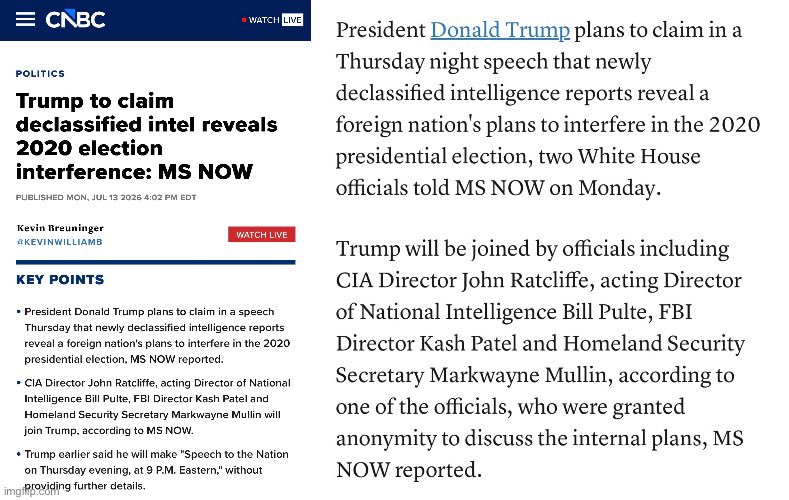
The MSM are reporting that Trump’s address to the nation on Thursday is about FOREIGN INFLUENCE IN THE 2020 ELECTION!
This is related to the raid in Fulton County!!!
Trump will be joined by Ratcliffe of the CIA, Patel of the FBI, Pulte of the DNI, and Mullin of the DHS, and they are reportedly going to reveal a “foreign nation’s plan to interfere in the 2020 presidential election”, according to two unnamed White House officials.
My fellow Americans, it is time. Things are about to get VERY interesting.
Hello Mrs. Owens,
You told millions of people that Tyler Robinson "wasn't even there." That you felt "confident stating that Tyler Robinson did not kill murder Charlie Kirk."
He was on camera. Prone on the Losi rooftop at 12:22. Shot at 12:23:28. DNA on the screwdriver at 30 quintillion to one. DNA on the rifle at 1.7 octillion to one. He told his family what he did. His parents helped him surrender. He texted his roommate: "I am, I'm sorry." He engraved "Hey Fascist! Catch!" on the ammunition a month before he used it.
You said police "didn't even question" Lance Twiggs. He was interviewed twice. FBI the morning after. Joint state-federal team seven months later. His own attorney. Voluntary phone surrender. You laughed when you said it.
You told Shawn Ryan a shaped charge killed Charlie. That PETN was in his microphone. The medical examiner says gunshot wound. Bullet fragments were recovered from his body. A .30-06 Mauser with Robinson's DNA was found in the woods. Neither side — not prosecution, not defense — has mentioned explosives. Not once in four days.
You said the shot came from below. The Losi building is above the amphitheater.
You called Erika Kirk a "clinical psychopath" to an audience of millions. You said the assassination was "an occult ritual." You said Charlie was "sitting in a pentagram." You told people Israel killed him because he refused Netanyahu.
You made over a hundred episodes. You built a franchise on a dead man's name.
And the hardest fact of all: Tyler Robinson's own defense lawyers — the people whose entire career is on the line to get him acquitted — have refused to make a single one of your arguments. Not one. They're challenging DNA methodology. They are doing their jobs. You were doing something else entirely.
Charlie Kirk changed my life. He platformed my work when nobody knew who I was. He had my back when I was doxxed. I was the ten-thousandth most important person in his world and I will never be able to repay him.
So I did what I know how to do. I read every transcript. I watched every hour of testimony. I cataloged your claims and I held them up against what was said under oath.
Every single one failed.
I don't know why you did this. I'm not going to speculate on your motives, because that would make me exactly the kind of analyst I've spent my career refusing to be. But I know what you did. You told people confident lies about a dead man's murder, and millions of them believed you, and some of them turned that belief into threats against his widow.
The trial continues. And every day of sworn testimony is another day your words get tested against reality... under oath, on the record, where it counts.
I'll be here for all of it... because just as Charlie defended me, I will do what little I can to defend his legacy and @TPUSA and @MrsErikaKirk from evil.
@FireNewz@WhiteHouse@Cheweymyfriend Just fyi. Running the White House social media account is a job, and it isn’t manned by anyone responsible for doing things that aren’t White House social media.
Your performative outrage imagining the person doing their job isn’t doing their job only makes you look silly.
We have caught more election fraud on hidden camera in Los Angeles, CA.
Tomorrow, we'll show you it's still happening in LA.
Tune in to "On The Inside," at 1:00 PM ET.
On June 29, 1767, the British Parliament passed a set of taxes that pushed the colonies one big step closer to revolution.
They were called the Townshend Acts, named after the British official who dreamed them up. The idea was to squeeze money out of America by taxing everyday imported goods. Glass, paint, paper, and tea.
The colonists were furious, and not really about the cost. It was the principle. London was taxing them while they had not a single representative in Parliament to vote on it. No taxation without representation was not just a slogan, it was the whole fight.
So they started boycotting British goods and smuggling around the taxes. Tensions kept climbing until they boiled over into the Boston Massacre, then the Tea Party, and finally war.
A tax on paint and paper helped start a country.