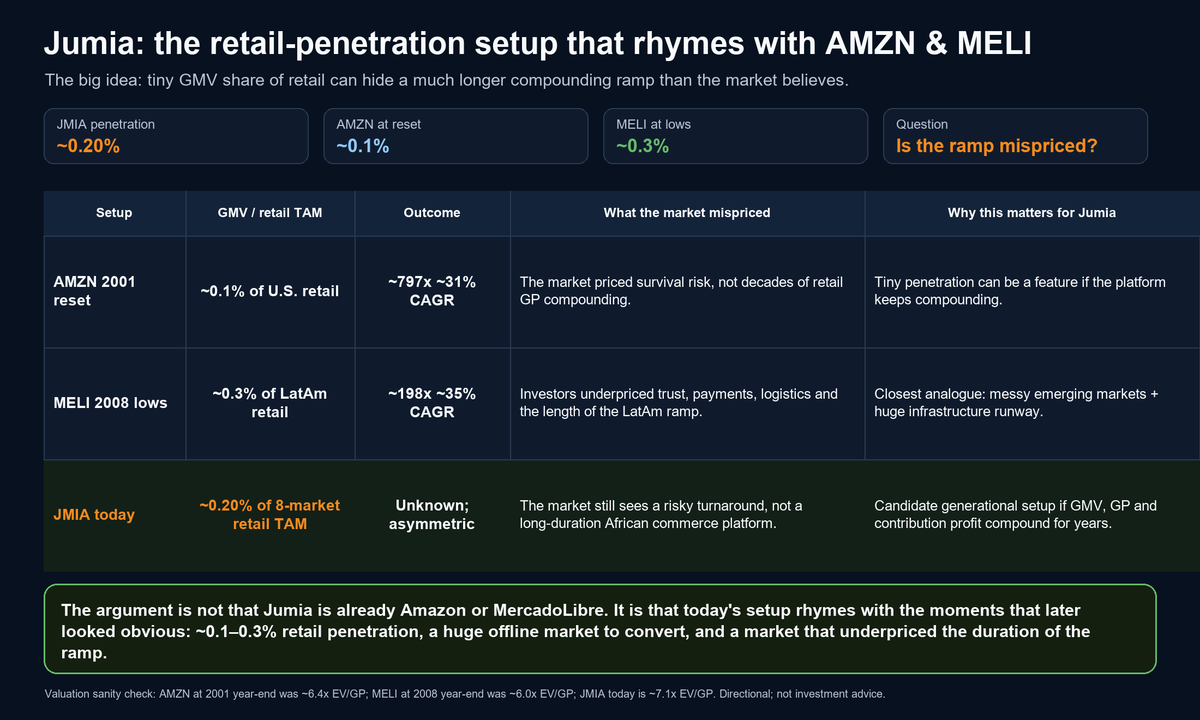
EV/GP is a better measure than, say, P/Sales when comparing ecommerce IMO. GP does better to normalize performance across 1st and 3rd party, and naturally EV accounts for net debt (cash), whereas price does not.
What happens when a commerce platform is still only ~0.2% penetrated into a massive retail market?
AMZN and MELI looked risky at similar penetration stages. In hindsight, the market underpriced the duration of the ramp.
$JMIA today is not AMZN or MELI. But the setup rhymes: tiny penetration, huge offline market, improving economics, and ~7x EV/gross profit.
What happens when a commerce platform is still only ~0.2% penetrated into a massive retail market?
AMZN and MELI looked risky at similar penetration stages. In hindsight, the market underpriced the duration of the ramp.
$JMIA today is not AMZN or MELI. But the setup rhymes: tiny penetration, huge offline market, improving economics, and ~7x EV/gross profit.
The contribution margin as a percent of GMV for $JMIA is already a very healthy 8.1%. I believe it very reasonably can expand to 10% over the next two years or so.
The size of the retail economy in Jumia's current markets is massively larger than their current GMV. Jumia isn't a 2x or 5x GMV story, but a 20x or 50x. $JMIA
The cheapest option is not simply the lowest factory price. The consumer pays the sum of every layer needed to get the product from origin to their city: source price, import coordination, in-country fulfillment, reliability friction, returns risk, and seller/platform margin. The thesis is that $JMIA can win on the total delivered price because it combines cheap origin supply with scale, route density, and lower required margin than fragmented local chains.
As $JMIA stock struggles,
Just remember…High Oil and Ebola are temporary.
The positive trends are enduring.
User growth now at 25%
Revenue growth at 28%
GMV growth at 31%
High margin ad revenue at 31%
Cash Burn down 34%
Profitable by EOY
Only 1% penetration out of 600 million
Only 1% ad revenue to GMV ratio.
Starlink to accelerate internet use.
China has shifted products to Africa.
Trading at 3x sales while accelerating.
All Star CEO in Francis Dufay.
IMO, the market has not priced in how incredible a 5.8% fulfillment expense as percent of GMV is for $JMIA. Much leaner than Amazon (13.1%) and Meli (>10%). It is comparable to Coupang (5.6%) and not yet on the level of, say, https://t.co/chDBodPdtJ (~3%). Give the (currently) much smaller scale and fractured geography, this is very, very impressive. It bodes well for the future, because I doubt competitors (both local retail and global e-commerce) can surpass the value proposition of Jumia. E-commerce is still (even scaled to GDP) much, much smaller in Africa than other regions of the globe. Jumia is a small fire burning in a vast field of dry tinder.
Uganda currently imports 100% of its petroleum (~44k bpd). Next month, the Tilenga project hits first oil. At peak, Tilenga alone will pump ~190k bpd, more than 4x domestic demand. Uganda should see *major* economic growth above its already high baseline. $JMIA
https://t.co/K0oRLQxfSZ
$JMIA has a similar population base to Shopee ($SE) and $MELI. 155x less GMV than Shopee, and 80x lower than $MELI. GDP per capita is around 2x to 3x lower than Shopee's largest SE Asian markets, and 5x lower than MercadoLibre's big 3. At current growth rates, current Jumia markets will double GDP in around 15 years. Francis comparing $JMIA to $MELI 20 years ago is quite apt. Will Mercado Pago, at some point, be a roadmap for a potential Jumia/Axian consumer finance partnership?
Francis Dufay explicitly compared $JMIA to $MELI 20 years ago (he also included $SE in the comparison).
While Mercado Libre is one of the gold standard for building localized logistics in volatile emerging markets, LatAm has a significantly higher baseline GDP per capita and more cohesive infrastructure than the 8 fragmented African nations Jumia operates in. Jumia targets consumers making $200–$400 a month. They are prioritizing scale over margins. It is a very early story and they are showing a lot of strength against their biggest competition in Temu.
It seems quite clear that Axian and Jumia are working on something, quite possibly with some connection to consumer finance or more. $JMIA
https://t.co/kJ28s9llCU
The total internet bandwidth in Africa was 36.7 Tbps in 2023. One SpaceX launch can provide 61 Tbps. Moreover, Starlink requires very little on-the-ground infrastructure. This will acceleratingly be a game changer for Africa. $JMIA both sells Starlink and its customer base benefits from it. SpaceX $SPCX IPO may open some eyes. People will ask "Who is benefiting the most from Starlink?", and Africa is a top candidate.
Starlink V3 satellites
Bandwidth per Satellite:
• V2: 96 Gbps
• V3: 1,024 Gbps
Bandwidth per Launch:
V2: 2,600 Gbps
V3: 61,000 Gbps
Deployment per Launch:
• V2: 27 satellites (on Falcon 9)
• V3: 60 (on Starship)
Starlink V3 satellites will begin to be deployed in late 2026 on Starship.