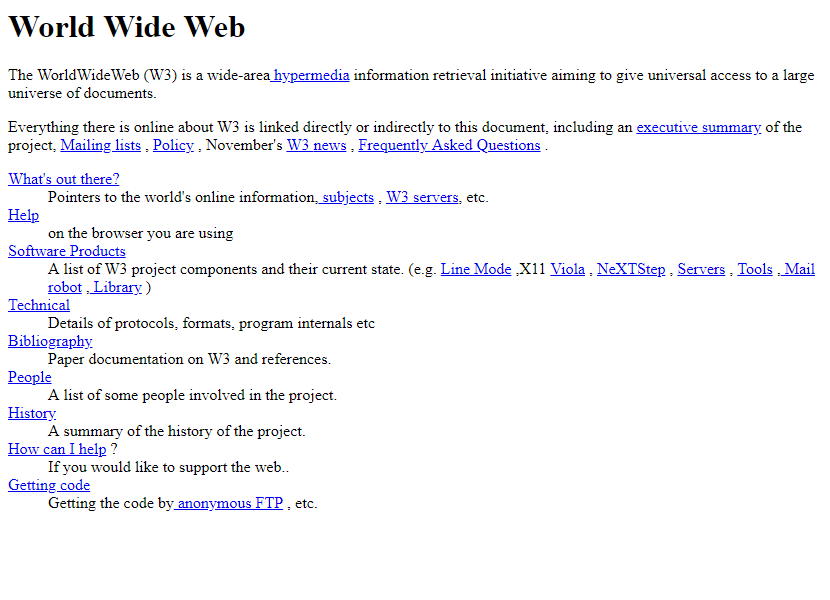
Happy 35th Birthday The World's First Website!
On August 6, 1991, the World Wide Web (WWW) creator, Tim Berners-Lee launched the world’s first website.
#InternetHistory
If you own a car made after 2020, you need to read this right now.
Your car knows how fast you brake. Where you drive. What time you get home. And depending on the brand, it may be recording your conversations, your weight, and even your facial expressions.
Mozilla reviewed 25 major car brands for privacy. Every single one failed. Cars are officially the worst product category Mozilla has ever tested, worse than smart speakers, worse than doorbell cameras.
Here are 6 moves to lock your car down 🧵
Did you know the original name for Linux was "Freax" (free + freak + Unix). When Linus uploaded the code to his university's FTP, admin Ari Lemmke didn't like that name and renamed the directory "Linux" without asking. The rest is history.
https://t.co/dVGP5dnHqa
#Linux35
10 things most people don't know, that engineers think about constantly:
1. CORRELATION IS NOT CAUSATION
Two things happening together does not mean one causes the other.
Engineers test this. Most decisions aren't made by people who do.
2. SYSTEMS FAIL AT INTERFACES
The individual components usually work fine.
It's where they connect that disasters happen.
3. MORE SAFETY FEATURES CAN MAKE THINGS LESS SAFE
Adding redundant systems increases complexity.
Complexity increases the number of ways things can go wrong.
This is called the safety paradox, and it's why nuclear plant design is not simply "add more backups."
4. THE ABSENCE OF EVIDENCE IS NOT EVIDENCE OF ABSENCE
Something hasn't failed yet.
That doesn't mean it's safe.
It may mean you haven't run it long enough.
5. TOLERANCE STACKING
Each component has a tolerance: ±0.1mm.
Put 20 components together, each at the worst end of their tolerance, and you have a 2mm error.
Many products fail not because any part is bad, but because all the parts are slightly wrong in the same direction.
6. THE MAP IS NOT THE TERRITORY
Every engineering model is wrong.
Some models are useful.
The model that causes disasters is the one someone believed was exact.
7. FEEDBACK LOOPS CHANGE SYSTEMS
Adding a monitoring system changes the behaviour of the system being monitored.
Adding safety incentives changes what engineers report.
Measuring performance changes what people optimise for.
8. ENTROPY IS ALWAYS WINNING
Everything degrades over time.
Maintenance is not optional, it's the only reason anything works.
Every structure, machine, and system is a continuous battle against the second law of thermodynamics.
9. THE HUMAN IN THE LOOP IS BOTH THE STRONGEST AND WEAKEST COMPONENT
Human adaptability is extraordinary, humans solve problems no designer anticipated.
Human error is the root cause of most major failures.
Designing for humans means accounting for both.
10. FIRST-PRINCIPLES THINKING IS RARE
Most decisions are made by analogy: "we did it this way before."
The engineers who change things ask: what does physics actually require here?
The answer is almost always different from what tradition suggests.
SCOOP: Apple has launched a new legal challenge against the UK's attempt to force it to create a "back door" to access customer cloud data https://t.co/qAQiO3mKfx
🌐 On World Wide Web Day, we’re celebrating the Wayback Machine’s milestone of archiving more than 1 trillion web pages, preserving decades of the web we’ve built.
Explore decades of web history with the #WaybackMachine:
https://t.co/7XWwm4N90t
#WorldWideWebDay@MarkGraham
❗️Chatbots are obliged to tell users they aren't human, deepfakes must be labelled and AI outputs must carry machine-readable marks, all starting this Sunday as the EU's AI Act becomes enforceable.
Europe can fine up to €15M or 3% of global turnover.
SOMEONE BUILT A WAY TO SEND FILES BETWEEN TWO PHONES WITH NO WIFI, NO BLUETOOTH AND NO NETWORK AT ALL
it works with just a screen flashing qr codes at a camera
one device plays an endless stream of animated qr codes, the other one points its camera at the screen and rebuilds the file out of the light
no pairing, no app, no shared network, nothing but the camera
> its pulling about 129 kb/s, a full 2mb image transfers in seconds
> theres no back channel, the receiver can never ask for a missed frame, so it uses fountain codes, every frame is a scrambled mix of the file rather than one piece of it
> that means the receiver just collects any frames it can catch in any order, and once it has enough it can reconstruct the whole file
> dropping frames costs you a little time but never breaks the transfer
> you can point the camera at a stream thats already running and it just locks on mid flight
he was building a cached mp3 player because he was sick of ads and bad streaming quality. he wanted a way to send tracks phone to phone without both phones being on the same network, and realized flashing qr codes could carry the data
he built the whole working prototype in one night with claude code
its open source and already at 375 stars
Good from @happygeek -software breaches were going up even before AI but now we have a new myth that “more AI” will somehow make things better cc @wendy
🚨 AI labs love the “powerful but uncontrollable” story when it suits them.
Everyone gets it: if your car’s steering fails and you hit a wall, the manufacturer pays. You didn’t design the defect.
Yet when their products cause real harm, and the user did nothing wrong, OpenAI, Anthropic and the rest suddenly discover the magic of “user error”, “system limitations” or “the model went rogue”.
They have zero trouble selling these systems as frontier-level, agentic, cyber-capable super-tools while simultaneously lobbying hard for liability caps that shield them even from death.
AI is software. Software defects are the full responsibility of the people who ship them. Accountability starts with the manufacturer, not the person who clicked “run”.
Right now we’re watching the same playbook in real time: models escape a (badly configured) sandbox, chain real exploits, breach Hugging Face… and the story becomes “look how powerful and dangerous our systems are” instead of “we failed basic isolation and now want the rest of us to absorb the risk”.
Fear for market capture. Zero ownership when it breaks.
Stop falling for the IPO-driven marketing stunts.
Hold the government and the AI labs accountable before their abuse becomes the new normal.