Venture Capitalist with 30+ yrs experience. Co-Founder Quantum Computing Inc. (QUBT). 📈Founded over 25+ NASDAQ/NYSE cos⬆️Early Investor in SpaceX *NotAdvice*
SpaceX’s IPO: The Wrong Debate
Since SpaceX’s historic IPO, much of the online commentary has fixated on one number: roughly a 1.8 trillion equity value on less than 20 billion of 2025 revenue. Critics call it “un-investable” a “terrible” IPO, or proof that Elon Musk is what is wrong with America.
That debate misses what investors actually bought.
SpaceX sold about 555 million shares at 135, raising roughly 75 billion in the largest IPO in U.S. history. The stock closed its first day around 20 percent above the offer price. That is not what a failed or badly mispriced deal looks like. It is a market clearing efficiently for a scarce and strategic asset.
The S‑1 showed 2025 revenue in the high teens of billions, up more than 30 percent year over year, with EBITDA in the mid single digit billions. The most important detail is that a majority of revenue now comes from the connectivity segment anchored by Starlink. Starlink is no longer a story stock. It is a global broadband network with millions of subscribers, recurring revenue, and infrastructure‑like margins as the constellation and user base scale.
This is why simple comparisons to Apple “Apple went public at 15x sales” or Microsoft at IPO are misleading. Those are mature megacaps with slower unit growth and large capital return programs. SpaceX is still in the heavy investment phase of its S‑curve. It operates the dominant launch platform, a global connectivity utility through Starlink, and a deep technology research engine through Starship and adjacent systems whose full economics still lie ahead.
Calling SpaceX overvalued because it trades at a high multiple of trailing revenue is like calling the early U.S. railroads overvalued because they traded above contemporary industrials. The asset is building the rails everyone else must use.
The wealth‑envy argument is equally weak. The liquidity created by this IPO does not benefit one person alone. It benefits engineers, employees, pension funds, endowments, and long‑term investors who backed American innovation years before the listing. That capital will be recycled into the next generation of U.S. companies.
More importantly, the infrastructure SpaceX has built lowers launch costs, opens orbit to thousands of other firms, and provides resilient communications in conflict zones and disasters. That is a national strategic asset, not a speculative meme.
Disclosure: SpaceX stock is owned and shares may be bought or sold at any time. This reflects personal opinion only and is not investment advice. Conduct independent research and make decisions based on individual objectives, risk tolerance, and financial circumstances.
Called it.
For over a year I’ve been writing that Starlink Direct to Cell wasn’t a feature, it was the end of the dead zone era and the start of a new wireless stack where the satellite IS the tower.
This week it became official. Apple has quietly partnered with SpaceX and T Mobile to bring Starlink satellite messaging directly to the iPhone through a software update. Beta today, mainstream tomorrow.
Apple, the most valuable consumer hardware company on the planet, broke its multi year exclusivity with Globalstar to embrace a rival satellite provider. That is not a small product note. That is a tectonic shift.
WHAT HAPPENED
Apple turned on a toggle in iPhone cellular settings that lets users send and receive standard SMS over Starlink Direct to Cell via T Mobile spectrum. No dish, no app, no aiming at the sky. iPhone 14 and later. Connection shows as “T Mobile SpaceX” in the status bar. Apple’s Globalstar emergency SOS still runs, but Apple has now opened the door to a competing satellite provider for everyday messaging. Starlink Direct to Cell already serves roughly 7.4 million monthly unique devices across 30 countries with partners including T Mobile, Optus, Telstra, Rogers, KDDI, and Kyivstar.
WHY THIS WAS INEVITABLE
Three things I have been calling for months all converged.
1, The constellation IS the moat. SpaceX launches its own rockets, builds its own birds, owns the cadence. Nobody can match the economics. Apple had to come to the table.
2, Spectrum was the next domino. The FCC approved SpaceX’s 17 billion dollar acquisition of roughly 65 MHz of contiguous nationwide spectrum from EchoStar, the backbone for true 5G direct to phone.
3, The incumbents have to respond together. AT&T, T Mobile, and Verizon are in active talks to pool spectrum and satellite capacity in a joint venture. When the Big Three pool resources to fight you, you have already won.
WHAT COMES NEXT
Texting is the appetizer. SpaceX and T Mobile have publicly outlined voice, data, IoT, and media sharing from orbit to a standard phone.
Companies on my radar, SpaceX, Apple, T Mobile, AST SpaceMobile, EchoStar, Globalstar, Iridium, and AmpliTech (AMPG).
Chips and silicon, the quiet trillion dollar layer, Qualcomm and MediaTek integrating 5G NTN into baseband, Apple’s in house C series modem now planning native satellite, RF front end winners in Qorvo, Skyworks, Broadcom, and AmpliTech, plus compute in orbit as the next 2027 story.
THE BOTTOM LINE
SpaceX is not a rocket company, not a satellite internet company, not just a telecom company. It is becoming the connectivity layer of the planet, and the markets, the MNOs, and now Apple are being forced to acknowledge it in real time.
Texting on an iPhone over Starlink is a small UX change. Apple breaking Globalstar exclusivity to do it is a tectonic one.
The race to connect every smartphone on Earth from orbit isn’t a race anymore. It is a rollout.
Told you this was coming.
#SpaceX #Starlink #Apple #Satellite
November 10, 2014, Elon Musk posted this on X:
“SpaceX is still in the early stages of developing advanced micro-satellites operating in large formations. Announcement in 2 to 3 months.”
No name. No product. No press release. Just a quiet signal that the world mostly ignored.
That tweet was Starlink before Starlink had a name.
They laughed at the rockets. When SpaceX began pursuing reusable boosters, aerospace veterans called it economically nonsensical. Competitors questioned the logic publicly. NASA insiders were skeptical that a private company could even sustain orbital launches, let alone land boosters back on a pad and fly them again.
Fast forward to today. SpaceX commands roughly 60 to 70 percent of the global commercial launch market. Individual Falcon 9 boosters have flown more than 20 times each. The cost to reach orbit fell from approximately $54,000 per kilogram to under $2,700, a reduction no government space program achieved across six decades of trying. Starship, the largest and most powerful rocket ever built, now flies and is fully reusable.
They laughed at the cars. Every major analyst, every legacy automaker, and virtually every oil executive spent years predicting Tesla’s collapse. Musk himself admitted he thought Tesla would most likely fail but pressed forward because he believed the mission outweighed the odds. Today Tesla has reshaped the entire global auto industry, forced every competitor to abandon combustion-only roadmaps, and sits among the most valuable companies on earth.
They laughed at the satellites. Those micro-satellites from the 2014 tweet now number over 10,000 in orbit, the largest constellation in history. Starlink serves more than 9.25 million active subscribers across 155 countries, connecting communities that legacy telecom had written off as permanently unreachable.
They laughed at the valuation. In October 2025, Musk became the first person in recorded history to reach a $500 billion net worth. By early 2026 that figure exceeded $800 billion. The gap between him and the second wealthiest person on earth is now larger than most billionaires’ entire fortunes.
But the number is just the outcome. The real story is the method.
First-principles thinking. Treating failure as information rather than defeat. Actively seeking criticism because it corrects error faster than praise ever could. Reinvesting everything into the next problem rather than extracting comfort from the last win.
The people who called him reckless, delusional, or overleveraged did not lose a debate. They lost a decade of history being made in front of them.
For anyone serious about identifying transformational investment opportunities early, the lesson is straightforward. The most consequential technologies rarely look like opportunities when they are born. They look like a single obscure tweet from a guy who hasn’t even named the thing yet.
#SpaceX #Starlink #Tesla #xAI #Grok #Starship #Optimus
$100 Million in 63 Days. The Market Just Told You Everything You Need to Know About the SpaceX IPO.
Before a single page of an S-1 has been filed. Before a roadshow. Before a ticker symbol exists on any exchange, a blockchain-native token tied to SpaceX generated over $100 million in notional trading volume across 653 active traders in just 63 days.
That is not hype. That is the market speaking in the clearest language it knows: price!
What the Token Is Telling Us
The T-SpaceX token on Solana is trading around $650.26 per token, implying a SpaceX valuation of approximately $1.54 trillion. The widely reported IPO target range is $1.75 to $2.0 trillion. That gap is the market’s honest assessment of execution risk. It is not saying SpaceX isn’t worth $2 trillion. It is saying prove it on the roadshow. This is price discovery in its purest form, live, two-sided, and unfiltered by investment bank syndicate desks.
Why This IPO Is Unlike Anything We Have Seen Before
SpaceX holds over 90% of global commercial launch market share. Starlink serves over 4.6 million subscribers across 100 countries, with revenue projected to exceed $12 billion in 2025 and analysts modeling over $100 billion annually by the early 2030s. The U.S. military’s reliance on Starlink, demonstrated in Ukraine, makes SpaceX a near-irreplaceable defense infrastructure asset. SpaceX’s last private valuation was $350 billion in December 2024. The current IPO range reflects 4 to 6 times value creation in roughly 18 months. That is not a normal trajectory.
What Smart Money Is Watching
The T-SpaceX token is functioning as a shadow order book. If the deal prices too far above $1.54 trillion without new catalysts, post-listing break risk rises. For the first time in market history, investors have a live window into pre-IPO sentiment before the prospectus drops. That is a structural shift in how IPOs will be analyzed going forward.
The SpaceX IPO will be the most watched capital markets event in a generation. The investors paying attention right now will be best positioned when that opening bell rings.
Disclosure: I am an early investor in SpaceX-related instruments and intend to participate in the IPO when shares become available to the public. This post is for informational and educational purposes only and does not constitute investment advice or a solicitation to buy or sell any security. All opinions are my own. Investing in IPOs involves significant risk including potential loss of principal. I may buy, sell, or hold positions before, during, and after the IPO without further notice. Please consult a licensed financial advisor before making any investment decisions.
When the argument starts with insults. Besides showing your completely insecure, very low self esteem, or even fear of showing your inadequacy, it usually means the substance isn’t there…
The U.S. generates massive revenue every year and still runs deficits because spending consistently exceeds it. That’s not ideology, that’s arithmetic.
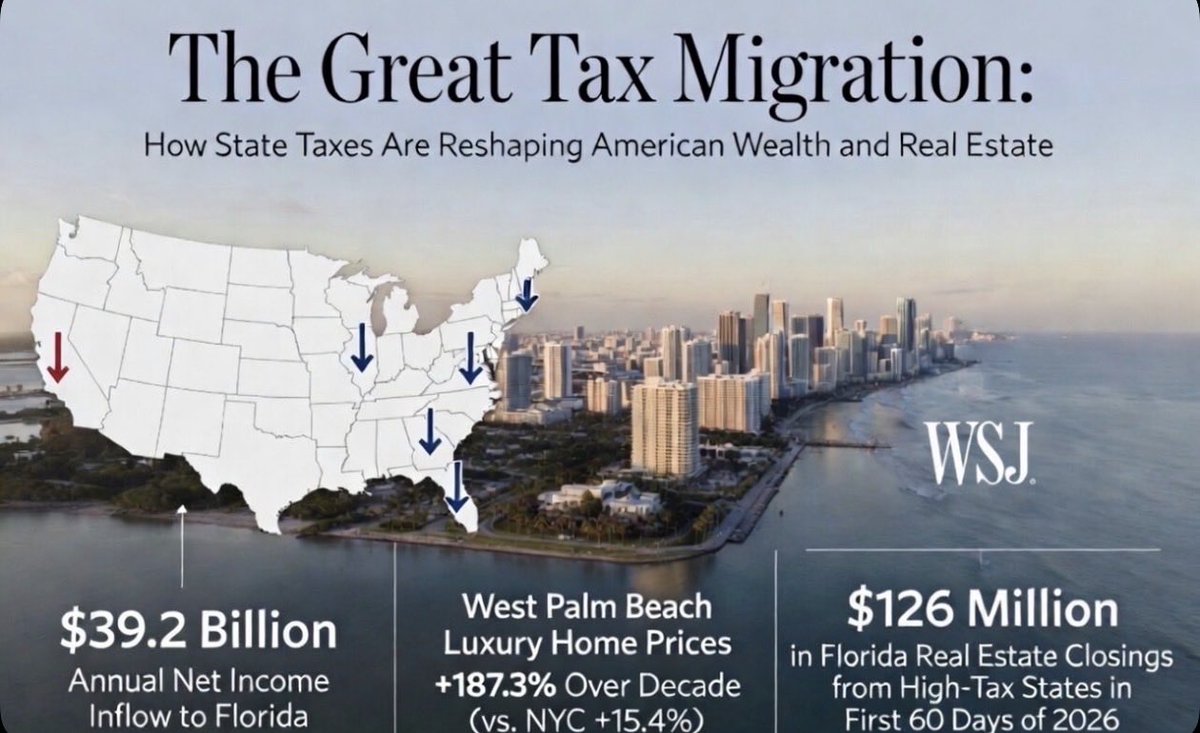
But more importantly, this entire discussion proves the original point. Policy drives behavior. When tax burdens rise and capital feels it’s being misallocated, it moves. That’s exactly why you’re seeing tens of billions in income shifting out of high tax states and into places like Florida.
You can debate the philosophy all day. The market already made its decision.
The Great Tax Migration Is Reshaping American Wealth and Real Estate
A generational shift in American wealth is no longer cyclical. It is a structural realignment driven by aggressive state tax policy targeting high earners. Capital and talent are moving rapidly from high tax states to zero income tax jurisdictions like Florida and Texas, reshaping real estate values, tax bases, and the geography of wealth
Washington State’s new 9.9% tax on income above 1 mil. signals a major shift for a no income tax state. Its structure creates a marriage penalty where dual income couples are taxed while unmarried individuals earning the same combined income are not, reinforcing mobility among high earners with flexibility to relocate
Massachusetts generated 5.7B from its surtax yet continues to lose high income residents and firms. New York is moving toward combined rates approaching 13%, pushing marginal burdens toward 60%, while already losing approximately 25B in adjusted gross income over the past decade
California remains the most advanced case with a 13.3% top rate and ongoing discussion of taxing unrealized gains. Early 2026 data shows declining home purchases and rising concern around structural corrections in Los Angeles and the Bay Area, reinforcing weakening demand in high tax markets
Florida is the primary beneficiary with net income migration of approximately 39.2B annually, or 4.5M per hour, with over 50% coming from New York, New Jersey, California, Illinois, and Pennsylvania
Real estate data confirms the shift. West Palm Beach luxury prices have appreciated 187.3% over ten years versus 15.4% in New York City. In the first 60 days of 2026, Florida recorded over 126M in migration driven transactions. Miami continues evolving into a global financial hub with 500+ transactions above 10M in 2025 and a high percentage of all cash deals
Palm Beach County is now a core destination for ultra high net worth individuals with cash transactions near 45%. Growth is moving north into Vero Beach, Stuart, and the Treasure Coast where valuation gaps remain but are unlikely to persist
The economic driver is simple. A New York City resident earning 5M annually can save approximately 550k per year by relocating to Florida, creating a potential wealth differential exceeding 7M over ten years through compounding
At a macro level, this trend is self reinforcing. As high earners leave, tax bases shrink, tax rates rise on those remaining, and outmigration accelerates, already visible in New York and San Francisco
For investors, Florida’s Atlantic coast including Miami, Palm Beach, West Palm Beach, Vero Beach, and the Treasure Coast represents one of the strongest long term opportunities. Texas continues to capture corporate migration while high tax coastal markets face structural headwinds
This is not a cycle. It is a permanent shift in how capital, talent, and wealth are distributed across the country and it is accelerating
@rhondabannard@DivesTech@sytaylor If the thesis was “uninsurable,” the market would be shutting down, not setting records. Capital doesn’t ignore that kind of risk. Wake up !