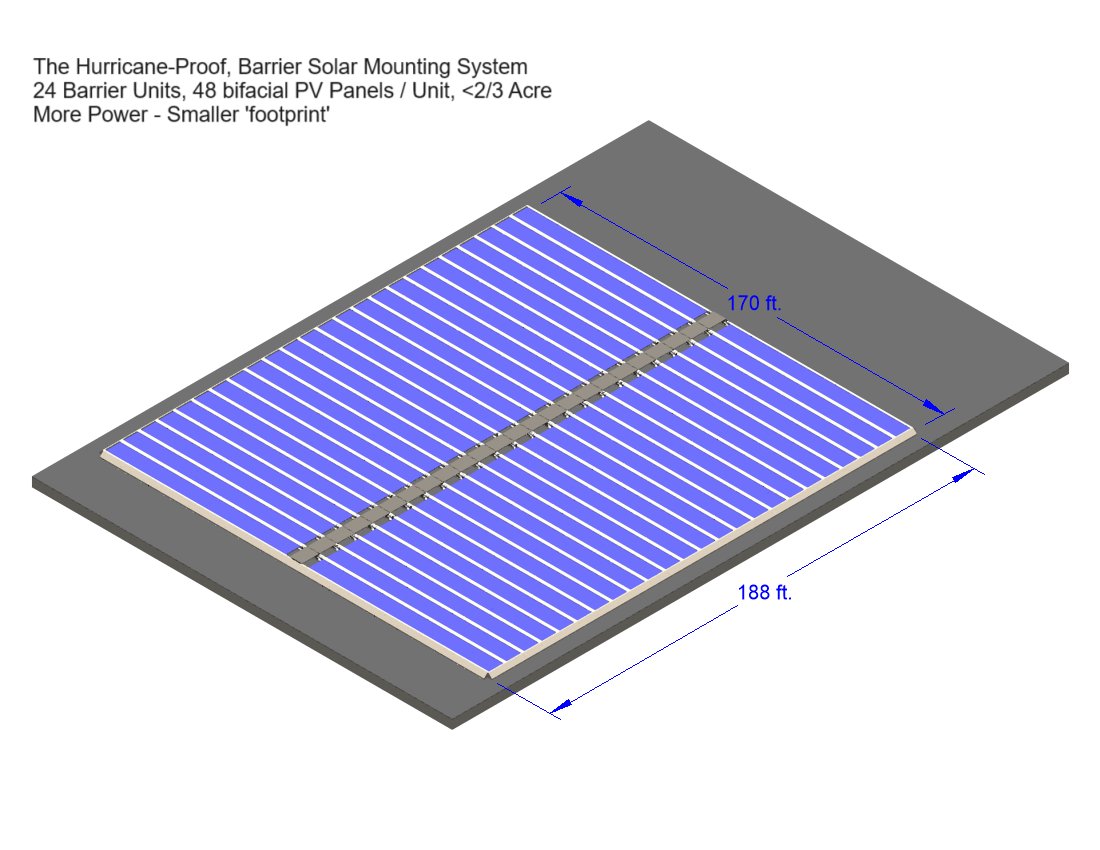
Founder with a Vision to change an Industry! Automated, 'Active-Protection', Renewable Energy Mounting Systems INTENDED for use in Hail/Hurricane-prone regions.
https://t.co/ECvOYhVRH6 is reaching out to potential Suppliers / Partners for our installations of our Sentinel Solar Carport System.
Commercial Projects, generally located in Severe Weather Regions (US and Territories), typically between 200 and 1000 PV Panels, including Battery / Management sufficient to support multiple EV Charging stations.
* Solar - bifacial PV (thin-glass), Commercial-size
* Battery / Inverter
* EV Charging Stations
Please DM to learn more.
@DrewSmithee@SimonMahan It'll be interesting to see what will happen to Rates in the Midwest when our Hail-proof, Residential Solar Mounting Systems become prevalent.
Backyard / Ground-Mounted, eliminating Hail, and Fire, Risks for Homeowners.
https://t.co/SYEEnMkU1Q
This damage was caused by airborne debris striking PV Panels, which then became flying objects which struck and dislodged other PV Panels, cascading into a huge debris cloud. Reden Solar, 9-20-2017
The Barrier Solar PV Mounting System System warranties against all damages, Excessive Wind Speed, Airborne Debris and Hail. Hail and Hurricane proof.
We're projecting 1 MWdc/acre installed.
Single-axis trackers can reduce (not eliminate) damages caused by hail (Hail-Stow Mode), although not much protection from airborne debris. Cannot survive direct strike Hurricanes.
Roughly 0.25 to 0.50 MWdc/acre?
Erthos is a ground-mount system has passed significant wind tunnel testing. Hardened PV glass. Cabling that secures the system to Concrete anchors. Single-sided PV. Claim to be Hurricane-proof. Unclear if they warranty against airborne debris though.
Roughly 0.75 MWdc/acre.
All approx's r application dependent.
Thanks Mike!
Barrier is a modular, machine-based, mounting system.
When 'Closed', the PV Panels are completely protected from hail, airborne debris and excessive wind speeds (with Warranty!).
The Barrier System applies bifacial PV panels with our 'auto-tilt' accessory, enabling nearly 40% more power output in the same installed 'footprint' (compared to single-axis tracker, Latitude dependent). Usually applied in an East-West configuration.
The Mounting System usually doesn't require ground penetration. The aerodynamic shape (at the array 'edges'), and the weight of the concrete structural elements, prevents movement.
In addition, the modular units can be operated independently, allowing for precise curtailment by simply 'closing' individual units. Perfect for utility-owned, Ancillary Services.
We typically estimate Installed Cost is around 2x that of an installed, single-axis tracker system, which will pay for itself several times over from reduced Insurance Costs.
Further Intended to last 50 years minimum (with scheduled Service / Maintenance) and to be 're-Powered' (increased PV Output) at intervals (20 to 25 years). In other words, the PV Array increases power output over time.
Operation of the Units is as easy as a smart phone App.
@JigarShahDC
For that matter, find some Federal Land that has a nearby Rail-line and High Voltage Lines.
Run a spur in, place 50, 10-mile long, parallel tracks (30 feet apart).
All inclined, all tracks have 3 electric locomotives, bi-directional power flow, 3rd-rail tech and hundreds of gravel filled rail cars.
Co locate Solar / Wind and NEVER Curtail again. Massive Battery
Well, not sure how big the losses are.
All electric (maybe 85% to 90% round trip efficiency?), Rail is least friction?
Co-locate Solar or Wind, eliminate ALL curtailment?
Can be Scaled massively. US has 1000's of miles of Right Of Ways where a side track could be built (in parallel).
All the TECH is available right now
Nice!
Interesting that the Report speaks to leasing storage to other Nations too.
So, Japan (or the Philippines) could choose to Buy Oil (at low Price), Store it and Sell for a profit later?
Also, if I'm reading this correctly, even after selling the Oil, there will be more than half left?
And a very well-read individual. Per TR Center,
"Theodore Roosevelt was known to be a voracious reader, reading on average a book a day even while President. He usually read several books at a time, rotating between them depending on his activities and/or his mood. Roosevelt read widely in genres ranging from classic and contemporary fiction & poetry to ancient philosophy, military histories and natural history studies. He read in many different languages, including German, French, Italian and Latin. On one day during the 1900 campaign, Roosevelt’s schedule included six different mentions of reading, totaling four and a half hours of reading for a single day. Many letters in the Roosevelt archival collections are of Roosevelt thanking someone for sending him a book or, in turn, someone asking him to read their newly published book."
@SullyCNBC So, this 'plan' ignores the coming reality of flying cars?
How does a State tax that?
Who knows. But within 10 years (maybe less) they will be discussing that question.