Attackers have frontier AI. Defenders need a frontier AI ecosystem—the best open and closed models, force-multiplied by a global community.
During the Hugging Face incident, closed AI blocked essential forensics. An open-weight frontier model helped contain the intrusion.
That’s why we created the Open Secure AI Alliance.
One can get Field’s medal, but not erase the fact that she wasn’t the smartest person in her class.
It would be interesting to see what her classmates achieved, not everyone wants civil servant position in France.
It is very likely many of her classmates work in finance and AI in China and have achieved much more than writing something on a piece of paper.
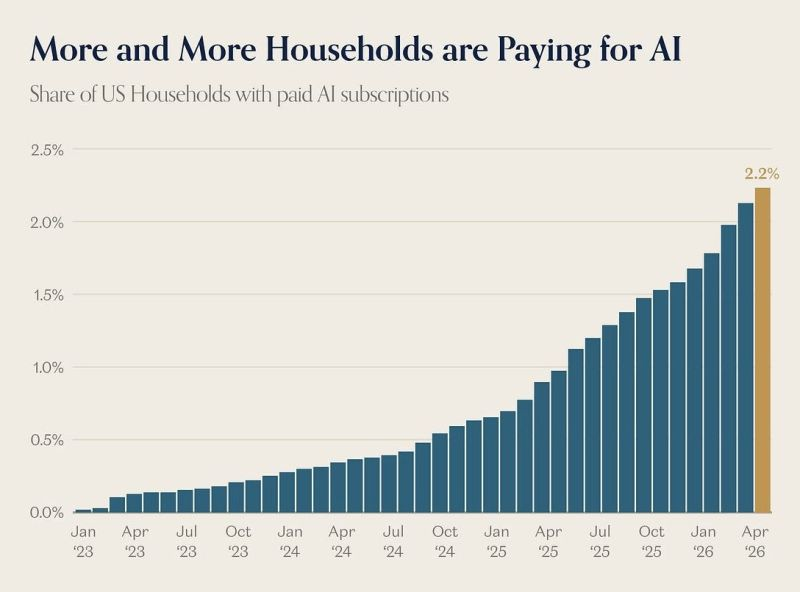
🦔2.2% of US households pay for an AI subscription as of April. The median spend is $20 a month. More Americans pay for sports betting apps (5%) than pay for AI. ChatGPT has 900 million weekly users but only 5% convert to paid. 37% of consumers say none of AI's uses are helpful. 30% say they're less likely to buy a product marketed as "AI-powered." Companies are spending $600 billion on AI infrastructure this year to serve a market where 97.8% of households don't pay for the product.
My Take
2.2% penetration nearly four years after ChatGPT launched. Netflix hit 25% household penetration in a similar timeframe. Spotify hit 15%. The growth is fast in percentage terms but off a base so small that doubling it still leaves you in single digits. The capex projections, the bond issuances, the IPO valuations all assume consumer adoption eventually catches up to the spending. Nearly four years in, it hasn't.
The pushback I'll get is that enterprise revenue is what counts and consumer subscriptions are a sideshow. Alphabet's cloud grew 82%. Anthropic reportedly hit $4.5 billion in ARR. But a lot of that enterprise spending is funded by VC money and hyperscaler capex, which makes it circular. Consumer willingness to pay is the closest thing to a genuine market signal, and right now that signal says $20 a month from 2.2% of households. The $600 billion in spending this year is a bet that the other 97.8% eventually show up. I'm not seeing it.
Hedgie🤗
For my first post, I’m sharing a letter @NVIDIA signed on why open models matter.
AI will transform every industry, power every company, and be built by every country.
Open models strengthen safety and cybersecurity, accelerate innovation and diffusion, and enable sovereignty.
The world needs both frontier closed models and frontier open models.
https://t.co/AUKzoQ5Ikb
🦔South Korea's stock market crashed 30% from its June peak in under a month. 1.2 million accounts received margin calls. 360,000 were liquidated to zero. The trigger wasn't an earnings miss or a recession. It was fear that AI spending might slow down. Samsung and SK Hynix make up over half the index and when both dropped, margin calls cascaded into forced selling which drove prices lower which triggered more margin calls. As of today the KOSPI is still swinging 5-6% per session and remains 25% below its June peak.
My Take
I think most US investors saw the Korea crash and assumed it couldn't happen here because our market is more diversified. It is, by percentage. But US margin debt is $1.5 trillion, 37 times Korea's $40 billion peak. Hedge funds are borrowing $7.2 trillion. Leveraged semiconductor ETF assets went from $163 billion to $60 billion in weeks, meaning $100 billion in speculative money evaporated and the broader market barely flinched.
That means the leverage is deep enough to absorb a $100 billion hit without repricing. When the hit is big enough that it can't be absorbed, the unwind will be proportional. And there has never been this much leverage.
All it takes is one disappointing earnings call or one capex cut from a hyperscaler. The selling wouldn't start with fundamental investors reading a 10-Q. It would start with leveraged ETFs rebalancing at the close, pushing prices down, triggering margin calls overnight, forcing more selling at the open. That's exactly what happened in Korea. The difference is Korea's forced selling ran through $40 billion in margin. The US version of that cascade would run through $1.5 trillion.
Hedgie🤗
Any help with LLMs for writing will make you sound like a journalist, stripped of all idiosyncracy, which, for many, is not a bad thing.
This is structural, the way statistical machines operate. LLMs are bland, dull, & devoid of personality.
instead of indulging in all this fear-mongering frontier-stealing narrative slop, @Alibaba_Qwen might as well release all "29 million Claude exchanges" for the benefit of open-source research and call it a day
let the public decide for themselves how "dangerously critical" these tokens actually are, relative to the other trillions upon trillions being used to train these models