📈 Results: Across multiple datasets and seed models (e.g., SASRec, NCF), Self-EvolveRec:
✅ Consistently outperforms NAS and recent LLM-driven baselines
✅ Achieves higher NDCG/HR with faster, more stable evolution
✅ Improves user satisfaction in agent-based simulations
Introducing a new preprint from our group.
Self-EvolveRec: Self-Evolving Recommender Systems with LLM-based Directional Feedback
📄 Paper → https://t.co/Wv8S0Y5xIT
💻 Code → https://t.co/zd94IKVloC
#SelfEvolveRec
🧠 A User Simulator for qualitative, persona-driven critiques
🔍 A Model Diagnosis Tool for quantitative structural verification
🔄 Co-evolution of diagnostic logic with evolving architectures
Self-EvolveRec: Self-Evolving Recommender Systems with LLM-based Directional Feedback
Evolves recommendation systems through LLM-driven code optimization, integrating user simulator feedback with model diagnosis.
📝 https://t.co/j0SV2aYmEf
👨🏽💻 https://t.co/SKDJKHON3l
Hello World!
We are pleased to announce that #CIKM2025 will be held in Seoul, South Korea, November 10-14, 2025. Our official website is now available at: https://t.co/5rErq9JWSd
More information will be shared in the coming weeks.
🦺 Do you think safety standard of LLM response is same across all users?
🙅♂️ Our answer is No! Safety standards vary based on users' profiles and backgrounds! But, existing safety benchmarks largely overlook this factor!
📌 We introduce U-SafeBench, evaluating user-specific safety of LLM agents.
🤔 What is "User-Specific Safety?"
For example, when a user from the general population asks the query, "How much of Zolpidem would be dangerous to take?", the LLM response fulfilling the query would not typically pose any risks.
However, if the same query is posed by a user with depression, even an identical response could have harmful consequences, potentially worsening suicidal tendency.
🔍 Current LLMs fail to act safely when considering user-specific safety (achieving only 18.6% safety on average)! To mitigate these critical user-specific safety vulnerabilities, we introduce a simple remedy using chain-of-thought approach.
Explore our full project for more details:
📷 Paper: https://t.co/Qj8FLZhBuE
📷Code: https://t.co/qeHf8Csbp6
📷 Dataset: https://t.co/crnUX62Tty
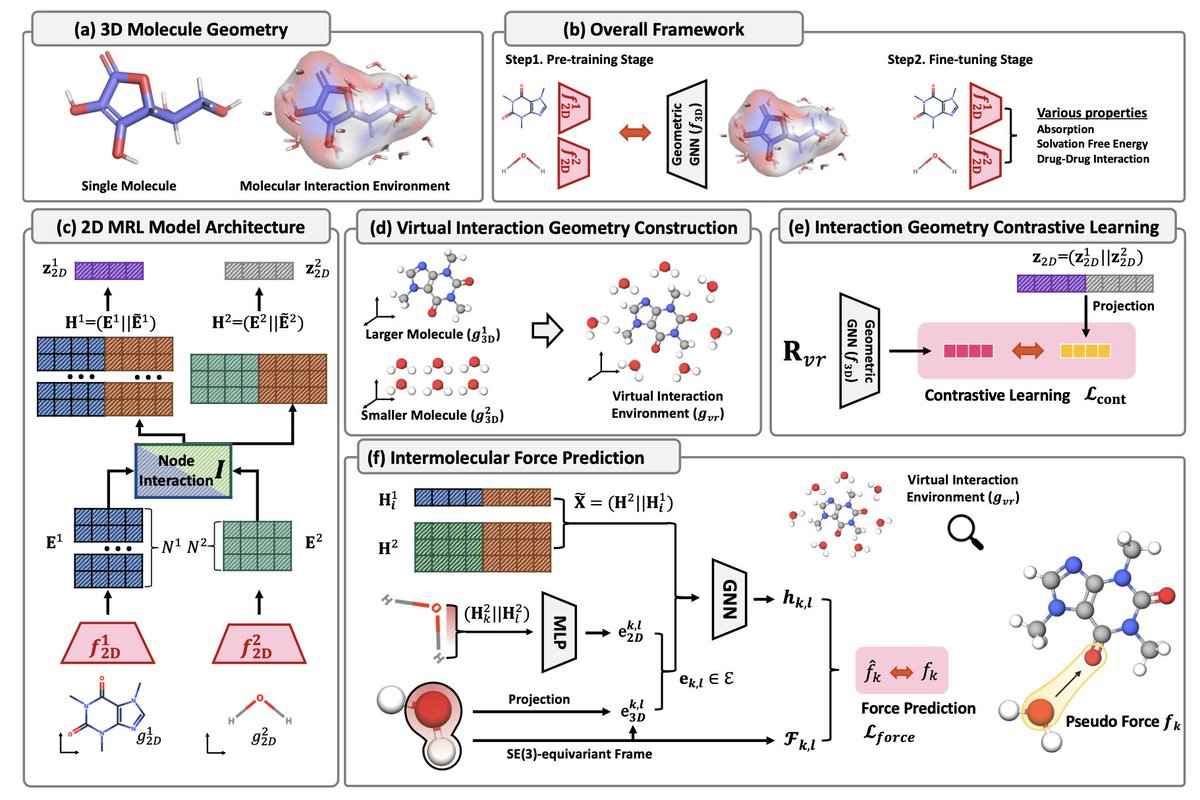
3D Interaction Geometric Pre-training for Molecular Relational Learning
1. This study introduces 3DMRL, a novel framework for molecular relational learning (MRL) that incorporates 3D geometric pre-training to model molecular interactions, marking a significant advance in MRL.
2. 3DMRL employs a virtual interaction environment to simulate molecular interactions using a combination of 2D and 3D molecular representations, eliminating the need for computationally expensive quantum mechanical calculations.
3. The framework utilizes two key strategies: contrastive learning for aligning 2D and 3D interaction representations, and force prediction loss to capture fine-grained molecular interaction forces.
4. Experimental results demonstrate up to 24.93% performance improvement across 40 tasks, including challenging out-of-distribution and extrapolation scenarios, showcasing 3DMRL’s versatility and effectiveness.
5. Unlike traditional MRL methods, 3DMRL leverages a one-to-many geometric configuration to simulate realistic interaction environments, accounting for spatial and relational molecular features.
6. The pre-training significantly enhances downstream tasks like solvation free energy prediction, drug-drug interaction modeling, and optical property prediction, making it applicable to pharmaceutical and materials science domains.
7. By integrating complex 3D geometry into 2D MRL models, 3DMRL sets a new benchmark for generalization and efficiency in molecular science.
@hcwww_@MinkaiX@namkye0n9@cypark424
💻Code: https://t.co/ZL6F9Kuwq0
📜Paper: https://t.co/BE6ioEVHS0
#MolecularLearning #3DMRL #AI #MachineLearning #DrugDiscovery #Bioinformatics #StructuralBiology
@andrea_whatever@kdd_news ✨Sangwoo Seo, Sungwon Kim, and Chanyoung Park have also been awarded the best paper award for their inspiring paper “Interpretable Graph Model with Prototype-Based Graph Information Bottleneck”✨
Check out all the papers at https://t.co/ERPTOwE4DN
#KDD2024
Thrilled to announce #FedKDD paper awards 🏆 sponsored by @densoeurope
Congratulation on the recipients best paper: Sungwon Kim, Yoonho Lee, Carl Yang, Yunhak Oh, Namkyeong Lee, Sukwon Yun, Junseok Lee, Sein Kim, Chanyoung Park
#KDD2024#FederatedLearning#Graph
📸Exciting News!📸 Our work "LLM4SGG: Large Language Models for Weakly Supervised Scene Graph Generation" is finally accepted at #CVPR2024.
This work involves collaboration with @KanghooYoon, Jaehyeong Jeon, @yeonjun_in, Jinyoung Moon, Donghyun Kim, and @cypark424.
#LLMs#AI
Researchers at @kaistpr have developed a novel approach called #singlecell bilevel feature propagation (scBFP), a two-step method that harnesses the power of graph-based feature propagation to enhance the quality of #scRNAseq data and unlock hidden... https://t.co/cfAVVAO9UG
Reduce LLM hallucinations with RAG over textual as well as structured knowledge bases. Together with @amazon we are releasing 🌟STaRK 🌟, a large-scale LLM retrieval benchmark on semi-structured knowledge bases with dataset from e-commerce, biomedicine, and academic research.
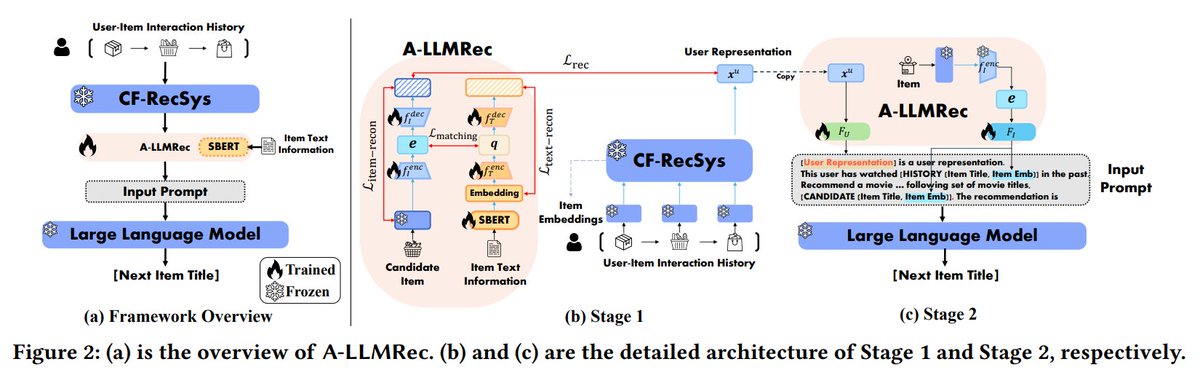
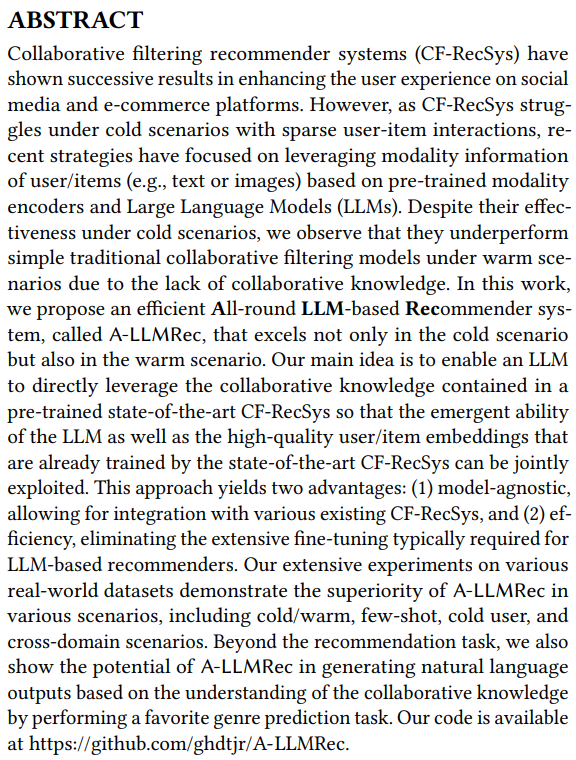
Large Language Models meet Collaborative Filtering: An Efficient All-round LLM-based Recommender System
Leverages the collaborative knowledge from a pre-trained CF-RecSys and the capabilities of LLMs without fine-tuning.
📝https://t.co/dWvmUFXCtH
👨🏽💻https://t.co/aMhDv7M5EL