U.S. policies are driving allies away from using American AI technology. This is leading to interest in sovereign AI — a nation’s ability to access AI technology without relying on foreign powers. This weakens U.S. influence, but might lead to increased competition and support for open source.
The U.S. invented the transistor, the internet, and the transformer architecture powering modern AI. It has long been a technology powerhouse. I love America, and am working hard towards its success. But its actions over many years, taken by multiple administrations, have made other nations worry about over reliance on it.
In 2022, following Russia’s invasion of Ukraine, U.S. sanctions on banks linked to Russian oligarchs resulted in ordinary consumers’ credit cards being shut off. Shortly before leaving office, Biden implemented “AI diffusion” export controls that limited the ability of many nations — including U.S. allies — to buy AI chips.
Under Trump, the “America first” approach has significantly accelerated pushing other nations away. There have been broad and chaotic tariffs imposed on both allies and adversaries. Threats to take over Greenland. An unfriendly attitude toward immigration — an overreaction to the chaos at the southern border during Biden’s administration — including atrocious tactics by ICE (Immigration and Customs Enforcement) that resulted in agents shooting dead Renée Good, Alex Pretti, and others. Global media has widely disseminated videos of ICE terrorizing American cities, and I have highly skilled, law-abiding friends overseas who now hesitate to travel to the U.S., fearing arbitrary detention.
Given AI’s strategic importance, nations want to ensure no foreign power can cut off their access. Hence, sovereign AI.
Sovereign AI is still a vague, rather than precisely defined, concept. Complete independence is impractical: There are no good substitutes to AI chips designed in the U.S. and manufactured in Taiwan, and a lot of energy equipment and computer hardware are manufactured in China. But there is a clear desire to have alternatives to the frontier models from leading U.S. companies OpenAI, Google, and Anthropic. Partly because of this, open-weight Chinese models like DeepSeek, Qwen, Kimi, and GLM are gaining rapid adoption, especially outside the U.S.
When it comes to sovereign AI, fortunately one does not have to build everything. By joining the global open-source community, a nation can secure its own access to AI. The goal isn’t to control everything; rather, it is to make sure no one else can control what you do with it. Indeed, nations use open source software like Linux, Python, and PyTorch. Even though no nation can control this software, no one else can stop anyone from using it as they see fit.
This is spurring nations to invest more in open source and open weight models. The UAE (under the leadership of my former grad-school officemate Eric Xing!) just launched K2 Think, an open-source reasoning model. India, France, South Korea, Switzerland, Saudi Arabia, and others are developing domestic foundation models, and many more countries are working to ensure access to compute infrastructure under their control or perhaps under trusted allies’ control.
Global fragmentation and erosion of trust among democracies is bad. Nonetheless, a silver lining would be if this results in more competition. U.S. search engines Google and Bing came to dominate web search globally, but Baidu (in China) and Yandex (in Russia) did well locally. If nations support domestic champions — a tall order given the giants’ advantages — perhaps we’ll end up with a larger number of thriving companies, which would slow down consolidation and encourage competition. Further, participating in open source is the most inexpensive way for countries to stay at the cutting edge.
Last week, at the World Economic Forum in Davos, many business and government leaders spoke about their growing reluctance to rely on U.S. technology providers and desire for alternatives. Ironically, “America first” policies might end up strengthening the world’s access to AI.
[Original text: https://t.co/Nr5kfzcs5w ]
Le regard intime d’un écrivain interviewé sur le sport national de son pays…« Le foot s’est immiscé dans ma vie de manière très intime": avant la CAN au Maroc, l'écrivaine Leïla Slimani raconte son rapport au ballon... et aux Lions de l'Atlas https://t.co/SweEZP3LRL
Très instructif, à lire ! Courts décrépis, balles usées, saisons déficitaires... Dans l’enfer du circuit secondaire, ou quand le tennis ne paie pas https://t.co/XH8Vy0mJlU
Thierry Breton : «Face aux nouvelles menaces de Donald Trump, l’Union européenne ne peut plus accepter la soumission»
https://t.co/AxWovccP3K
par @Le_Figaro
L'Europe est à un tournant critique de son histoire.
👉 Discours complet de @ClaudeMalhuret à l'occasion d'un débat au @Senat sur la guerre en #Ukraine et la sécurité de l'Europe.
📑 https://t.co/OZFp98bm9N
Ukraine is Europe!
We stand by Ukraine.
We will step up our support to Ukraine so that they can continue to fight back the agressor.
Today, it became clear that the free world needs a new leader. It’s up to us, Europeans, to take this challenge.
Il est évident en effet que la suppression des moyens de défense contre les campagnes d'influence étrangères rend les États-Unis plus vulnérables à ces dernières. Fin du thread 14/14. Voici le lien vers l’article : https://t.co/AlZNkKBJGN
BREAKING. Quelques semaines avant les élections américaines, #Google a discrètement cessé d’informer ses utilisateurs sur les résultats de recherche peu fiables, ce qui a eu pour effet de faciliter la propagation des théories du complot. Thread ⬇️ 1/18
Dans le contexte de l’attentat odieux de Magdebourg, et à quelques semaines des prochaines élections en Allemagne, @elonmusk — 1er influenceur mondial sur X et membre potentiel de la future administration américaine — soutient ouvertement le parti d’extrême-droite AfD.
Ce n’est pas la définition même de l’ingérence étrangère?
Il faut en finir avec le « deux poids deux mesures » et appliquer le #DSA en Europe 🇪🇺
@EP_President@RobertaMetsola@eucopresident@antoniolscosta
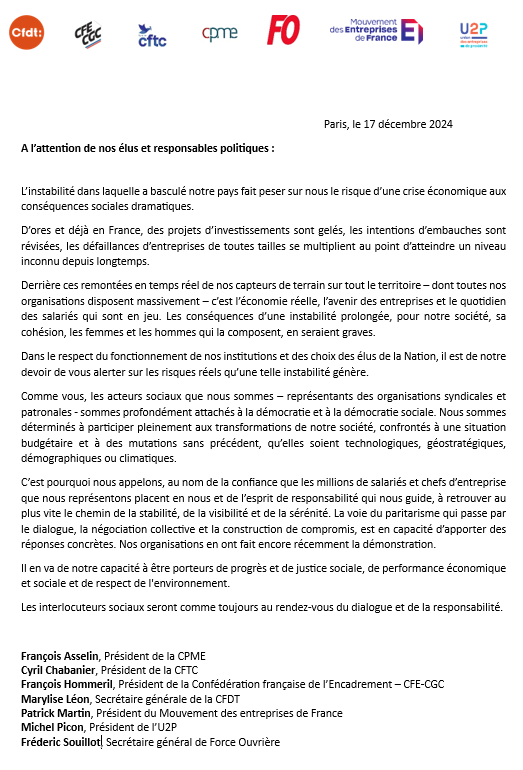
🔴 Communiqué de presse | Les organisations patronales et syndicales : #CPME@SyndicatCFTC@CFECGC@CFDT@medef@U2P_france et @force_ouvriere appellent les élus et responsables politiques à retrouver au plus vite le chemin de la stabilité, de la visibilité et de la sérénité.
Le 04 décembre, @jeanvictorblanc sera parmi nous pour participer au débat du Big Bang sur la santé mentale (en direct sur https://t.co/J5l4zN9AAk).
Retrouvez le programme de la nouvelle édition du Big Bang de la Santé sur https://t.co/ox4NJ426Kn
#BigBangFigaro#SanteMentale
"Ce qu'Elon Musk appelle le 'journalisme citoyen' n'est autre qu'une arme de destruction massive de la réalité factuelle" : je consacre aujourd'hui une tribune dans @lemondefr à Musk, apôtre du #postjournalisme