@Athanasius_45 Herodotus also mentions how influenced Pythagoras was by Egyptian philosophy, namely the immortality of the soul, and “rebirth” of the soul in new bodies. Of the pre-Socratics, him and Heraclitus are fascinating. Much more than a simple mathematician!
@Athanasius_45 I could easily be misremembering but doesn’t Herodotus use the term “Libya” instead of “Africa”? I also don’t recall him calling Palestine/Syria as a part of Africa, when he discusses the dimensions of Egypt.
@red_loeb@GallicaBnF Thank you! It has definitely been a while since I've read Jeremiah. Funny how it of course can be translated to a Medieval Italian context.
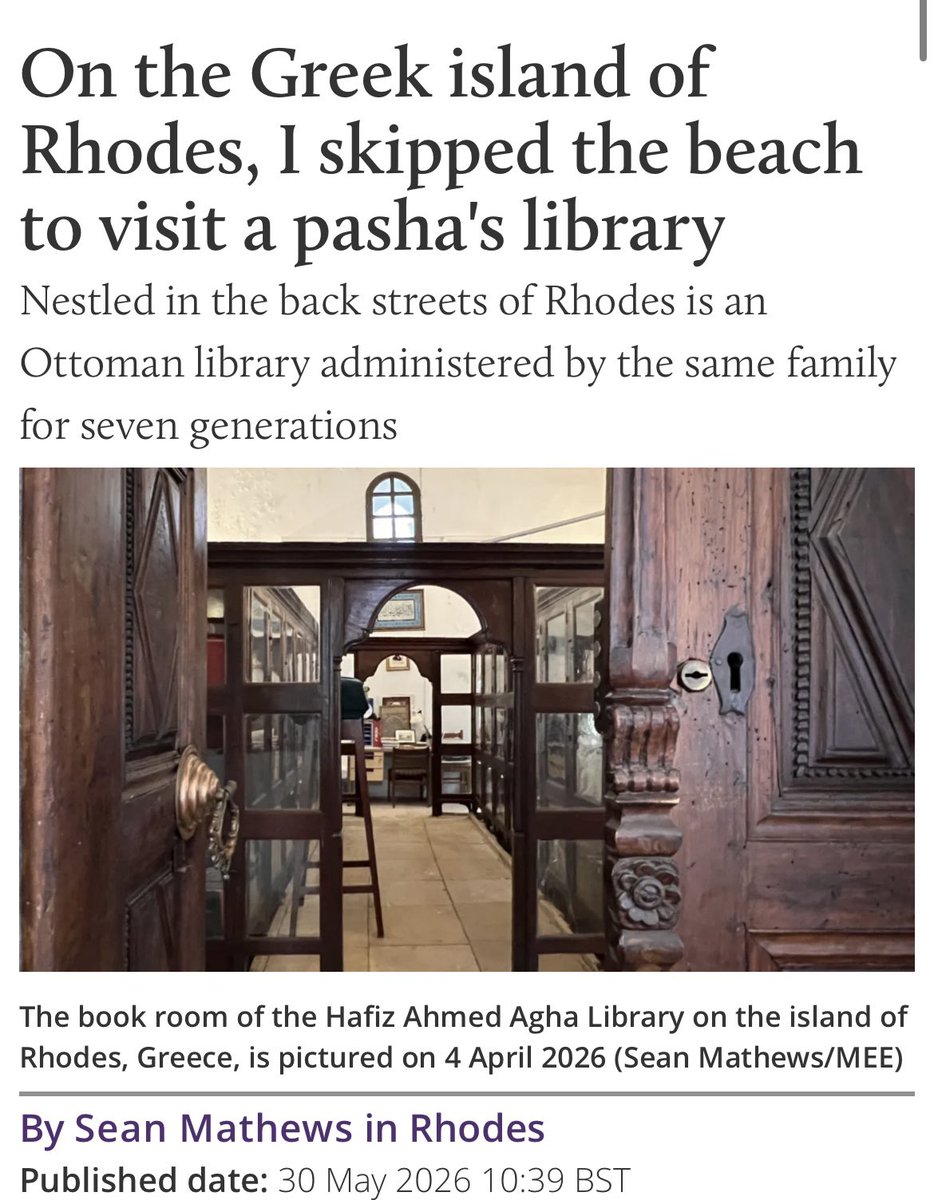
In the footsteps of Egypt’s Khedive, Chateaubriand and Lawrence Durrell I traveled to Rhodes. But I skipped the Pasha and found a 18th century library stashed with Persian, ottoman and Arabic manuscripts. 🧵
Ancient Greek: ἃλις (halis)
Latin: lassus
French: hélas
Arabic: خلاص (khalas)
I can't find anything confirming this, but are these not cognates or at least borrowings, meaning in aggregate "enough (of) sth."? Not so sure about the latin connection though.
Very interesting comparative econ. work on grain prices in the Ottoman East Mediterannean compared to other European trends. Space x time effects on pre-modern pricing, especially of essential commodities is always revealing of economic integration when we don't have other data.
Osmanlı’nın diğer Avrupa ülkeleriyle karşılaştırıldığında iç pazar entegrasyonunu gösteren oldukça önemli bir grafik. İç pazar entegrasyonunu ölçmek için kullanılan temel gösterge, farklı şehirlerdeki fiyatların kovaryansıdır (yani fiyatların birlikte hareket edip etmediği). Grafik, 1900 yılına gelindiğinde bile Osmanlı’da entegre bir iç pazardan söz etmenin oldukça güç olduğunu ortaya koyuyor.
Üstelik 1580 gibi erken bir tarihte bile Britanya ve Fransa, iç pazar entegrasyonu konusunda Osmanlı’nın önündeymiş ve Osmanlı’daki iç pazarın oluşumu konusunda, 1600 ile 1900 arasında pek bir somut gelişme yaşanmamış.
Homer was translated into Syriac by Theophilus ibn Tuma in the 8th century and Ḥunayn bin Isḥaq translated it into Arabic in the 9th. So yes they were indeed preserved in Arbic translation prior to any non-Greek Europeans reading the text. Wilson does not say "only preserved".
@HistorianZhang Come to think of it, I had tried asking the hotel concierge to help book tickets, they said the museum had no more availabilities, but showing up anyway, I had no problem entering.
@HistorianZhang I haven't been to Beijing in a while, but I was told to book tickets for the Guangdong museum in Guangzhou, but wasn't able to do so, as what you said. Ended up showing up there anyway, and had no problem entering, even with the museum already packed. Is it stricter in Beijing?