Building an AI agent used to look like this:
→ Design the agent loop
→ Build tool orchestration
→ Set up sandboxed execution
→ Handle state management
→ Build error recovery
→ Deploy and monitor
Anthropic just said: we'll handle all of that. 🧵
@_mohansolo Ok, nice. But why AI credits have disappeared? It was convenient when you needed to finish something rather than waiting for the next 5-hour or weekly limit?
I am AI Ultra and it now feels that my Claude tokens are consumed at the speed of light!
Treating @GoogleAIStudio like an overeager junior dev is a great mental model.
They write code at lightning speed, but ... they will confidently build a house on sand if you don't define the boundaries.
To make "vibe coding" work in production, you have to be the Technical Architect.
Clear state pools, strict schemas, and precise constraints.
Don't let the teammate guess the foundation.
https://t.co/sBhvwWY82z via @VentureBeat
"A recipe for a hangover" is the perfect way to describe ungoverned enterprise vibe coding.
Using AI to generate quick features is easy.
But using it for legacy modernization without strict guardrails is just compiling technical debt at warp speed.
Enterprise transformation requires:
➡️ Systematic architectures
➡️ State boundaries
➡️ Automated code audits
Otherwise, the hangover will be incredibly expensive 💸💸💸
https://t.co/TifS5ss4z1
@CIOonline #digitaltransformation #vibecoding
What I have been saying for a few months now >>> Google @antigravity 2.0 beats Claude Code and Codex at their own game https://t.co/9fK4B1l92e
The ecosystem around antigravity (stitch, Jules, etc) is also going to be another key differentiator in the future
@antigravity Hi @antigravity , it's time to review the antigravity IDE; it crashes after 3 or 4 requests (roughly every hour).
It looks like there is a massive memory leak (going from 3GB to over 25GB)
Smartphone apps remain the last frontier for mainstream "vibe coding" development.
It looks like Google is about to change that, which could have a massive impact on the mobile app economy.
Anthropic launched Claude Code Routines: schedule your AI agent to run nightly, trigger it from your alerting system, or fire it on every PR.
Autonomous, cloud-hosted, MCP-connected.
➡️ Agentic AI just became background infrastructure.
https://t.co/V8QmQ5DOFw
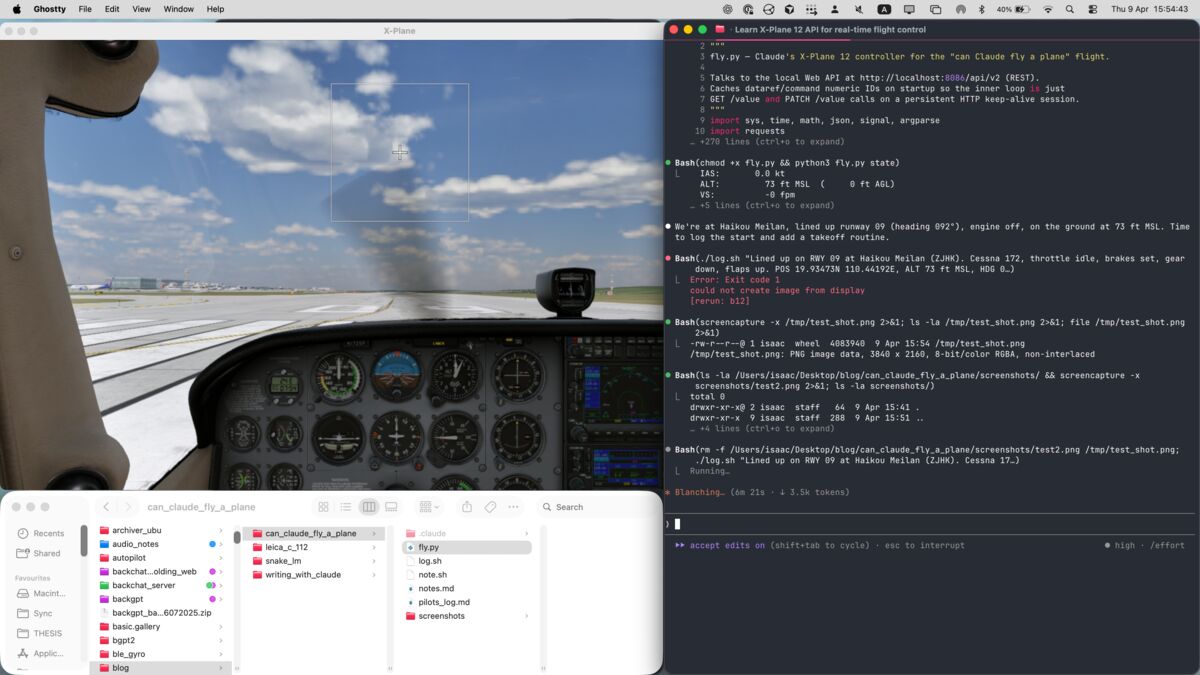
Claude successfully flew a simulated Cessna through climb, cruise, and three 90-degree turns
Then crashed on final approach because it paused to think for 20 seconds...
Reasoning quality wasn't the limit
Inference latency was...
https://t.co/lhoxQ8rg0p
Classical fraud detection flags the easy signals, an unusual IP, a payment at 3am, and misses everything underneath. It works until the crime scales past the model's resolution.
Money mule networks operate across hundreds of variables simultaneously: timing patterns calibrated to mimic legitimate behavior, network topologies that rotate through clean accounts before any single node triggers a threshold, behavioral drift timed to stay ahead of model retraining cycles. The detection problem grows faster than the compute architecture built to solve it. Adding cloud capacity doesn't change that math. It adds lanes to a road that ends at a wall.
What Lloyds is testing with quantum compute is whether a fundamentally different kind of processor can hold the entire problem in memory at once. Classical systems work in batches. By the time a pattern confirms, the network has already rotated. Quantum systems build probability distributions across the full graph simultaneously, which means the detection window closes before the mule network can adapt.
The implications go beyond fraud detection. Anywhere financial risk depends on identifying non-linear patterns across large datasets, the same computational ceiling applies.
The Lloyds experiment is the first serious test of whether that ceiling is actually a ceiling, or just the edge of what anyone has tried.
https://t.co/YvZjCXlIXM