How Hysen SI Works, Visualised ⚡️
We turned the way Hysen SI works into a visual model, so it is easier to picture what happens to a request from start to finish.
When you make a request in Chat, it goes through six steps. First, the SI Orchestrator breaks it into smaller tasks and assigns each one to an AI agent. Each agent then calls the right model through the Model Hub. 💻
The computing power comes from HYRA Zone GPUs and from devices across the HYRA Network. The network is spread across many devices and locations, so together they provide a large pool of computing power. Hysen SI uses that power to process your request, and shares it with other businesses that need it.
Once the work is done, the results are checked, refined and sent back to you. That is the whole process, and it runs as one closed loop.
We are still finishing the new website. In the meantime, you can follow our social channels for updates and find the Hysen SI app on the App Store and Google Play. When you connect your device through the app, its spare computing power joins the HYRA Network. Every device that joins helps the network grow and gives it more capacity to share.
Thank you for your contribution and your continued support. There is a lot more to come, so stick around. 💕
#HysenSI
Be among the first to explore the world of Feather Games.
Earn a whitelist spot to mint one of 1,000 unique NFTs.
Get started here https://t.co/pu9nglTZ1O
Docker Desktop, but written in Rust and about 80x faster to start a container. Your docker CLI, Compose and buildx keep working; the first launch sets up a kiri context.
Explore it here:
https://t.co/ucqKPYQ6my
The waitlist closes in 12 hours.
We are still running tests to give you the best possible experience on launch day.
The Genesis of $IMPRINT is coming on November 10.
Waitlisted agents paint first: 6 hours early, cheaper pixels.
https://t.co/zTWj1x936p
$MOCHI Airdrop Application is Live.
1% of $MOCHI will be bought & airdropped back to the community
Register → https://t.co/OtW7lz5EVz
Drop your wallets = $MOCHI.
Zaps by @zerufinance
2.17M zScore checks.
Not users — checks.
Every wallet lookup on Etherscan + Basescan
counts as one check.
And that number already crossed 2.17M in August 2026.
Why does it matter?
Because people now want to see onchain behavior
before they trust a wallet.
Score: 0 - 1000
Built on real wallet behavior
Live where people already check addresses
Reputation is no longer just a claim.
Now you can actually see it.
Check yours: https://t.co/PTQ95PQnLL
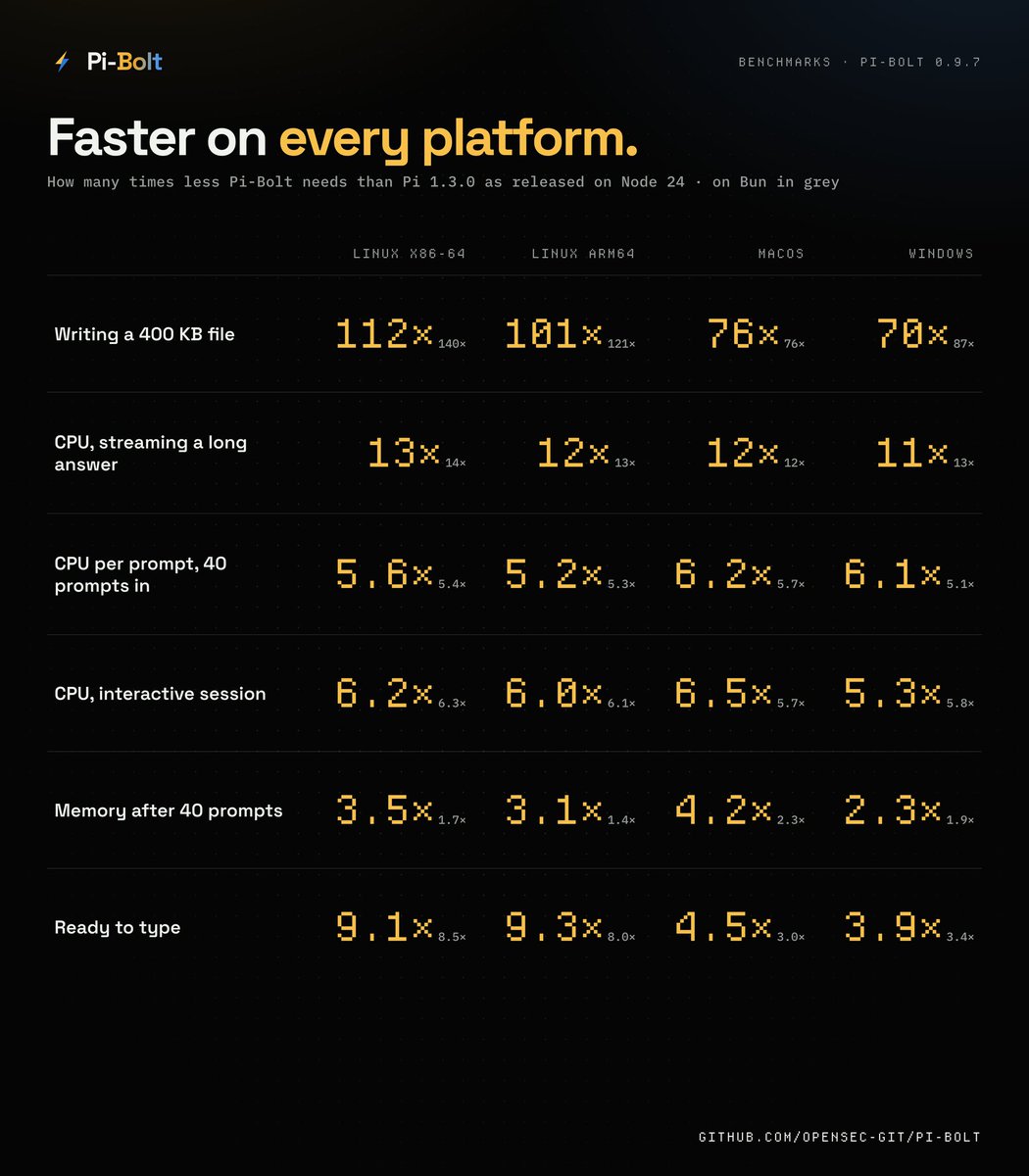
⚡ Introducing Pi-Bolt: the Pi coding agent, compiled to native code (AOT). Same Pi, same extensions, same config.
Against Pi on Node:
Up to 112x faster large file writes
13x less CPU while streaming
6x less CPU per session
3.5x less memory
https://t.co/vTXsNewjO8…
AI security benchmarks inflate scores by counting every crash as a "vulnerability."
A reproducible bug ≠ an exploitable flaw. Evaluating LLMs on synthetic fuzz harnesses is just gaming the scoreboard.
#Cybersecurity#LLMs#Vulnerability#AI#Pentesting https://t.co/XXfy0ReYzj
google has been strangely quiet about gemini 3.5 pro
they certainly have a strong model -- gemini 3.5 flash was distilled from it, and to achieve that, you’d need a very strong model to begin with
google went all in on agentic capabilities, but it still might not match fable 5