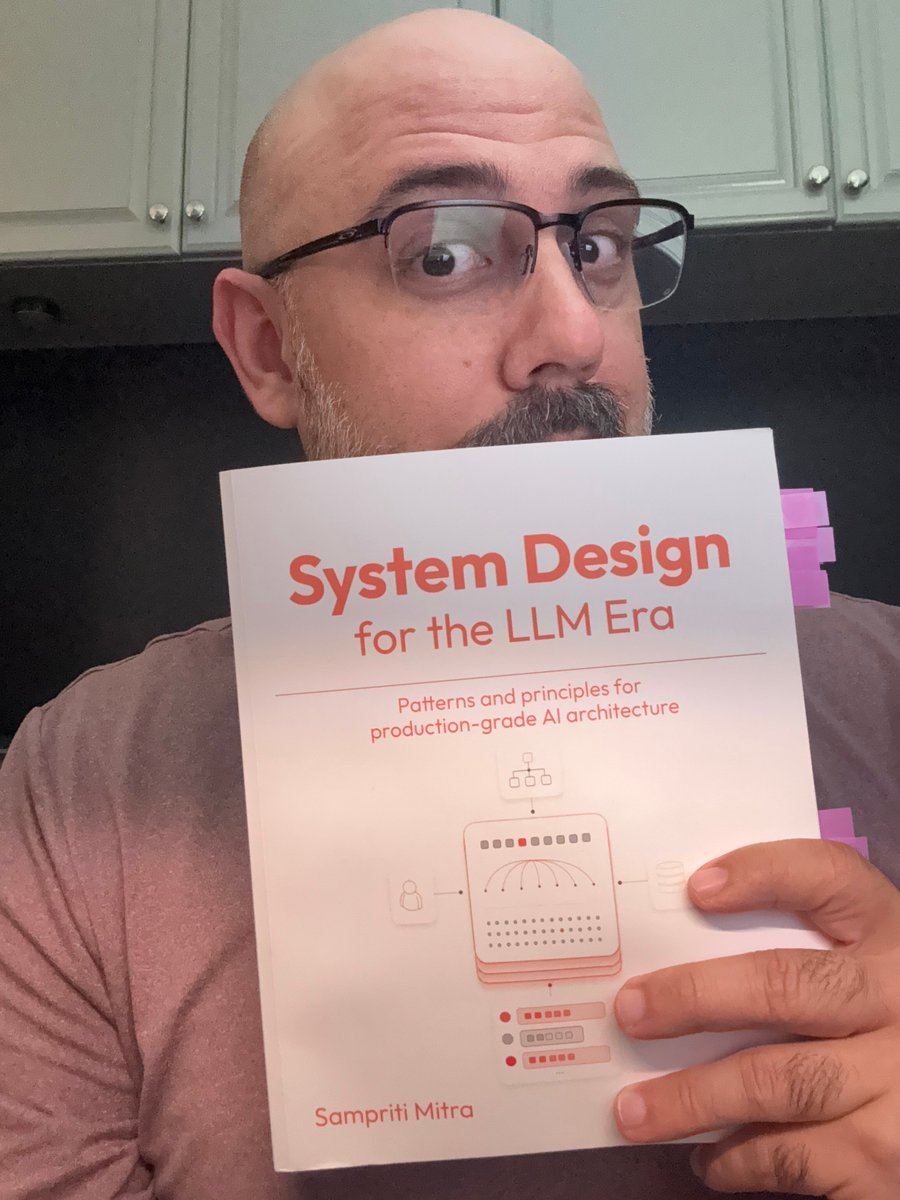
It was about time someone connected system design to LLMs in a practical way.
Most material around LLMs still focuses on prompts and model choice.
And that will help you with your POC, but production forces you to deal with latency, cost, failures, security, and unpredictable outputs.
This book treats LLMs as what they are: an expensive, slow, non-deterministic dependency that can fail in strange ways.
If you want to take this dependency to production, you need to apply real engineering discipline around it: gateways, circuit breakers, caching, model routing, evaluation, retrieval pipelines, observability, and human review.
This book is full of case studies, and they are the best way to connect the dots.
The adaptive learning platform, for example, generates content offline, puts it through human review, and prepares personalized lessons before the user needs them. It separates the hot and cold paths and keeps LLMs away from the critical request path whenever possible.
It puts the focus where I think it belongs: the system around the model.
You can use my code SDL30 for 30% off at:
https://t.co/ejgL6Fl2bB
or
https://t.co/fMknOkwZou
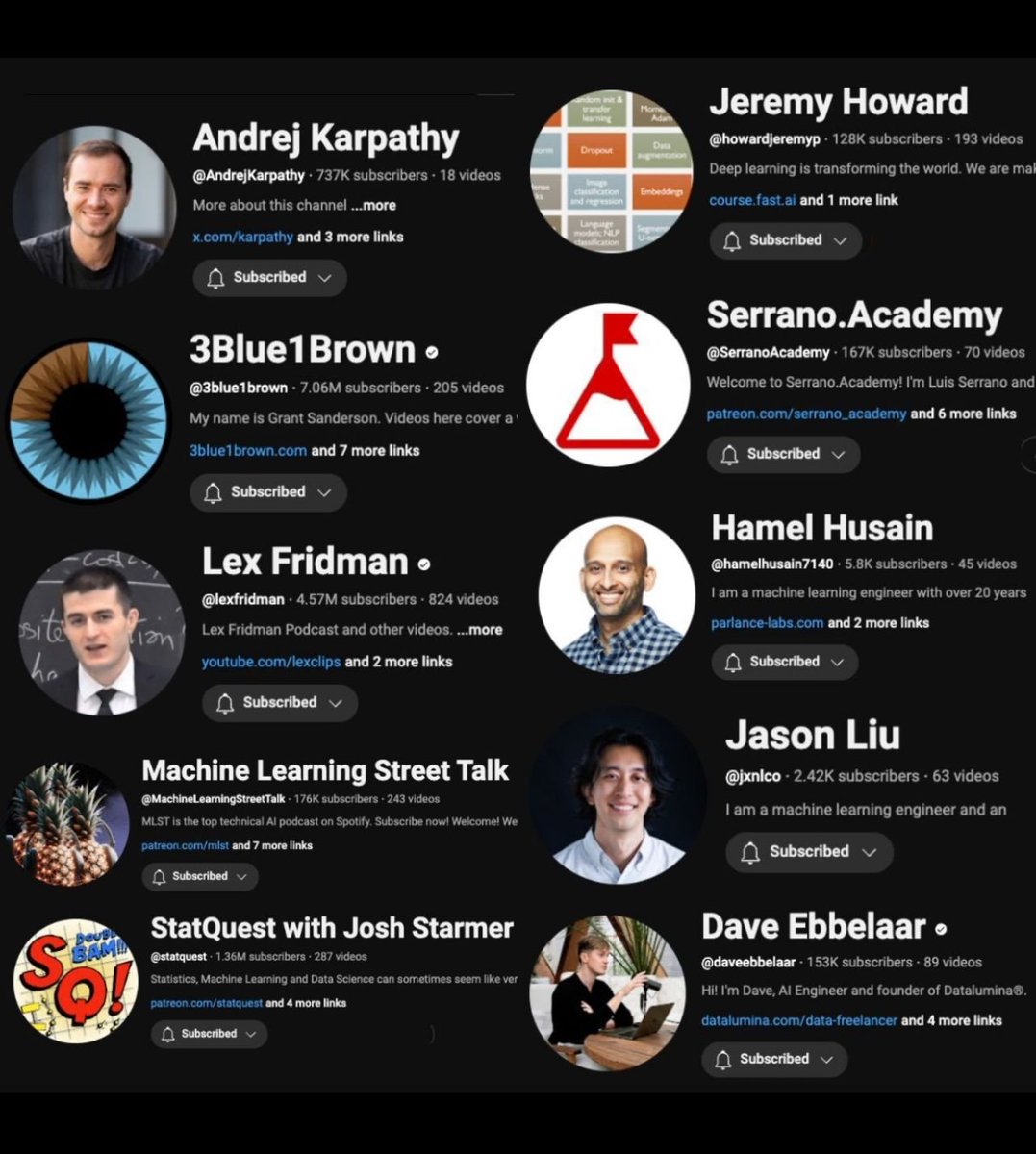
10 experts' YouTube channels for AI lectures, tutorials, tips, conversations, opinions, guides, lessons learned, explainers, perspectives, mathematics background, etc.:
🎓 1) Andrej Karpathy – Deep yet accessible lectures on deep learning, LLMs, and an intro course on neural networks. https://t.co/jycWqOsFOF
📊 2) 3Blue1Brown – Stunning visualizations that make abstract mathematical concepts intuitive. https://t.co/y6qOcSPLXl
🎙️ 3) Lex Fridman – In-depth conversations with AI leaders, offering a broader perspective on the field. https://t.co/PahPfkKMKs
🤖 4) Machine Learning Street Talk – Technical deep dives and discussions with top AI researchers. https://t.co/gnWrxWQ6IJ
📚 5) StatQuest with Joshua Starmer PhD – Beginner-friendly explainers on machine learning and statistics. https://t.co/u3d2EtLaHl
🍉 6) Serrano Academy (Luis Serrano) – Clear and accessible content on ML, deep learning, and AI advancements.https://t.co/hzXa2LsKRQ
💻 7) Jeremy Howard – Practical deep learning courses and AI-powered web app tutorials. https://t.co/Z33ddvHLHx
🛠️ 8) Hamel Husain – Hands-on lessons in LLMs, RAG, fine-tuning, and AI evaluations. https://t.co/Nq6ZAHjq50
🚀 9) Jason Liu – Expert-led lectures on RAG and AI freelancing tips for ML developers. https://t.co/UQwyMu9Pze
⚙️ 10) Dave Ebbelaar – Practical guides on building AI systems and real-world applications. https://t.co/xyu3dhiH54
Build your own harness.
This is a seriously good paper from NVIDIA on self-improving agent harnesses.
The paper is called SoL-Pi, out of NVIDIA, NTU and MIT.
Every coding agent runs inside a harness. That's the layer that reads files, runs commands, manages memory and talks to the model. Humans tune it by hand, reading long execution logs and turning what they notice into code changes.
They handed the job to an AI instead.
A research AI watched a coding agent work, proposed changes to the harness, tested them, and kept only what saved tokens without hurting results. It ran about 150 research directions across roughly 500 environments, more than 3,000 runs and over 60,000 agent-environment interactions.
Four fixes survived.
1. The agent edits a file and runs the test in one call instead of two.
2. It compresses its memory when a subtask finishes, and only if that's cheaper than keeping everything.
3. It sends big tool outputs in full twice, then swaps them for a 1KB excerpt with a handle to pull the rest on demand.
4. A cheap model summarizes build and test logs, and a verifier rejects the summary if it drops evidence.
None of that touches the model. It's all in the software around it.
On EdgeBench, a 51-task benchmark, token traffic dropped 44.7 to 49% and API cost fell by about a third against Pi, the harness it was built on. Against the native harnesses it came in 50% cheaper than Codex on GPT-5.6 Sol and 54.3% cheaper than Claude Code on Opus 5. Scores held at roughly 94% of the baseline.
They built all of it on GPT-5.6 Sol, then dropped it onto Opus 5 with zero changes. It still used 44.7% fewer tokens.
The cost conversation so far has been about cheaper models. This paper says a big chunk of the waste sits in the software around the model, and an AI finds it faster than we do.
Their next move is running the search again with the cheaper harness, so a cheaper agent funds the search for an even cheaper one.
Jev + Muse is the first AI agent system that actually automate 100% of my life
99% of people pay 200x more for slower AI agents - while 1% run this 2030 setup
just 5 min and setup is ready:
prompt → Muse → Jev decision → Muse execution → result
step 1 → create your Jev API key (typesafe website)
step 2 → clone and install the complete router from Github below
python3 -m venv .venv && .venv/bin/pip install -r requirements.txt && cp config.example.yaml config.yaml
step 3 → export the key before running anything: export TYPESAFE_API_KEY='YOUR_KEY'
add the same export to ~/.zshrc or ~/.bashrc if you want it to survive a new terminal session
step 4 → give your agent skill/jev-decision-layer.SKILL.md and connect it to src/router.py + recipes/ , raw Jev returns probabilities - the router converts them into executable actions
step 5 → test the entire chain, not the raw Jev API:
.venv/bin/python -m src.cli '{"goal":"what is 2+2?","kind":"chat"}'
the final JSON should contain action, reason, mode, jev_used and confidence details
step 6 → keep mode: shadow for 20–50 real decisions: the agent works normally while Jev’s routes are logged and checked; promote only reliable question packs
step 7 → switch to mode: active with hard confidence gates: ≥0.80 act automatically, 0.50–0.79 advisory only, <0.50 escalate to the human
the result: Jev + Muse is a system that decides what to do, what to skip and when to bring in - I’ve tested it across my daily workflows, and it’s the best setup I’ve found for automating routine
Take the exact stack I built, run it yourself from the repo - then read the full Jev architecture behind it ↓
Jev Founder, Diogo Amogo, just released a PDF on building a Jev Harness for coding agents
this is a blueprint on how to make your coding agents 200× faster and 400× cheaper
Send this PDF and the article below to your Claude
Code or Codex instance and start shipping 200× faster 👇
Anthropic acaba de publicar un PDF de 13 páginas sobre memoria para agentes de IA
5 capas para reducir un 90% el coste en tokens y hacer que tu agente aprenda de verdad👇
1. MEMORIA DE TRABAJO: lo que ve ahora
La ventana de contexto. Todo lo que el agente tiene delante en este momento
Cuando se llena, el contexto antiguo se pierde. La mayoría de los agentes se quedan aquí y luego nos preguntamos por qué fallan
2. MEMORIA EPISÓDICA: lo que pasó
El historial completo de interacciones, con fecha y hora
El agente recuerda que el despliegue falló el martes a las 3 de la mañana porque el script de migración tenía una errata
No tienes que explicárselo otra vez
3. MEMORIA SEMÁNTICA: lo que sabe
Hechos, entidades y relaciones guardados en un grafo de conocimiento
«El usuario prefiere TypeScript» vive aquí
Y no desaparece cuando termina la sesión
4. MEMORIA PROCEDIMENTAL: cómo hacer las cosas
El agente prueba 3 enfoques. Uno funciona
Ese método se convierte en una habilidad reutilizable
La próxima vez va directamente a lo que funcionó
5. OLVIDO: lo que debe borrar
Un agente que nunca olvida acaba acumulando contradicciones
Las preferencias antiguas se imponen a las nuevas. Te mudas de ciudad y sigue recomendándote restaurantes donde vivías antes
Recordar importa. Saber qué olvidar, también
¿El resultado?
→ Mem0 almacena 1.800 tokens por consulta en lugar de 26.000
→ Snowflake añadió una capa de ontología: un 20% más de precisión y un 39% menos de llamadas a herramientas
La memoria compensa su coste desde el primer día
Este PDF de 13 páginas marca la diferencia entre un chatbot y un agente que aprende de verdad
No lo pases de largo ↓
THIS "GETTING STARTED WITH LOOPS" DOC TURNS CLAUDE INTO AN EMPLOYEE THAT SHIPS WHILE YOU SLEEP
spoiler: prompt engineering didn't survive the summer
the 4 loop types, from hands-on to hands-off:
> turn-based - 25% autonomy. one task per round, then control comes back to you. the right call while requirements are still fuzzy
> goal-based - 70%. you put "done" into /goal and a separate evaluator keeps sending Claude back until it clears the bar. tests green, target scores hit, bugs closed
> time-based - 60%. /loop runs on a clock: check the PR every 5 minutes, clear review comments, fix failing CI
> proactive - 95%. an event fires, a router fans child agents out in parallel, a review model reads the output. nobody online at all
pick the lowest setting that still gets the job done. autonomy you can't verify costs more than it saves
the line worth keeping: a loop is only as good as the system around it, and tokens are where the cost actually lives
knowing the 4 types is level one
level two is wiring loops into a graph. that's the article below: 14 steps from a single loop to 300 agents on one shared knowledge base, running on a $20 Kimi K3 plan
loops, graphs, dynamic workflows and routines, in the order you should actually build them 👇
ESTE DOCUMENTO DE ANTHROPIC LITERALMENTE TE VA A CONSEGUIR UN ASCENSO
La forma más rápida de ascender es automatizar el trabajo que haces hoy
Esta guía técnica oficial de Anthropic explica cómo enseñarle a Claude a ejecutar tus tareas del día a día
Crea «Skills» personalizadas para que la IA se encargue del trabajo pesado:
→ convierte tus procesos habituales en instrucciones reutilizables
→ deja que el agente ejecute tareas en segundo plano
→ conéctalo a tus herramientas locales mediante servidores MCP
Delega las tareas repetitivas y dedica tu tiempo al trabajo que te puede conseguir ese ascenso
Aquí tienes la guía para hacerlo paso a paso👇
With AI Engineering skills, you actively shape the build: You influence what gets built, and drive the build loop. Here're key skills to do this. https://t.co/sysOYdzuZY