I know I've reposted this before, but it's worth re-emphasizing.
If you want to get good at using AI, GET GOOD AT THE THING YOU'RE USING IT FOR
This is a great illustration of why:
you now have the ability to
- play with every possible solution to a problem
- refactor everything when you think of better patterns
so many people complaining about the code the LLMs produce, if you're not producing the best software of your life right now something is wrong
This vocabulary is a side-effect of domain expertise. Having domain expertise makes you way better at getting what you actually want from AI relative to other people.
So learn how to code, learn design, all the fundamentals. It’s incredibly revelant, and it will stay relevant.
"What I failed to realize was that running agents feels less like a project manager for agents and more like stepping into a super mech suit where I don't have two arms, I have twelve."
THE LEGENDARY DHH IS NOW OFFICIALLY AI-PILLED 🍻
Tragically I am continuing to find that the most effective guardrail against slop is extremely talented engineers doing very thoughtful, human code review
A few things I've noticed as all devs write code with AI.
When you write foundational / architectural code of a new project by hand, you "feel" the code pushing back if your abstraction isn't right. You feel when something is harder than it should be. The code is telling you it's not in the right shape. Good engineers are sensitive to this.
When you're using an LLM, you keep pushing right through this in a way that feels like you're making progress, and it may even be directionally correct in a sense, but the underlying foundation of it all is actually bad in a way that either kills progress of the LLM later as it buckles under the complexity it has created or destroys your ability to maintain the code long term.
Related to this, I see a general restlessness with just sitting and thinking about a problem for a while.
As I've been working on a new library here at Laravel, there have been days where it feels like I mainly just stare at my screen thinking about something. When Claude Code is at your fingertips, it's tempting to just start yapping into the terminal and watching code come out the other end. Again, directionally correct in some ways, but often doesn't land on the elegant solution that is waiting to be discovered.
Nike: Everyone is an athlete
Apple: Everyone is an artist
Shopify: Everyone is an entrepreneur
Cursor: Everyone is a developer
Cluly: Everyone cheats
What's about your company?
Starting a startup, at the start, requires you to be an
Engineer
Designer
CMO
Customer Success Rep.
Platform Educator
Copywriter/Storyteller
Project Manager
Investor
etc.
All in one, everyday, until people equally as passionate and convicted as you believe in what you're building enough to join and take over each of these roles.
The hardest part about building a startup, at the start, ends up not being building the startup, but navigating life outside of building it and convincing yourself to keep going despite everything around you pulling you away from doing so (I'm still at the beginning of building so there is likely more to be discovered here). This doesn't include those attempting to start a startup while working a job, maybe you can get a spark for the idea and build a team but I'm inclined to believe committing to a company while working is not possible (I'd love to hear stories of those who did this anyway).
The best way to determine whether or not you are building a startup, at the start, is if despite going through the hardest parts of it, like being ignored, copied, or not having rallying support from those around you, you still have the same conviction to pursue it. When you have that strange feeling that it's everyone else who is missing the big picture, and if people just tried your thing they would realize you were on to something impactful, building something useful or at the least building the foundation to pivot toward something of the sort.
Success likely goes to the most relentless pursuers of it, not the smartest and not the most privileged. Those who despite the signs telling them to turn around, go forward anyway. And I believe the hardest of it is likely to occur right before you hit a breakthrough.
Maybe a secret is to use how bad you feel as a measuring stick for how far away success may be lol.
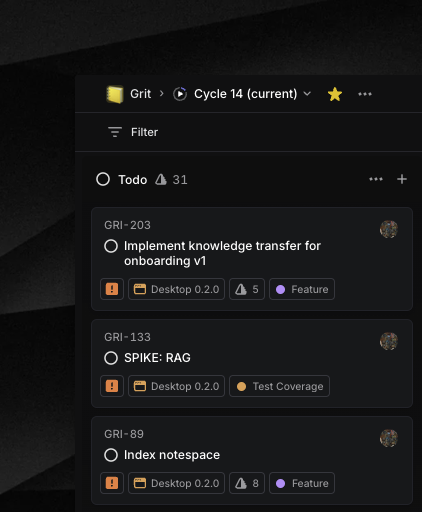
For @gritxai I actually prioritized building the workspace and integrated chat so you can talk with your knowledge and jump straight into writing/researching with AI.
While important and needed, spending less time on the workspace and chat sort of items upfront and prioritizing first a knowledge transfer type option and, of course, RAG, I think is more substantial. This to me gives anyone willing to try the chance to see what switching to an AI powered tool gets you from day one.
The biggest pain point when trying new tools is starting over. The main reason to switch to an AI-powered tool is being able to prompt your way through information you've already given it, without having to re-upload, re-paste, or start every chat from scratch. Solving these first might matter more than anything else moving forward.
Reworking the MVP to put knowledge transfer in onboarding and retrieval in ⬇️
Whether surfacing files, notes, or knowledge in PKM systems, leveraging RAG for accurate broad search and retrieval across all data will become the floor (if isn't already).
If we're all still using keywords to find our stuff, what's the point of switching tools or getting excited about new AI integrations?
Considering there are always shinier tools for us to try
Caring about how you’re solving a problem just as much as the problem itself is likely the way to last through the noise in a problem space and accomplish this.