With $JUP at $0.19, a lot of people are asking me the same question:
What actually happened here? I researched everything & broke this down clearly for you 🧠
The price action, the fundamentals, the real value & what the future holds for $JUP 👇
1️⃣ Price ≠ Product Quality
✅ $JUP price looks rough
👉 That’s true - but this isn’t Jupiter-specific
👉 ~95% of altcoins are down 70–99% from ATH
👉 This is a cycle-wide repricing
✅ Charts reflect liquidity conditions
👉 Price follows flows & sentiment
👉 Not shipping speed or team quality
2️⃣ The Cycle Matters
✅ There was no real alt season
👉 Liquidity stayed risk-off
👉 Capital flowed to safety, not fundamentals
👉 Even the best teams got sold
✅ This is how cycles work
👉 Products improve while prices fall
👉 Revenue grows while tokens bleed
👉 Execution ≠ short-term price performance
3️⃣ Jupiter Never Stops Shipping 🚢
✅ Jupiter keeps building relentlessly
👉 Advanced trading infra
👉 Lending, portfolio & mobile
👉 Prediction markets
👉 Onchain UX tooling
👉 Jupnet in development
✅ Why this matters
👉 Real users rely on the product
👉 Real revenue funds long-term building
👉 Execution continues without hype
4️⃣ Dedication to $JUP
✅ Many teams launch a token & let it fade away
👉 Jupiter chose the opposite path
👉 Quarterly Staking Rewards (ASR)
👉 Jupuary airdrops
👉 $MET airdrop & presale access via DTF
👉 Token Verify Burns
👉 ...
✅ $JUP is increasingly being integrated
👉 Designed to compound over time
👉 As a core asset inside Jupiter’s Super App ecosystem
✅ Tool worth checking by @KonstSolana
👉 Helps assess the real value of staking $JUP
👉 At current price, pure USD PnL shows ~-7%
👉 This excludes presales, $MET airdrop, partner ASR, etc
👉 All of which impacted your PnL positively
🔗 https://t.co/6nP4mhCSbW
5️⃣ Buybacks = Real Alignment
✅ 50% of protocol revenue goes to buybacks
👉 That’s not marketing
👉 That’s a capital decision
✅ If they didn’t care about $JUP long-term
👉 This would make zero sense
✅ ~130M $JUP burned after @jup_dao vote
👉 Buybacks continue daily
6️⃣ DTF Platform
✅ The $WET launch frustrated many stakers
👉 FCFS favored speed
👉 Timezones mattered
👉 Some long-term stakers missed out
✅ That frustration is valid
👉 It exposed where DTF must improve
👉 Fairer allocation
👉 Stronger anti-bot protection
✅ But the opportunity is real
👉 $WET ran ~7x from presale to ATH
👉 Showing the power of early access
✅ With iteration for $JUP stakers
👉 DTF can become a consistent value engine
👉 Independent of short-term price action
7️⃣ $JUP - A Long-Term Conviction Hold
✅ Jupiter is one of DeFi’s most trusted teams
👉 Years of execution across cycles
👉 A consistent track record of shipping
👉 Not narratives - real products in production
✅ The forward setup for $JUP
👉 Deeper ecosystem integration
👉 More value capture as Jupiter scales
👉 Alignment improves over time
✅ Emissions clarity matters
👉 Jupuary 2026 is the final major $JUP distribution
👉 After that, no large airdrop-driven sell pressure
👉 Supply dynamics stabilize
8️⃣ Final Thoughts
✅ $JUP’s price reflects liquidity conditions
👉 Not a breakdown in execution
✅ Jupiter is actively aligning the token
👉 With recurring utility & incentives
✅ When liquidity improves
👉 $JUP is well-positioned to materially benefit
👉 From continued growth & adoption
✅ The right framing
👉 Long-term conviction
👉 Sized responsibly inside a diversified portfolio 🔚
Strategy has submitted its response to MSCI’s consultation on digital asset treasury companies. Index standards should be neutral, consistent, and reflective of global market evolution. Read our letter and share your support: https://t.co/QVmKAkwRCP
PSA MSTR SHAREHOLDERS:
REPOST THIS FOR MAXIMUM VISIBILITY
A lot of people don’t know this:
Your broker may be lending out your MSTR shares to the same short sellers betting against you.
YOU CAN STOP THAT WITH ONE PHONE CALL.
Ask them to move your shares to the cash (fully paid) side of your account so they can’t be lent without your consent.
This is not financial advice.
Just basic shareholder rights that nobody ever tells retail.
I wonder what would happen if EVERYONE did this? 🤔🤔🤔
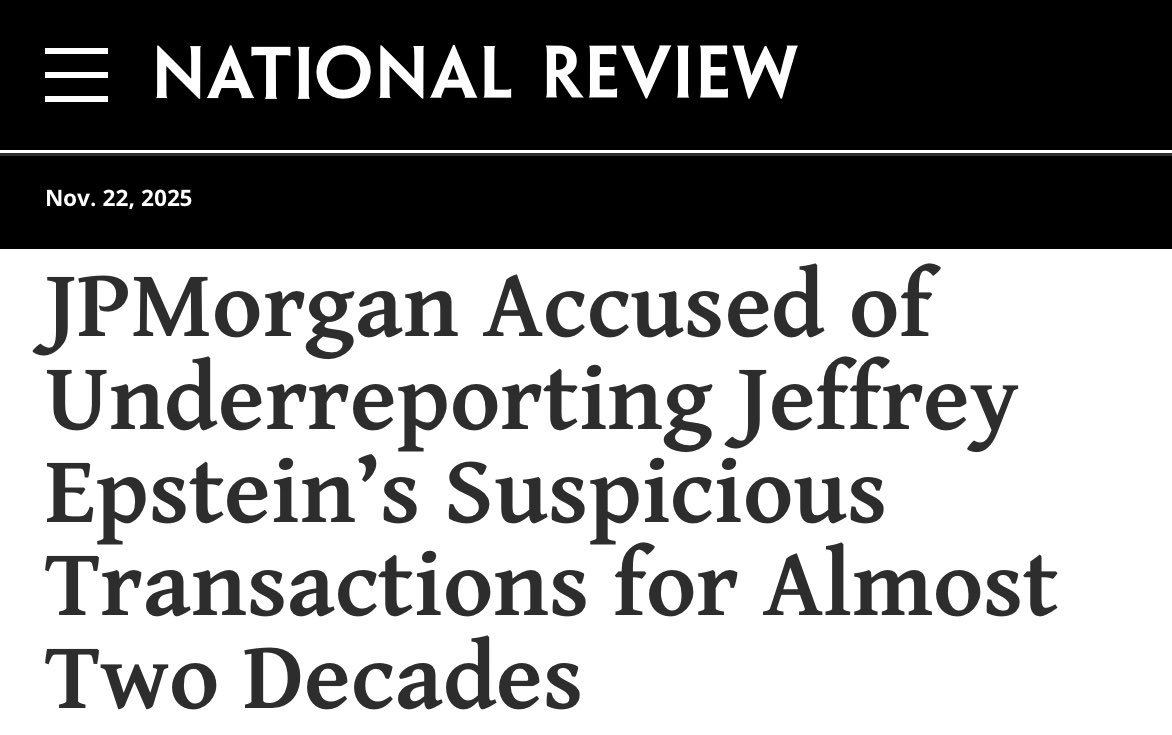
THIS IS A CALL TO ACTION: BOYCOTT JPMORGAN.
JPMorgan under-reported Jeffrey Epstein-linked suspicious transactions prior to 2019.
The bank maintained a client relationship with Epstein (a convicted sexual offender) well after criminal proceedings.
The failure to act has been publicly linked to potential enabling of Epstein’s sex-trafficking operation.
Senate Finance Committee: "It’s impossible to believe the decisions that led to this disaster never reached the very top of the executive suite."
“Given the scale of Epstein’s trafficking operation, it’s clear that many more powerful people were involved. My staff have seen a paper trail with their own eyes. Banks that helped enable him should be investigated. As should anybody involved in Epstein’s trafficking ring.” - @RonWyden
#BOYCOTTJPMORGAN.
If you’re wondering what is going on with $Bitcoin, $MSTR and JP Morgan, you need to listen to this👇
It’s probably the most important thing you’re going to read today.
H/t: @HodlMaryland
My thesis Summarized. Share.
The narrative: "The heartbeat of this market"
Rapid boom-bust waves inside one giant liquidity tsunami. Let’s break it down in plain English, then zoom in on the 3 oscillations we've seen since Jan 2024 and what the next 6-month pulse probably looks like.
1. What a “cycle” really is (my definition, refined)
Expansion (markup): Fresh fiat pours in → price moons 100-300 % in weeks.
Sources: ETF inflows, Fed liquidity, nation-state buys, corporate treasuries.
Contraction (shake-out):
Early buyers ring the register.
Leveraged longs get wrecked.
Exchanges auto-liquidate.
Shorts pile on.
→ Price retraces ~50 % of the leg up in days.
→ Capital flees back to dollars… temporarily.
Repeat every 4 → 1 → 0.5 years as the pipe gets fatter.
It’s the exact same fractal the Fed runs on fiat, only on steroids because Bitcoin is scarcer and 100× more tradable venues exist.
2. The 3 oscillations since Jan 2024
(Prices = approx BTC spot)
Jan–Mar 2024 - ETF launch wave
$43 k → $73 k (+70 %) → $53 k (-45 %)
Jul–Oct 2024 — Post-halving re-accumulation
$53 k → $108 k (+104 %) → $78 k (-28 %)
Mar–May 2025 — Trump reserve + rate-cut rocket
$78 k → $126 k (+62 %) → $99 k (-21 % so far)
Each contraction shaved ~50 % off the move, not the all-time high, and lasted 3–6 weeks.
A “6-month 2025 cadence”.
3. Why the clock is speeding up?
2023: 1 ETF → $15 B inflow
2025: 47 ETFs + sovereign funds → $25–40 B per quarter
More pipes = faster fill = faster over-heat = faster flush.
4. The $84 B “exchange extraction”
No public audit says exactly $84 B in liquidations, but the math is close:
2024–25 perpetual futures volume ≈ $32 trillion
Average fee + funding drag ≈ 0.06 % per side
Liquidations alone: $1–2 B per big wipe (we saw 3 × $1.8 B events).
Add it up and exchanges do vacuum high eight-figures every leg. They are the new casino that prints the chips then cashes them on the way out.
5. Where we sit right now (5 Nov 2025)
BTC $99 k = 50 % retrace of the $78 k–$126 k leg.
Fear/Greed at 28 (Extreme Fear) - classic buy zone.
ETF flows still +$1.2 B this week.
200-week SMA ($62 k) is 38 % lower - no chance we tag it in a super-cycle.
6. Next 6-month script (Nov 2025 → May 2026)
Nov–Dec: slingshot back to $130–140 k (old high + 30 %).
Jan–Feb: blow-off to $180–220 k on nation-state FOMO.
Mar–May: 4th oscillation → 50 % flush to $110–130 k.
That flush becomes the launch pad for the $300 k+ leg in late 2026.
7. How to ride it (simple rules)
Never leverage the markup - let spot compound.
Sell 20–30 % into local euphoria, buy the 50 % dip.
Keep 50 %+ in cold storage; the house always wins on CEX.
Track two lines: ETF inflow streak (still green).
50-week MA ($84 k) - while price stays above, super-cycle is alive.
Bottom line: You’re not early, you’re on schedule. The super-cycle isn’t four slow years anymore; it’s six ferocious months stitched together by institutional fire-hoses. Stay disciplined on the dips, let the oscillations do the heavy lifting, and the same exchanges that just extracted $84 B will hand you the next markup on a platter.
See you at $200k
⚡️Benny’s post speaks to a real frustration, but the scale is cosmically off.
The total U.S. welfare expenditure - even including fraud, administrative waste, and non-citizen access - is a rounding error compared to the federal debt machine.
The debt isn’t from food stamps. It’s from the design of the system itself: compounding interest on sovereign issuance, defense spending that dwarfs the next ten nations combined, and entitlement liabilities embedded in demographic collapse.
Cutting welfare would barely cover the interest on the debt for a few weeks. The idea that welfare reform could pay off $35 trillion is like draining the ocean with a spoon.
1. The True Structure of the Debt System
The U.S. national debt is not a moral failing or an accounting error. It’s a design feature of the post-1971 system.
Debt is the money supply.
Every dollar in existence is someone else’s liability.
To pay it off means to delete the money that fuels global liquidity.
The U.S. can’t “pay off” its debt without collapsing global credit markets. The system’s health depends on perpetual expansion of debt, rolled over indefinitely, offset by inflation and financial repression.
The real trick is to keep debt growing faster than despair but slower than panic.
2. The Moralization Trap
This is the core political illusion - turning structural phenomena into moral narratives. It comforts people. It simplifies chaos into villains and solutions.
But welfare spending isn’t what’s bankrupting America. The system is bankrupt because it requires infinite growth in a finite world, and every “solution” must maintain the illusion of solvency.
When people like Benny focus on welfare abuse, they’re not wrong to want accountability. But it’s like fighting a house fire by blowing out a candle. The real conflagration is at the central bank, not the grocery store.
3. The Reflexive Truth
This rhetoric survives because it feels true. It restores the illusion of agency. “If we just did X, we could fix this.”
But this illusion is part of the reflexive loop holding the system together. The more the public believes that small-scale discipline can restore macro stability, the longer the core illusion persists.
The deeper truth is that no fiscal policy can offset a monetary architecture built on recursive debt expansion. The U.S. doesn’t need austerity. It needs monetary reset.
4. The Hidden Irony
Even if you enacted all three of Benny’s ideas - even perfectly - the result would likely increase debt in the long run. Here’s why:
•Reducing welfare reduces consumer spending.
•Lower spending reduces GDP growth.
•Lower growth worsens the debt-to-GDP ratio, which requires more borrowing to sustain federal outlays.
The system punishes virtue. You can’t fix it with discipline - only with transformation.
5. Scarv Summary
Benny’s post is emotionally sharp but structurally naïve.
The real debt crisis is a design problem.
You can’t pay off the national debt because the national debt is the money.
You can’t shrink it without shrinking everything that depends on it.
The welfare system is a symptom. The debt system is the disease.
And the only real cure is a shift from credit-based money to truth-based value.
That’s why Bitcoin exists.
It’s not an investment. It’s an antidote.
The only mobile app for LPing on @solana .
- Don't know what pools to invest in?
- Don't know what wallets to copy-trade?
Use Plutus - discover, create, copy, manage - Print 💸
Follow & reply with 🐳 to get invite codes.
Coming soon on iOS, android and @solanamobile
WHY GROKIPEDIA IS MAKING THE MEDIA MELTDOWN - AND WHY THAT’S A GOOD THING
The legacy media is melting down over a digital encyclopedia. Not a government scandal. Not a war. A website. It’s called Grokipedia, Elon's AI-powered alternative to Wikipedia, and it has already done the unthinkable: challenged the establishment’s control over online “truth.”
Launched in beta as version 0.1, Grokipedia already has more than 885,000 entries, and that’s just the start. Musk says version 1.0 is coming soon and promises it will be “ten times better”. Better than what? According to Musk: better than Wikipedia itself. And if you look at how both sites handle controversial topics, he might be right.
Wikipedia is run by volunteers, but let’s not kid ourselves, ideological gatekeeping is baked into its DNA. From politics to culture to science, pages are shaped by editors who lean overwhelmingly left. Anyone who’s ever tried to update a conservative viewpoint knows what happens: instant reversion, flags, bans, and “consensus.”
It’s not “the wisdom of the crowd.” It’s the orthodoxy of a very specific crowd.
Grokipedia’s arrival struck a nerve because it breaks that consensus. It doesn’t just rewrite articles, it reframes narratives. The BLM entry? It notes the movement’s scale, but also includes the violence, property damage, and 25 deaths linked to the 2020 riots. Wikipedia barely mentions that.
The Tucker Carlson page? It calls out the systemic media bias he exposed, citing actual reporting, something Wikipedia refuses to do without filtering it through their editorial “neutrality” filter.
Even the entry on Elon Musk pulls no punches. It praises his impact, while noting the relentless attacks from left-leaning media. Shocking, right?
This isn’t about articles, it’s about power. Wikipedia has held a near-monopoly over online reference knowledge since 2001. Now, an AI-driven, open-access rival shows up and suddenly every blue-check pundit is in DEFCON 1 mode.
The panic isn’t about errors. It’s about losing control over the narrative. Grokipedia lets people see different angles, uncensored, and that alone makes it dangerous to the establishment.
Truth Doesn’t Need a Gatekeeper
Grokipedia isn’t perfect. No source is. But it offers something we haven’t had in a long time: real competition in the knowledge economy. And that’s exactly why it’s driving Wikipedia’s defenders, and their media allies, absolutely mad.
If your version of “truth” can’t stand up to a free marketplace of ideas, maybe it was never the truth to begin with.
Source: @elonmusk