“If you think the world is selfish and rotten, go to the cemetery at Colleville-sur-Mer overlooking Omaha Beach. See what one group of men did for another on D-Day, June 6th, 1944.” — Andy Rooney
I’m looking to hire a talented postdoctoral research assistant to work with me on my Wellcome Trust-funded project at the @Dunn_School. If you’re interested in bacterial pathogenesis and host-pathogen interactions, please apply below! https://t.co/0gvhNJdbR3
I see people say "why is there so much resistance to doing vaccinated vs. unvaccinated studies?" like the Henry Ford "Inconvenient" study.
The reasons "any vs. no vaccine" studies are problematic have nothing to do with any "resistance" — they reflect genuine methodological limitations. The completely unvaccinated cohort is typically small and differs from the vaccinated population in so many systematic ways that isolating causal vaccine effects becomes nearly impossible. That's why most researchers focus on more tractable questions: specific vaccines, different schedules, timing of events relative to vaccination, and dose-response relationships. It is not "resistance", it is an attempt to do good science.
There's a contingent that treats long-term saline placebo-controlled RCTs (possibly of all vs. no vaccines) as the only legitimate study design for assessing vaccine safety, and assumes the reason they aren't done is that researchers fear what they'd find. But this ignores the practical reality: no one advancing that argument has ever proposed a workable design, and if they tried, they'd quickly discover why it's infeasible. Even if such a trial were somehow conducted, it couldn't detect rare events, and its findings would still be constrained by whatever schedule was used in the active arm.
The same people advocate for "any vs. no vaccine" observational designs as the gold standard retrospective alternative — again implying the only barrier is fear of results. But well-known biases and confounders make these designs deeply problematic, and the versions typically promoted fail to adjust for them, dramatically overclaim the strength of their conclusions, and refuse to acknowledge fundamental limitations.
Most tellingly, this group dismisses the entire existing safety literature because it doesn't meet their preferred design criteria — effectively pretending no safety data exists. In doing so, they ignore the largest and most rigorous studies available, which happen not to support their conclusions.
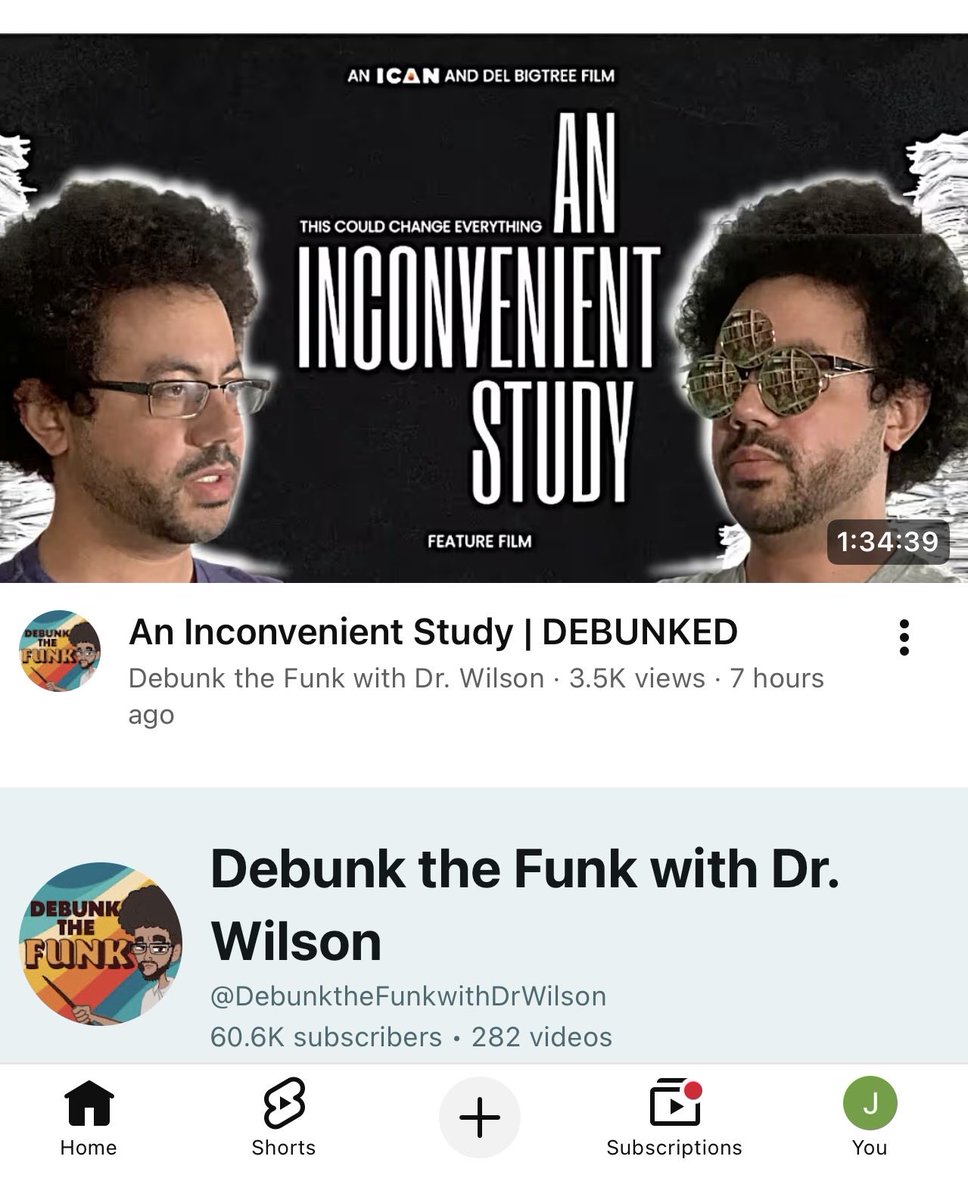
Dan Wilson (aka Debunking the Funk) put together a long video extensively debunking the Henry Ford study dubbed by ICAN as “An Inconvenient Study” and the propaganda video of the same name.
It’s a cutting critique of both the study, its purported conclusions, its framing in the video, and the many other anti vaccine talking points present in the video.
And one in which its points are quite well explained for the general public.
I don’t personally subscribe to some of the personal shots against vaccine skeptics and prefer to focus on the substance, but he gets the massive substantive flaws of the paper right, explains them well, and correctly characterizes them as fatal flaws that prevent the paper from answering the questions it is purported to answer, and correctly states the framing and conclusions are not at all scientifically substantiated.
I agree with almost all of the statistical points he makes.
I recommend anyone who has watched the video or seen ICAN or other proponents pump up this study to watch this video than accurately conveys many of its key limitations as well of many of the misleading or even fallacious arguments made in the video.
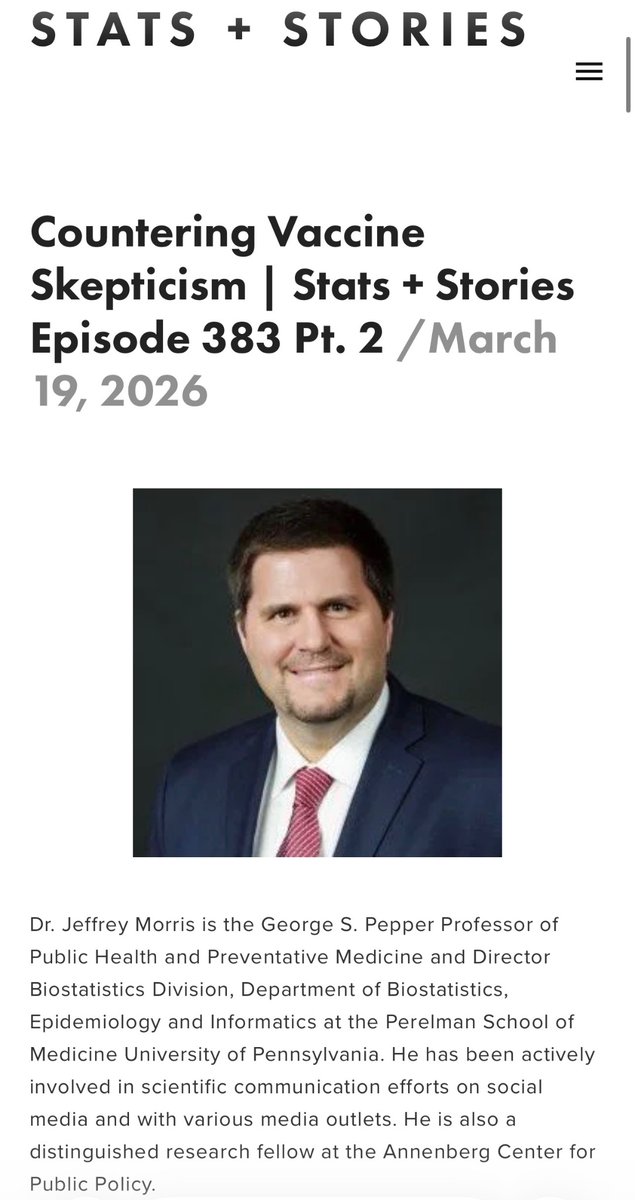
In this Stats + Stories episode, I discuss how vaccine safety is actually studied in the U.S.
A key point: clinical trials are necessary but not sufficient—they’re not large enough to detect rare adverse events. That’s why safety evaluation relies on a multi-layered system that includes trials, passive surveillance (like VAERS), active monitoring systems (like VSD/PRISM), and detailed clinical investigation.
Each component has strengths and limitations. For example, VAERS can identify signals but cannot establish causation or incidence, while active systems are used to rigorously evaluate those signals.
I also explain how misinformation often arises—from misinterpreting VAERS, cherry-picking individual studies, and applying impossible standards (the “Nirvana fallacy”) to dismiss the full body of evidence.
Bottom line: vaccine safety isn’t based on any one dataset or study—it comes from integrating evidence across multiple complementary systems.
Congratulations to Gilles Brassard from @UMontreal for winning the Turing Award. @NSERC_CRSNG is proud to have supported his research for many years, having awarded him the NSERC Herzberg Gold Medal in 2010.
Still waiting for the NIH and NSF to start finding grants for this fiscal year — almost no new grants have been funded yet - only continued funding for existing ones.
I’m hiring on my team at OpenAI for Research Engineer / Scientist and Software Engineer roles.
I believe one of the most important questions for future AI systems is: how do we train them to help people over time?
We work on that through RLHF, post-training, reward modeling, long-horizon evals, and the data infrastructure behind personalized multimodal AI.
If you care about human flourishing and serious research, links in comments.
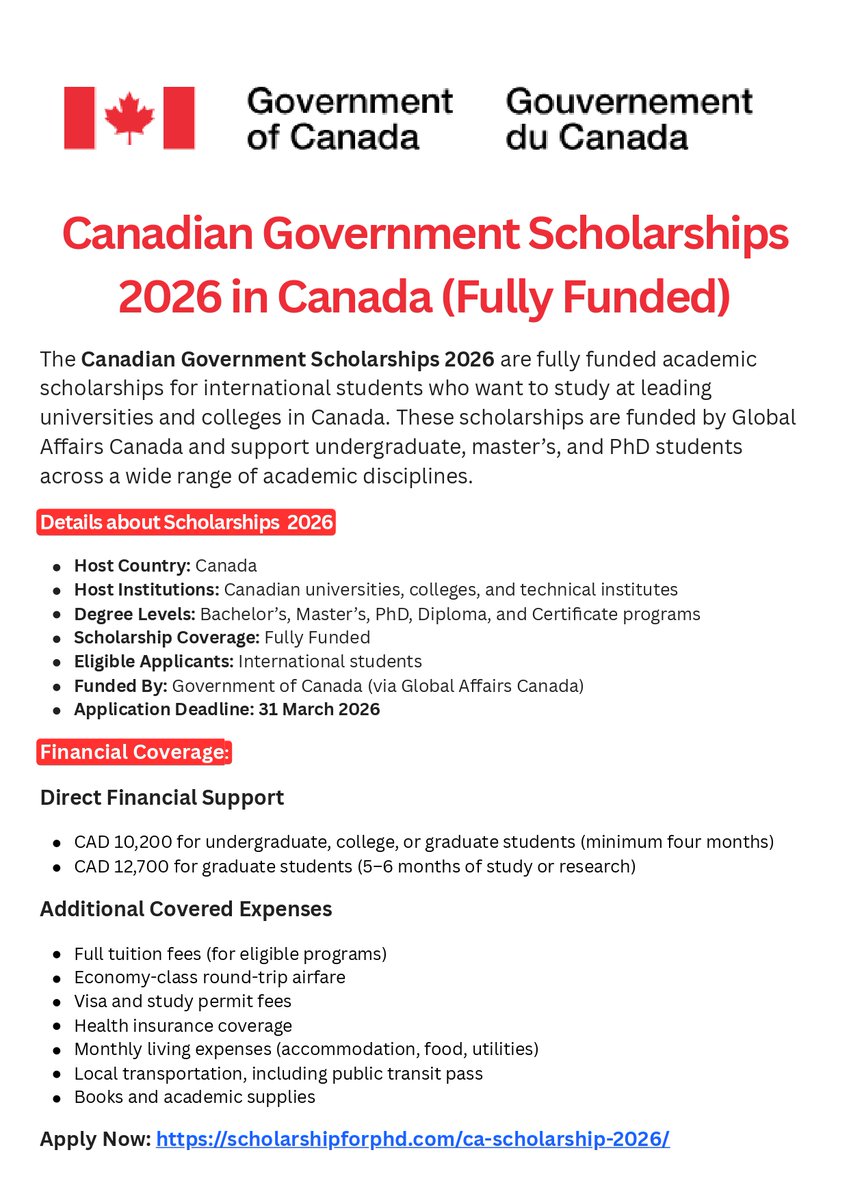
Canadian Government Scholarships 2026 in Canada (Fully Funded) for International Students
Visit: https://t.co/OLnFuCUstb
Degree: Bachelor’s, Master’s, PhD, Diploma, and Certificate programs
Deadline: 31 March 2026
We are hiring research scientists and engineers to accelerate the next era of intelligence. 🔥✨
We are tackling problems that are extremely technically demanding but hugely satisfying at @adaptionlabs
Join us.
🚀 We’re hiring a Machine Learning Intern (Remote) at @TensorTonic
Most people use ML models.
We want someone who can build them from scratch.
Looking for someone who:
• Understands ML math (LA, Calc, Prob)
• Is strong in Python + PyTorch / TF
• Knows LLM concepts (LoRA, KV Cache, GRPO)
• Can implement models without just calling .fit()
You’ll help implement ML algorithms, break down research papers, and build interactive learning modules.
If Transformers, ViT, GANs, DDPM, RLHF excite you — apply 👇
https://t.co/WQJSJrOS7N
CIHR funding rate: 13.6%.
Early 2000s: 30%+.
Canada’s new $1.7B Impact+ program recruits talent — but without increased Tri-Council base funding, we risk further strain on an already stretched system.
We’re calling for $1B over 5 years.
Support here: https://t.co/iknRwlOqvM
We’re looking for some team members. And we want to meet you if you:
- Are an underdog with something to prove
- Love contrarian viewpoints
- Love robots (bonus if you’ve built one or think you know how to build one)
- Have a diverse background and real-world experience (we don’t value FAANG or Ivy paths more than others)
- Studied psychology, neuroscience, medicine, mechatronics, or dropped out
- Know how to code (not only vibe-code)
- Believe robots are the species that will conquer space, and want to help make that happen
- Have a brain that gravitates toward the hardest problems
- Have watched or read Frankenstein
Send us a short message explaining:
1. Why you
2. What you’d contribute to the team
3. What your dream job is (so we can build it for you)
📩 [email protected]
Anthropic AI Safety Fellows Program is OPEN
> Direct mentorship from Anthropic researchers
> On-site workspace (Berkeley 🇺🇸 or London 🇬🇧)
> Embedded in the global AI safety research ecosystem
> Weekly stipend:
– $3,850 USD
– £2,310 GBP
– $4,300 CAD
> ~$15k/month in compute + research budget
> No PhD, prior ML experience, or published papers required
> Fellows come from physics, math, CS, cybersecurity & other quantitative backgrounds
> Benefits included (country-dependent)
Apply:
https://t.co/PVISHPAWaz
We’re quietly assembling a small, elite team at @InceptLabsAI to work on long-horizon AI research that actually matters.
Roles: AI/ML researchers (strong preference for people already doing frontier-level work).
If you’ve built something real (papers, open-source, strong internal research, shipped systems), we’d love to talk.
Stealth mode • best-in-class resources • equity that reflects the risk/reward.
If this sounds like your next chapter, reach out → DMs open 🚀