I’m super proud to share that we’ve published a unique mixed-methods case study into day-by-day patterns of chronic self-injury and aggression. A thread! https://t.co/jNt7KjYGU0 (1/6)
(6/6) I hope this study shows the added value of case-studies and complex systems theory to guide it. Super thankful to the participant, her staff and amazing co-authors @Roy__O EvelienPoelen AnnemarieVanVonderen @SerenaDaalmans@FredHasselman @OlthofMerlijn @AnnaLichtwarck
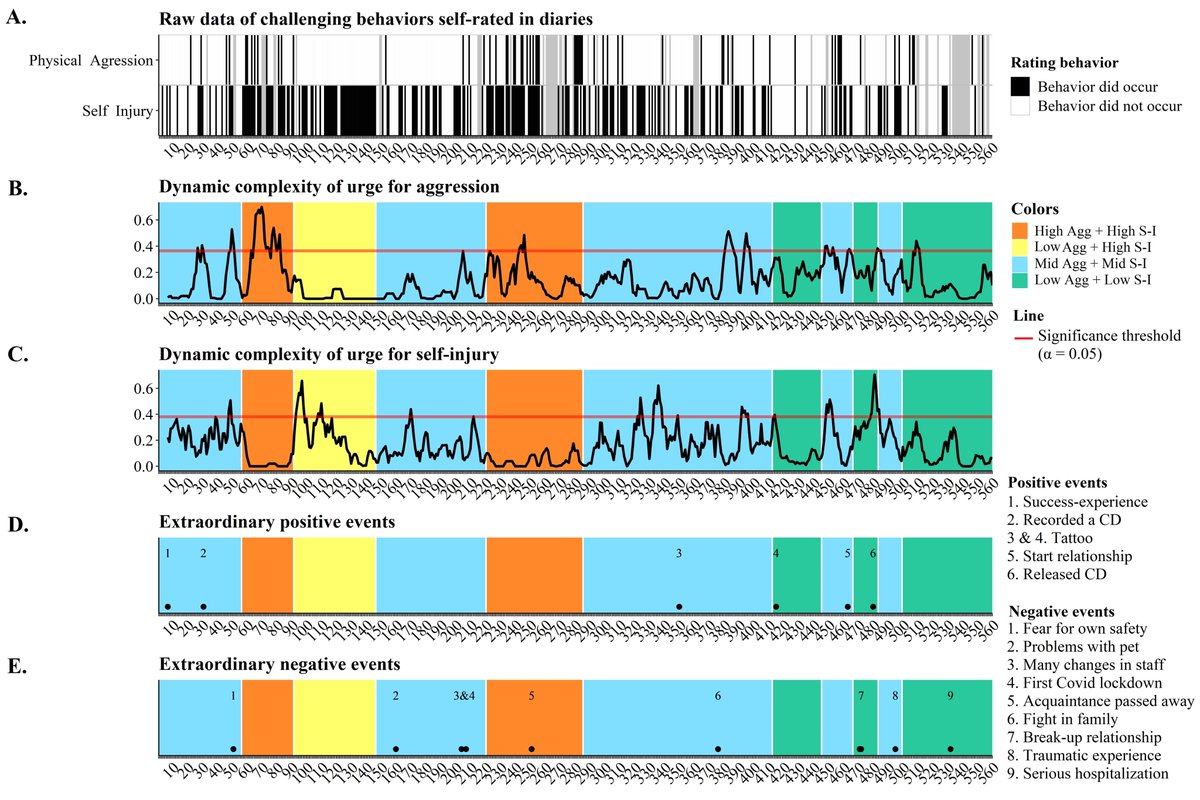
(2/6) A woman in residential care used EMA to self-report self-injury and aggression for 560 days (!) as part of treatment. Qualitative analyses of care taker records resulted in a holistic summary of her life, which added time-specific context to the quantitative EMA data
(5/6) The EMA timeline had 11 stable phases that alternated between different attractor states: combinations of high, average and low challenging behavior. Most phase transitions were preceded by instability in self-reported emotions or an exceptional event (e.g. Covid lockdown)
I’m super proud to share that we’ve published a unique mixed-methods case study into day-by-day patterns of chronic self-injury and aggression. A thread! https://t.co/jNt7KjYGU0 (1/6)
(7/7) Last but definitely not least, a very big thanks goes to co-authors @psychedfreek@Roy__O Evelien Poelen and @AnnaLichtwarck, who’s contributions were invaluable! Our collaboration has been a pleasure😊
(6/7) We need 1) to include situational information in data collection and 2) theory building on the to-be-modeled timeframe, timescale(s) and components. See our article for implications and recommendations, now out in a special issue of the Journal of Research in Personality!
@DomMaciejewski @TruijensFemke@NWOFunding@SAAscience Thanks Dominique, for my first ever twitter tag (yes, I'm also a twitternewbie) @TruijensFemke your MEANS project looks super cool - def overlaps with our methods and interests, so I'd also be happy to meet up if you want :)