Toma una sonrisa: regálasela a quien nunca la ha tenido. Toma un rayo de sol: ponlo en el corazón de la noche. Descubre un manantial: conforta a quien está postrado en el polvo. Recoge una lagrima: ponla en el rostro de quien nunca llora. Toma el valor: ponlo en el alma de quién no sabe luchar. Vive la vida: cuéntasela a quien no puede entenderla. Ábrete a la esperanza: Vive en su luz. Toma la bondad: donasela a quien no la sabe donar. Descubre el amor: hazlo crecer en la tierra.
✝️
25/12/2025
1 - With their victory against Sweden, the Netherlands break the records for:
✅ Most consecutive FIFA World Cup matches without defeat (14)
✅ Most consecutive FIFA World Cup group stage games without defeat (18)
Best-ish.
Nadie es tan tonto que “quiere comprar la ENEE”. El valor de cualquier activo es la suma de flujos de efectivos futuros descontados por el costo del capital. La ENEE como existe ahora tiene y siempre tendrá flujos negativos. Su valor es negativo, aun si se la regalan nadie la querría. Querer la ENEE es como querer la sífilis, dudo que haya muchos que se apuntan.
Lo que muchos quieren es que la ENEE siga como está, porque pueden seguir desangrándola como han estado haciendo por décadas. Empleados holgazanes que son el triple de lo que una compañía bien manejada necesita; políticos que entregan esos puestos de trabajos a sus amiguitos y votantes; productores (térmicos y renovables) que venden la energía a la ENEE a precios vergonzosamente altos (Brassavola el caso más extremo); ciudadanos, que se “pegan” a las líneas y roban la electricidad; clientes industriales que corrompen para no pagar la energía; proveedores que venden insumos a precios más altos del mercado; y muchos otros parásitos de diversa naturaleza.
El resultados es que los hondureños normales (los que no se aprovechan), pagan una de las energías más caras del mundo, y al mismo tiempo tienen que pagar las enormes pérdidas con los impuestos.
Esto no debería sorprender. Cualquier empresa manejada por el Estado es mucho más vulnerable a la corrupción que una privada, por el simple hecho que no pertenece a nadie, y los incentivos para cuidarla de un empleado que recibe de todo modo el sueldo, son mucho menores de los incentivos de un dueño que recibe las ganancias y tiene que reponer las pérdidas de su bolsillo. Hasta en Suecia, con la cultura de honestidad que tienen allá, hay casos de corrupción clamorosa. En Honduras (y en Italia) es un masacre, es como disparar a la Cruz Roja.
La solución es mantener un monopolio, aún estatal, en la transmisión, y dejar a todos producir y vender la electricidad. Estos pagarán al monopolio un valor igual para todos por la transmisión (uno o dos centavos de dólares por kilovatio), pero para vender a privados (empresas o ciudadanos cualquiera) tendrán que competir con el precio, porque la única forma de “corromper” un cliente final es venderle un mejor servicio a un precio más bajo.
La ENEE puede hasta quedarse con los activos de generación actual, y los nuevos entrantes tendrían que poner nuevas plantas y línea de distribución (“la última milla”). Sería bastante estúpido, sin embargo quitaría cualquier sospecha de corrupción. Pero sin ser subsidiada por los impuestos de los ciudadanos: si gana sobrevive, sino muere. Y si alguien piensa que sobrevive, tengo un puente sobre el Río Choluteca que venderle.
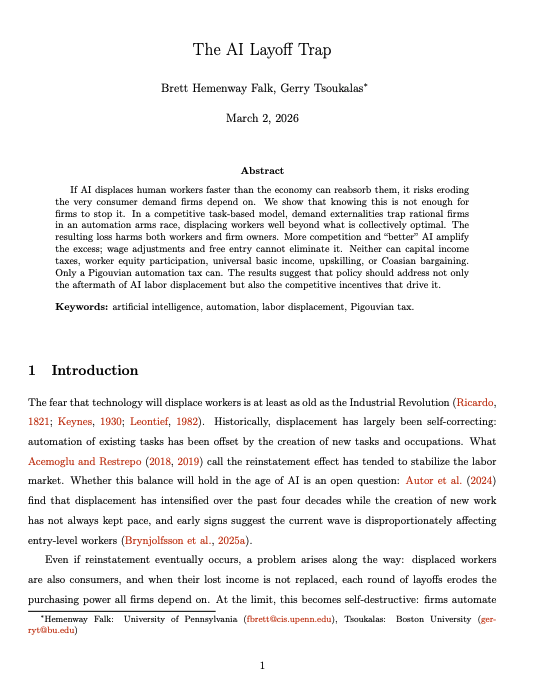
🚨BREAKING: Two researchers from UPenn and Boston University just published a paper that should be uncomfortable reading for every CEO automating their workforce right now.
The argument is straightforward. Every company replacing workers with AI is also eliminating its own future customers. Laid off workers stop spending. Enough of them stop spending and nobody can afford to buy anything. The companies that fired everyone end up selling into an economy with no purchasing power left.
Every executive can see this. The math is not complicated. But here is why nobody stops.
If you do not automate, your competitor does. They cut costs, lower prices, take your market share, and you collapse anyway. So every company automates knowing it is collectively destructive because the alternative is dying alone while everyone else survives. The researchers proved this is a Prisoner's Dilemma playing out in real time.
The numbers are already moving. Block cut nearly half its 10,000 employees this year. Jack Dorsey said AI made those roles unnecessary and that within the next year the majority of companies will reach the same conclusion. Salesforce replaced 4,000 customer support agents with AI. Goldman Sachs deployed a coding tool that lets one engineer do the work of five. Over 100,000 tech workers were laid off in 2025 and AI was cited as the primary driver in more than half those cases. 80% of US workers hold jobs with tasks susceptible to AI automation.
The researchers tested every proposed solution. Universal basic income does not change a single company's incentive to automate. Capital income taxes adjust profit levels but not the per-task decision to replace a human. Collective bargaining cannot hold because automating is always the dominant strategy.
They also identified what they call a Red Queen effect. Better AI does not solve the problem, it accelerates it. Every company chases faster automation to gain market share over rivals but at the end everyone has automated equally, the gains cancel out, and the only thing left is more destroyed demand.
The one thing the math says could work is a Pigouvian automation tax. A per-task charge that forces companies to account for the demand they destroy each time they replace a worker.
The conclusion is that this is not a transfer of wealth from workers to owners. Both sides lose. Workers lose income. Companies lose customers. It is a deadweight loss with no market mechanism to stop it on its own.
(Link in the comment)
Wi-Fi was built in Nieuwegein, a Dutch suburb of 60,000 people that nobody outside the Netherlands had heard of
In 1999, Cees Links flew to California and closed the deal with Steve Jobs that put wireless internet in every Apple laptop
He did not own the patents, his employer did
A humble Dutch employee connected the world
Roboadvisors rebalance your portfolio
Agentic finance negotiates your mortgage, finds tax alpha, and moves capital while you sleep
These are not the same category
It is amazing how many companies I talk to STILL have AI effectively blocked by IT & legal departments for out-of-date reasons when many companies in highly regulated industries have figured out ways to deploy enterprise ChatGPT, Claude & Gemini without any apparent problem.
Today, we announced more than $250 million in new funding, led by Innovation Industries with BlackRock and SiteGround Capital joining as new investors alongside many of our original backers doubling down. Total capital raised now exceeds $450 million, making this the largest investment ever in an EU AI semiconductor company.
This funding isn't the story. It's a signal that the problem we set out to solve is real, urgent, and large.
Most edge AI deployments today are still being built with hardware that wasn't designed for the job. Adapted datacenter chips, power budgets that don't survive procurement, thermal constraints that kill reliability in the field. The gap between what AI can do and what actually works in production is still enormous. That's the problem we set out to solve.
Shipping to our 500th customer across manufacturing, retail, defense, robotics, and agritech tells us we're on the right track. And we're just getting started.
Here's what comes next:
Metis continues to scale globally, giving customers the performance they need within the power and thermal budgets of physical AI.
Europa, our next-generation AIPU at 629 TOPS of INT8 performance, begins PCIe accelerator shipments in the first half of 2026. Workloads that were cloud-only are about to run at the edge.
Then, Titania, backed by the €61.6M EuroHPC DARE grant, will extend our architecture into HPC and data center environments.
And our Partner Accelerator Network keeps growing, because hardware alone doesn't win. The ecosystem around it does.
None of this happens without the partners, customers, investors, and employees who believed in what we were building before it was obvious. Thank you.
It's still day one, and we're just getting started.
#AxeleraAI #EdgeAI #AIInference #AIHardware #Semiconductors #EuropeanTech
https://t.co/PvXVhhW9w4
One of the often slept-upon benefits of attending the University of Chicago is that they make you read Marx as part of the core curriculum, which is why this article gave me flashbacks of taking SOSC 114 as a freshman.
Marx, writing during the Industrial Revolution, predicted capitalism would periodically devour itself: firms replace labor with machinery to boost profits, but competition diffuses the technology, drives prices to marginal cost, and the gains get competed away. Meanwhile, displaced workers lose purchasing power, hollowing out the demand the whole system depends on. Production rises but no one can afford to buy what's produced - the contradiction between production and realization.
Citrini's piece describes this exact dynamic, then declares there's "no natural brake." It's the most Marxist piece of financial analysis written in years, and makes the same errors Marx did.
Schumpeter offered the obvious rebuttal 80 years ago: creative destruction doesn't just destroy, it creates industries we can't yet conceive of. Everyone in the replies is already making this point, and I think they're right.
But the sharper rebuttal is Hayek's: prices are the brake Citrini says doesn't exist. Who funds $200bn / qtr in AI capex when equities are down 38%, private credit marks are in the 50s, and consumer demand has collapsed? Cost of capital rises. Incremental build-out becomes uneconomical. Capital gets destroyed and reallocated.
Citrini also unknowingly describes Marx's proletarianization of the petite bourgeoisie: the $180k PM driving Uber is textbook. But the article claims this collapses consumer demand, and that's where it breaks.
The top decile drives 50%+ of spending and their wealth is in equities, not W-2 income; they're long the hyperscalers posting records in Citrini's own model. Blue collar is insulated because AI replaces cognitive labor, not physical.
The professional middle class gets crushed, but aggregate demand doesn't.
The spending class IS the capital-owning class. The K-shaped recovery they fear actually stabilizes the demand base they say is collapsing. In the stable aggregate demand, the petit bourgeoisie finds ways to reinvent itself.
I think the Citrini piece is excellent and worth reading. But history has repeatedly shown that periods of transformative productivity gains ultimately accrue to the consumer through lower prices, more leisure, and higher quality of life. Marx's error wasn't diagnosing the disruption, it was underestimating the system's ability to adapt.