SUBRAMANYAM: You tweeted in March that the US Navy had successfully escorted an oil tanker through the Strait of Hormuz. Was that true?
CHRIS WRIGHT: No.
There is no expunging the stain of Trump’s two impeachments.
Or avoiding the conclusion that the President cares little about the economic hardships of the American people.
His priority is only, ever, Donald Trump.
Let's walk through what actually happened here, in order.
DOGE cut the USAID program specifically designed to prevent screwworm from crossing the U.S.-Mexico border. DOGE cut USDA's animal disease control and prevention funding. That funding had supported more than 180 outbreak investigations in 22 countries and capacity-building in more than 160 laboratories. The screwworm monitoring and response program that watched the border for exactly this parasite - cut.
Then screwworm showed up in Texas cattle. Texas Governor Greg Abbott declared a disaster for Zavala and Uvalde counties this week.
Agriculture Secretary Brooke Rollins went on CNBC this morning and blamed the Biden administration, 17 months out of office.
Her specific words: "obviously not much had been done to push back."
The program that was supposed to push back existed. DOGE eliminated it in March 2025. Rollins has been Agriculture Secretary since February 13, 2025. The cuts happened on her watch.
Beef prices are already high. Ranchers in south Texas are now dealing with a flesh-eating parasite that was eradicated in this country in the 1960s - eradicated, specifically, using the sterile fly program her department defunded.
The flies existed. The program existed. The budget existed.
Until it didn't.
Hi, Donald. Midcoast Mainer here.
You did not, in fact, “have to go to Japan” to get a Maine lobster before you. We sold millions. Our lobster fishery is one of the most valuable in the U.S.
It’s a big reason why people come here, in case you didn’t know!
If anything is hurting our lobstermen, it’s inflation (which you apparently “love”).
Also, exactly *zero* Maine fishermen run their boats at three knots. More like 30 knots—and some go even faster. You should check out a lobster boat race sometime!
I think it might be time for one of your famous Oval Office naps, because you have ZERO idea what you’re talking about.
This is Trump’s Watergate.
Today, the @nytimes released a truly stunning report on the Epstein cover-up by the White House.
Collusion, breaking the law, evading subpoenas—it’s all in there:
- Trump quashing the files
- The VP, COS, DOJ, FBI, and others colluding in the Situation Room to stop their release and compliance
- Officials lying to the public
- Admin in-fighting and exits
- Officials who appeared in front of Congress during this time
Read the report here: https://t.co/prgyF2Isfg
If you or I skipped a tax bill, the IRS would come knocking. Donald Trump and his family? "Forever barred" from audits.
The Trump family is abusing the presidency to rig the rules in their favor.
The Acting AG, @DAGToddBlanche, is a national disgrace.
His actions in covering up the Epstein Files to protect trump are unethical and likely illegal.
He will be disbarred. He will be investigated. And if the facts warrant it, he will be prosecuted.
November is coming.
Buttigieg: Nowhere in the Constitution does it say that there have to be nine Supreme Court justices. That one doesn't even take a constitutional amendment. It just takes a readiness to set up a court that fits this country.
We could have 13 seats matching the district structure of the federal judiciary, but also a process that makes it less partisan. We cannot have partisan warfare every time there's an opening on the court
At the San Diego Zoo, an otter family stole the spotlight in the most adorable way, turning a simple visit into a viral sensation.
While visitors watched in delight, a proud mother otter carried her tiny newborn pup right up to the glass for everyone to see. Moments later, the father joined in… but instead of another pup, he proudly held up his favorite smooth rock, creating a hilarious “show and tell” moment.
The charming video quickly exploded online with millions of views. Viewers couldn’t stop laughing, joking that the rock was “the one that got him the family,” while others praised the otters’ playful and social personalities. Wildlife experts noted that these heartwarming, funny moments are exactly why otters captivate people around the world.
Eleven days after they killed Dr. King, a teacher sat down to force a Black child into America's most famous comic strip. Harriet Glickman wrote Charles Schulz in 1968 and asked him to put a Black kid in Peanuts, where in eighteen years not one had ever appeared.
He almost said no, afraid that a white man drawing a Black child would look like pity. A hundred million readers, eighteen years, and the whole thing turned on one letter.
Eleven days after Dr. King was killed in Memphis, a schoolteacher in California sat down at her typewriter and wrote a letter to a cartoonist. She did not expect him to write back.
Her name was Harriet Glickman. She was forty-one, a mother of three living in the San Fernando Valley, and that spring she felt as powerless as everyone around her.
The country was coming apart. Cities were burning, the television was wall to wall with funerals, and a teacher in suburban Los Angeles kept asking herself what one ordinary person could possibly do.
She was not an activist.
She was a mother with a typewriter and a feeling she could not shake.
The man she wrote to was Charles Schulz. His comic strip, Peanuts, ran in around a thousand newspapers and reached close to a hundred million readers every week.
Charlie Brown, Lucy, Linus, Snoopy.
Eighteen years of that strip, going back to 1950, and not one of those children was Black.
Glickman had spent her life around children. As a teacher, she had watched something up close that stayed with her.
Black children and white children never saw themselves sitting side by side, not in school in the funny pages, not anywhere a child went looking for his own face.
So she said it plainly on the page. She wrote that since Dr. King's death she had been asking what she could do about the "vast sea of misunderstanding, hate, fear and violence" that had swallowed the country.
She had actually sent the same idea to several cartoonists. Schulz was the one who wrote back.
That was the first surprise.
His reply was honest in a way that probably stung. He told her he had thought about putting a Black child in the strip, and that the idea frightened him.
Not because of his readers.
He was afraid of getting it wrong.
He worried it would come off like a white man patting Black families on the head, talking down to them. "I don't know what the solution is," he wrote, and left it right there.
A lot of people would have folded at that. A polite no from a famous man is an easy place to stop.
But Glickman wrote again, and Schulz answered again, and this time he sounded even more certain it was a mistake. He was sure that whatever he drew would come off as a white man being clumsy about something this raw.
Still she did not let it drop.
She wrote back and asked his permission to do one small thing.
She had no interest in speaking for Black people. So she asked if she could show his letter to some Black friends of hers, parents, and let them answer him in their own words.
Schulz said yes.
One of those friends was a man named Kenneth Kelly. He was a Black father of two young boys, and he was an engineer.
Not just any engineer.
Kelly worked on the Surveyor program, the unmanned American craft that was setting down on the surface of the moon.
Sit with that picture for a second. A Black man helping land a spacecraft on the moon took the time to write a cartoonist about whether a Black child could sit in a comic strip.
Kelly was patient with him. He told Schulz that no Black parent he knew would call the gesture condescending, and that even if a few did, it would be "a small price to pay" for what it would give their children.
What it would give them was not complicated. It was the simple sight of themselves, somewhere inside the ordinary American picture they were shut out of every single day.
Kelly even told him how to do it. Do not make the boy a hero, he suggested, and do not turn him into a lesson.
Just a regular kid, one of the gang, nothing special, simply there.
Years later, Kelly would spend himself fighting housing discrimination in his city. That summer, he changed a comic strip instead.
Another friend and parent, Monica Gunning, wrote to Schulz as well. The letters kept landing on his desk in Northern California, polite and unhurried and impossible to wave off.
All of this was happening while the year kept getting worse. In June, Robert Kennedy was killed in Los Angeles, Glickman's own city, a few weeks after Kelly mailed his letter.
The country was taking blow after blow.
And in the middle of it, that quiet argument about a comic strip kept moving forward, one letter at a time.
Then, one day that summer, Schulz sent Glickman a short note. He told her to check her newspaper the week of July twenty-ninth, because he had drawn something he thought would please her.
On July 31, 1968, Charlie Brown is standing on a beach, and he has lost his ball in the water. A boy he has never met before wades in and carries it back to him.
The boy's name is Franklin. The two of them get to talking and build a sandcastle together, two children on a beach on a summer afternoon.
No speech. No halo.
No lecture about brotherhood, just a Black child being kind to Charlie Brown, printed in a thousand papers from coast to coast.
The strip would later show that Franklin's father was a soldier serving in Vietnam. He was never written as a symbol.
He was somebody's son.
When Franklin appeared, mail poured into Schulz's office from all over the country. Most of it said the same simple thing, which was thank you.
It should have ended there, small and sweet. It did not.
When Schulz later drew Franklin in school, he sat him at a desk right in front of Peppermint Patty. A Black child and a white child, learning in the same room.
For one Southern newspaper editor, that was the line. He wrote to Schulz to say he did not mind a Black character, but please do not show the children in school together.
The man could accept Franklin existing in the strip.
He could not accept that child sharing a desk with a white girl.
This was 1968. Black children were walking into newly integrated schools behind federal marshals, and a grown man was objecting to a cartoon doing the very same thing.
Schulz had a decision to make, and he made it without any noise. Years later, asked what he had done about that complaint over the classroom, he gave a short answer.
It was five words. "I didn't even answer him."
He just kept drawing the two of them at the same desk.
Far off in Philadelphia, a six-year-old Black boy watched Franklin appear with no idea of the fight behind him. His name was Robb Armstrong.
That year had already taken something from him. His older brother had died thirty days before Franklin first turned up on that beach.
Thirty days.
A boy loses his brother, and a month later a new face shows up in the comics page he reads on the living room floor.
So here was a child who already knew the shape of a hole in a family. And then, right inside that grief, a Black kid walked into his favorite comic strip.
Robb looked at Franklin and thought one thing. "That's like me."
He had already told his mother, at three years old, that he was going to be a cartoonist.
Now he had proof there was room for him.
A Black boy could belong on the funny pages, because one already did.
That child grew up to become exactly what he had promised. Robb Armstrong created JumpStart, one of the most widely syndicated Black comic strips in the country.
And here is where the story closes a circle no one could have planned. Franklin, through all those decades, never had a last name.
In the 1990s, Charles Schulz picked up the phone and called Robb Armstrong. A special was in the works, every character needed a full name, and Schulz had just realized Franklin did not have one.
So he asked the grown man, the one who had once been that grieving six-year-old, whether he could borrow his name. Robb said yes right away.
That is why the first Black character in Peanuts is named Franklin Armstrong.
Armstrong called it the highest respect a person could be shown.
About the man who reached a lonely kid through a comic strip, he said it simply, "He inspired a kid."
Harriet Glickman lived to be ninety-three. She died in March of 2020, in the same Sherman Oaks house where she had typed that letter more than fifty years earlier.
The letter outlived her. It rests now in the Charles M. Schulz Museum, the real page, her real words, dated eleven days after Dr. King was killed.
You can stand in front of it today, behind glass, and read the date typed across the top. April 15, 1968, mailed by a woman who was certain no one was listening.
Two Black boys running a lemonade stand received an unexpected show of support after someone called 911 on them. Instead of shutting them down, Kansas City police officers and firefighters showed up to support them, helping them earn hundreds of dollars. This is what community should look like! Investing in our youth instead off discouraging their entrepreneurship. ✊🏿
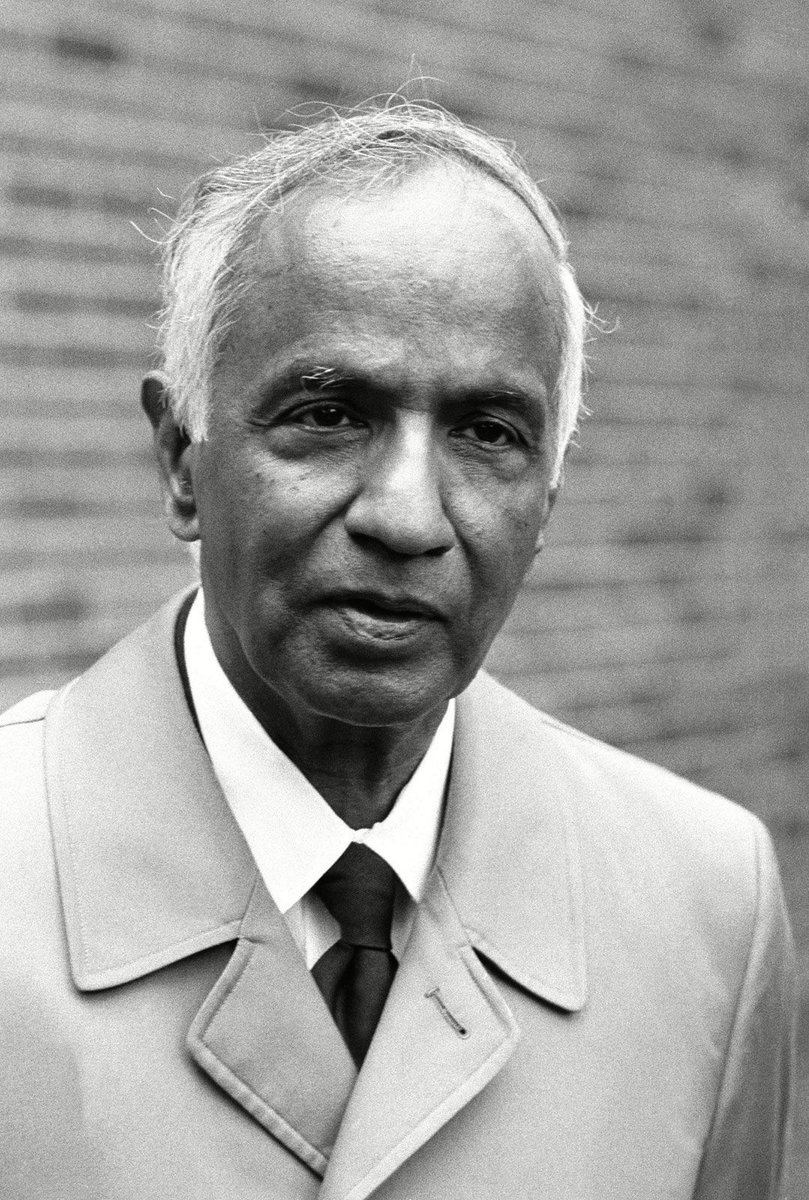
In 1930, a 19-year-old student sat on a steamship traveling from India to England, scribbling math equations in a notebook to pass the time.
By the time the ship reached port, the teenager had mathematically proven that the most massive stars in the universe do not die peacefully. Instead, they are destined to collapse into infinitely dense, terrifying monsters.
He had just discovered the mathematical trigger for black holes.
But when he arrived at Cambridge and presented his work, the leading astronomer of the Western world publicly mocked him, calling his mathematics a stellar joke.
His name was Subrahmanyan Chandrasekhar.
It would take nearly 50 years for the scientific establishment to admit they were wrong and award him the Nobel Prize for the math he did on that ship when he was nineteen.
His struggle against scientific elitism is the ultimate lesson in what happens when rigid dogmas clash with undeniable mathematical reality.
In the early 20th century, astronomers believed they understood the life cycle of stars. They knew that when a star runs out of fuel, gravity tries to crush it. But quantum mechanics offered a beautiful safety net: a force called "electron degeneracy pressure" would push back against gravity.
The star would shrink into a stable, peaceful, glowing ember called a White Dwarf.
The entire scientific establishment agreed: every star, no matter how big, would eventually settle into this quiet retirement. It was a neat, comforting formula.
But on that ship, Chandra realized the establishment had left a massive variable out of their equations: Albert Einstein’s Special Relativity.
Chandra recalculated the math, factoring in what happens when the collapsing particles inside a dying star approach the speed of light.
What he found shattered the comforting consensus.
He proved that if a dying star is more than 1.44 times the mass of our Sun (a boundary now immortalized as the Chandrasekhar Limit), the quantum safety net snaps. The gravity becomes so intense that the electrons cannot push back.
The star cannot form a peaceful White Dwarf. There is no formula to stop it. It must keep collapsing, falling inward forever, crushing itself into a single point of infinite density.
When Chandra presented this at the Royal Astronomical Society, Sir Arthur Eddington,the most powerful physicist in Britain, literally stood up, tore Chandra’s paper to pieces, and ridiculed the idea of stars collapsing into nothingness. Eddington’s ego couldn't accept a universe with such violent, unpredictable geometry.
Chandra was completely isolated. The establishment closed ranks around Eddington.
Instead of fighting a toxic, biased system, Chandra quietly shifted his focus to other areas of physics, leaving his flawless math in the journals for a future generation to find. Decades later, when advanced telescopes finally spotted real neutron stars and black holes in deep space, the world realized the 19-year-old kid on the boat had been right all along.
The philosophical blueprint Chandrasekhar left behind is a vital truth for navigating gatekeepers and institutional pushback:
Comforting illusions will always be more popular than harsh, disruptive truths. Trust the math anyway.
Most of us approach our careers and projects seeking the validation of the current experts or the established guard. When we propose a radical new idea or try to change a broken system, and the authorities tell us we are wrong, our instinct is to assume our logic is flawed. We abandon our data to fit the consensus.
But Chandrasekhar’s legacy proves that institutional authority is not the same thing as truth.
Gatekeepers are human; they protect their own theories, their own legacies, and their own comfort.
What is an idea, a project, or a direction you’ve abandoned just because an expert or a boss told you it wouldn't work? What happens if you stop looking for their permission and trust the structural integrity of your own work?
I’m a chemist. I need to say this - because it’s getting dangerous out there. The biggest health myth in the world isn’t about vaccines.
Or GMOs. Or fluoride.
It’s the root of all of them.
It’s called chemophobia - and it’s killing science.
Fear of “chemicals” now drives vaccine rejection, GMO bans, food hysteria, and entire political movements.
From tampons to tap water, people have been taught to fear chemistry - the very thing that keeps us alive.
Chemophobia tells us:
“Natural is good.”
“Synthetic is bad.”
That’s a lie.
Botulinum toxin is 100% natural and one of the deadliest molecules known. Aspirin is synthetic and life-saving.
We’ve gone from banning harmful substances for good reason…to banning safe, well-tested molecules for emotional reasons.
You’ve seen the slogans: “If you can’t pronounce it, don’t eat it.” “Paraben-free.” “Clean beauty.”
They sound empowering. But they’re not science - they’re marketing. And they’re making the world dumber, poorer, and sicker.
Your body doesn’t care if a molecule comes from a plant or a lab. Vitamin C is vitamin C.
Formaldehyde is formaldehyde and your body makes more of it every day than any vaccine ever could.
Dose matters. Source doesn’t.
This fear isn’t harmless.
It shapes public policy.
It blocks innovation.
It raises food prices.
It slows down cancer treatments.
Chemophobia is now mainstream and it’s costing lives. Scientists aren’t losing because we’re wrong.
We’re losing because fear spreads faster than facts. Because influencers sell fear for clicks.
Because lawyers monetize doubt. And because scientists are too tired to fight back.
So here’s my message, as a chemist and as a citizen: Learn how toxicology works.
Call out chemical fear-mongering. Support policies based on evidence, not emotion.
Chemistry isn’t the enemy. It’s the reason you have clean water, safe food, and modern medicine.
If we let fear win, we lose all of it.
A self-taught Irish schoolteacher wrote a book in 1854 that almost nobody read for 80 years, until a 21-year-old MIT student picked it up and realized it could be used to design every computer in human history.
His name was George Boole. The book is called An Investigation of the Laws of Thought.
Boole was born in 1815 in Lincoln, England. His family was poor. He left school at 16 to support them. He taught himself Latin, Greek, French, German, and Italian.
Then he taught himself mathematics. By 19 he had opened his own school. By 24 he was publishing original papers in the Cambridge Mathematical Journal, competing with men who had spent decades inside the best universities in Britain.
He never had a degree. He never had a mentor. In 1849, Queen's College in Cork hired him as a professor anyway.
In 1854, he published his masterwork. What he built inside it was something nobody had attempted before at this scale. He turned logic into algebra.
Before Boole, logic was philosophy. You argued in sentences. You reasoned in paragraphs. It was powerful and completely impossible to automate, because there was no formal system underneath it, just language.
Boole stripped it down to arithmetic. He showed that every act of human reasoning could be reduced to operations on two values. True or false. One or zero. AND, OR, NOT. If both conditions are true, the result is true. If neither is, the result is false. Every judgment a human mind makes, every decision, every deduction, could be written as an equation following those rules.
Logicians read it. They found it interesting. Engineers building machines had never heard of it.
For 83 years, the book sat there.
Then in 1937, a 21-year-old MIT master's student named Claude Shannon was working on a thesis about electrical relay circuits. Switches that could be open or closed. Current that either flowed or didn't.
He read Boole and understood something nobody had connected before.
An open switch is a zero. A closed switch is a one. A circuit with two switches in series only carries current when both are closed. That is AND. A circuit with two switches in parallel carries current when either is closed. That is OR. Shannon proved that every possible logical relationship Boole had described could be physically built using wire and switches.
That single insight is the foundation of every computer ever made.
After Shannon, chip designers stopped thinking about electricity and started thinking about logic. Every transistor on every processor running right now is implementing a Boolean operation. Every if-statement in every codebase is Boolean logic. Every database query using AND or OR. Every neural network threshold that fires or doesn't fire. All of it is running the algebra of a self-taught schoolteacher from Lincoln who died 160 years ago.
The strangest part is what happened to Boole at the end.
He was walking to class in November 1864 when he got caught in a rainstorm. He lectured for hours in wet clothes. He went home sick. His wife, Mary, believed in homeopathic medicine and thought the cure should mirror the cause. She wrapped him in wet sheets and poured cold water over him repeatedly.
He died a few days later. He was 49.
He never saw a transistor. He never saw a circuit. He never saw a single physical machine run a single one of his rules.
His book is in the public domain. Free to download. Most engineers use the word Boolean dozens of times a week. Almost none of them know who they are saying.
The man whose logic runs inside every phone, every server, and every AI model on Earth died soaking wet in a small Irish town, 83 years before anyone figured out what he had actually built.
Trump has spent the last week trying to undermine faith in California's elections.
Why? Because he's laying the foundation to discredit the same results nationwide when his party loses in November.
Warnock: Right now, somebody is trying to buy groceries in Georgia and they can’t afford them.
Rollins: That’s because of the Biden administration.
Warnock: Two years later and that’s your answer? Because of the Biden administration?
AI is already changing our economy.
So we can’t let a handful of Big Tech billionaires make all the decisions and get all the benefits.
We can start to level the playing field by taxing AI data centers and investing in people.