most people don't have an information problem in crypto, they have an information management problem.
there are thousands of telegram groups right now & hundreds of alpha calls getting dropped every hour including project announcements, wallet moves, listing rumors, insider leaks & all of it are buried inside chats you're barely keeping up with.
by the time you see something important, it's already priced in.
this is the real bottleneck for most retail participants not research skills, conviction, or even capital. the problem is the inability to process signal at the speed the market moves.
flowgaia is built for exactly this problem: https://t.co/1j7qDeLZNo
■■
what is it?
@flowgaiaio's tg alpha hunter is an intelligence layer built on top of telegram.
telegram is a place where crypto alpha often appears before it reaches anywhere else. here communities coordinate, teams communicate, and narratives begin to form. the problem is that no one can realistically monitor dozens of groups at once.
@flowgaiaio can.
■■
why telegram?
x is where narratives get confirmed. discord is where communities get built and telegram is where alpha gets generated.
the difference between being first and being late often comes down to who saw the information first & by the time something reaches broader timelines, much of the opportunity has already disappeared.
most tools focus on on-chain activity like wallet trackers, dex scanners & whale alerts. those tools matter, but they're often reacting to events that have already started unfolding.
the conversations usually happen before the transactions do and that's the layer flowgaia is trying to capture.
■■
why i think this matters:
i've spent years creating content, building communities, and following different ecosystems in real time. one thing i've learned is that information asymmetry remains one of the few advantages retail participants still have.
institutions already have analysts, private feeds, and sophisticated infrastructure, and they've automated large parts of the on-chain layer.
what remains difficult to automate is qualitative signals like the discussions, repeated mentions, soft announcements, and emerging narratives hidden inside community conversations.
this is where flowgaia operates.
it is meant to capture the proposed value, while taking less time to manage information & giving more time to act on it.
if you're tracking thirty telegram groups manually, you're spending energy on work that a tool should be handling.
flowgaia does the monitoring and surfaces what matters while you focus on making decisions.
that's leverage and in crypto, leverage on information is everything.
■■
who is this for?
> traders trying to stay ahead of narratives
> researchers tracking multiple ecosystems
> community managers monitoring sentiment shifts
> content creators staying on top of trends
> anyone who's ever thought, "if only i had seen this earlier"
the next wave of crypto infrastructure won't just be chains and protocols. it will be intelligence tooling.
it would be about who can aggregate signal faster, who can filter noise better & who can identify important information before it becomes common knowledge.
the real advantage is knowing what matters before everyone else does.
flowgaia is building toward that future and i think we're still early.
https://t.co/1j7qDeLZNo
every ecosystem says it wants more builders until someone actually starts building.
that's pretty much what's happening with @predictinj right now.
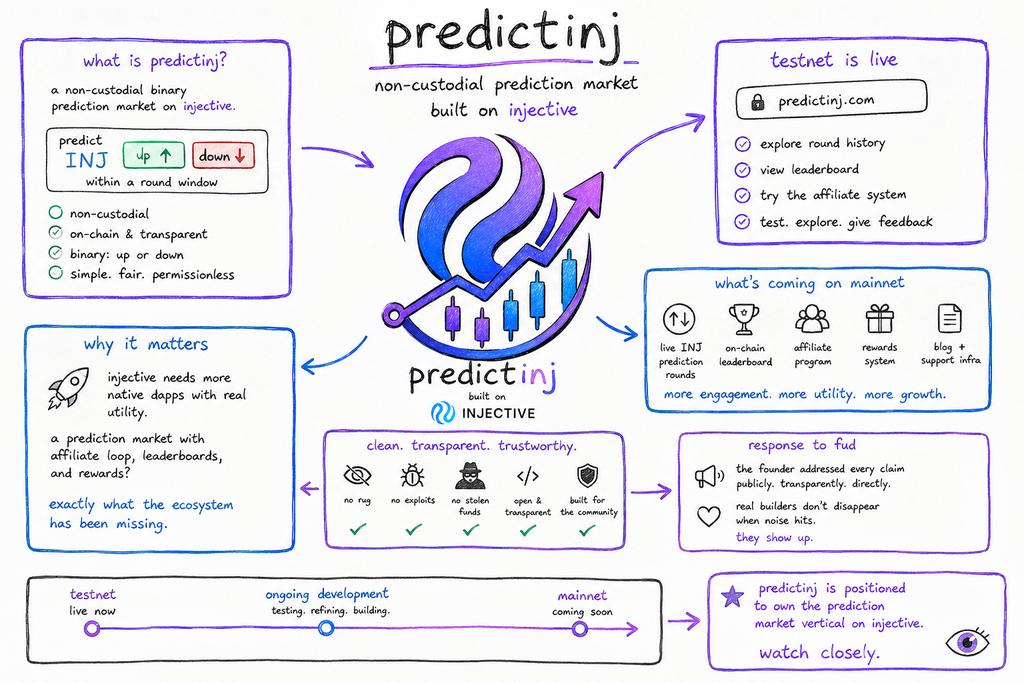
for those who don't know yet, predictinj is a non-custodial binary prediction market being built on @injective.
the idea is simple: predict whether $inj goes up or down within a specific round and let the blockchain handle the rest.
on here, there is no custody of the user's funds. it is just a transparent, on-chain prediction market designed specifically for the injective ecosystem.
the platform is already live on testnet at https://t.co/cXyI51WusZ, which means the team is currently focused on testing, refining mechanics, collecting feedback, and making sure everything works as intended before mainnet.
users can:
> explore round history
> check out the leaderboard
> interact with the affiliate system
> join daily $inj giveaway discord server
when mainnet arrives, users will be able to participate in live inj prediction rounds, build a publicly verifiable track record through the on-chain leaderboard, earn through referrals via the affiliate program, and benefit from a rewards system designed to encourage consistent participation and community growth.
the support system on discord is also being built out including documentation, support channels, and educational content are all part of the long-term vision.
■■
all of the info above explains why the recent scam allegations make very little sense.
a few people rushed to label @predictinj a scam without presenting evidence of any exploit, rug pull, stolen funds, or malicious activity. the claims spread faster than the facts.
meanwhile @cryptophrex, the founder, has been doing exactly what builders should do by addressing concerns publicly, answering questions, and engaging with criticism directly instead of disappearing when pressure shows up.
that's what transparency looks like.
the reality is that injective needs more native applications that people actually use & more products that create engagement, attract users, and expand what can be done within the ecosystem.
a non-custodial prediction market with an affiliate engine, public leaderboards, and community rewards isn't something injective has too much of.
it's something that has been missing and the prediction market sector on injective is still wide open.
with the mainnet coming soon, the noise will eventually fade and the product will remain.
did you know that @injective was the first to crack open one of the most exclusive $13 trillion market on earth, and almost nobody is talking about it?
■■
back in october 2025, injective introduced something that sounded almost impossible at the time: pre-ipo perpetual futures.
instead of waiting years for a company to go public, qualifying as an accredited investor, or getting access through elite venture networks, traders could gain exposure to the future valuation of private companies directly on-chain.
this won't be made possible by owning shares, not tokenized equity but through synthetic perpetual markets that track the value of these companies using oracle-powered pricing mechanisms.
the idea was simple.
if public markets allow traders to speculate on stocks, commodities, indices, and currencies, why shouldn't markets exist for some of the most valuable private companies in the world?
the market responded immediately.
within just 30 days of launch, these products generated over $1 billion in trading volume.
that was demand right there.
for the first time, everyday traders could participate in price discovery around companies that were previously locked behind venture capital firms, private placements, and institutional gatekeepers.
the list of available markets wasn't filled with obscure startups either.
we're talking about some of the most sought-after private companies on the planet:
> openai
> spacex
> anthropic
> perplexity
> xai
> revolut
> monzo
> airtable
> notion
these companies are worth billions, shaping entire industries, yet historically inaccessible to the vast majority of investors.
but through @helixmarkets, users could trade these valuations with leverage of up to 5x, creating an entirely new category of on-chain financial products.
what makes this even more interesting is that the system wasn't built around a centralized committee deciding everything behind closed doors; the community had a say.
governance participants could influence which private company markets should be listed next, creating a more open and transparent listing process than traditional financial institutions have ever offered.
meanwhile, oracle infrastructure continuously tracked valuation data to keep markets aligned with real-world developments.
this wasn't just another trading product, it was a new financial narrative and that's the part many people still haven't understood.
for decades, access to private equity has been one of the greatest wealth-generation advantages reserved for insiders.
by the time retail investors like you and i get exposure, the biggest gains have often already been captured by whales and market makers.
injective challenged that structure by building a solution & deploying it directly on-chain.
now the rest of the industry is paying attention.
now okx & bitget are moving into the space created by injective.
others are racing to launch similar products and capture the same demand, but history matters.
injective won't be following a trend because injective started it. 👌
the first successful experiment in bringing private market speculation fully on-chain came from injective.
and the fact that major exchanges are now rushing to replicate the model says everything.
when competitors copy your product, that's validation.
when they rush to copy it, that's proof you've discovered something important.
the conversation around crypto often focuses on memecoins, short-term narratives, and market cycles.
meanwhile, one protocol quietly opened access to a multi-trillion-dollar asset class and proved there was real demand for it.
and years from now, when on-chain private market trading becomes normal, people will probably forget where it started.
always remember, injective got there first.
Every cycle creates its own symbols, some people chase gold because that's what they've been taught success looks like. first place. the winner.
The one standing at the top of the podium while everyone else fades into the background, but the truth is that most people don't start there.
They start in third place, they start overlooked, they start underestimated, they start with @brz_coin, that's the idea behind $BRZ.
It's not pretending to be the next technological breakthrough or reinvent the foundations of finance. instead, it's embracing something much simpler and arguably much more relatable: the underdog mentality that exists at the heart of every journey worth taking.
because everybody celebrates gold.
Its mission is straightforward: to unite grinders and believers into a community centered on resilience, growth, and shared success.
Its vision extends even further to become a symbol of the underdog spirit across web3, inspiring people to keep believing when progress feels slow and keep building when recognition hasn't arrived yet.
In a market dominated by narratives built on hype, $BRZ is leaning into identity, because communities don't survive on price action alone, they survive on shared values.
The tokenomics reflect that simplicity, there's a fixed supply of 1 billion tokens. no buy tax. no sell tax.
liquidity has been locked. the project launched on solana, leveraging one of the fastest and most accessible ecosystems in crypto today.
Distribution remains transparent.
>70% has been allocated toward liquidity.
>20% is dedicated to community initiatives and marketing efforts.
>10% belongs to the team.
no hidden mechanisms, no complicated structures,no unexpected surprises waiting down the road.
The roadmap follows the same philosophy.
>phase one focuses on establishing the foundation: launching the token, growing the community, and expanding awareness.
>phase two shifts toward holder growth, larger marketing initiatives, and strategic partnerships capable of extending the project's reach.
>phase three introduces ecosystem expansion, community-driven events, and continued development of the brand itself.
>eventually, phase four envisions a future centered around governance, global recognition, and sustainable long-term growth shaped by the people who helped build it from the beginning.
right now, the project remains in its earliest chapter.
which means everyone discovering it today is arriving before the story has fully unfolded.
bronze isn't where you finish, it's where you begin then back to the top , the winner .
$BRZ.
Every cycle creates its own symbols, some people chase gold because that's what they've been taught success looks like. first place. the winner.
The one standing at the top of the podium while everyone else fades into the background, but the truth is that most people don't start there.
They start in third place, they start overlooked, they start underestimated, they start with @brz_coin, that's the idea behind $BRZ.
It's not pretending to be the next technological breakthrough or reinvent the foundations of finance. instead, it's embracing something much simpler and arguably much more relatable: the underdog mentality that exists at the heart of every journey worth taking.
because everybody celebrates gold.
Its mission is straightforward: to unite grinders and believers into a community centered on resilience, growth, and shared success.
Its vision extends even further to become a symbol of the underdog spirit across web3, inspiring people to keep believing when progress feels slow and keep building when recognition hasn't arrived yet.
In a market dominated by narratives built on hype, $BRZ is leaning into identity, because communities don't survive on price action alone, they survive on shared values.
The tokenomics reflect that simplicity, there's a fixed supply of 1 billion tokens. no buy tax. no sell tax.
liquidity has been locked. the project launched on solana, leveraging one of the fastest and most accessible ecosystems in crypto today.
Distribution remains transparent.
>70% has been allocated toward liquidity.
>20% is dedicated to community initiatives and marketing efforts.
>10% belongs to the team.
no hidden mechanisms, no complicated structures,no unexpected surprises waiting down the road.
The roadmap follows the same philosophy.
>phase one focuses on establishing the foundation: launching the token, growing the community, and expanding awareness.
>phase two shifts toward holder growth, larger marketing initiatives, and strategic partnerships capable of extending the project's reach.
>phase three introduces ecosystem expansion, community-driven events, and continued development of the brand itself.
>eventually, phase four envisions a future centered around governance, global recognition, and sustainable long-term growth shaped by the people who helped build it from the beginning.
right now, the project remains in its earliest chapter.
which means everyone discovering it today is arriving before the story has fully unfolded.
bronze isn't where you finish, it's where you begin then back to the top , the winner .
$BRZ.
everyone wants to become the infrastructure underpinning the next generation of finance.
almost every chain claims to have the speed, scalability, and developer tooling needed to support trillions of dollars moving onchain.
but very few are actually optimizing for that future and that's why vulcan matters.
this was launched on june 4, 2026 following overwhelming governance support, injective's vulcan upgrade isn't a cosmetic update designed to generate headlines for a news cycle.
it's a deliberate repositioning focused on strengthening the three things institutional adoption actually depends on:
> accurate pricing
> efficient execution
> reliable asset infrastructure
the most significant change comes through injective's rebuilt oracle engine.
oracles sit quietly beneath every serious financial application as they determine collateral values, trigger liquidations, price derivatives, and influence lending decisions worth millions of dollars.
when oracle systems become expensive or slow, the consequences ripple across entire ecosystems.
the introduction of vulcan fixes this directly.
the upgrade reduces oracle gas costs by approximately 90% while integrating both pyth pro and seda natively into injective's infrastructure. that combination matters more than most people realize.
■■
> for traders: vulcan means tighter market conditions and fewer situations where outdated pricing leads to unnecessary liquidations.
> for developers: it removes major constraints.
> for institutions: it reduces one of the most overlooked forms of operational risk.
vulcan also introduces native oracle accessibility across @injective's evm environment through a dedicated oracle precompile.
while that may sound like a minor technical improvement, its implications are significant.
for developers, this means:
building within injective's multi-vm architecture no longer requires fragmented third-party integrations just to access reliable pricing data.
canonical injective prices are now available directly inside evm smart contracts, reducing complexity while improving consistency across applications.
the result is less middleware, fewer dependencies, and more reliable infrastructure.
this same philosophy extends to vulcan's approach to stablecoins and real-world assets.
the market has spent years talking about rwa adoption as though it were inevitable. but tokenization requires more than enthusiasm.
it demands asset standards capable of meeting institutional requirements, alongside pricing systems sophisticated enough to support increasingly diverse forms of collateral.
vulcan strengthens injective's asset standards while continuing the expansion of its canonical circle usdc framework.
combined with the circle usdc and cctp integration introduced earlier in may, injective now offers a significantly cleaner stablecoin experience. users gain access to native dollar liquidity moving securely across ecosystems without relying on wrapped assets.
with vulcan now live, injective has made its intentions clear.
it isn't trying to become just another defi destination.
it's positioning itself to become the settlement layer for onchain finance itself.
while most people were busy chasing narratives, 8 teams spent the last three months building them.
welcome to the injective × @cointelegraph accelerator program.
although it officially concluded with demo day, marking the end of an intensive 12-week journey, this was designed to identify, support, and accelerate the next generation of builders choosing injective as their foundation.
this wasn't another accelerator where founders collect logos, attend calls, and disappear.
this was a dedicated $1m fund-backed program where every participating team received grants from the @injective foundation.
cointelegraph committed significant media support, and founders gained access to mentors, operators, strategists, and investors whose sole objective was helping them move faster.
the result wasn't a collection of ideas.
it was a collection of products highlighted below:
■ @kustodia_mx is among the standout projects with a team tackling a problem that becomes increasingly relevant as ai agents become more capable. their infrastructure allows one ai agent to hire another, escrow payments through smart contracts, and automatically release funds once work is verified.
in regions like latin america, where fraud remains a significant economic burden, the implications are massive.
■ @paradyzefi approached the ecosystem from a different angle.
while much of defi remains obsessed with unsustainable emissions and temporary incentives, paradyze is focused on yield infrastructure.
the team is building products designed around structured opportunities, sustainable liquidity, and long-term capital efficiency. it reflects a growing maturity across the injective ecosystem where protocols are increasingly being designed for serious users rather than short-term speculation.
■ @handlpay is addressing one of crypto's oldest promises: payments.
for years, blockchain payments struggled against slow settlement times, poor user experiences, and expensive transaction costs.
injective changes that equation with the sub-second finality and near-zero fees where handlpay is building payment rails that merchants can realistically adopt without sacrificing speed or efficiency. the gap between onchain and real-world commerce continues to shrink.
■ then there's @0xundefined_
their work may not generate headlines every day, but infrastructure rarely does.
they're focused on building foundational components that strengthen the broader injective ecosystem. the kind of products users depend on every day without necessarily realizing it. every successful ecosystem eventually reveals the same truth: the most important builders are often the least visible.
■ @realmintio is betting on what many believe will become one of the largest opportunities in blockchain over the next decade which are real-world assets.
from traditional financial instruments to tangible assets, tokenization has the potential to unlock trillions of dollars in value. rather than building elsewhere and integrating later, realmint is developing its rwa infrastructure directly on injective, leveraging a blockchain designed specifically for financial applications from day one.
■ @svimfinance sits at the intersection of structured finance and defi.
instead of focusing solely on basic swaps or simple liquidity pools, the team is creating products for users and protocols that require more sophisticated financial tooling. injective's native onchain orderbook creates possibilities unavailable on most chains, giving teams like svim the infrastructure necessary to build products that can operate at scale.
■ @projektanimas reminds everyone that finance isn't the only thing moving onchain. culture is too.
they're exploring the relationship between communities, identity, attention, and value creation. in a world where belief increasingly drives markets, projekt animas is building systems where culture itself becomes a measurable and investable asset. what sounds abstract today could become a major category tomorrow.
@falqexchange is focused on dex trading.
while many chains still rely heavily on automated market makers, injective's fully decentralized onchain orderbook offers an entirely different foundation for exchange design. falq is building a trading experience that takes advantage of that infrastructure, delivering precision, efficiency, and performance without sacrificing decentralization.
■ ■ ■ ■
what stands out most about this cohort isn't that all eight teams are building different products.
it's that all eight teams arrived at the same conclusion.
they chose injective.
they chose a blockchain capable of sub-second finality, near-zero transaction fees, native onchain orderbooks & an ecosystem engineered specifically for financial applications rather than adapting generic infrastructure for financial use cases later.
every cycle produces noise, produces builders and this cohort belongs firmly in the second category.
demo day may be over, but for these teams, the real work is only beginning.
and if this accelerator cohort is any indication, the next chapter of the injective ecosystem is already being written.
ciao, ninjas 🥷