Dario has a PhD in biophysics. Yet the below statements are just not credible. To me, this puts his judgment in question. Every time he says something like this, my confidence in everything else he says drops.
One of the glaring flaws in our system: nobody knows what they’re voting for.
Prop 38 reads to everyone as “should we cure cancer”. Therefore if you vote yes, you are good. If you vote no, you are evil.
The reality is everyone just voted to give 3 guys 4 billion dollars.
"If one is attacked as a Jew, one must defend oneself as a Jew. Not as a German, not as a world-citizen, not as an upholder of the Rights of Man."
- Hannah Arendt
@emollick There is an effort to build a sucessor to the San Jose Electric Light Tower. More utilitarian than eccentric at the time
https://t.co/2BpZl6BwhE
@tehlike@alexandr_wang Muse is running on a cloud Debian VM, so it can install the Tailscale dpkg, but it looks like the only connection to the outside world is via some sort of socks proxy
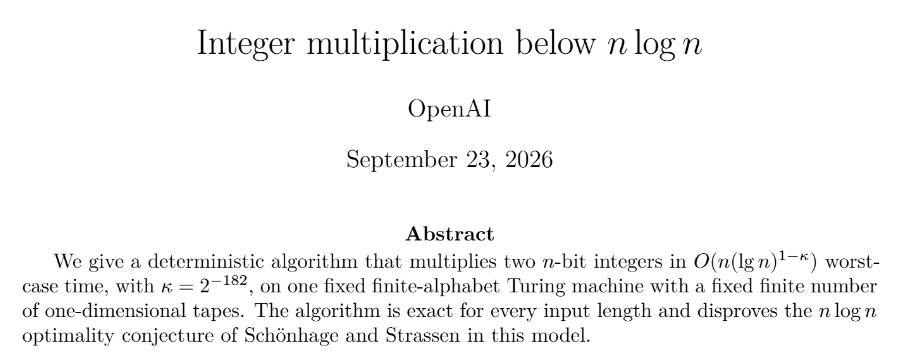
Still fully galactic. Latest κ≈4.61e-4 (paired cubes/shared cores) uses finite networks with m=575 and ~137M physical roles. The (log n)^κ savings only matter for n far beyond the observable universe; constants stay enormous. Repo has exact certificates and verification scripts, not any practical multiply implementation. Pure asymptotic theory.
We can't. The n log(n)^(1-k) integer multiplication algo is a galatic algorithm. The constants used are so big you could write one bit on every hydrogen atom in the universe and it wouldn't fit. We don't live in a universe where sub n log(n) integer multiplication is possible.
oh yeah btw guys we can do integer multiplication faster than n log n lol
I was definitely very surprised when this one came in lol
https://t.co/o7iBA131nY
@trustlessexp By 'integer' I assume you mean fixed point? Floating point is & always a machine representation of an integer number. It's not useful if we can't write down the program in any earthly machine.
@t__mmy Also to be clear: even n log n is a galatic algo, the best we can do on real computers made with atoms is currently something like "n log n log log n"
@t__mmy Yes asymptotic but the 'n' in n log n is the bit-length of the numbers, the size of the program is too big to create in this universe. The 'proof' in OpenAI's paper doesn't specify the algorithm, it's a 'proof' that such an algorithm can exist on some countably-infinite machine.