SENATOR FADAHUNSI, YOUR MESSAGE HAS BEEN DELIVERED
What happened in Ilesa today is deeply disturbing and should concern every responsible citizen. Reports indicate that eight people were shot today, with two reportedly losing their lives.
Only a few days ago, Senator Fadahunsi was reported to have made a statement calling for Accord Party members to be killed in Ilesa.
Today, we are witnessing a horrifying incident in which people have been shot and lives have reportedly been lost.
Senator Fadahunsi, your message has been delivered but this is not the kind of message any responsible leader should ever want to receive.
Politics should never become a reason for people to kill, maim, intimidate or terrorise one another. Political differences must be settled through dialogue, the ballot box and the rule of law, not through violence.
We therefore call on the security agencies and relevant authorities to immediately investigate what happened in Ilesa today, protect innocent residents, and ensure that anyone found responsible is brought to justice, regardless of their political affiliation or status.
Ilesa belongs to all of us. No political ambition is worth a single human life.
FOSAD Stands with Catholic Bishops: Speaking Truth to Power is a Sacred Duty, Nigerians have Suffered Untold Hardship in the Last Three Years https://t.co/n10bJjzjI1
FOSAD International Conference Calls for Coordinated Action to Reposition South-East Through Education, Agriculture, Health and Technology
The Forum of South-East Academic Doctors (FOSAD) has concluded its 2026 International Conference with a call for coordinated regional action aimed at accelerating sustainable development across the South-East through strategic investments in education, agriculture, healthcare and technological innovation.
The two-day conference, held on 2 and 3 July 2026, brought together PhD holders, researchers, academics, policymakers and development experts from the five South-East states to deliberate on the theme: "Reinvigorating South-East Nigeria Development through Sustainable Education, Agriculture, Health, and Technological Advancement."
Participants examined critical development challenges confronting the region and adopted a 10-point communiqué outlining practical policy recommendations designed to promote inclusive economic growth, strengthen educational institutions, modernize agriculture, improve healthcare delivery and accelerate technological advancement.
Delivering the keynote address, the Chief Executive Officer of Educare, Mr. Alex Onyia, described human capital as Nigeria's most valuable resource, arguing that sustainable national development depends primarily on investing in education rather than relying on natural resources.
According to him, "The greatest asset Nigeria has is not oil; the greatest asset Nigeria has is its people."
He observed that countries that deliberately invested in education and human capital had achieved remarkable developmental progress, citing Singapore as an example of a nation that transformed itself through sustained educational reforms and strategic investment in knowledge.
"Singapore of today is better than the Singapore of yesterday, whereas Nigeria of yesterday is better than Nigeria of today," he remarked.
Onyia stressed that the South-East possesses a long-standing educational tradition capable of positioning the region as a continental leader in knowledge production and innovation if properly harnessed.
"The mind is an endless source of wealth. The South-East believes in education, and if we fully capitalize on this comparative advantage, no region in Africa will surpass us."
He further argued that education remains the most effective pathway for positioning the region competitively in the era of Artificial Intelligence and the global knowledge economy.
According to him, universities across the South-East must prioritise quality assurance and eliminate corruption within higher education institutions to restore public confidence in the value of academic qualifications.
"We must decisively confront corruption in our universities so that the quality of our graduates will improve. If we solve the problem of education, we will have solved the majority of our developmental challenges."
Drawing from his experience coordinating national academic competitions, Onyia noted that Ebonyi State had recorded significant improvements in educational outcomes, describing the state as one of the leading performers in recent academic Olympiads.
He expressed optimism that the South-East would emerge as one of Nigeria's strongest educational regions within the next decade if current investments in learning continued.
He also encouraged leading private educational institutions to undertake corporate social responsibility initiatives by supporting less-privileged schools through teacher training, mentorship programmes and the provision of instructional equipment.
In addition, he advocated comprehensive curriculum reforms that would place greater emphasis on practical learning, innovation and problem-solving rather than excessive dependence on theoretical instruction.
Presenting the lead paper at the conference, the Deputy Vice-Chancellor of Ebonyi State University, Professor Ike-Elechi Ogba, called on FOSAD to move beyond annual academic engagements by developing a comprehensive development blueprint for both the South-East and Nigeria.
According to him, the region possesses exceptional human resources whose entrepreneurial achievements have significantly contributed to Nigeria's economic development.
Professor Ogba observed that the South-East has consistently produced outstanding entrepreneurs, industrialists, academics and technology innovators whose contributions extend across Nigeria and the global economy.
He argued that the economic influence of Igbo entrepreneurs across major commercial centres demonstrates the enormous developmental capacity of the region.
"Remove Igbos from Lagos, Northern Nigeria, the United Kingdom, South Africa and the United States, and the economies of those places would feel the impact," he stated.
Drawing lessons from the developmental experience of South Korea, Professor Ogba encouraged young scholars to emulate countries that deliberately acquired global knowledge before returning home to build their societies.
He therefore appealed to successful Igbo business leaders to invest substantially in educational institutions across the South-East as part of their contribution to regional development.
He described FOSAD as "the crème de la crème of education in the South-East" and urged members to provide intellectual leadership on issues affecting the region.
Professor Ogba also advocated the establishment of specialised Igbo Research Centres within universities across the South-East to promote research, preserve cultural heritage and develop policy solutions tailored to regional realities.
He further advised academics to maintain humility and professionalism while engaging public office holders.
"Political office holders sometimes feel intimidated by PhD holders. We must carry ourselves with grace because we possess knowledge that should be used to serve society."
Earlier in his welcome address, the President of FOSAD, Dr. Stephen Nwala, stated that the South-East possesses abundant talent, resilience and entrepreneurial capacity but requires coordinated and sustainable systems to unlock its full developmental potential.
He identified education, agriculture, healthcare and technological advancement as the four strategic pillars capable of transforming the region over the coming decades.
Speaking on education, Dr. Nwala said the region must shift its emphasis from certificate acquisition to competence development by investing in vocational education, digital literacy, innovation and research capable of addressing local challenges.
According to him, educational institutions must prioritise the production of innovators, entrepreneurs and critical thinkers who will drive sustainable development over the next fifty years.
On agriculture, he noted that despite the South-East's fertile land and hardworking farming population, the region continues to import products that could easily be cultivated and processed locally.
He therefore called for the modernisation of agriculture through climate-smart farming, improved access to finance, storage infrastructure and agro-processing value chains capable of retaining wealth within local communities.
Dr. Nwala further stressed that agriculture should be repositioned as a profitable business venture capable of attracting educated young people rather than being viewed merely as a subsistence occupation.
Addressing healthcare, he argued that no economy can achieve sustainable growth without a healthy population.
He therefore advocated increased investment in primary healthcare, maternal and child health services, mental healthcare and digital health technologies capable of improving healthcare delivery across rural communities.
He equally described technological advancement as the principal accelerator of regional development.
According to him, innovation has the capacity to reduce production costs, expand economic opportunities and create entirely new industries in agriculture, healthcare, manufacturing and financial technology.
He called for increased investment in digital infrastructure, innovation ecosystems and policies that would enable young people to become creators rather than consumers of technology.
Dr. Nwala further emphasised that education, agriculture, health and technology must not be treated as isolated sectors but should function as integrated components of a comprehensive regional development strategy.
He urged stronger collaboration among academics, governments, private sector leaders and development partners to translate research into practical policies capable of transforming the South-East.
At the conclusion of the conference, participants adopted a comprehensive communiqué containing key recommendations for regional development.
Among the resolutions, FOSAD resolved to champion the establishment of Igbo Research Centres in universities and other higher institutions across the South-East to promote indigenous scholarship, innovation and cultural preservation.
The conference also called on the Federal Government to prioritise the approval, funding and construction of a deep seaport in the South-East as part of Nigeria's long-term maritime and economic development strategy.
Participants urged the South-East Development Commission (SEDC) to make seaport development one of its flagship regional infrastructure projects while encouraging the five South-East state governments to establish a joint regional investment framework to support land acquisition, transport infrastructure, rail connectivity and complementary facilities.
The communiqué further recommended that state governments prioritise energy infrastructure for rural agro-processing zones to enhance agricultural productivity and industrial development.
Participants also advocated the integration of mental health services into primary healthcare systems across the region while promoting greater economic inclusion for persons living with disabilities.
The conference recommended that technical education programmes should leverage existing industries, including the Nnewi Industrial Cluster and small-scale enterprises, as practical training centres for youth entrepreneurship and wealth creation.
It also called on Ministries of Education in the South-East to institutionalize play-based creative pedagogy through teacher training and curriculum reform.
In the area of agriculture, participants encouraged greater adoption of innovative farming techniques, including sack farming, increased use of organic livestock feeds and other indigenous agricultural practices to enhance food security and reduce dependence on genetically modified food products.
Finally, the conference resolved that healthcare systems across the South-East should be repositioned through strategic management reforms aimed at improving service delivery, accessibility and efficiency.
The communiqué was signed by the Secretary-General of the Forum of South-East Academic Doctors (FOSAD), Dr. Uzor Ngoladi, on behalf of the conference.
FOSAD International Conference Calls for Coordinated Action to Reposition South-East Through Education, Agriculture, Health and Technology https://t.co/eolpulOI20
FOSAD International Conference Calls for Coordinated Action to Reposition South-East Through Education, Agriculture, Health and Technology https://t.co/VEU3L1TqNG
OBITUARY ANNOUNCEMENT 28/06/2026
FOSAD Mourns the Passing of Dr. Joy Ogechi Azubuike
It is with profound sorrow and a deep sense of loss that the Forum of South-East Academic Doctors (FOSAD) announces the passing of one of its esteemed members, Dr. Joy Ogechi Azubuike, a distinguished scholar from Mbaise, Imo State, whose life was dedicated to academic excellence, research, and the advancement of gender equity in Nigeria.
Dr. Joy Azubuike was an accomplished academic, a committed intellectual, and a passionate advocate for the empowerment of women and the promotion of gender inclusion. Through her scholarship, mentorship, and advocacy, she made meaningful contributions to the discourse on social justice and gender equity, inspiring colleagues, students, and communities alike.
Her dedication to knowledge, service, and nation-building earned her the admiration and respect of members of the Forum of South-East Academic Doctors. She will be remembered for her humility, professionalism, and unwavering commitment to using education as a tool for societal transformation.
On behalf of the leadership and entire membership of FOSAD, I extend our heartfelt condolences to her beloved husband, children, the Azubuike family, her colleagues, friends, and the people of Mbaise, Imo State, over this painful loss.
While we mourn the departure of a remarkable scholar and valued member of our forum, we take solace in the enduring legacy of her contributions to academia and her steadfast commitment to the cause of gender equity in Nigeria.
According to the family's announcement, the late Dr. Joy Ogechi Azubuike will be laid to rest on Friday, 4th September, 2026.
As we bid farewell to our dear colleague, we pray that Almighty God grants her eternal rest and gives her family the strength, comfort, and fortitude to bear this irreparable loss.
May the gentle soul of Dr. Joy Ogechi Azubuike rest in perfect peace. Amen.
Signed:
Dr. Uzor Ngoladi
Secretary-General
Forum of South-East Academic Doctors (FOSAD)
NOTICE TO ALL DISTINGUISHED PROFESSORS AND DOCTORS
Dear Esteemed Colleagues,
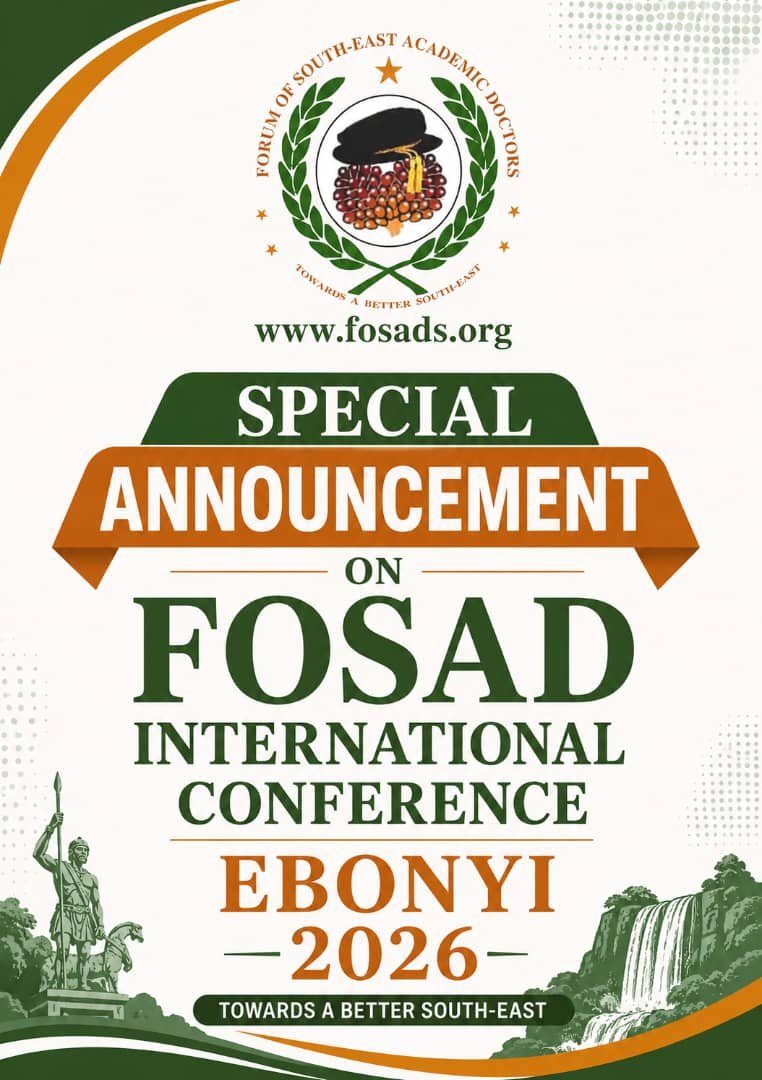
Please be informed of the following important updates regarding the FOSAD International Conference Ebonyi 2026:
1.The FOSAD International Conference Ebonyi 2026 will be held virtually on Thursday, 2nd July and Friday, 3rd July 2026 by 10 am daily.
2.A Google Meet link for participation in the conference will be sent to all duly registered participants prior to the commencement of the event.
3.The FOSAD State Chapter Elections will be conducted virtually on Friday, 3rd July 2026.
4.The FOSAD Electoral Committee will publish the official list of duly nominated candidates before the election.
5.All registered conference participants will receive printed hard copies of the Conference Brochure and Book of Abstracts.
6.Every conference participant will also be awarded a Certificate of Participation.
7.All accepted papers presented during the conference will be considered for publication in the Second Edition of the FOSAD International Journal, subject to the journal's editorial and peer-review requirements.
We appreciate your continued support and commitment to the Forum of South-East Academic Doctors (FOSAD). We look forward to your active participation and wish you a productive, engaging, and successful conference.
Signed
Dr. Uzor Ngoladi
Secretary General
Forum of South-East Academic Doctors (FOSAD)
PRESS STATEMENT
N16.6 billion: FOSAD Demands Accountability, Transparency from South East Development Commission (SEDC) Managing Director, Mark Okoye
The Forum of South-East Academic Doctors (FOSAD) has called on the Managing Director and Chief Executive Officer of the South East Development Commission (SEDC), Mr. Mark Okoye, to provide a comprehensive public account of the estimated ₦16.6 billion reportedly released to the Commission since its inauguration by President Bola Ahmed Tinubu in February 2025.
As an organization committed to good governance, accountability, transparency, and sustainable development, FOSAD is deeply disturbed by recent developments surrounding the activities of the South East Development Commission, particularly the ongoing scrutiny by the Nigerian Senate over the Commission's financial expenditures.
Most disturbing among the allegations is the reported payment of ₦153 million for the rent of a one-bedroom liaison office in Abuja. Such a revelation, if accurate, raises serious questions about financial prudence, fiscal responsibility, and the management of public resources entrusted to the Commission for the development of the South-East geopolitical zone.
The South East Development Commission was established to address decades of infrastructural neglect, stimulate economic growth, rebuild communities, and accelerate development across the five South-East states. The expectations of millions of people in the region were understandably high following the establishment of the Commission. Unfortunately, more than a year after its inauguration, the region is yet to witness commensurate developmental projects that justify the huge financial allocations reportedly made to the Commission.
FOSAD considers the current controversy an embarrassment to the South-East geopolitical zone and an unfortunate distraction from the noble objectives for which the Commission was created. At a time when Nigerians are demanding greater accountability from public institutions, it is imperative that the leadership of the SEDC demonstrates the highest standards of integrity and openness.
We therefore call on Mr. Mark Okoye and the entire management of the Commission to immediately provide a detailed breakdown of all funds received and expended since the Commission became operational. The people of the South-East deserve to know how public resources allocated for their development have been utilized.
Transparency is not optional in public service; it is a constitutional and moral obligation. Public confidence can only be restored when public officials willingly subject themselves to scrutiny and provide verifiable evidence that public funds have been deployed for the benefit of the people.
FOSAD further insists that this matter must not be swept under the carpet. Nigeria cannot successfully wage the war against corruption while overlooking allegations of financial impropriety in institutions established to promote development. Accountability must not be selective.
We also note that Mr. Mark Okoye belongs to a younger generation of Nigerian leaders who have consistently advocated for greater youth participation in governance. It is therefore important that he conducts himself in a manner that strengthens public confidence in young leaders rather than reinforcing negative stereotypes that could undermine future opportunities for competent young Nigerians seeking leadership positions.
Furthermore, FOSAD calls on the Governors of Abia, Anambra, Ebonyi, Enugu, and Imo States, as principal stakeholders in the South East Development Commission, to intervene by demanding a transparent, independent, and comprehensive inquiry into the financial activities of the Commission.
The National Assembly, anti-corruption agencies, civil society organizations and development partners should equally ensure that due process is followed and that investigation is conducted without fear or favour.
The South-East cannot afford another institution that fails to deliver on its mandate. The region urgently needs quality roads, modern healthcare facilities, educational infrastructure, industrial development, youth empowerment programmes, agricultural investments, and employment opportunities—not financial controversies that erode public trust.
FOSAD remains committed to promoting accountability, evidence-based governance, and responsible leadership. We shall continue to monitor developments at the South East Development Commission and speak out whenever the public interest demands it.
The people of the South-East deserve transparency. They deserve development. Above all, they deserve leaders who recognize that public office is a sacred trust.
Signed
Dr. Stephen Nwala
President
Forum of South-East Academic Doctors (FOSAD)
Dr. Uzor Ngoladi
Secretary General
Forum of South-East Academic Doctors (FOSAD)
https://t.co/KbcmnYZ7Ws @winexviv@DrKalu_@alexottiofr@markokoyeII@Hope_Uzodimma1@FrancisNwifuru@CCSoludo@UchePOkoye@IgboHistoFacts@VoiceOfTheEast@247IGBO @VivianIfeomaOj @PeterObi
PRESS STATEMENT
FOSAD Reports Tinubu’s Government To Education International Over Abduction Of Teachers And Students In Oyo State, Seeks Urgent Global Intervention
The Forum of South-East Academic Doctors (FOSAD) has formally petitioned Education International (EI), the global federation representing teachers and education workers worldwide, over the continued abduction of teachers and students in Oyo State, Nigeria, and the Federal Government's inability to secure their release more than two weeks after the incident.
In a letter addressed to the leadership of Education International, FOSAD strongly condemned the terrorist attack on three schools in Esiele and Yawota communities of Oriire Local Government Area of Oyo State on May 15, 2026, during which armed terrorists abducted seven teachers and thirty-nine pupils and students.
The academic body described the incident as one of the most disturbing attacks on education in recent Nigerian history and expressed outrage over the brutal beheading of a mathematics teacher, Mr. Michael Oyedokun, during the attack. FOSAD noted that the murder of an educator whose only crime was serving his community represents a direct assault on the teaching profession and the future of Nigerian children.
According to FOSAD, the continued captivity of the abducted teachers and students highlights the worsening insecurity facing schools across Nigeria and demonstrates the failure of authorities to provide adequate protection for educational institutions.
The organization expressed deep concern that despite widespread public outrage, emotional appeals by family members, and sustained advocacy by education stakeholders, the victims remain in captivity while government efforts have yielded little progress.
FOSAD criticized what it described as the Federal Government's lackadaisical response to the crisis, accusing the administration of President Bola Ahmed Tinubu of failing to accord education the priority it deserves.
"The Nigerian education sector is under siege. Teachers and students have become soft targets for terrorists, kidnappers, and criminal elements. Yet, government response has been grossly inadequate. We are witnessing a dangerous situation where those responsible for shaping the future of our nation are being abandoned to their fate," the organization stated.
FOSAD further lamented that teachers across the country continue to work under extremely difficult conditions characterized by poor welfare, insecurity, inadequate infrastructure, and increasing threats to their lives.
The group noted that the abduction in Oyo State is part of a disturbing trend of attacks on schools that threatens to reverse decades of progress in educational development and discourage parents from sending their children to school.
FOSAD also drew attention to the indefinite strike declared by the Nigeria Union of Teachers (NUT) on June 1, 2026, describing the action as a reflection of the growing frustration and anger within the teaching profession.
FOSAD urged Education International to immediately raise the matter before relevant international bodies, including the United Nations, UNESCO, UNICEF, and other global institutions committed to protecting education in conflict and crisis situations.
The Forum appealed to Education International to issue a strong global statement condemning the attack and demanding the unconditional release of all abducted teachers and students.
"We call on Education International to stand in solidarity with Nigerian teachers and learners. The international community cannot remain silent while teachers are murdered, students are abducted, and schools become battlefields. An attack on teachers anywhere is an attack on teachers everywhere," FOSAD stated.
The group further expressed concern that while government agencies often demonstrate remarkable efficiency in monitoring and tracking political activists and critics of government policies, the same urgency has not been applied in locating and rescuing innocent teachers and schoolchildren held by terrorists.
FOSAD warned that unless urgent and decisive action is taken, Nigeria risks witnessing a collapse of confidence in the education system, particularly in rural communities where insecurity has become rampant.
"Education may become endangered if teachers and students continue to be exposed to these threats without adequate protection. No society can develop when its classrooms are turned into crime scenes and its teachers become targets of violence," the statement added.
FOSAD therefore called on the Federal Government to intensify rescue operations, strengthen security around schools, prosecute perpetrators of attacks on educational institutions, and implement comprehensive measures to safeguard teachers and learners across the country.
FOSAD concluded by expressing hope that international pressure and advocacy would compel authorities to take more decisive action toward ending attacks on schools and ensuring that every child and teacher in Nigeria can learn and work in safety and dignity.
Signed
Dr Stephen Nwala
President, Forum of South East Academic Doctors (FOSAD)
Dr Uzor Ngoladi
Secretary General, Forum of South East Academic Doctors (FOSAD)
https://t.co/KbcmnYZ7Ws
PRESS STATEMENT
FOSAD Celebrates Obi of Onitsha at 85, Urges Governor Soludo to Reconcile with the Revered Monarch
The Forum of South-East Academic Doctors (FOSAD) heartily congratulates His Majesty, Igwe Nnaemeka Alfred Achebe, CFR, the Obi of Onitsha, on the occasion of his 85th birthday anniversary.
At 85, the Obi of Onitsha remains one of Nigeria’s most respected traditional rulers, a globally admired intellectual, and a symbol of dignity, wisdom, integrity, and purposeful leadership. His remarkable contributions to national development, cultural preservation, peacebuilding, and intellectual advancement have continued to inspire generations across Nigeria and beyond.
FOSAD notes that the reign of Igwe Achebe has brought immense honour not only to the Onitsha Kingdom but also to the entire South-East region through his exemplary commitment to justice, education, social harmony, and nation-building.
As a distinguished professional before ascending the throne and now one of Africa’s most influential monarchs, the Obi of Onitsha has consistently demonstrated that traditional institutions remain critical pillars for societal stability, moral guidance, and progressive development.
The Forum particularly commends the monarch for his intellectual depth, humility, statesmanship, and unwavering commitment to peace and unity. His voice has remained one of reason and moderation in moments of national uncertainty and social tension.
FOSAD therefore joins millions of admirers, sons and daughters of Onitsha Kingdom, traditional institutions, scholars, and patriots across the world in celebrating this extraordinary milestone in the life of a rare statesman and royal father.
However, while celebrating the revered monarch, FOSAD also considers it necessary to call for reconciliation and greater harmony between the Anambra State Government and the Obi of Onitsha in the broader interest of peace, unity, and development in the state.
The Forum respectfully urges Governor Chukwuma Charles Soludo to take deliberate steps towards ending any perceived rift or strained relationship with the first-class monarch.
As major stakeholders in the progress of Anambra State, both the government and traditional institutions must work together in mutual respect and cooperation for the collective good of the people.
FOSAD believes that the Obi of Onitsha is not only a traditional ruler but also a national asset whose wealth of experience, global exposure, and moral authority remain invaluable to governance and development efforts in Anambra State and Nigeria at large.
At a time when the South-East region faces serious socio-political and economic challenges, unity among leaders and institutions has become more important than ever.
The Forum therefore appeals for constructive engagement, dialogue, and reconciliation between Governor Soludo and the revered monarch in order to strengthen social cohesion and foster a more united Anambra State.
FOSAD maintains that history has shown that societies thrive when political leaders and traditional institutions work together in an atmosphere of mutual trust, respect, and shared responsibility.
As Igwe Nnaemeka Achebe marks his 85th birthday, FOSAD prays that God grants him continued good health, wisdom, peace, and strength to continue serving humanity and offering fatherly guidance to future generations.
Happy 85th Birthday to a truly distinguished royal father, intellectual icon, and national statesman.
Signed
Dr Stephen Nwala
President, Forum of South East Academic Doctors (FOSAD)
Dr Uzor Ngoladi
Secretary General, Forum of South East Academic Doctors (FOSAD)
https://t.co/KbcmnYZ7Ws @CCSoludo@AdaIgbo22@IgboHistoFacts@VoiceOfTheEast@UchePOkoye@DrKalu_@alexottiofr