Semiconductors are anything but a simple industry. They are an ecosystem of bottlenecks.
Fabless designers create the architecture and drive demand, but they rely entirely on foundries to turn ideas into silicon. Foundries translate capital and process expertise into scale, and that scale takes years and enormous upfront investment to build.
Testing and packaging determine whether chips can ship reliably and at volume. This layer rarely gets attention, but it is where yield issues, cost overruns, and delays tend to surface first.
Suppliers sit underneath everything. Design software, manufacturing tools, and raw materials touch nearly every step of the process. These companies benefit as long as wafers are moving, regardless of which end product wins.
IDMs add another wrinkle by combining design, manufacturing, and in some cases packaging under one roof. That structure shows up most clearly in areas like memory, analog, automotive, and power.
Every company shown here is publicly traded, but they do not move for the same reasons. Memory names like Micron are reacting to pricing cycles as much as chip demand, while others are tied more closely to capital spending or tooling cycles.
Bookmark this and use it as a cheat sheet!
$AVGO $MRVL $NVDA $AMD $TSM $QCOM $ASML $LRCX $APLD $INTC
$NFLX just posted their Q4 2025 earnings.
Overall a very solid FY2025 with lowered guidance for 2026. Presumably due to their Warner Bros deal pending.
Here are the numbers!
Q4 Performance
• Revenue: $12.05B vs $11.97B est✅
• EPS: $0.56 vs $0.55 est✅
��� Paid Memberships: crossed 325M during the quarter
Q1 2026 Outlook
• Revenue: $12.16B vs $12.19B est❌
• EPS: $0.76 vs $0.81 est❌
• Operating Margin: 32.1%
Everyone’s aware of how much money is being poured into AI. The better question is how much performance that money is actually buying.
Recently on The Joe Rogan Experience, numbers were thrown around loosely, “~4x the cost for ~25% improvement.” Those figures are not precise, but they are not far off either.
Current estimates put GPT-5 at roughly 15–30% better performance than GPT-4 across reasoning, reliability, and task execution.
So what did that improvement cost?
Most credible estimates suggest ~4–10x more resources.
Why the gap?
1) Reliability is expensive.
Recent gains are less about new abilities and more about consistency. That means longer training, more redundancy, more verification passes, and fewer tolerated failures. Reducing error rates near the frontier requires disproportionately more compute.
2) High-quality data is no longer abundant.
Human-generated text is effectively exhausted at this scale. New training data increasingly has to be generated synthetically, filtered, evaluated, and periodically checked. Each step adds real compute and human oversight costs that did not exist in earlier generations.
3) Power and infrastructure scale poorly.
At frontier scale, GPUs become less efficient per unit. Cooling, redundancy, and power delivery can rival compute draw itself. This is why you are seeing Sam Altman talking about energy constraints, Microsoft securing nuclear capacity, and renewed interest in names like Oklo.
AI is still improving, but the easy gains are gone.
If GPT-6 costs another multiple of GPT-5, the real question is not whether progress continues. It is who can afford to fund it, and for how long.
$NVDA $SMCI $ORCL $SPOT
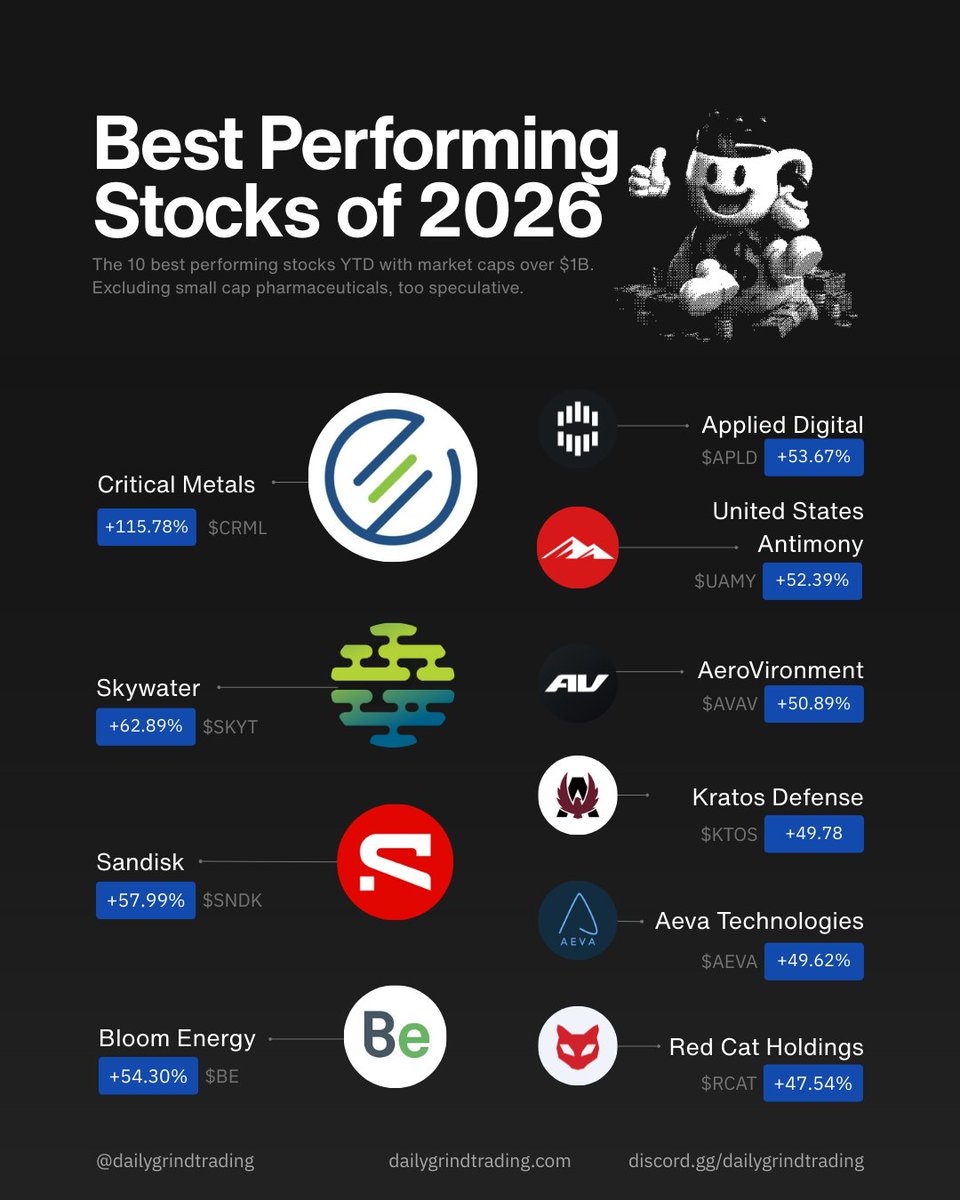
The first trading week of the year has been defined by capital moving into metals, energy, defense, and data infrastructure. Early performance is coming from areas tied to supply constraints, government spending, and physical demand rather than consumer growth.
$CRML $SKYT $SNDK $BE $APLD $UAMY $AVAV $KTOS $AEVA $RCAT
With the Supreme Court rumored to be making a decision on tariff authority, Nike is one of the most directly exposed consumer brands.
Since the mid 2000s, Nike has steadily moved footwear production from China to Vietnam and Indonesia. Vietnam now produces roughly half of Nike’s shoes, compared with China at less than 20 percent today.
Footwear imports have historically been a primary target of U.S. tariffs due to their manufacturing concentration outside the United States.
$NKE
@Roblox continues paying the bills; what an astronomical chart that the DGT family has been capitalizing on 🤝 JOIN THE COMMUNITY TODAY!
https://t.co/KonqG6r2YV
$RBLX