Gustavo Fring was right, if you have a problem that means it can be solved. If it cannot be solved then it is not a problem. It is a reality to be accepted.
Dari sekian banyak pidato, pidato kali ini bener bener nyesek
Rakyat yang bayar gaji kalian, dikritik malah dibales:
“EMANG GUE PIKIRIN” dan disambut tepuk tangan yang meriah
“kami mau melapor ke polisi, polisi punya dapur sppg, kami mau melapor ke TNI, TNI punya dapur sppg, kami mau melapor ke DPR, DPR pun punya dapur sppg. jadi ini jalan terakhir kami untuk mengadu, kepada konstitusilah kami berharap”
—ucap seorang guru, pendidik anak bangsa. ironi.
Jangan nyinyir sama pendemo.
THR, upah minimum, hak lembur, sampai Reformasi 1998 yang membuka jalan demokrasi hari ini. Semuanya lahir dari orang-orang yang berani bersuara dan turun ke jalan.
REPUBLIK INI SUNGGUH SESAK DAN BERISIK SEKALI DALAM 72 jam terkahir:
- nyinyiran kosong Seskab ke Pak Dino
- sidang panas di pengadilan Nadiem (sampe mati lampu)
- tuntutan geli-geli 2.5th kasus Andrie Yunus
- pencopotan si Botak Dadan sampe ditahan Kejaksaan
- kasus korupsi imigrasi, katanya wamen imigrasi hilang
- kurs Dollar/Rupiah cetak rekor Rp 18.000
Belum pernah semuak ini jadi WNI!😭🤬🫵🔥😵💫😇
Saya dapat info bhw ada 17 calon Dubes asing yg sudah tiba di Jakarta tapi sampai sekarang masih MENUNGGU waktu utk memberikan surat kepercayaan kpd Presiden. Dari mereka ada yg sudah menunggu 8 bulan. Ada juga Dubes dari negara ASEAN yg menunggu 6 bulan. Karenanya, mereka belum bisa bekerja secara resmi.
Ini memberikan kesan buruk bagi negara2 sahabat yg mengirim Duta Besarnya ke 🇮🇩, apalagi Dubes 🇮🇩 di luar negeri selalu dgn cepat menyerahkan surat kepercayaan kpd host country. Tanpa menyalahkan siapapun, Mohon masalah ini dapat segera dituntaskan Istana krn menyangkut reputasi diplomatik kita.
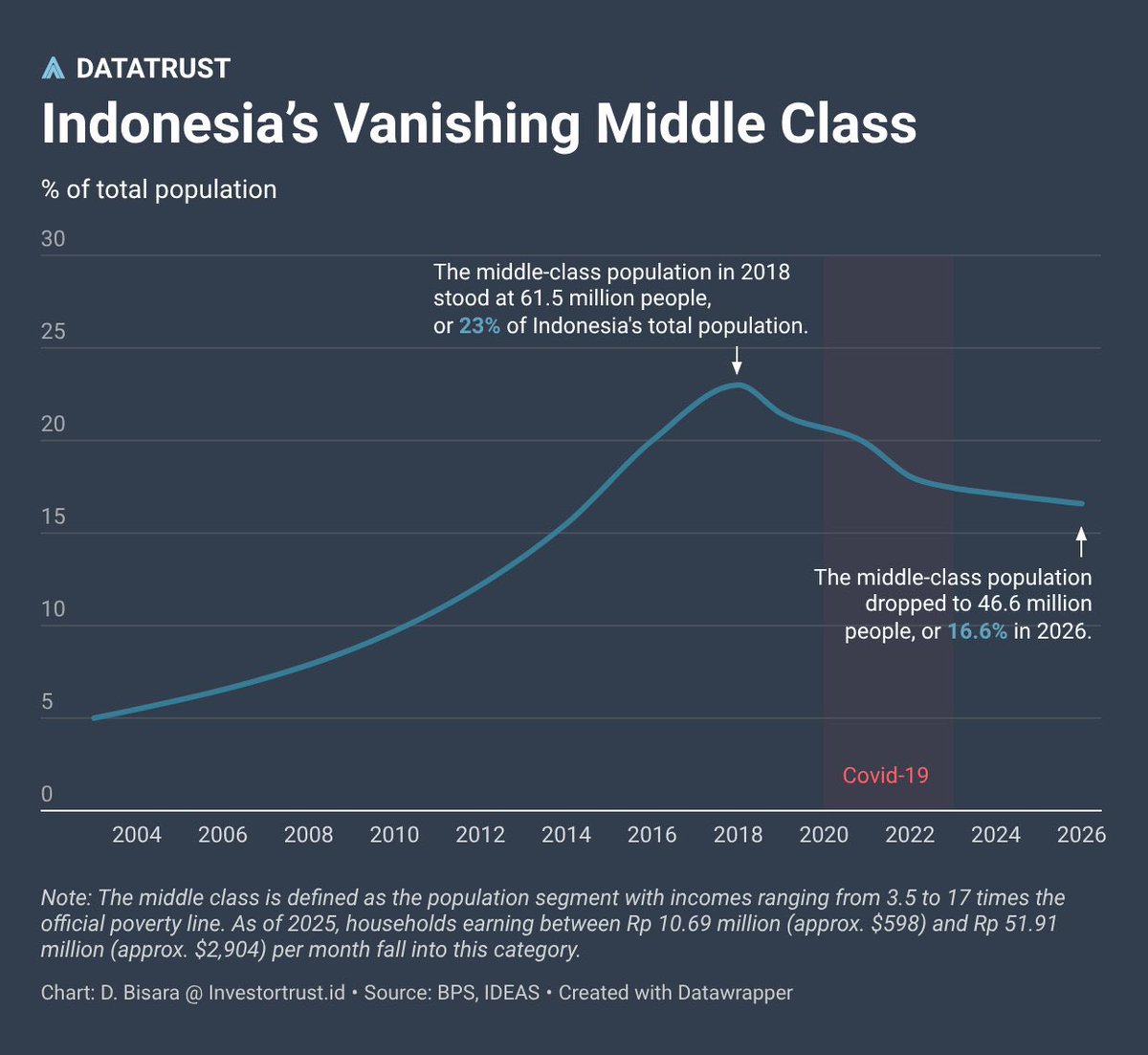
This chart should terrify policymakers. Indonesia’s middle class did not merely slow down. It went into reverse.
After two decades of expansion, the middle-class population peaked at 61.5 million people in 2018, representing 23% of the population. By 2026, that figure had fallen to just 46.6 million people, or 16.6%. That is not a cyclical slowdown. That is structural deterioration.
For years, policymakers celebrated GDP growth, infrastructure projects, commodity booms, and headline investment numbers. But the ultimate scorecard of an economy is whether ordinary people become wealthier over time. This chart suggests millions of Indonesians are moving in the opposite direction.
The middle class is the economic engine of every successful country. They buy homes, cars, insurance, consumer goods, education, travel, financial products, and healthcare. They generate tax revenue. They create small businesses. They drive domestic demand. When the middle class shrinks, the economy loses its most important customer.
The uncomfortable question is simple: where did the gains go? If GDP is growing, if conglomerates continue expanding, if commodity exports remain large, then why are fewer Indonesians qualifying as middle class than eight years ago?
More importantly, if you are born poor in Indonesia today, what ladder exactly are you supposed to climb?
If you are exceptionally good looking, perhaps you can monetize attention through social media. If you are academically gifted, perhaps you can break into an ultra-competitive institution like MBB, survive years of brutal expectations, and eventually use that platform to do something bigger. If you are entrepreneurial, maybe you build a business against overwhelming odds. If you are lucky, perhaps you benefit from family connections, inheritance, or access to opportunities unavailable to most people.
But an economy cannot rely on exceptionalism. A healthy economy creates millions of pathways upward, not a handful of lottery tickets.
The situation becomes even more concerning when you consider that well-paying white-collar jobs are becoming increasingly scarce. Many multinational companies that once established regional operations, technology centers, shared-service hubs, and professional offices in Indonesia have either downsized, relocated, or shifted future expansion elsewhere.
Those jobs were not valuable merely because of the salaries they paid. They were valuable because they transferred knowledge, management expertise, technical skills, global best practices, and professional networks into the local workforce. Over time, they helped develop intellectual capital that could later be recycled into entrepreneurship, leadership positions, startups, and domestic businesses.
When those opportunities disappear, the loss is not limited to employment. The country also loses a training ground for future managers, engineers, consultants, analysts, and business leaders. Human capital compounds just like financial capital. Once that pipeline weakens, rebuilding it can take years or even decades.
The bigger risk is that social mobility slows. When people stop believing hard work leads to a better life, trust in institutions weakens. Aspirations decline. Consumption slows. Talent leaves. The country’s most productive people increasingly look elsewhere for opportunity.
This is why Indonesia’s biggest economic challenge is no longer growth. It is upward mobility. A country cannot thrive without a growing middle class, a steady pipeline of high-quality jobs, and a clear path for ordinary people to join it. And right now, all three appear to be moving in the wrong direction.
Gue suka banget sama statement ini nih:
Sebenarnya pekerjaan yang lagi lo tekunin sekarang itu adalah hadiah terbaik yang Allah kasih khusus buat lo. Makanya lo ditakdirin berada di posisi ini, meskipun dari sananya bukan bidang atau pilihan lo sama sekali.
Lanjut...
Suatu hari tiba² disuruh atasan ngerjain kerjaan random ke sebuah Dinas...
🐣: Permisi pak, saya disuruh mas Be*a nganter flashdisk
👨🦱: Sampean Sabil ya? Sini mas, ke ruang meeting
🐣: (waduh feeling ga enak…) nggih pak
👨🦱: Lha mas Be*a mana? Ini sampean yg presentasi ya?
🐣: (lah tenan😭) saya cuma disuruh nganter sama diskusi dikit pak…
👨🦱: Oalah… yaudah sekalian tak panggil yang lain ya
(singkat cerita, diskusi bareng)
👨🦱: Jadi ini kemarin problemnya hasil scan datanya jadi 150 ribu file PDF (90GB), tapi penamaannya kacau semua, direktorinya juga nyebar gak karuan, gak kebaca sistem, harus penamaan NIK
🐣: Iya pak, sudah saya rapikan semua sesuai database, monggo dicek
👨🦱: Loh… iya ini udah bener 😳 berapa hari ngerjainnya?
🐣: 3–4 hari pak
👨🦱: Cepet amat… sampean IT ya?
🐣: Bukan pak, admin 😅
👨🦱: Lah… kuliah IT?
🐣: Sistem Perkapalan pak… hehe
👨🦱: Lah kok nyasar 😭 terus ngerjainnya pake apa?
🐣: Excel pak 😁
👨🦱👨💼👨🔧: LAH EXCEL??
👨🦱: Itu tim arsip ngerjain lama gak kelar² loh mas 😐
👨🦱: Ini ada lagi problem JSON & query buat upload ke SANDIKA
🐣: (lihat bentar) oh ini bisa pak
👨🦱: Kira² berapa lama? Keburu lebaran gak?
🐣: Kirim aja format JSON dan QUERYnya pak, mungkin… beberapa jam selesai
👨🦱: Lah aku ngerjain satu-satu lama banget lho mas😑
🐣: hehehe 😄
The power of Excel (lagi) 🔥🔥🔥🔥
Jeff Bezos on why too many ideas can destroy a company, and the discipline that built Amazon's inventive edge:
"Jeff, you have enough ideas to destroy Amazon."
That's what senior executive Jeff Wilke told Bezos after just one year of working together.
Bezos was confused. He pushed back: "What do you mean?"
Wilke was a manufacturing expert. He explained it simply:
Every new idea Bezos released created a backlog. Work piling up, adding no value, creating distraction instead.
The fix wasn't to stop having ideas. It was to control when they came out:
"You have to release the work at the right rate that the organisation can accept it."
So @JeffBezos changed how he operated.
He started keeping lists, holding ideas back, and waiting until the organisation had the bandwidth to absorb them.
But then he flipped the problem entirely.
He asked: "How do I build an organisation that's ready for more ideas?"
His answer was structural: get the right senior team, give leaders real executive bandwidth, and build a company capable of running multiple bets at once.
And there's a benefit he didn't expect. Slowing down made the ideas themselves better:
"If you are releasing the ideas through time, it forces you to prioritise them better. You end up sharpening the ideas better."
The constraint becomes a filter. The ideas that survive the wait are the ones worth acting on.
The result? Faster execution, less distraction, and better ideas.
I’m 35.
If you’re in the 25-35 bracket, you’ll notice this:
- Some friends are married to their soulmates.
- Others are quietly googling "how to file for divorce."
- Some are hitting a 5 AM personal best in the gym.
- Others are battling burnout and anxiety.
- Some are meditating, reading, and healing.
- Others are escaping reality with cheap dopamine.
This decade is messy. It’s brutal. It’s beautiful.
There is no rulebook. There is no "perfect" pace.
Move at your own speed. Your timeline isn’t broken - it’s yours.
In 2010, Bill Ackman gave a 44-minute masterclass on how money actually works using a lemonade stand.
He talks about:
• How businesses create value
• Why most investors lose money
• How compounding really builds wealth
12 timeless lessons from Ackman's masterclass:
There is a terrifying quietness to a life left unattended. If you do not wake up every morning with the intent to carve out the existence you want for yourself, the world will assign you a default one and it will not be the one you wanted.
You might believe you are simply waiting for the right moment, but you are actually killing your dreams.
One gray day bleeds into the next, and the weeks dissolve into decades.
And before you know, you begin ti have that silent, creeping realization, years from now, that you have arrived at a destination you never chose.
You will wake up to find that the life you were meant to live has become a ghost, haunting a timeline you let slip through your fingers.
Do not let your life happen to you. Grab it with both hands before the years become memories you wish you had made
Your brain doesn't age because of time. It ages because of repetition. The more predictable your days become, the faster your neurons quiet down. Your brain builds neural pathways based on experience. New experiences create new connections. Repetition strengthens old ones. But when you repeat the same patterns for years, your brain stops building. That's why time feels faster as you age. Your brain stops encoding new memories. It just references old ones. A year at 40 feels shorter than a year at 10, because at 10, everything was new. At 40, everything is familiar. But neuroplasticity doesn't stop. You can still grow new neurons. You can still learn. You can still change. You just have to break the loop. Your brain will wake up. And time will slow down again.