Does digital surveillance make citizens more compliant? We (with @jvzhan1) find yes, at first, but the effect fades within a couple of years, even as the state adds more cameras. Surveillance shapes behavior, but with a time limit. Read more @Journal_PoPs: https://t.co/YMncdyBj8w
We are hiring a full-time RA with:
✅ Deep academic passion
✅ Strong computational skills
✅ Good understanding of Chinese politics
Join us at CUHK!
Apply here 👇 https://t.co/UBJEGgr7O3
New Anthropic Fellows Research: a new method for surfacing behavioral differences between AI models.
We apply the “diff” principle from software development to compare open-weight AI models and identify features unique to each.
Read more: https://t.co/VAsu2PSgCX
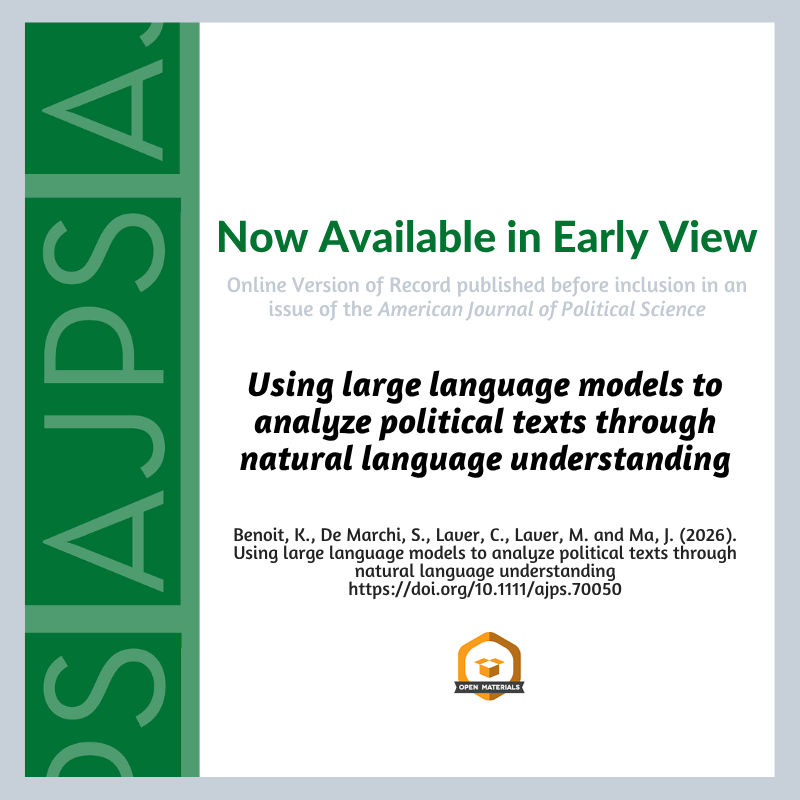
Using large language models to analyze political texts through natural language understanding by Kenneth Benoit, Scott De Marchi, Conor Laver, Michael Laver, and Jinshuai Ma is now available in Early View. @kenbenoit https://t.co/8tE6nqVci9
Meet a game-changer in AI reasoning: Qwen3.5-35B-A3B. This model isn't just another text generator. It's been distilled from top-tier reasoning models to think step-by-step like the best. Perfect for complex problem-solving!
Built a Claude Code skill for R/Python data science — inspired by
@posit_pbc
's AI prompts in Positron Assistant. Makes Claude think and behave like a tidy person: tidyverse, ggplot2, polars, notebook-aware protocols, etc. https://t.co/lv0EXpiDu1
OpenCode Go is a low cost ($10/month) subscription designed to bring agentic coding to programmers around the world
it provides generous limits and reliable access to the most capable open source models
run /connect and select OpenCode Go to get started
1/ 🐎 Our gift for the Year of the Horse:
An AI-assisted workflow that scales reproducibility in empirical research. w/ @YangYang_Leo
Paper: https://t.co/fslLN0zTQO
@Agimon_AI That’s right, and data scientists have to deal with “‘mixed” language context, switching between python, r, (maybe Julia) and stata for different tasks.
Got early API access to Kimi k2.5 (https://t.co/gWYwFO3p9V) and spent the past few days testing it extensively in Claude Code for data science and coding tasks. Compared it against GLM-4.7, Claude Sonnet 4.5, and Gemini 3 Pro. Here are my findings (1/6)
The official platform now supports multi-sub-agent coordination, but I couldn't test this with API access.
Among China's three major coding models (MiniMax, GLM, Kimi), I use GLM most for volume, but if I had to pick one top performer, it would be Kimi k2.5.
(6/6)
Task consistency is robust. For automation tasks (outputting series of MD files with specific format/naming), GLM-4.7 tends to forget instructions in long contexts. k2.5 maintains consistency throughout.
Others noted major aesthetic improvements in code generation as well.
(5/6)
Multi-program-language support has improved. I primarily work with R for data science, and previous Kimi versions would jump to Python (sometimes hallucinating non-existent R packages). k2.5 stays in R reliably, better than GLM-4.7, approaching Gemini, though behind Claude.
(4/6)
Exceptional stamina for long-running tasks. k2.5 easily handled 15+ minute sessions, executing autonomously based on the plan. Outperforms both Gemini 3 Pro and GLM-4.7 here, though not at Claude subscription levels. Token generation is noticeably quicker than GLM-4.7.
(3/6)
I am developing a keyboard/musical note matching game for my daughter. Native multimodal capability is nice. Unlike GLM-4.7 where you need to configure vision MCP, k2.5 handles images out of the box. Its ability to understand coding intent from screenshots is impressive. (2/6)