AC made certain requests regarding my #NeurIPS2026 submission in the initial metareview that directly violate the official reviewing guidelines, while simultaneously declaring those requests impossible to satisfy, effectively rendering the author-reviewer discussion pointless before it had even started.
Today, I tried to report this to the SACs but was basically told to fuck off. How am I supposed to report violations like this? Or should I just accept that NeurIPS reviewing has always been, and always will be, nonsense?
@predict_addict@srchvrs@LucaAmb@peter_richtarik Maybe you should try reading with your eyes instead of your ass.
I am not a PhD student, the original thread clearly contains lifelong consequences, and I am not defending pollution of science.
I am pleased to announce that together with 3 of my (then present and now former) KAUST PhD students
- Samuel Horváth @sam_hrvth (now Assistant Professor at MBZUAI, Abu Dhabi),
- Dmitry Kovalev @dakovalev1 (now Research Scientist at Yandex, Moscow),
- Konstantin Mishchenko @konstmish (now Research Scientist at Meta, Paris)
and Sebastian U Stich @SebastianUStich (now Faculty at CISPA, Saarbrücken; who was visiting us at KAUST at the time)
we have won the
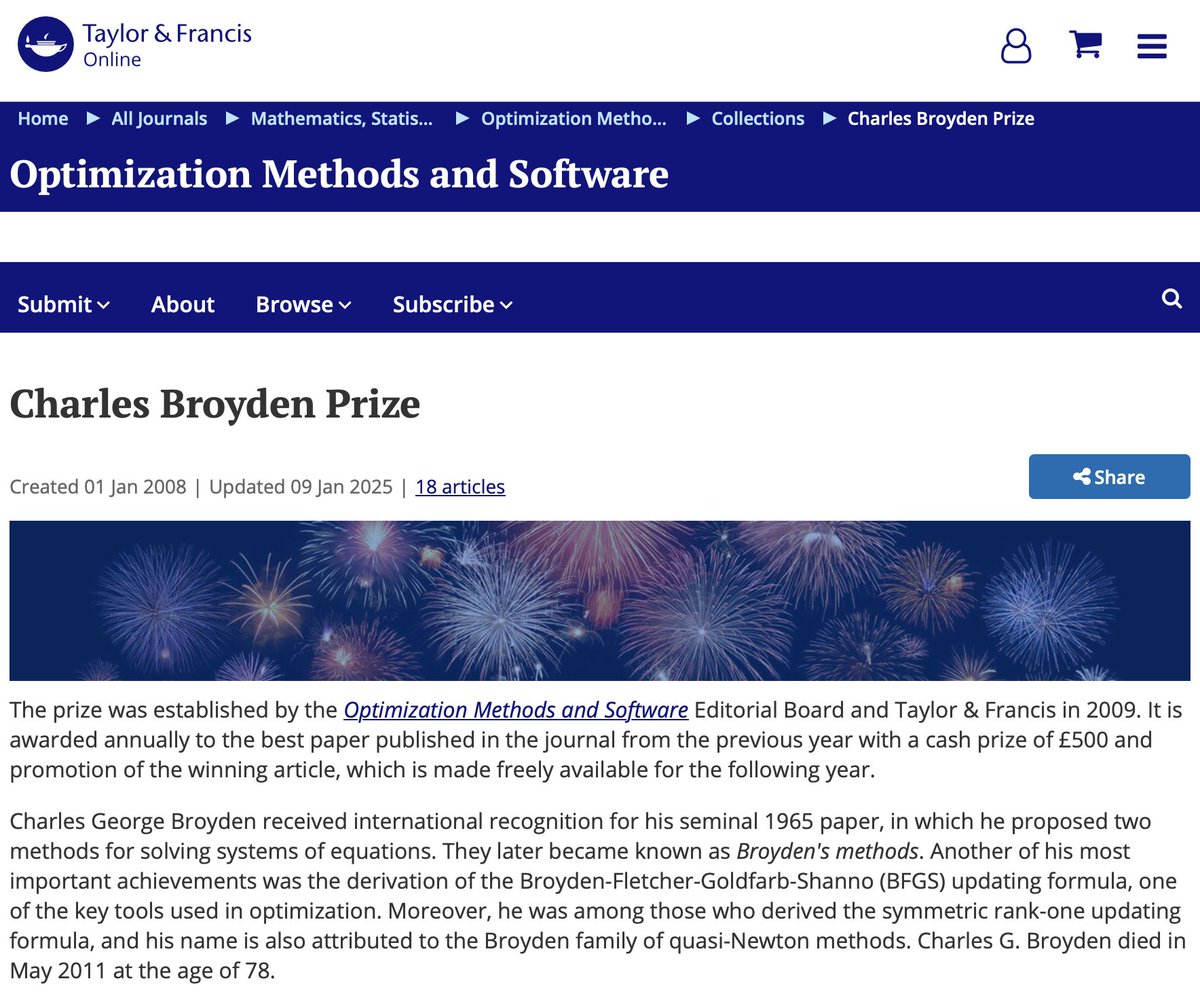
2023 Charles Broyden Prize
for the paper
Stochastic distributed learning with gradient quantization and double-variance reduction
the paper: https://t.co/hTJpLM3ScW
previous prizes: https://t.co/375niVZSsG
*****
The Charles Broyden Prize is an annual international award honoring the best paper published in the journal Optimization Methods and Software (OMS) during the preceding year. Established in 2009, the prize commemorates the life and work of British mathematician Charles George Broyden (1933–2011), a pioneer in numerical optimization known for his namesake methods and his role in the development of the BFGS algorithm.
*****
I consider this prize to be shared with the authors of the original DIANA paper
Konstantin Mishchenko @konstmish, Eduard Gorbunov @ed_gorbunov, Martin Takáč @TakacMartin and P.R. Distributed learning with compressed gradient differences, https://t.co/Snlj4jGgF5,
which was the inspiration for this follow up work that polished, generalized and improved it, and the authors of the previous SEGA work,
Filip Hanzely, Konstantin Mishchenko @konstmish and P.R.. SEGA: Variance reduction via gradient sketching, Advances in Neural Information Processing Systems 31:2082-2093, 2018,
which can be seen as a single-node variant of DIANA, as well as the authors of the JacSketch paper, which was the inspiration for SEGA:
Robert M. Gower @gowerrobert, P.R. and Francis Bach @BachFrancis, Stochastic quasi-gradient methods: Variance reduction via Jacobian sketching, Mathematical Programming 188:135–192, 2021 (https://t.co/gtOm87M7YP)
One can keep going like this, since every new discovery builds on prior work, but I'll stop here.
So, once again, congrats to the authors of the award-winning paper, as well as to the authors of all these prior works!
I find this new paper on adaptive methods very impressive. It develops a new accelerated method with adaptive estimation of smoothness. Its unique feature is that the method keeps adapting to local geometry as long as we run it. It's not trivial, so let me explain in a thread.
Several research groups have released papers on the convergence of Muon, mostly looking at either as a Frank-Wolfe method with momentum or a trust region procedure. I find this one to be particularly easy to read.
@vigimadi@ioannZH Не зависимо от того, как вы относитесь к т.н. репарациям, надо быть безмозглым выродком, чтобы не видеть разницы между выплатами в пользу граждан РФ и выплатами в пользу других государств.