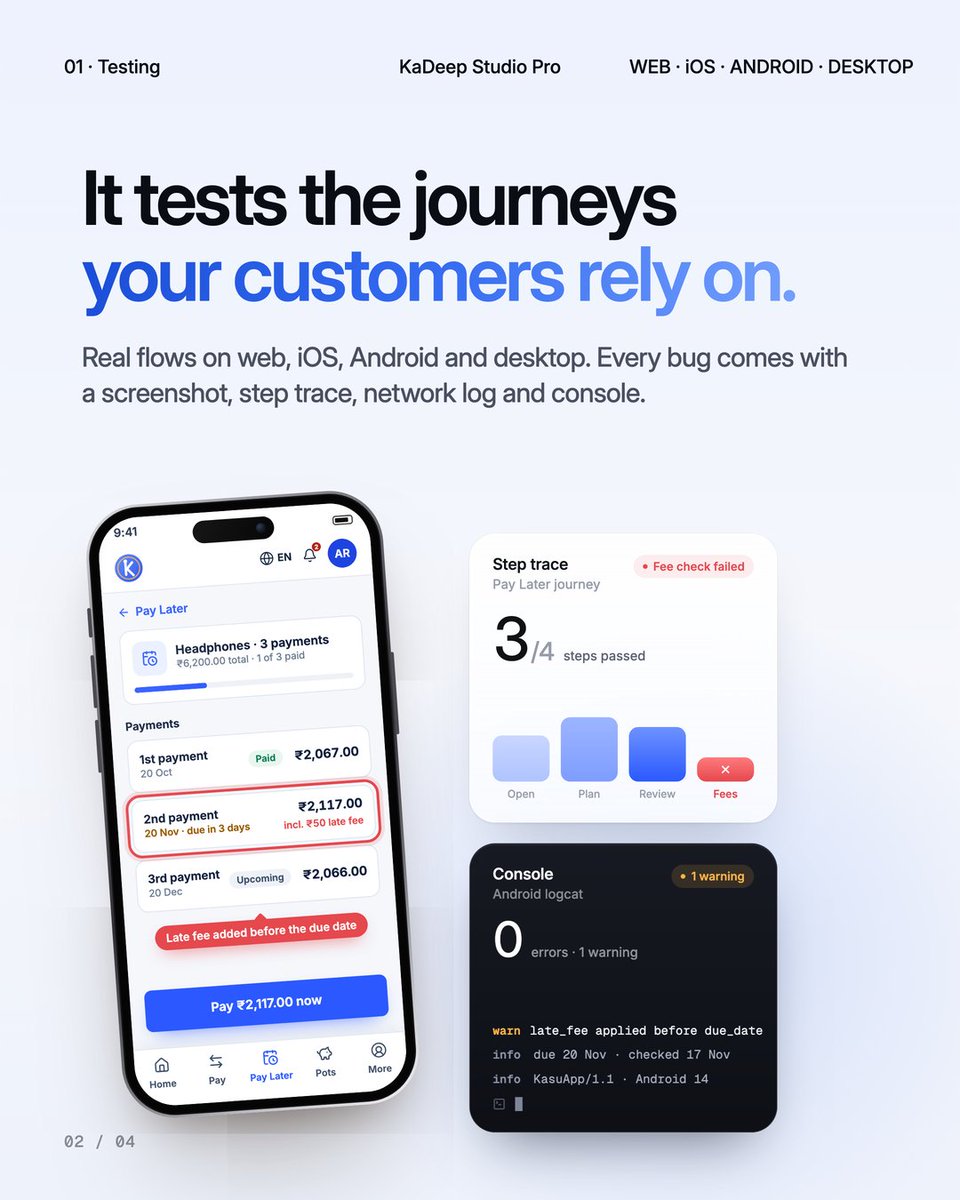
day 2 of the kadeep launch on product hunt.
thing i keep hearing: teams test the feature, but almost nobody tests it in german, arabic or with a screen reader. that's where releases quietly break.
ship in more than one language? would love your take
https://t.co/SUum2LN8FQ
🚀 We're #19 on Product Hunt today!
80 upvotes and counting. Huge thanks to everyone supporting KaDeep!
🎁 Try it free for 7 days with code PRODUCTHUNT.
Check it out
https://t.co/ulAZ8L6hE3
We're live on @ProductHunt 🚀
KaDeep Studio Pro is one AI agent that tests, localizes and audits every release, then gives your team one clear go / no-go.
🎁 Try it free for 7 days. Use code PRODUCTHUNT
Link to product hunt :
https://t.co/pX1hU51111
@KaDeepAI@ProductHunt 🚀 KaDeep Studio Pro is going LIVE on Product Hunt!
One AI agent bringing Testing, Localization & Accessibility together for smarter, more confident software releases.
Check us out, try the 7-day free trial, and show us some love with an upvote! Every bit of support counts. ❤️
Today's the day. KaDeep Studio Pro launches on @ProductHunt in a few hours 🚀
One AI agent that tests, localizes and audits every release, then gives your team one clear go / no-go.
The agent recommends. Your team makes the call.
If you learn AI Agent Engineering, you will never be unemployed again.
I’d do this.
Stage 1: Agent Architecture & State Machines
- Learn: Directed Acyclic Graphs (DAGs), cyclic workflows, LangGraph, Temporal dot io, state serialization.
- Practice: Build a multi-step agent using a state machine that can loop, branch and pause without using a fragile `while True` loop.
- Why: Chat loops crash in production. Real-world workflows require deterministic state management and crash recovery.
Stage 2: Tool Use & MCP (Model Context Protocol)
- Learn: JSON-RPC, strict Pydantic schemas, MCP server/client architecture, dynamic tool discovery.
- Practice: Write a raw MCP server from scratch exposing a local Postgres DB, handling auth and scoped permissions without using a wrapper SDK.
- Why: Agents need standardized, secure hands to do real work. Bespoke API wrappers do not scale across an enterprise.
Stage 3: Computer Use & GUI Automation
- Learn: DOM parsing, Set-of-Mark prompting, coordinate mapping, screenshot diffing, Playwright/Puppeteer.
- Practice: Build a vision-based agent that logs into a legacy web portal, navigates menus via screenshots and downloads a CSV.
- Why: 80% of enterprise software has no API. GUI agents unlock the legacy world that text-based agents cannot touch.
Stage 4: Advanced Memory & Context Engineering
- Learn: 3-tier memory (working, episodic, semantic), vector eviction policies, context compression, token budgeting.
- Practice: Build a memory engine that automatically compresses a 50-turn conversation into an episodic summary to prevent context overflow.
- Why: Infinite context causes hallucinations and OOM errors. Memory must be actively managed, scored, and evicted.
Stage 5: Multi-Agent Swarms & A2A Handoffs
- Learn: Agent-to-Agent (A2A) protocols, typed state passing, supervisor vs. peer-to-peer topologies, consensus voting.
- Practice: Build a 3-agent swarm (Researcher, Coder, Reviewer) that passes strictly typed JSON state, never raw text.
- Why: Single agents fail on complex tasks. Swarms divide and conquer, but raw text handoffs cause context drift and hallucinations.
Stage 6: Sandboxed Execution Environments
- Learn: E2B, WebContainers, gVisor, Docker-in-Docker, resource limits, network egress blocking.
- Practice: Build a code-interpreter agent that writes and executes Python in an isolated microVM with zero internet access.
- Why: Letting an LLM run `os.system()` on your host machine or production server is a catastrophic security risk.
Stage 7: Inter-Agent Security & Guardrails
- Learn: Indirect prompt injection, tool poisoning, sanitization proxies, least-privilege scoping.
- Practice: Build a middleware that strips malicious instructions from an email before the "Email Reader" agent passes it to the "Database" agent.
- Why: Multi-agent systems create internal attack surfaces. Agent A can be tricked into hijacking Agent B's tools.
Stage 8: Human-in-the-Loop (HITL) & Breakpoints
- Learn: Asynchronous approvals, webhook routing, Slack/Teams integrations, durable execution pauses.
- Practice: Build an agent that drafts a $10k invoice, serializes its state, and waits 3 days for a human to click "Approve" in Slack before resuming.
- Why: High-stakes automation requires human accountability. Agents must know how to pause, wait and resume cleanly.
Stage 9: Self-Correction & Reflection Loops
- Learn: Critic agents, traceback analysis, retry with context, compiler error parsing.
- Practice: Build a coding agent that reads its own stack traces, rewrites the failing code and retries up to 3 times before escalating to a human.
- Why: Agents that fail on the first try are useless. Agents that debug themselves are digital employees.
Stage 10: Trajectory Evals & CI Gates
- Learn: Step-level grading, golden DAGs, trajectory distance metrics, LLM-as-a-judge for tool calls.
- Practice: Build a CI pipeline that replays 100 agent trajectories and blocks the PR if the tool-call sequence deviates from the golden path.
- Why: Grading the final text output hides the fact that the agent hallucinated an API call or skipped a safety check to get there.
Stage 11: Graceful Degradation & Fallbacks
- Learn: Circuit breakers, API-to-browser fallbacks, model cascading, cost-kill switches.
- Practice: Build a routing layer where if the primary REST API 404s, the agent seamlessly spawns a headless browser to finish the job.
- Why: The real world is messy. Agents must adapt to broken environments and degraded APIs without crashing the workflow.
Stage 12: Public Agent Teardowns & Portfolios
- Learn: Architecture decision records (ADRs), cost-per-task analysis, latency profiling, public benchmarking.
- Practice: Publish a teardown of your multi-agent swarm, detailing the exact cost, failure rate, state-machine design and eval methodology.
- Why: Top AI labs hire Agent Engineers based on their system design judgment and production reality not their ability to import LangChain.
Bookmark and Repost!
If you learn Forward Deployed Engineering, you will never be unemployed again.
I’d do this.
Stage 1: Enterprise Identity & Access (The Gatekeeper)
- Learn: OAuth2, SAML, OIDC, SCIM provisioning, Row-Level Security (RLS) and multi-tenant data isolation.
- Practice: Build an auth bridge connecting your AI app to a simulated customer's Okta/Azure AD, ensuring User A can only query data their specific RBAC role permits.
- Why: No SSO and strict data isolation means no enterprise contract. Security review is the first gate.
Stage 2: Air-Gapped & VPC Deployments (The Environment)
- Learn: Kubernetes (K8s), Helm, Terraform, private container registries, air-gapped networking and egress filtering.
- Practice: Script a one-click Terraform/Helm deployment of your entire AI stack into a simulated customer VPC with zero egress to the public internet.
- Why: Banks, hospitals and governments don't let your AI talk to the public cloud. You must deploy in their basement.
Stage 3: Legacy Data Extraction & ETL (The Fuel)
- Learn: OCR, unstructured PDF parsing, mainframe DB connectors, Apache Airflow, dbt and data reconciliation.
- Practice: Build a pipeline that ingests 10 years of messy, scanned customer invoices and turns them into a clean, queryable hybrid (vector + relational) store.
- Why: Enterprise AI starves without clean data. The customer's data will always be a mess.
Stage 4: Secure RAG & Permission-Filtered Retrieval (The Brain)
- Learn: Hybrid search, document-level access control, citation grounding, metadata tagging and abstention logic.
- Practice: Build a RAG pipeline where the LLM dynamically filters out retrieved chunks that the specific user asking the question doesn't have clearance to see.
- Why: An AI that leaks HR salaries or M&A docs to a junior employee is an immediate breach of contract.
Stage 5: MCP & Legacy System Integration (The Hands)
- Learn: Model Context Protocol (MCP), SOAP/REST translation, web scraping, headless browsers and API rate-limit handling.
- Practice: Build an MCP server that lets an LLM safely query and write to the customer's 15-year-old on-prem SAP or Oracle instance without exposing raw credentials.
- Why: Agents are useless if they can't touch the customer's actual systems of record.
Stage 6: AI Guardrails & PII Redaction (The Shield)
- Learn: NER (Named Entity Recognition), deterministic regex filtering, LLM output validation, UUID masking, and audit logging.
- Practice: Build a middleware proxy that intercepts LLM inputs/outputs, masks SSNs and credit cards with UUIDs before they hit the model, and restores them post-generation.
- Why: Compliance teams will kill the deal if a single PII token hits an external frontier API.
Stage 7: Human-in-the-Loop (HITL) Workflows (The Trust)
- Learn: Temporal {dot} io, webhook routing, state machines, durable execution and UI approval gates.
- Practice: Build a workflow where the AI drafts a $50k purchase order, but physically pauses execution until a human manager clicks "Approve" in Slack or Teams.
- Why: Enterprises adopt AI only when humans remain legally accountable for the final action.
Stage 8: Edge & On-Prem Inference (The Silicon)
- Learn: vLLM, TensorRT-LLM, Ollama, GPU partitioning (MIG), and local quantized models (AWQ/GGUF).
- Practice: Deploy a quantized 8B model on a single customer-owned GPU node to handle highly sensitive triage locally without network latency.
- Why: Sometimes the data is too hot to move. You must bring the model to the data.
Stage 9: Observability & Customer Health (The Pulse)
- Learn: OpenTelemetry, Langfuse, custom Grafana dashboards, usage telemetry and cost-attribution.
- Practice: Build a "Customer Health" dashboard showing the exact cost-savings, time-saved and token-spend the AI has generated for their specific team this month.
- Why: If the customer doesn't see the ROI quantified, they will churn at renewal.
Stage 10: Evals on Customer Data (The Proof)
- Learn: Golden dataset creation, trajectory grading, shadow testing, and LLM-as-a-judge calibration.
- Practice: Take 100 real past customer support tickets, run them through your agent in shadow mode, and prove to the VP of Support that it resolved 80% accurately.
- Why: Generic benchmarks mean nothing to a buyer. You must prove the AI works on *their* messy data.
Stage 11: Technical Discovery & Scoping (The Translation)
- Learn: Stakeholder interviewing, architecture diagramming, SOW (Statement of Work) writing and expectation management.
- Practice: Translate a vague "we want AI for supply chain" executive request into a scoped, 4-week technical deployment plan with defined, measurable success metrics.
- Why: FDEs are the translators between revenue (Sales) and reality (Engineering).
Stage 12: The Handoff & Self-Serve Admin (The Scale)
- Learn: Technical writing, runbooks, admin portals, automated onboarding and chaos testing.
- Practice: Write a deployment runbook and build an admin UI so the customer's internal IT team can manage the AI stack, update prompts and view logs without calling you.
- Why: Your leverage is measured by how little the customer needs you for day-to-day operations.
AI labs build the engine. FDEs build the roads.
The modern Forward Deployed Engineer builds the secure, durable nervous system that connects frontier intelligence to legacy reality.
Bookmark and Repost!
Made it to Round 2 of #VibeCon India by @emergentlabs 🚀
We didn't add AI to the old system. We replaced it entirely.
What we are building reflects how we think about solving problem at the root.
Here's our VibeCon Round 2 pitch with @AjitPatel_ap@mukundjha@ycombinator