Human beings need to belong.
It's one of our deepest psychological needs.
Communities give us identity, support, purpose, and meaning.
But every community also creates pressure.
Sometimes that pressure encourages us to become more compassionate, courageous, and disciplined.
Sometimes it quietly teaches us that acceptance depends on agreeing, defending, or remaining silent.
The question isn't whether groups influence us. They always do.
The question is whether our communities strengthen our integrity, or slowly replace it.
Healthy belonging should make it easier to live your values, not harder.
Here's a question I come back to often:
If new evidence challenged one of my beliefs, would I feel free to reconsider it?
If the answer is no, it may be worth asking why.
Integrity doesn't require us to defend every conclusion we've ever reached.
It asks us to remain faithful to our deepest values while staying open to learning.
Our values should make us more honest.
Not more defensive.
Why do smart people sometimes ignore good evidence?
Often, it's not because the evidence is weak.
It's because accepting it feels like betraying part of who they are.
When beliefs become fused with identity, disagreement can feel like a personal threat.
Values create a healthier foundation.
If my identity is rooted in curiosity, honesty, and compassion, then changing my mind isn't a failure.
It's an expression of those values.
One of the healthiest shifts we can make is learning the difference between values and beliefs.
Values answer questions like:
Who do I want to be?
Honest.
Compassionate.
Courageous.
Curious.
Beliefs answer questions like, "What do I think is true?"
Beliefs should evolve as we learn.
Values provide the compass that guides us through that learning.
When our identity becomes rooted in specific beliefs, changing our mind can feel like losing ourselves.
When our identity is rooted in values, we can revise our beliefs without sacrificing who we are.
That isn't weakness.
It's integrity.
Before choosing a strategy, I try to ask one question:
"Will this still matter five years from now?"
Not whether it wins today's headline.
Not whether it satisfies today's outrage.
But whether it increases the likelihood that more people will voluntarily embrace the values we're trying to advance.
Movements succeed when people internalize ideas, not merely when they comply with pressure.
That's the difference between a moment of victory and a culture of change.
When people feel attacked, the brain shifts into protection mode.
Instead of asking, "Could I be wrong?" it asks,
"How do I defend myself?"
That doesn't make people immoral.
It makes them human.
This is one reason shame and humiliation so often produce resistance rather than reflection.
If we want people to think differently, we have to create conditions where thinking is still possible.
When we care deeply about an issue, it's tempting to assume that stronger pressure will produce stronger change.
Sometimes it does.
People comply.
Organizations change policies.
Public statements get rewritten.
But compliance and conviction are not the same thing.
Persuasion changes how people think.
Punishment often changes what people are willing to say in public.
Both have a place. Accountability matters.
But if our goal is durable change, we have to ask a different question:
Are we changing behavior...or are we changing minds?
The deepest social change happens when people begin to see the world differently, not simply when they fear the consequences of saying the wrong thing.
One question has quietly changed how I think about advocacy:
"What is reality trying to teach us?"
Not:
"How do we defend our position?"
Not:
"How do we win this argument?"
If our methods aren't producing the outcomes we hoped for, integrity asks us to learn—not double down.
Curiosity isn't weakness.
It's how good strategies improve.
Every organization develops blind spots.
Every movement does too.
The healthiest cultures aren't the ones that avoid mistakes.
They're the ones that make it safe to discover them.
Questions are not signs of weak commitment.
They're often signs of strong commitment to reality.
Curiosity is often misunderstood as uncertainty.
It isn't.
Curiosity is the willingness to keep learning even after you've formed an opinion.
In advocacy, leadership, and organizations, certainty can feel like strength.
But complex human problems rarely reward certainty.
They reward observation.
Listening.
Adaptation.
Strong convictions and deep curiosity can exist together.
In fact, the leaders most committed to their values are often the ones most willing to rethink their assumptions.
Curiosity doesn't weaken integrity.
It protects it.
A useful question for leaders, advocates, and organizations:
"If everyone handled conflict this way, what kind of culture would it create?"
More trust?
More honesty?
More courage?
More curiosity?
Or more fear, suspicion, and silence?
Methods are rarely as temporary as we imagine.
People carry them forward.
Often long after the original conflict has been forgotten.
People do not only learn from mission statements.
They learn from incentives.
From status systems.
From who gets rewarded, protected, promoted, or punished.
Organizations are constantly teaching values whether they intend to or not.
The question is not whether culture is being created.
The question is:
"What kind of culture are our methods creating?"
We often act as though methods are temporary and outcomes are permanent.
History suggests the opposite may be true.
The methods we normalize while pursuing change often become the norms that govern whatever comes next.
Cultures built on humiliation frequently produce fear.
Cultures built on coercion frequently produce resentment.
Cultures built on dignity and accountability are more likely to produce trust.
This was one of Martin Luther King Jr.'s deepest insights:
"The aftermath of nonviolence is the creation of the beloved community."
The means do not disappear once the conflict ends.
The means become the culture.
A useful discipline in conflict:
Describe the person's strongest argument in a way they would recognize as fair before responding to it.
Not because they are correct.
Because understanding people accurately is often the first step toward influencing them effectively.
Common humanity is not softness.
It is strategy.
The human brain is remarkably good at sorting people into categories.
Us.
Them.
Safe.
Dangerous.
Helpful.
Threatening.
These shortcuts can be useful for survival.
They are much less useful for democracy, organizations, and relationships.
The moment another person's suffering starts to feel deserved, it may be worth asking whether a human being has quietly become a category in our minds.
One of the first casualties of conflict is often common humanity.
People stop becoming neighbors, coworkers, citizens, or potential partners in solving problems.
They become categories.
Opponents.
Threats.
Obstacles.
Enemies.
This shift changes everything.
Once people become symbols rather than human beings, curiosity declines, persuasion becomes less important, and cruelty becomes easier to justify.
Protecting common humanity does not require agreement.
It requires remembering that the person across from us is more than the worst thing they have said, the worst thing they have done, or the group they belong to.
The work of advocacy, leadership, and community building becomes much harder once we forget that.
Dignity is not conditional on agreement.
Some of the most effective leaders and advocates I have met share an unusual trait:
They update quickly.
Not because they lack conviction.
Because they care more about reality than ego.
They are willing to ask:
"What am I missing?"
"What changed?"
"What would success actually look like now?"
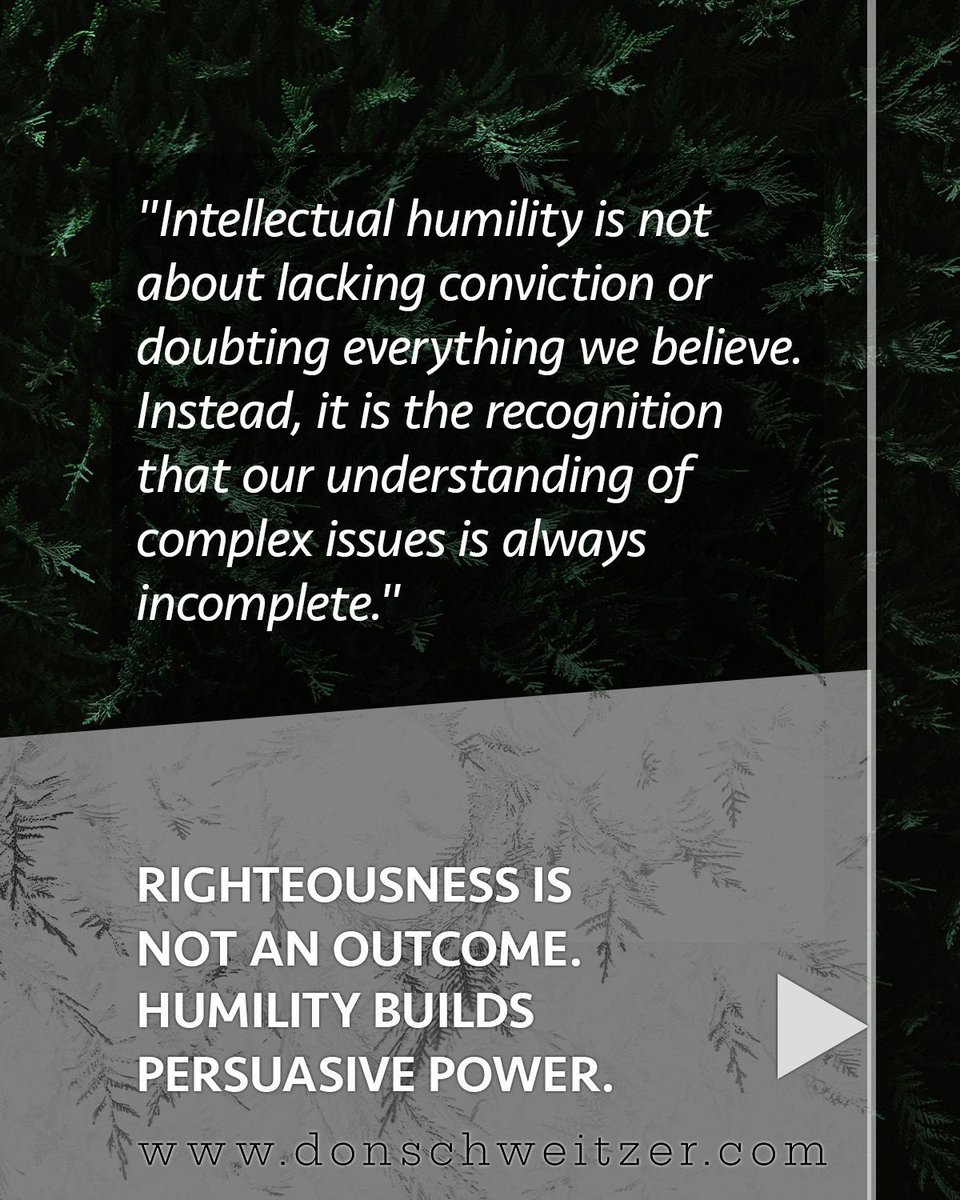
In complex human systems, adaptability is not weakness.
It is a competitive advantage.
I explore this idea more deeply here:
https://t.co/Om7Z0gkgPT](https://t.co/Om7Z0gkgPT
#Leadership #Advocacy #Psychology #IntellectualHumility #IntegrityBasedAdvocacy
There is an important difference between commitment and attachment.
Commitment says, "This value matters deeply to me."
Attachment says, "This belief must be defended at all costs."
One creates resilience.
The other makes learning feel dangerous.
Advocacy rooted in integrity needs the first far more than the second.
A question I have been sitting with lately:
What evidence would convince me that one of my strategies isn't working?
Not my values.
My strategy.
Values like dignity, justice, and fairness can remain stable.
Methods should be expected to evolve.
When strategies become untouchable, they often stop serving the mission they were created to advance.