@imelizabethlane@RealCandaceO Has anybody taken a look at the speakers boxes that were right in front of Charlie? Hiding a remote controlled low caliber suppressed gun in there would be a no brainer nowadays
I think hierarchy is the missing layer. It's not "one master branch that forks and merges". It's a structured descent from intent to execution, with process-isolated agents working in parallel, and a structured ascent where results are validated and failures are recorded. Perhaps you don't need a new git abstranction, but a governance layer above git. The branches don't need to merge -- they need to be orchestrated.
In John 6, Jesus shifts from the standard Greek for "eat" to a different word: trogein.
To gnaw. To crunch. To devour like a glutton.
For 1,500 years, the Church has read this as proof of literal consumption.
There is another reading. And it's harder, not softer.
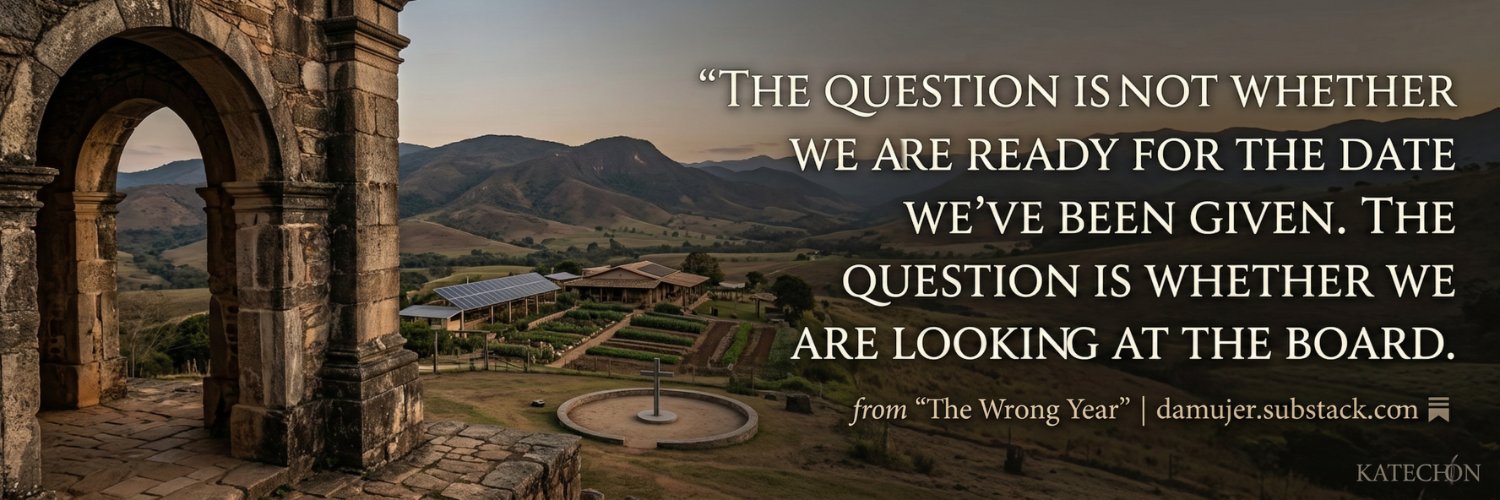
My third essay for The Katechon.
Post 1 was the geopolitical board. Post 2 was the eschatological framework. This one is the root beneath both.
It asks: what is the smallest thing the fire cannot burn?
Full essay: https://t.co/DabT4DLlAD
In 1969, a young theology professor named Joseph Ratzinger described the future of the Church on a Christmas radio broadcast.
He said it would become small. It would lose its buildings, its privileges, its cultural weight.
Then he said something no one was ready to hear.
You can be linked to eight billion people and known by none of them.
You can have infinite information and no truth.
You can be monitored every second and never once be seen.
That is the totally planned world. And the deep root is what survives it.
My second essay for The Katechon.
It may be wrong in its specifics. Every generation that has mapped Revelation onto its own time has been at least partially mistaken.
But if even a fraction of the pattern is accurate, the response is the same whether the culmination arrives in three years or thirty: repentance, prayer, and an interior freedom no system can penetrate.
Full essay: https://t.co/QSEdnLQGHE
On June 17, 1689, a consecration was requested of the King of France.
On June 17, 1789 — exactly one hundred years later — the French Revolution began.
This interval is historical fact, not theology. And it gets stranger from there.
"The question this theory poses is not 'When will the end come?' but 'Would you recognize the system if it arrived gradually, dressed in convenience, promising connection, efficiency, and security?'
Because the text suggests that most people will not."