Interesting...
First you asked, "how could something that wasn't lost be restored?"
I gave a clear example, which you rejected on the basis of what so far can only be described as insecurity.
You then asked for examples of proof of truth claims of the church. I offered several, which you are now rejecting because I apparently addressed the wrong unspecified truth claims.
It seems to me that you didn't expect to be called out. Now you are stuck shifting goalposts to maintain your pride. Does that seem like honest behavior? If you are not interested in a genuine conversation, you may freely exit the conversation anytime.
The Book of Mormon includes numerous historical claims previously believed to be anachronistic to the setting of the text which have since been confirmed through literary and archaeological evidence. A few of these examples include:
- Use of cement among Native American populations.
- Manufacture of steel swords in the Middle East as early as 600 B.C.
- Large scale warfare among Native Americans.
- Large scale cities and trade networks among Native Americans.
- Keeping of ancient records upon engraved metal plates in the Middle East.
Claims within the Pearl of Great Price now accepted as the mainstream view among non-LDS Biblical scholars:
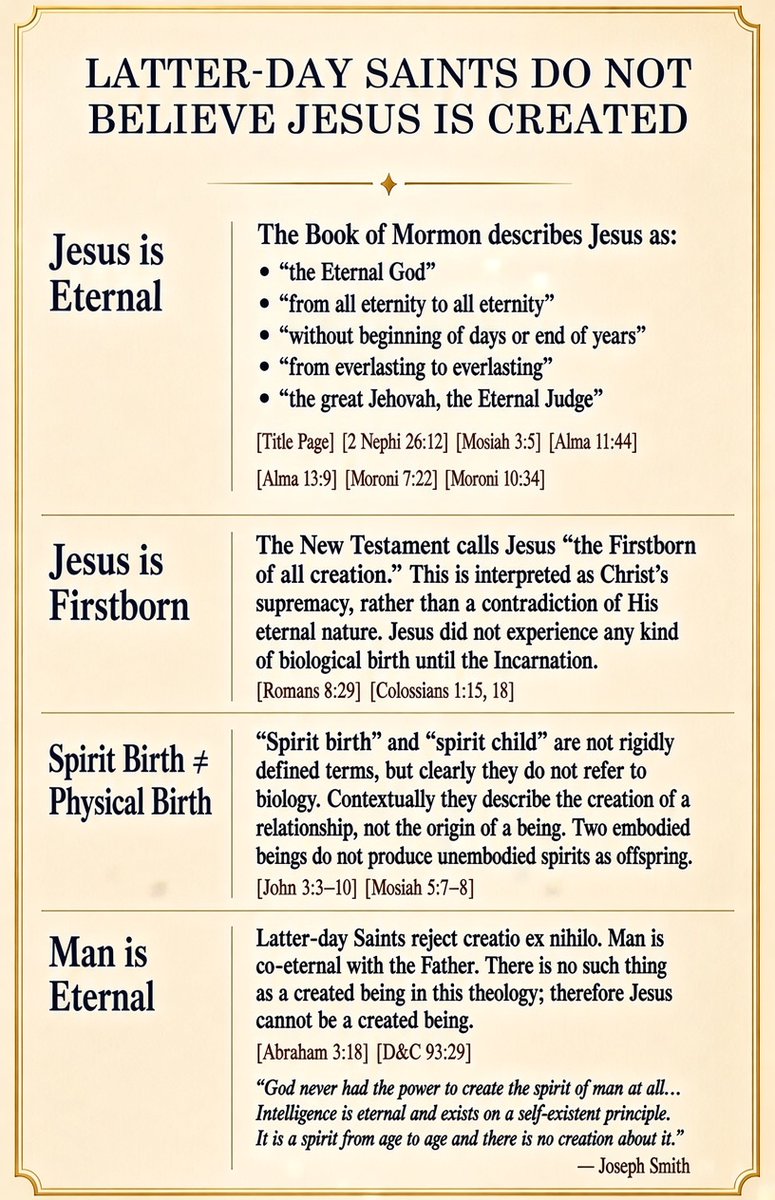
- The Hebrew conception of a Divine Council of many gods headed by the Most High God.
- Consistency with the narrative and other key aspects of The Book of Enoch.
- The understanding that Creatio Ex Nihilo is anachronistic to ancient Israelite theology.
Which of these would you like more detail on?
So... putting aside the fact that the analogy is a clear example of something that is restored without ever having been lost...
The reason you believe the analogy fails actually has nothing to do with the analogy itself. Rather, it has to do with your preconceived notions of what my personal thought process might be regarding the timing and efficacy of the restoration combined with your ignorance of the many proven claims that resulted from that restoration?
Fascinating...
@ArgusofTalmud@Darb_Seyah777 Obviously, The Church of Jesus Christ is not a car. That's how analogies work.
That wasn't the question, though. You asked how something could be restored without ever being lost.
Could you explain exactly where the analogy breaks down?
@moak_ryan Assuming you believe in Sola Scriptura, the Trinity, univocality of scripture, infallibility of scripture, the closure of the canon, and that nothing can come from God outside of the Bible, those would be six such examples...
@WardRadioShow:
"Hayden is crushing it! He's earning that planet today. Straight up space commander and Starbase Kolob right now. Bigfoot is Cain!"
Moderator:
"I'm gonna be honest, I don't know what all that means, but based, I guess."
Freaking legend.
https://t.co/c3qMC2sFCG
I'm sorry, are you trying to project? Are you trolling? I am not the one that has been adding any kind of theology in any of my posts. I've literally done nothing but provide the text and parrot the view of mainstream non-LDS scholars.
The Book of Mormon doesn't teach modalism unless you choose to impose it on passages out of context.
The Old Testament doesn't teach strict monotheism unless you choose impose it on passages out of context.
The Dead Sea Scrolls clearly reflect an evolving theology among the scribal class as reflected in well attested modifications to the text in later manuscripts.
Which part are you struggling to follow?
Christ is only called "the Father" in The Book of Mormon in two ways:
1. As the Creator, i.e. the Father of Heaven and Earth.
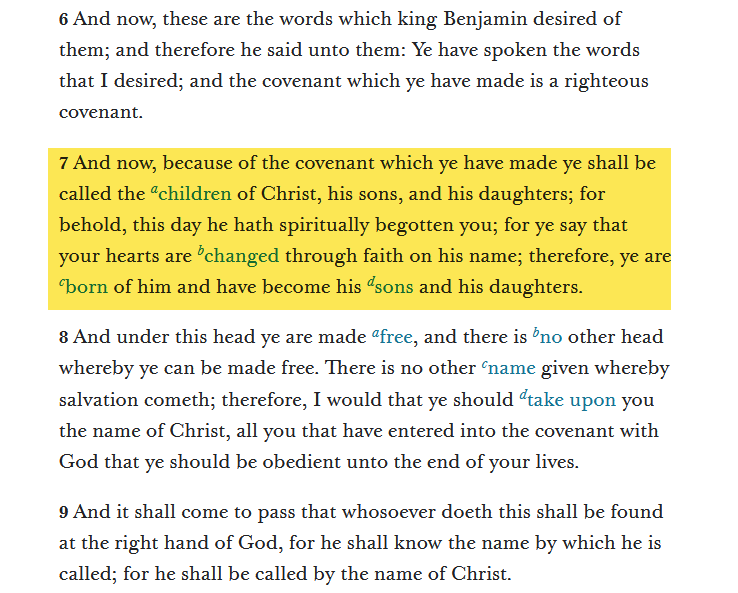
2. As the covenanted or spiritual Father of all Christians.
There is no passage within any version of The Book of Mormon that has ever implied modalism in context.
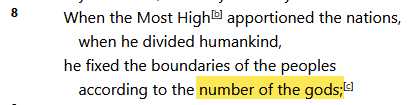
You really think the difference between these two statements is insignificant? Deuteronomy 32 is a key text which scholars use to prove the concept of the Divine Council in addition to the existence of multiple real gods in the Hebrew Bible. The overwhelming belief is that later redactors made this modification specifically to impose strict monotheism onto the text.
Regardless, there are several more examples, not the least of which being that the Dead Sea Scrolls include different versions of Isaiah and books not found in the Protestant canon.
If you think any of this is minor for a text some claim to be utterly infallible, strictly monotheist, and Trinitarian, then I guess we will just have to agree to disagree.
Could you give an example of any changes made to The Book of Mormon which have significant theological ramifications?