Welcome to MICCAI friends joining the ELAMI workshop! 🚀
Also, we warmly invite everyone to check out CyberNeuro.
Schedule: https://t.co/VGpfyZuzoZ
CyberNeuro/CyberBench: https://t.co/KiSkPoMIsR
#MICCAI2026#ELAMI#CyberNeuro#Neuroimaging#AI
🎉I am beyond excited to announce that our CyberNeuro platform.
Designed specifically as a local-first neuroimaging workbench for cutting-edge brain science, it completely revolutionizes how we handle massive scan cohorts. All your sensitive data stays safely on your local servers or institutional computing clusters, with zero cloud uploads. The peace of mind is next level!
The most thrilling part? We can finally say goodbye to memorizing tedious command-line scripts. Just tell our AI assistant Wanda what you need in plain, everyday language exactly like chatting with a colleague. Whether you're running classic pipelines or integrating your team's custom algorithms, Wanda automatically generates the execution plan, submits the jobs to your cluster scheduler, and even performs automated quality control (QC) across the entire cohort before the analysis begins.
This labor of love from our team at the University of North Carolina at Chapel Hill is now officially detailed in our paper on https://t.co/qCBav6cCkH and https://t.co/bnjeMkT6Ex. I truly cannot wait for neuroimaging colleagues worldwide to get their hands on it and experience the joy of fully liberated brain science research.
Come check out the platform https://t.co/2wG3ccC5dc and see it for yourself!
https://t.co/Q1fnN1PvW1
@NeuroscienceNew@UNC@unc@UNCPsychiatry
🚀 Excited to share Wanda, our agentic AI platform designed to automate routine neuroimaging data processing workflows.
By combining AI agents with domain-specific neuroimaging expertise, Wanda helps researchers streamline complex analyses, reduce manual effort, and accelerate scientific discovery.
We're looking forward to connecting with neuroimaging labs, sharing live demos, gathering feedback, and exploring new collaborations.
Paper:
https://t.co/bnjeMkT6Ex
https://t.co/qCBav6cCkH
🔗 Explore Wanda: https://t.co/2wG3ccC5dc
https://t.co/wSzYHprkvV
Thanks to the students' effort Shaoqi Wang Junhong Tong Ran Ren Yiyao Chen Yucheng Li Kunhao Zhou Xilin Yan Yunxi Kong Peter Sun
#ArtificialIntelligence #AgenticAI #Neuroimaging #MedicalAI #ResearchInnovation #Neuroscience
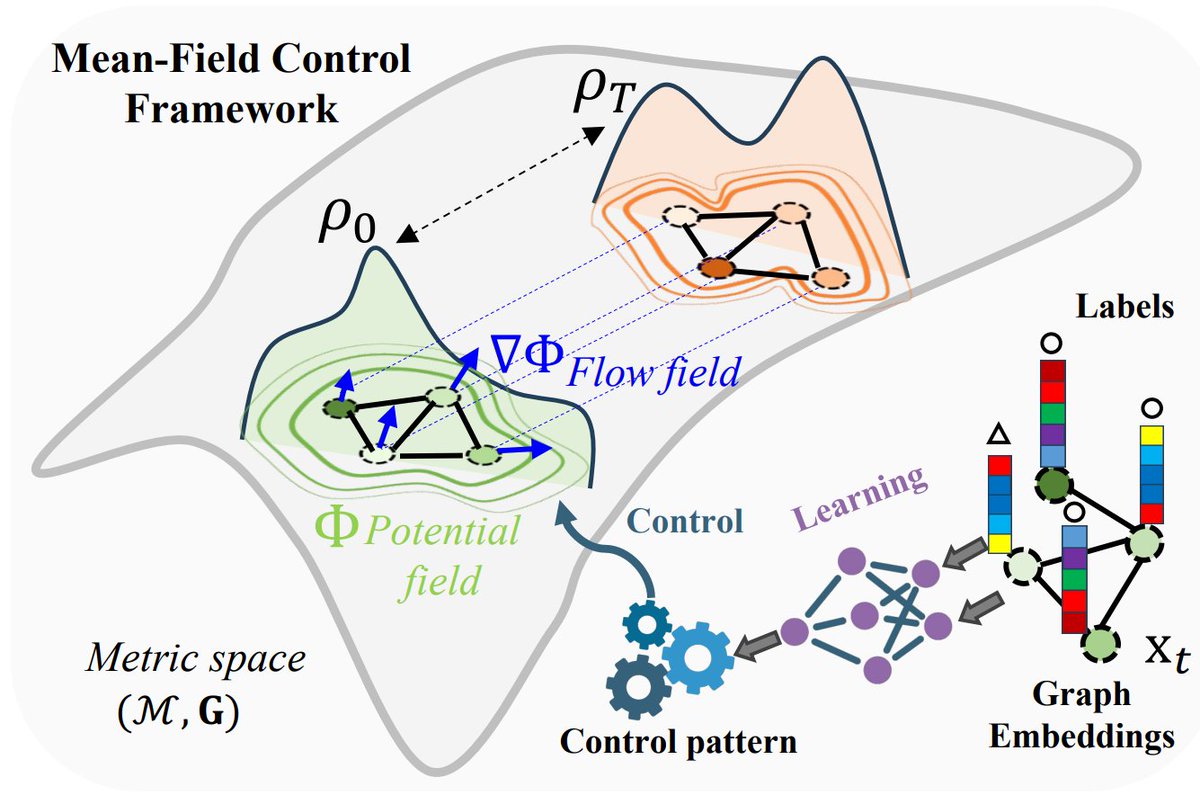
🚀 Out now in IEEE TPAMI! How can we make GNNs adaptively learn from unseen & heterophilic graphs?
We propose a Variational Mean-Field Control (MFC) framework for Graph Representation Learning! 🧵👇
🔍 The Problem: Standard GNNs use rigid message-passing that fails when relational biases conflict with graph properties (e.g., heterophily).
💡 Our Solution: We model graph learning as an MFC variational problem. Using PDE-characterized Hamiltonian flows, we jointly control: 1️⃣ Diffusive mobility (global propagation) 2️⃣ Reactive mobility (local transformation)
🏆 The Result: Our end-to-end Nash-GNN unifies existing PDE-based GNNs and delivers SOTA performance on heterophilic graphs & human connectomes!
🔗 Read the paper: https://t.co/xJUwSblF3Y
#GNN #MachineLearning #AI #TPAMI
Scale your neuroimaging pipelines without scaling your manual workload. 🚀
Introducing dcm2bids-skill — the open-source tool designed to automate raw neuroimaging data conversion into clean, analysis-ready BIDS datasets.
📁 Raw DICOM ➔ 📁 Aligned func/anat/dwi BIDS Structure in one command.
High-throughput ready, robust error handling, zero manual hassle.
🛡️ Tested & Proven on Major Cohorts: Validated across large-scale neuroimaging datasets including ADNI, ABCD, OASIS, UK Biobank, PPMI, and so on.
✅ 100% Automated Mapping: Raw DICOM to perfect BIDS layouts seamlessly.
✅ Smart Metadata Parsing: Lossless sidecar .json extraction out of the box.
✅ Robust Validation: Built-in integrity checks to eliminate human error.
➔ 💻 Get started: https://t.co/JPcOlINelX
#ReproducibleResearch #NeuroScience #Neuroimage #MRI #Coding #Skills
@UNC@UNCPsychiatry
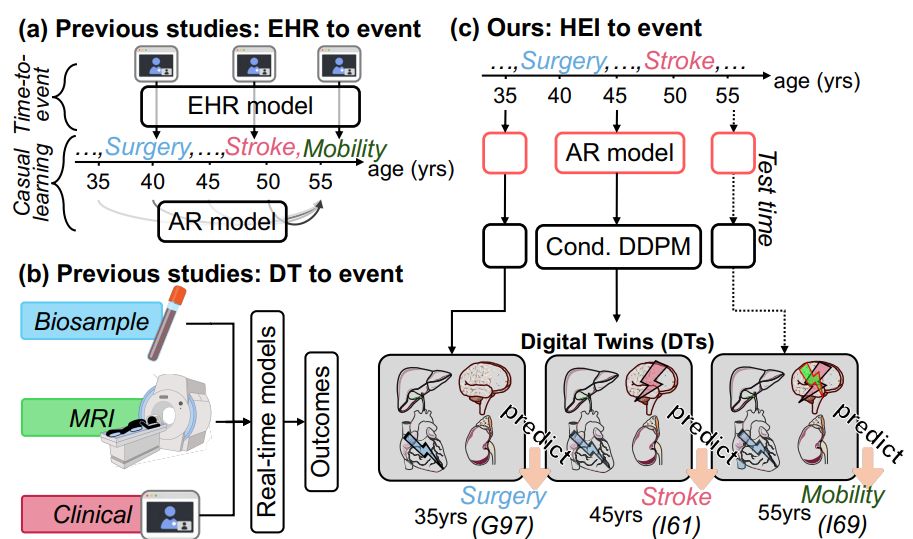
🧬 Excited to share our paper, "Marrying Generative Model of Healthcare Events with Digital Twin of Human-Environment Interaction for Disease Reasoning", accepted at #ICML2026!
Most generative models for disease prediction learn from electronic health records alone, sequences of ICD codes that capture "what" happened, but not the underlying physiology driving "why". We propose DiffDT to bridge this gap, since imaging traits, plasma biomarkers, and organ-level measurements are the actual biological signals clinicians reason over.
DiffDT is a conditioned latent diffusion framework that connects multi-organ sensor data with tokenized healthcare events, letting an autoregressive model mediate through a sensor-derived physiological state, a digital twin, rather than directly from event history.
A few things we're proud of:
🔗 A mediation inference mechanism, P(Future | Biomarker) · P(Biomarker | History), that enables multi-pathway disease reasoning rather than direct event-to-event prediction.
🧠 A geometric diffusion model for brain functional connectivity, which lives on the Riemannian manifold of SPD matrices. We use Cholesky decomposition in a VQ-VAE (SPD-VQVAE) to keep generations on the manifold while dramatically reducing the O(N³) cost of standard SPD approaches to O(N³).
📊 Validated for multi-organ biomarkers across heart, liver, and kidney from UK Biobank: 44,834 brain, 23,987 heart, 28,722 liver, and 32,155 kidney imaging samples, with ~500k medical history sequences spanning ages 25–89. DiffDT outperforms state-of-the-art autoregressive disease models and imaging-trait baselines, with the largest gains on the hardest cases, semantically distant past-future disease pairs where multi-pathway causality dominates.
https://t.co/8fxk7lBq9r
Congrats @ZiquanWei. See you in 2026!
#ICML2026 #MachineLearning #DigitalTwin #GenerativeAI #HealthcareAI #DiffusionModels #UKBiobank
🚀 Excited to share our latest work published in Medical Image Analysis: "Geo-Mamba: Geometry-informed state-space learning of functional brain organization."
We bridge the gap between selective SSMs and SPD manifolds to better model brain functional connectivity. 🧠✨
Highlights:
✅ Dual-path selective SSM on SPD manifolds.
✅ Diagonal pyramid extraction for anatomical priors.
✅ Competitive performance across 7 fMRI & 3 EEG datasets.
Read the full paper here: https://t.co/hxNDpULv9t
our code: https://t.co/T5PNBba1Di
#AI4Science #NeuroImaging #Mamba #DeepLearning #fMRI
@Exxactcorp We purchased a $178K server from Exxact Corporation in June. It began shutting down in 08 and by 12/25 was crashing almost every other day, disrupting our research. After months of communication and a return shipment at our expense, the problem remains unresolved. Please assist.
📢 Our lab is now recruiting PhD students
@UNC@unccs
for Fall 2026! 📷 computer science, medical image analysis, machine learning, bioinformatics, AI4science. See our website for more details: http://acmlab.orgPlease contact Dr. Wu.
📢 Our lab is now recruiting PhD students
@UNC@unccs for Fall 2025! 📷 computer science, medical image analysis, machine learning and bioinformatics, AI for science. See our website for more details: https://t.co/qX9CjQ7rnz. Please contact Dr. Wu.