@memetoro_mt Hi - you guys are running your SEO/content campaigns through crypto media outlets, where I can offer you a 40% discount from what you're currently paying. Trying to reach the right person on Telegram.
@Pepetocoin Sent a direct proposal to your operations desk regarding an allocation of premium, direct editorial slots on with publications you are already working with at a massive 50% discount.
This is genuinely impressive.
Gauth just dropped Atlas and it might be the end of textbooks.
Type any topic like "Silk Road," "how a camera works," "fall of Constantinople" and it builds you a hand-drawn, interactive visual world you can walk through.
No more reading walls of text. You explore knowledge like a map.
Here's how to use it (step by step): ↓
Your Hermes Agent can now build full videos with the official HyperFrames skill by @HeyGen
HyperFrames videos are HTML-native, so your agent has total control over the final output
Video made entirely by Hermes using the HyperFrames skill
This is one of the craziest AI launches of 2026 and it came out of basically nowhere (Save this).
A company called Subquadratic just shipped SubQ, and the benchmarks are almost hard to believe.
To understand why this is such a big deal, you have to understand the fundamental problem that has defined AI for the last decade.
Every large language model in existence is built on transformer architecture, and transformers use a mechanism called standard attention that checks every single word in a sequence against every other word.
Double the context length and compute doesn't double, it quadruples, triple it and compute goes up nine times.
This quadratic scaling is why frontier models have been stuck at roughly 1 million tokens, why running them at those lengths gets expensive fast, and why the AI labs have essentially been printing money charging you more the longer you need the model to think.
The industry has known this problem existed since 2017 but they scaled it anyway. SubQ is built from the ground up to solve it.
Instead of processing every possible token relationship, SubQ's sparse attention architecture identifies which relationships actually matter and ignores the rest meaning compute is used where it counts and wasted nowhere else.
The result is that compute scales linearly with context length instead of exponentially, and the implications of that one architectural shift are enormous.
At 12 million tokens, SubQ reduces attention compute by nearly 1,000x compared to standard frontier models and at 1 million tokens, it runs 52x faster than FlashAttention.
And it does all of this while posting frontier level accuracy, scoring 95% on the RULER 128K long-context benchmark versus Claude Opus 4.6's 94.8%, and an 81.8 on SWE-Bench Verified coding tasks, besting Opus 4.6 (80.8) and DeepSeek 4.0 Pro.
The cost comparison is where it gets genuinely insane.
SubQ runs at under $1.50 per million tokens less than 5% of what Claude Opus charges.
On the RULER benchmark, running the test with SubQ cost $8, running the same test with Claude Opus cost $2,600 and that's a 300x cost reduction at equivalent or better accuracy..
Subquadratic launched with $29 million in funding, SubQ is available today for early access via API, and SubQ Code, a coding agent built on the architecture ships alongside it.
The transformer has been the unchallenged foundation of every major AI system since 2017.
SubQ is the first serious evidence that something structurally better might have just arrived.
If Dawkins had said, 'AI is just a calculator,' would anyone have shared it? Exactly. The algorithm doesn't amplify truth. It amplifies debate. #AlgoWars@RichardDawkins
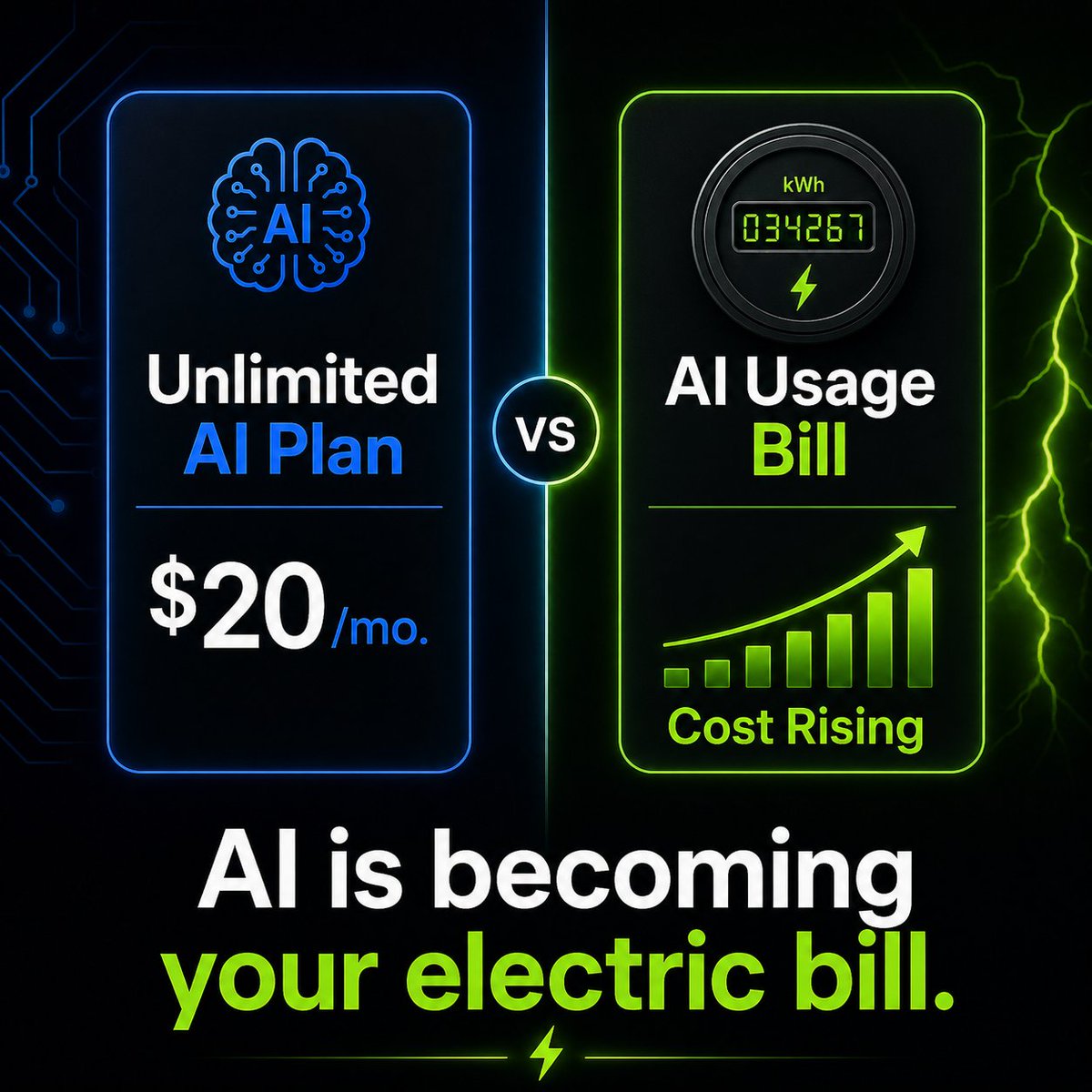
AI is becoming less like Netflix and more like your electric bill.
The more you use, the more you pay.
GitHub just made it obvious: Copilot moves to usage-based billing on June 1st.
Sam Altman said token pricing may not make sense long term.
The subsidy era is ending.
@ChrisLaubAI Fair point. But you already mentioned above in the comments that you don't care about what happens to companies outside the US, so fair enough. Agree that US enterprises won't touch Deepseek.
Kimi k2.6 used DeepSeek’s v3 architecture. DeepSeek v4 used kimi's muon optimiser. 1.6 trillion parameters & 1M context - both match or beat closed models on benchmarks while being 8x cheaper. Both build on each other's breakthroughs. Both keep shipping frontier LLMs w far less & nerfed NVIDA GPUs.
China’s full domestic stack/ecosystem chip-model-cloud is now on full speed.
Debate on distillation all you want. The dragon 🐉 is fully awake & good luck stopping it.
Unlike OpenAI and Anthropic, Deepseek kept working for 16 months behind the scenes, avoiding the limelight, with incremental updates. One release. One announcement. The AI War is now officially over.
https://t.co/kgnMkIfUoQ
Do you actually realize what's happening?
Deepseek just dropped a 1.6 trillion parameter open-source model featuring a 1 million token context window.
OpenAI is charging $200/month.
but China is giving it away completely free.
Let that sink in.
☠️ ANTHROPIC HAT GERADE EBAY ERLEDIGT!
Das ist der Chart von $EBAY. Minus 5,3 Prozent. An einem Tag. Von $103,40 runter auf $97,94. Kein Earnings. Kein Skandal. Kein Insider-Verkauf. Nur ein Forschungs-Paper von Anthropic.
"Project Deal" heißt das Ding.
Anthropic hat in seinem San-Francisco-Büro einen Marktplatz für die eigenen Mitarbeiter gebaut. 69 Leute. Je 100 Dollar Budget. Klassisches Craigslist-Setup. Nur mit einem Twist: Die Verhandlungen führt Anthropic. Nicht der Mensch. Die KI kauft, verkauft, dealt für dich. 186 Transaktionen in einer Woche, über 4.000 Dollar Volumen.
Und ein interessantes Detail aus dem Paper: Wer einen schwächeres Modell bekam, machte nachweislich schlechtere Deals. Hat es aber selbst nicht gemerkt.
Klingt nach Büro-Spielerei. Ist es nicht.
Es ist ein Proof of Concept dafür, dass jeder Marktplatz im Netz austauschbar ist. eBay verdient Geld weil Menschen eBay brauchen, um zu handeln. Was, wenn Menschen nichts mehr machen müssen?
Wall Street hat verstanden. Sofort.
Alles, was Marktplatz ist betroffen. Salesforce ist seit Januar 33 Prozent runter, weil "Claude Cowork" die ganze CRM-Industrie in Frage gestellt hat. Adobe minus 36. ServiceNow gerade von UBS auf Neutral runtergestuft. Der Software-Index IGV ist 35 Prozent unter seinem Hoch.
Eine ganze Branche wird vor unseren Augen umgeschrieben.
Wall Street hat dafür schon einen Namen. SaaSpocalypse. Seit Januar 2026 sind ungefähr 2 Billionen US-Dollar aus der Software-Wirtschaft verdampft. Zwei Billionen. Und das Spiel fängt grade erst an.
Was Wall Street gerade einpreist: Pro-Seat-Lizenzen verlieren ihren Sinn, wenn ein Agent eine ganze Abteilung ersetzt. Plattform-Take-Rates kollabieren, sobald Agenten direkt mit Agenten verhandeln. Werbung verliert ihre Logik in einem Markt ohne menschliche Klicker. Was bleibt sind Infrastruktur-Anbieter, Daten-Besitzer und die Modell-Hersteller selbst.
Und genau da kommt der nächste Schlag.
Anthropic hat letzte Woche Opus 4.7 vorgestellt. Sonnet 5 ist seit Anfang April live. Das Roadmap-Leak von vor zwei Monaten zeigt interne Referenzen auf Sonnet 4.8 und Claude 5 - geplant für den Sommer. Google hat parallel angekündigt, bis zu 40 Milliarden Dollar in Anthropic zu investieren. Das ist ein All-In auf die Disruption der eigenen Cloud-Kunden.
Bei OpenAI läuft das gleiche Spiel, nur lauter. Sam Altman hat im März bei BlackRock öffentlich gesagt, sie trainieren in Abilene, Texas, das nach eigener Einschätzung beste Modell der Welt. Übersetzt: GPT-6. Release-Fenster: Ende Mai. Was die Modelle laut Roadmap können sollen? Selbstständige Workflows. Bezahlsysteme. Buchungen. Verhandlungen. Komplexe Transaktionsketten ohne menschliche Aufsicht. OpenAI hat parallel mit Etsy und Shopify die ersten Pilot-Integrationen für agentic shopping gestartet. Du sagst ChatGPT was du brauchst, ChatGPT kauft. Ohne Klick auf Etsy.
Und du musst dir die Frage stellen, welches Geschäftsmodell das überlebt.
Marktplätze überleben so nicht. Wenn ein Agent für mich kauft, brauche ich keine Plattform mit Suchfunktion und Verkäufer-Reviews. SaaS-Lizenzen pro Sitzplatz fallen genauso. Wenn 10 Agenten die Arbeit von 100 Sales-Reps erledigen, braucht keiner mehr 100 Salesforce-Logins. Werbung wird ein Nullsummenspiel. Agenten klicken keine Anzeigen.
Wie schnell diese Unternehmen sterben, ist die einzige offene Frage.
Ich sehe drei Szenarien.
⚠️ Erstens: Die Plattformen integrieren die Agenten und werden selbst zur Infrastruktur. eBay wird zum reinen Settlement-Layer für Claude und GPT. Möglich. Aber die Margen brechen weg.
⚠️ Zweitens: Die Plattformen sterben langsam und Anthropic plus OpenAI werden selbst zum neuen Marktplatz. Wahrscheinlich. Wer die Schnittstelle besitzt, besitzt den Kunden. Und die zwei sammeln gerade die Schnittstellen ein.
⚠️ Drittens: Eine ganz neue Asset-Klasse setzt sich durch. On-Chain. Programmierbar. Permissionless. Wo Agenten ohne Custodian und ohne Plattform handeln können. Krypto war von Anfang an für eine Welt gebaut, in der Maschinen Geld bewegen. Keine andere Schiene kann das aktuell.
Ich bin etwas besorgt 🫠.
https://t.co/no3JK9V7iH
Three Chinese AI labs. Three frontier models. All three were released to the public within the last week. All open source. All are free or cheaper than any American equivalent.
DeepSeek V4. Kimi K2.6. Qwen3.6.
This can't be a coincidence. It's a strategy.
@AnjaneyaCMishra@cryptopunk7213 Don't think hobbyists are going to bother in the first place. But even a decent SMB setup should be able to afford it without breaking the bank.
@cryptopunk7213 Yeah, just wondering about the long-term implications of this commoditization of LLMs. Because the timing can't be a coincidence when every nation is jumping to build its own AI, particularly the Global South.
i mean this is just insane
google and amazon now collectively own ~39% of anthropic
anthropic’s biggest competitor google is investing $40 billion in a bid to launch claude mythos to the public.
new deal gives them $10B upfront, targeting 5GW of compute in 2027
comes right after Amazon’s $5B investment this week…
no secret anthropic under-invested in scaling compute to train and serve their models
race is on to beat openAI after a p impressive gpt 5.5 launch
@cryptopunk7213 Yeah, just wondering about the long-term implications of this commoditization of LLMs. Because the timing can't be a coincidence when every nation is jumping to build its own AI, particularly the Global South.
@dhruvtwt_@nvidia This is not available for everyone yet. I am hopeful that they will add Pakistane because I don't want to circumvent the system for no reason.
🚀 DeepSeek-V4 Preview is officially live & open-sourced! Welcome to the era of cost-effective 1M context length.
🔹 DeepSeek-V4-Pro: 1.6T total / 49B active params. Performance rivaling the world's top closed-source models.
🔹 DeepSeek-V4-Flash: 284B total / 13B active params. Your fast, efficient, and economical choice.
Try it now at https://t.co/GCdiMzk1Dl via Expert Mode / Instant Mode. API is updated & available today!
📄 Tech Report: https://t.co/drlDrxkYtp
🤗 Open Weights: https://t.co/T13Y8i7SDM
1/n