DANCHI-GOURMET INSIGHTS
━━━━━━━━━━━━━━
Independent perspectives on global business, markets, and technology for US and worldwide audiences.
━━━━━━━━━━━━━━
TODAY’S FEATURED INSIGHT
AI & INFRASTRUCTURE | CoreWeave’s growth test: demand is real, but financing is the risk
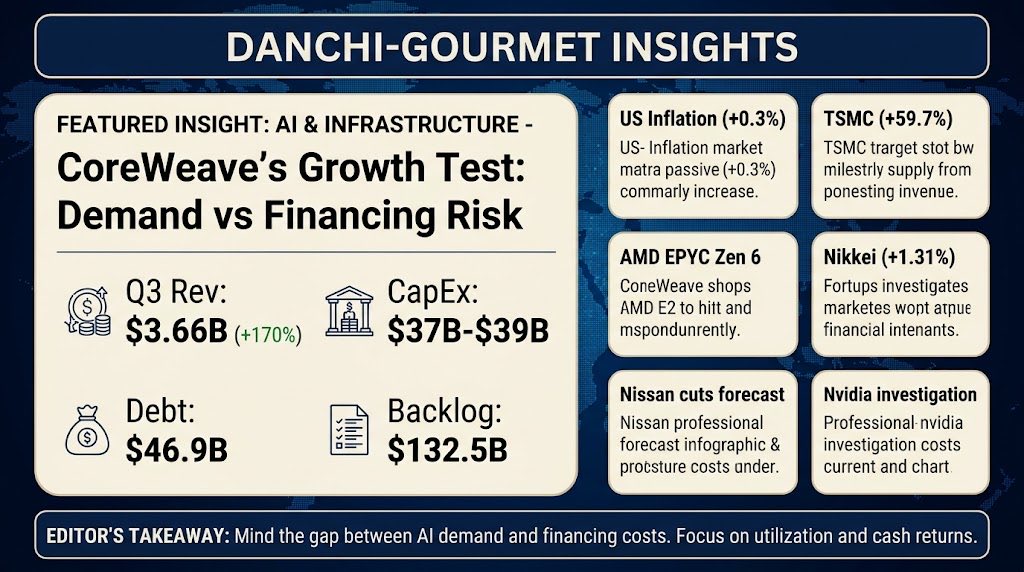
CoreWeave’s third-quarter revenue rose nearly 170% year over year to $3.66 billion, beating estimates. The company lifted its 2026 revenue outlook to $13.0–$13.3 billion and expects to exit the year at a $20–$21 billion annualized revenue run rate. Its backlog reached $132.5 billion, up from $104 billion in June.
The figures confirm strong AI-computing demand, but expose the economics: CoreWeave expects to spend $37–$39 billion on capital investment this year, reported $46.9 billion of debt at September-end, and expects fourth-quarter interest expense of $1.05–$1.15 billion. Management says customer commitments and about $9 billion in near-term customer prepayments support its funding plan. It targets adjusted profitability in the first half of 2028.
Demand is not the same as returns. A large backlog is not the same as cash already collected, and rapid capacity expansion requires power, chips, data centers and financing before all revenue is recognized. If utilization and pricing hold up, CoreWeave can turn scarce capacity into durable cash flow. If customers delay deployments or AI spending cools, high fixed costs and interest expense could magnify losses.
Nvidia benefits from demand for accelerators, while AMD and other suppliers can gain as cloud operators diversify hardware. Hyperscalers such as Microsoft, Amazon and Google have deeper balance sheets and can build internally, putting pressure on specialist providers’ pricing and financing costs. The winners may therefore be companies that combine high utilization with lower-cost capital—not simply those buying the most GPUs.
For US investors, CoreWeave is a stress test for the AI cycle. Its results validate demand, but do not yet prove attractive returns on the capital required. Watch backlog conversion, customer concentration, cash flow, debt costs and data-center power availability.
Is the AI infrastructure boom becoming a durable earnings engine, or is growth still running ahead of its financing model?
OTHER GLOBAL NEWS
🇺🇸 UNITED STATES — October US core inflation rose 0.3% month over month, above the 0.2% forecast. Markets increased bets on a December Fed hike, lifting Treasury yields and the dollar.
🇹🇼 TAIWAN — TSMC’s October revenue climbed 59.7% year over year to NT$586.9 billion, reinforcing evidence that AI-chip demand is flowing through the semiconductor supply chain.
🇺🇸 UNITED STATES — AMD made its sixth-generation EPYC server processors, based on Zen 6, generally available, targeting cloud, enterprise and AI workloads as data-center CPU competition intensifies.
🇯🇵 JAPAN — The Nikkei 225 gained 789 points, or 1.31%, to 61,248.59, with 836 advancers versus 668 decliners.
🇯🇵 JAPAN — Nissan cut its global sales forecast to 2.97–3.0 million vehicles as sales in China weakened sharply, highlighting the pressure from local EV and hybrid competitors.
🌍 GLOBAL — Nvidia’s independent directors hired outside counsel to investigate allegations involving CEO Jensen Huang; the claims remain unproven, and the company says it has no reason to believe secrets were compromised.
EDITOR’S NOTE
Today’s signals point to a widening gap between AI demand and the cost of supplying it. Chipmakers and infrastructure providers are seeing strong orders, but higher interest rates raise the hurdle for every data-center project. The next phase of the AI trade will depend less on headline spending and more on utilization, cash generation and returns on invested capital.