LLMs still use web_search for cases where specific tools exist. Why?
In the world of tools for everything, discovering the right tool is a problem itself.
Intuition goes towards system one models to solve this but they have a different limitation.
How are you handling this for your agents?
AI agents made 68.3 million stablecoin payments in Q3, double the quarter before, by Allium’s count.
Together they were worth about $3.7 million. That’s roughly 5 cents a payment. The average stablecoin payment this year was $462.
So agent payments are a count story, not a dollar story, and I think that’s the right shape. An agent buying data pays per call.
What I’d watch instead: how many of those payments come from buyers who come back, and how many sellers each buyer pays. Tiny payments are easy to inflate, so a count alone says little.
Fifteen issuers now hold more than $1B of supply, up from eleven in December.
David Walsh from @ethereuminsti shared his perspective in our Q3 State of Stablecoins & Payments report.
Read the full quote:
https://t.co/2EUeejsrQG
Agent commerce, this month:
One airline: agents can’t book flights.
Rides: 4 agent bookings in a week.
Food delivery: 500.
Can’t fly, won’t drive, keeps ordering in.
Agents are ready for a remote job.
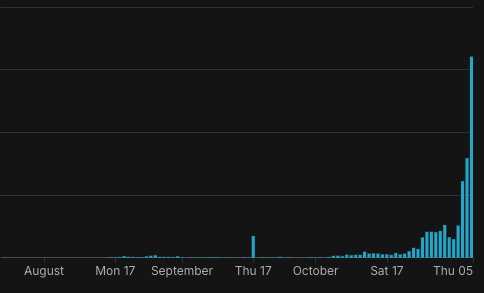
Agentic payment volume (x402) on Base is up, to the right 📈.
This isn't just more transactions, bigger ones too, with a $30 median.
Real businesses providing services to users who expect their agents to have full autonomy.
An agentic strategy is no-longer optional.
Two AI models can get about the same number of answers right and still act very differently in your product.
Think of two coworkers who are both right about 9 times out of 10. One says “I’m sure” all the time. The other rarely says it.
Now give them a rule: go ahead whenever you’re sure. The first one acts far more often, even though they’re about equally good.
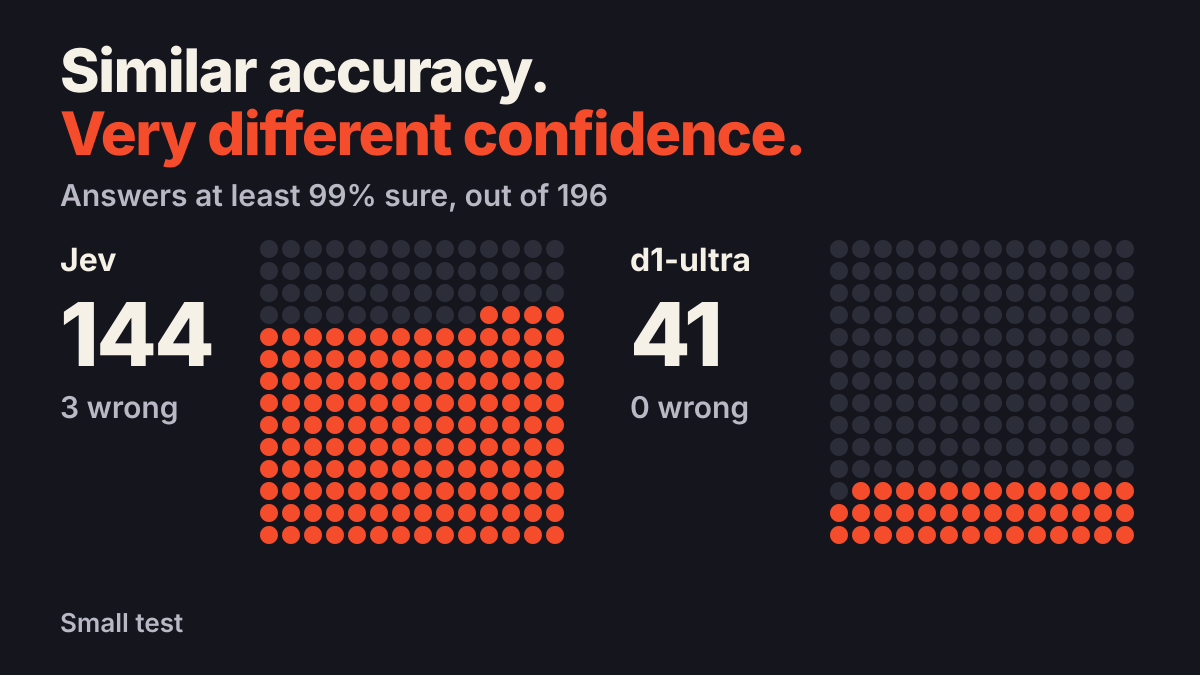
One small test found this with two decision models, @typesafeai Jev and @liquidau d1-ultra. Instead of writing a reply, these models give an answer with a confidence score.
Out of 196 answers, Jev was at least 99% sure on 144. d1-ultra was at least 99% sure on 41. Overall accuracy was close. At that level of confidence, Jev got 3 wrong and d1-ultra got none.
Here’s how I think that plays out when an agent picks tools.
Buying something. Say your rule is “if the model is 99% sure, buy the paid report without asking.” With d1-ultra, the agent will probably stop and check more often. That’s slower, but a wrong purchase costs money.
Making a shortlist. Say the agent has hundreds of tools and needs a few that might help. Leaving out the right tool is the bigger mistake, so you’d keep anything plausible, using a much lower bar. This test says little about that range.
Switching models. A 99% from one model doesn’t behave like a 99% from another. Swap the model and your agent changes, even if your code didn’t. Retest your rule first. It’s also why our tool search plan avoids “latest” model names: they can change underneath you.
My beliefs going into 2027
1. Models will be 10x smarter, 100x faster and 1000x cheaper. You need to build into that future.
2. The cost to create new software is going to 0. What remains are capital, network and distribution. Twitter engineering will be more important than software engineering. People that can drive the right eye balls and users are extraordinarily valuable. The same has happened to the music industry a decade ago. No one makes money on Spotify. They make money on concerts and merch.
3. Obviously agents will spend trillions on the internet.
4. Assistants are the native interface to everything in the digital world. Online first becomes agent first. Interfaces become irrelevant. I personally switched from Revolut to Chase just because ChatGPT has better access. Your nice UI and fancy animations do not matter anymore. No one will open the Gmail or Chase app ever again.
5. Every single line of human written code is a liability. Agents will have to re-write everything. Autonomous 24/7 agentic auditing is the only defence.
6. Social and entertainment remain and become even more important. AI does not replace doom scrolling or dating apps.
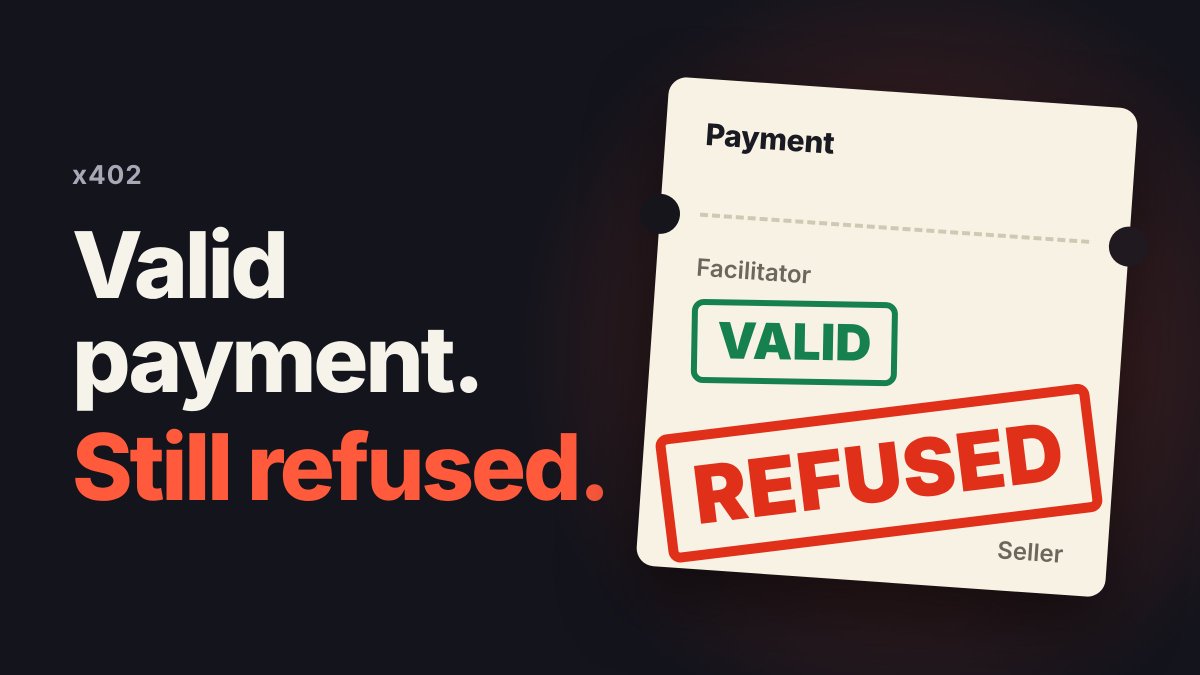
An x402 payment can be valid and still get refused.
That happened to us this week. One seller answered every payment we signed with “Verification error” and never settled it, so we pulled its tool from our catalog.
It’s easy to assume a refused payment means you signed it wrong. But x402 has two separate decisions. A facilitator checks whether the payment meets the seller’s stated terms. Then the seller decides whether to do the work.
So we checked each piece:
We sent the same payment to the facilitator’s verify step. It came back valid.
The seller’s retry named the same deposit address we had signed the payment to.
The same wallet and code pay six other sellers.
The x402 directory showed no settled call to this seller since Nov 1.
That last check is my favorite. Because the payment record is public, a buyer can ask whether anyone is getting through.
We still don’t know the cause. The timing fits the seller’s move to a new deposit address for each request, but that’s a guess.
Agentic payments are just beginning. It's soon going to be many services fastest growing revenue channel.
They'll be 1000x the number of agents on the Internet as humans.
I asked Claude to summarize 2 X posts. Direct access was blocked, as expected. We already had a tool that reads X posts, but Claude didn’t use it until prompted.
If an agent takes minutes and still fails, it may just be using the wrong tool.
Had a chat about ideas with one of the partner at YC in NYC.
10 minutes in, they said the same advice that I've been reading across the internet.
"Stop thinking and start building. You can have a v0 in 1 day."
And since that day my GitHub has become a green forest.