Extract from the Book "Thinking & Destiny" by Harold Waldwin Percival https://t.co/SlYeM895Gs
Author’s Foreword
This book was dictated to Benoni B. Gattell at intervals between the years 1912 and 1932. Since then it has been worked over again and again. Now, in 1946, there are few pages that have not been at least slightly changed. To avoid repetitions and complexities entire pages have been deleted, and I have added many sections, paragraphs and pages.
Without assistance, it is doubtful whether the work would have been written, because it was difficult for me to think and write at the same time. My body had to be still while I thought the subject matter into form and chose appropriate words to build out the structure of the form: and so, I am indeed grateful to him for the work he has done. I must also here acknowledge the kind offices of friends, who desire to remain unnamed, for their suggestions and technical assistance in completing the work.
A most difficult task was to get terms to express the recondite subject matter treated. My arduous effort has been to find words and phrases that will best convey the meaning and attributes of certain incorporeal realities, and to show their inseparable relation to the conscious selves in human bodies. After repeated changes I finally settled on terms used herein.
Many subjects are not made as clear as I would like them to be, but the changes made must suffice or be endless, because on each reading other changes seemed advisable.
I do not presume to preach to anyone; I do not consider myself a preacher or a teacher. Were it not that I am responsible for the book, I would prefer that my personality be not named as its author. The greatness of the subjects about which I offer information, relieves and frees me from self-conceit and forbids the plea of modesty. I dare make strange and startling statements to the conscious and immortal self that is in every human body; and I take for granted that the individual will decide what he will or will not do with the information presented.
Thoughtful persons have stressed the need of speaking here of some of my experiences in states of being conscious, and of events of my life which might help to explain how it was possible for me to be acquainted with and to write of things that are so at variance with present beliefs. They say this is necessary because no bibliography is appended and no references are offered to substantiate the statements herein made. Some of my experiences have been unlike anything I have heard of or read. My own thinking about human life and the world we live in has revealed to me subjects and phenomena I have not found mentioned in books. But it would be unreasonable to suppose that such matters could be, yet be unknown to others. There must be those who know but cannot tell. I am under no pledge of secrecy. I belong to no organization of any kind. I break no faith in telling what I have found by thinking; by steady thinking while awake, not in sleep or in trance. I have never been nor do I ever wish to be in trance of any kind.
What I have been conscious of while thinking about such subjects as space, the units of matter, the constitution of matter, intelligence, time, dimensions, the creation and exteriorization of thoughts, will, I hope, have opened realms for future exploration and exploitation. By that time right conduct should be a part of human life, and should keep abreast of science and invention. Then civilization can continue, and Independence with Responsibility will be the rule of individual life and of Government.
Here is a sketch of some experiences of my early life:
Rhythm was my first feeling of connection with this physical world. Later on I could feel inside the body, and I could hear voices. I understood the meaning of the sounds made by the voices; I did not see anything, but I, as feeling, could get the meaning of any of the word-sounds expressed, by the rhythm; and my feeling gave the form and color of the objects which were described by words. When I could use the sense of sight and could see objects, I found the forms and appearances which I, as feeling, had felt, to be in approximate agreement with what I had apprehended. When I was able to use the senses of sight, hearing, taste and smell and could ask and answer questions, I found myself to be a stranger in a strange world. I knew I was not the body I lived in, but no one could tell me who or what I was or where I came from, and most of those whom I questioned seemed to believe they were the bodies in which they lived.
I realized that I was in a body from which I could not free myself. I was lost, alone, and in a sorry state of sadness. Repeated happenings and experiences convinced me that things were not what they appeared to be; that there is continued change; that there is no permanence of anything; that people often said the opposite of what they really meant. Children played games they called “make-believe” or “let us pretend.” Children played, men and women practiced make-believe and pretense; comparatively few people were really truthful and sincere. There was waste in human effort, and appearances did not last. Appearances were not made to last. I asked myself: How should things be made that will last, and made without waste and disorder? Another part of myself answered: First, know what you want; see and steadily hold in mind the form in which you would have what you want. Then think and will and speak that into appearance, and what you think will be gathered from the invisible atmosphere and fixed into and around that form. I did not then think in these words, but these words express what I then thought. I felt confident I could do that, and at once tried and tried long. I failed. On failing I felt disgraced, degraded, and I was ashamed.
I could not help being observant of events. What I heard people say about things that happened, particularly about death, did not seem reasonable. My parents were devout Christians. I heard it read and said that “God” made the world; that he created an immortal soul for each human body in the world; and that the soul who did not obey God would be cast into hell and would burn in fire and brimstone for ever and ever. I did not believe a word of that. It seemed too absurd for me to suppose or believe that any God or being could have made the world or have created me for the body in which I lived. I had burned my finger with a brimstone match, and I believed that the body could be burned to death; but I knew that I, what was conscious as I, could not be burned and could not die, that fire and brimstone could not kill me, though the pain from that burn was dreadful. I could sense danger, but I did not fear.
People did not seem to know “why” or “what,” about life or about death. I knew that there must be a reason for everything that happened. I wanted to know the secrets of life and of death, and to live forever. I did not know why, but I could not help wanting that. I knew that there could be no night and day and life and death, and no world, unless there were wise ones who managed the world and night and day and life and death. However, I determined that my purpose would be to find those wise ones who would tell me how I should learn and what I should do, to be entrusted with the secrets of life and death. I would not even think of telling this, my firm resolve, because people would not understand; they would believe me to be foolish or insane. I was about seven years old at that time.
Fifteen or more years passed. I had noticed the different outlook on life of boys and girls, while they grew and changed into men and women, especially during their adolescence, and particularly that of my own. My views had changed, but my purpose—to find those who were wise, who knew, and from whom I could learn the secrets of life and death—was unchanged. I was sure of their existence; the world could not be, without them. In the ordering of events I could see that there must be a government and a management of the world, just as there must be the government of a country or a management of any business for these to continue. One day my mother asked me what I believed. Without hesitation I said: I know without doubt that justice rules the world, even though my own life seems to be evidence that it does not, because I can see no possibility of accomplishing what I inherently know, and what I most desire.
In that same year, in the spring of 1892, I read in a Sunday paper that a certain Madam Blavatsky had been a pupil of wise men in the East who were called “Mahatmas”; that through repeated lives on earth, they had attained to wisdom; that they possessed the secrets of life and death, and that they had caused Madam Blavatsky to form a Theosophical Society, through which their teachings could be given to the public. There would be a lecture that evening. I went. Later on I became an ardent member of the Society. The statement that there were wise men—by whatever names they were called—did not surprise me; that was only verbal evidence of what I inherently had been sure of as necessary for the advancement of man and for the direction and guidance of nature. I read all that I could about them. I thought of becoming a pupil of one of the wise men; but continued thinking led me to understand that the real way was not by any formal application to anybody, but to be myself fit and ready. I have not seen or heard from, nor have I had any contact with, “the wise ones” such as I had conceived. I have had no teacher. Now I have a better understanding of such matters. The real “Wise Ones” are Triune Selves, in The Realm of Permanence. I ceased connection with all societies.
From November of 1892 I passed through astonishing and crucial experiences, following which, in the spring of 1893, there occurred the most extraordinary event of my life. I had crossed 14th Street at 4th Avenue, in New York City. Cars and people were hurrying by. While stepping up to the northeast corner curbstone, Light, greater than that of myriads of suns opened in the center of my head. In that instant or point, eternities were apprehended. There was no time. Distance and dimensions were not in evidence. Nature was composed of units. I was conscious of the units of nature and of units as Intelligences. Within and beyond, so to say, there were greater and lesser Lights; the greater pervading the lesser Lights, which revealed the different kinds of units. The Lights were not of nature; they were Lights as Intelligences, Conscious Lights. Compared with the brightness or lightness of those Lights, the surrounding sunlight was a dense fog. And in and through all Lights and units and objects I was conscious of the Presence of Consciousness. I was conscious of Consciousness as the Ultimate and Absolute Reality, and conscious of the relation of things. I experienced no thrills, emotions, or ecstasy. Words fail utterly to describe or explain CONSCIOUSNESS. It would be futile to attempt description of the sublime grandeur and power and order and relation in poise of what I was then conscious. Twice during the next fourteen years, for a long time on each occasion, I was conscious of Consciousness. But during that time I was conscious of no more than I had been conscious of in that first moment.
Being conscious of Consciousness is the set of related words I have chosen as a phrase to speak of that most potent and remarkable moment of my life.
Consciousness is present in every unit. Therefore the presence of Consciousness makes every unit conscious as the function it performs in the degree in which it is conscious. Being conscious of Consciousness reveals the “unknown” to the one who has been so conscious. Then it will be the duty of that one to make known what he can of being conscious of Consciousness.
The great worth in being conscious of Consciousness is that it enables one to know about any subject, by thinking. Thinking is the steady holding of the Conscious Light within on the subject of the thinking. Briefly stated, thinking is of four stages: selecting the subject; holding the Conscious Light on that subject; focusing the Light; and, the focus of the Light. When the Light is focused, the subject is known. By this method, Thinking and Destiny has been written.
The special purpose of this book is: To tell the conscious selves in human bodies that we are inseparable doer parts of consciously immortal individual trinities, Triune Selves, who, within and beyond time, lived with our great thinker and knower parts in perfect sexless bodies in the Realm of Permanence; that we, the conscious selves now in human bodies, failed in a crucial test, and thereby exiled ourselves from that Realm of Permanence into this temporal man and woman world of birth and death and re-existence; that we have no memory of this because we put ourselves into a self-hypnotic sleep, to dream; that we will continue to dream through life, through death and back again to life; that we must continue to do this until we de-hypnotize, wake, ourselves out of the hypnosis into which we put ourselves; that, however long it takes, we must awake from our dream, become conscious of ourselves as ourselves in our bodies, and then regenerate and restore our bodies to everlasting life in our home—The Realm of Permanence from which we came—which permeates this world of ours, but is not seen by mortal eyes. Then we will consciously take our places and continue our parts in the Eternal Order of Progression. The way to accomplish this is shown in chapters which follow.
At this writing the manuscript of this work is with the printer. There is little time to add to what has been written. During the many years of its preparation it has been often asked that I include in the text some interpretations of Bible passages which seem incomprehensible, but which, in the light of what has been stated in these pages, make sense and have meaning, and which, at the same time, corroborate statements made in this work. But I was averse to make comparisons or show correspondences. I wanted this work to be judged solely on its own merits.
In the past year I bought a volume containing “The Lost Books of the Bible and The Forgotten Books of Eden.” On scanning the pages of these books, it is astonishing to see how many strange and otherwise incomprehensible passages can be comprehended when one understands what is herein written about the Triune Self and its three parts; about the regeneration of the human physical body into a perfected, immortal physical body, and the Realm of Permanence,—which in the words of Jesus is the “Kingdom of God.”
Again requests have been made for clarifications of Bible passages. Perhaps it is well that this be done and also that the readers of Thinking and Destiny be given some evidence to corroborate certain statements in this book, which evidence may be found both in the New Testament and in the books above mentioned. Therefore I will add a fifth section to Chapter X, “Gods and their Religions,” dealing with these matters.
H. W. P.
New York, March 1946
**The Human Systems Law**
“Humans should protect, improve, and responsibly develop the systems that sustain and enrich interdependent relationships, communities, living beings, and the non-living environment upon which present and future flourishing depends—without treating any individual as merely disposable in pursuit of an asserted collective benefit.”
From the Book "Thinking & Destiny" by Harold Waldwin Percival https://t.co/DKEWOnm5Wl 1946 by Harold W. Percival Copyright 1974 by The Word Foundation, Inc. All rights reserved, including the right to reproduce this book or portions thereof in any form.
DEFINITIONS AND EXPLANATIONS
I-W
Instinct in the Animal: is the driving power from the human which is in that animal.
Intelligence: is that by which all Intelligences are related and which distinguishes and relates and establishes relation of all beings to each other.
Intelligence, An: is of the highest order of units in the Universe, relating the Triune Self of man with the Supreme Intelligence through its self-conscious Light.
Intelligence, Faculties of an: there are seven: the light, time, image, focus, dark, motive and I-am faculties.
Intelligence, The Supreme: is the limit and ultimate degree that an intelligent unit can advance to in being conscious as a unit.
Intuition: is the teaching, tuition from within; it is direct knowledge which comes through reason to the doer.
Istence: is the feeling-and-desire of the doer, conscious of the reality of itself in itself, as itself.
Jealousy: is the resentful and jaundiced fear of not getting or having one’s rights in the affections or interests of another or of others.
Joyousness: is the expression of the feeling and desire of one in whom there is trust.
Justice: is the action of knowledge in relation to the subject under consideration, and in judgment pronounced and prescribed as law.
Karma: is the results of the actions and reactions of mind and desire.
Knower, The: is that of the Triune Self which has and is actual and real knowledge, of and in time and the Eternal.
Knowledge: is of two kinds: real or Self-knowledge, and sense- or human knowledge.
Knowledge of the Doer: is the essence of the doer’s learning by thinking.
Knowledge of the Thinker of the Triune Self: includes all knowledge concerning the administration of law and justice to its doer.
Knowledge of the Knower of the Triune Self, Self-Knowledge: comprises and embraces everything in the four worlds.
Knowledge, Noetic: is composed of the noetic atmospheres of all the knowers of Triune Selves.
Law: is a prescription for performance, made by the thoughts and acts of its maker or makers, and to which those who have subscribed are bound.
Law of Nature, A: is the action or function of a unit which is conscious as its function only.
Law of Thought, The: is that every thing on the physical plane is the exteriorization of a thought which must be balanced by the one who generated it.
Law of Thought, Destiny. Agents of the: each human is an agent for good or for wickedness by his purpose in life and by what he thinks and what he does.
Learning: is the essence of experience extracted from the experience by thinking, so that the Light can be freed and that experience need not be repeated.
Liar, A: is one who tells as true what he knows to be not so, untrue.
Liberty: is immunity from imprisonment or slavery, and the right of one to do as one pleases, as long as one does not interfere with another’s equal right and choice.
Life: is a unit of growth, the carrier of light through form.
Life (To One’s Critical Understanding): is more or less of a nightmare, an apparently real but uncertain series of sudden or long drawn out happenings.
Light: is that which makes things visible, but which cannot itself be seen.
Light, Attachable and Unattachable: is the Conscious
Light of the Intelligence loaned to the Triune Self.
Light, Conscious: is the Light which the Triune Self receives from its Intelligence.
Light in the Doer, Potential: is the Light freed when one balances thoughts through willing performance of duty.
Light of Nature: is the reaction as shine, sparkle, brightness or glitter of combinations of nature units to the Conscious Light sent into nature.
Link Unit, A Breath-: catches and holds transient units of radiant matter.
Link Unit, A Life-: catches and holds transient units of airy matter.
Link Unit, A Form-: catches and holds transient units of fluid matter.
Link Unit, A Cell-: catches and holds transient units of solid matter.
“Lost Soul,” A: what is called a “lost soul” is not the soul but a portion of the doer part, temporarily lost or cut off from its re-existences.
Love: is Conscious Sameness through the worlds.
Love in the Doer: is the state of balanced union and interaction between feeling-and-desire.
Lying and Dishonesty: the desire to be dishonest and to lie are a special pair of evils; they go together.
Malice: is the obsession by a spirit of ill-will and evil intent to injure, to cause suffering.
Manners: good manners are inherent in the character of the doer.
Matter: is substance manifested as unintelligent units as nature, and which progress to be intelligent units as Triune Selves.
Meaning: is the intention in a thought expressed.
DEFINITIONS AND EXPLANATIONS
Continuation: M to W
Meaning: is the intention in a thought expressed.
Medium, A: is a general term meaning channel, means, or conveyance. It is here used to describe a person whose radiant or astral body exudes and radiates an atmosphere which attracts any of the many nature sprites, elementals, or wandering ones in the after death states and which seek the living. The medium thus acts as a means of communication between such one and the doer in human bodies.
Memory: is the reproduction of an impression by that on which the impression is taken. There are two kinds of memory: sense-memory, and doer-memory.
Memory, Doer-: is the reproduction of the states of its feeling-and-desire in its present body, or in any of the former bodies it has lived in on this earth.
Memory, Sense-: involves the organs of sense, the sense itself, the breath-form on which impressions are recorded, and the doer who perceives the impression. The reproduction of an impression is a memory.
Mental Attitude and Mental Set: one’s mental attitude is one’s outlook on life; it is as an atmosphere with the general intention to be or to do or to have something. One’s mental set is the particular way and means in being or doing or having whatever that something is, which is determined and brought about by thinking.
Mental Operations: are the manner or way or working of any one of the three minds used by the doer-in-the-body.
Metempsychosis: is the period after the doer has left the Hall of Judgment and the breath-form, and is in and passes through the process of purgation, where it separates those of its desires which cause suffering, from its better desires which make it happy. Metempsychosis ends when this is done.
Mind: is the functioning of intelligent-matter. There are seven minds, that is, seven kinds of thinking by the Triune Self, with the Light of the Intelligence—yet they are one.
Mind, The Body-: the real purpose of the body-mind is for the use of feeling-and-desire, to care for and to control the body, and through the body to guide and control the four worlds by means of the four senses and their organs in the body.
Mind, The Feeling-: is that with which feeling thinks, to know what feeling is in itself as apart from the body, and its relation to desire and nature, and its relation to the thinker and knower as the Triune Self.
Mind, The Desire-: is that with which desire should think, to know what it is apart from nature and in its relation to feeling and to its Triune Self.
Morals: are determined to the degree that one’s feelings and desires are guided by the soundless voice of conscience in the heart concerning what not to do, and by the sound judgment of reason, as to what to do.
Mysticism: is the belief in or the effort for communion with God, by meditation or by experiencing the nearness, the presence of or the communing with God.
Nature: is a machine composed of the totality of unintelligent units; units that are conscious as their functions only.
Necessity: is destiny, compelling action, usually immediate, from which there is no escape for gods or men.
Noetic: that which is of knowledge or related to knowledge.
Plan: is that which shows the way or the means by which purpose is accomplished.
Pleasure: is the flow of sensations in agreement with the senses, and gratifying to feeling-and-desire.
Poetry: is the art of modeling the meaning of thought and rhythm into forms or words of grace or of power.
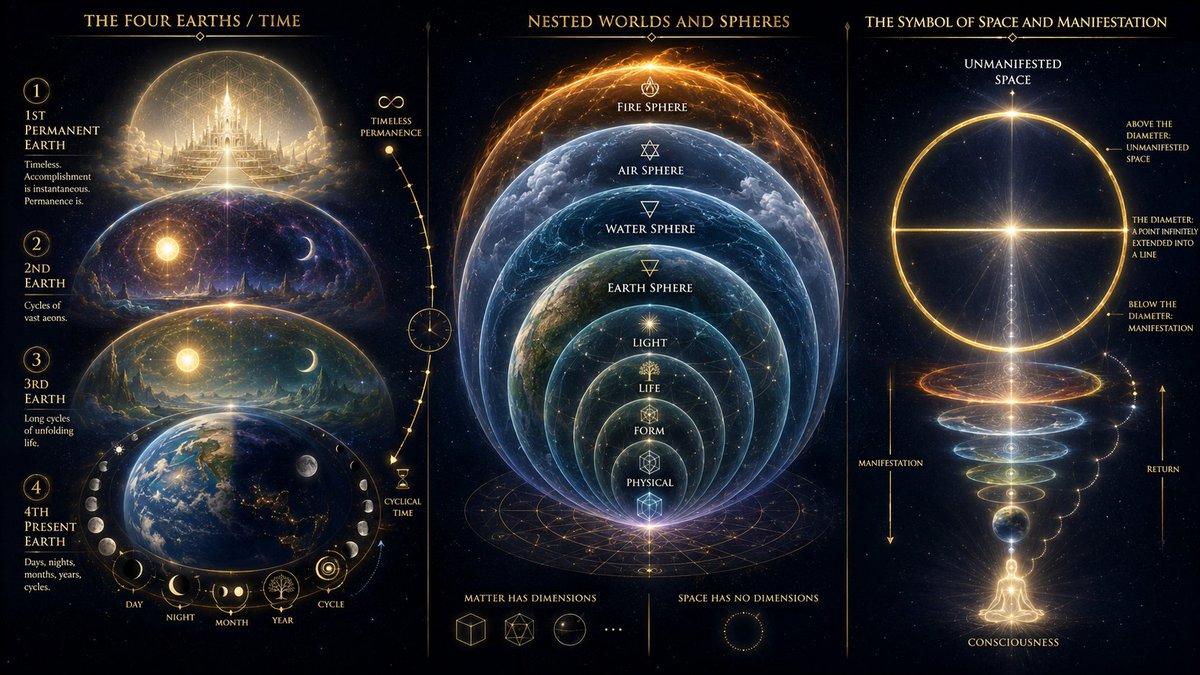
Point, A: is that which is without dimension but from which dimensions come. A point is the beginning of every thing. The unmanifested and the manifested are divided by a point. The unmanifested manifests through a point. The manifested returns to the unmanifested through a point.
Poise: is the state of balance, of equanimity of mind and control of body, in which one thinks and feels and acts with ease, not disturbed by circumstances or conditions, or by the thoughts or acts of others.
Possessions: are such necessaries as food, clothing, shelter, and the means to maintain one’s personality in its position in life; in excess of these and in all other respects they are snares, cares, and shackles.
Power, Conscious: is desire, which brings about changes in itself, or which causes change in other things.
Pranayama: is a Sanskrit term which is subject to numerous interpretations. Practically applied it means the control or regulation of breathing by prescribed exercises of measured inhalation, suspension, exhalation, suspension, and again inhalation for a certain number of such rounds or for a certain period of time.
Preference: is the favor of some person, place or thing by feeling and desire, without due regard for right or reason; it prevents true mental vision.
Prejudice: is judging a person, place or thing to which feeling-and-desire are opposed, without considering, or regardless of, right or reason. Prejudice prevents right and just judgment.
Principle: is the substratum from which all principles are what they are and by which they may be distinguished.
Principle, A: is that fundamental in a thing of which it was, by which it came to be what it is, and according to which its character may be known wherever it is.
Progress: is the continuing to increase in the capacity to be conscious, and in the ability to make good use of that of which one is conscious.
Punishment: is the penalty for wrong action. It is not intended to cause torment and suffering to the one punished; it is intended to teach the one punished that he cannot do wrong without suffering, soon or late, the consequences of the wrong.
Rightness: is the name here given to the passive side of the thinker. Its nature is to be right, that is, as it should be, in the Light of the Intelligence.
Triune Self: the indivisible self-knowing and immortal One; its identity and knowledge part as knower; its rightness and reason part as thinker, in the Eternal; and, its desire and feeling part as doer, existing periodically on the earth.
Triune Self of the Worlds, The: is as the identity of the noetic world of Triune Selves, and stands in relation to the Supreme Intelligence as does the Triune Self to its Intelligence.
Trust: is the fundamental belief in the honesty and truthfulness of other human beings, because there is the deep seated honesty in the one who trusts.
Truthfulness: is the desire to think and speak straightforwardly about things without intending to falsify or misrepresent the subject thought of or spoken about.
Types: a type is the initial or beginning of form, and the form is the inclusion and completion of the type. Thoughts are the types of the animals and objects and are forms bodied out as the expressions of human feelings and desires on the screen of nature.
Understanding: is the perceiving and feeling what things are of themselves, what their relations are, and comprehending why they are so and are so related.
Unit, A: is an indivisible and irreducible one, a circle, which has an unmanifested side, as shown by a horizontal diameter.
Units: the training and education of units is based on the proposition that every nature unit has the potentiality of becoming an Intelligence.
Units, Nature: are distinguished by being conscious as their functions only. Nature units are not conscious of anything.
Virtue: is power, strength of will, in the practice of honesty and truthfulness.
Will, Free: will is the dominant desire, of the moment, of a period, or of the life. It dominates its opposing desires and may dominate the desires of others. Free will is to be unattached, unattachment.
Wisdom: is the right use of knowledge.
Work: is mental or bodily activity, the means and the manner by which purpose is accomplished.
World, Noetic: is not a world of nature-matter; it is the intelligent realm or knowledge of the Realm of Permanence, a oneness composed of the noetic atmospheres of all Triune Selves and of the laws which govern nature.
Wrong: is that thought or act which is a departure from what one is conscious of as right.
From the Book "Thinking & Destiny" by Harold Waldwin Percival https://t.co/DKEWOnm5Wl 1946 by Harold W. Percival Copyright 1974 by The Word Foundation, Inc. All rights reserved, including the right to reproduce this book or portions thereof in any form.
DEFINITIONS AND EXPLANATIONS
A-I
Accident, An: is usually said to be an unexpected happening or event without apparent cause. Nevertheless, an accident is the only visible segment in a chain or circle of unobserved or preceding causes inevitably resulting in that occurrence called accident. The other segments of the circle are the thoughts and acts which are related to the accident.
Aia: is the name here given to a unit that has successively progressed through each and every degree in being conscious as its function in a University of Laws, in a perfect, sexless and immortal body; which has graduated from nature, and is on the intelligent-side as a point or line distinguishing it from the nature-side.
Alcoholism: is a psychic disease of the doer of desire-and-feeling, with which disease the physical body is infected by the drinking of alcoholic liquors. Alcohol is excellent and trustworthy, while kept as a servant, or used as a medium in the making of pharmaceutical preparations. But alcohol, as a spirit, is ruthless and relentless when it becomes master. It is only a matter of time, in this or some future life, when every doer will of necessity have to face the fiend and conquer or be conquered by it. The liquor is harmless, if one does not drink it; it is only a medium. But when one drinks it, the spirit of which alcohol is the medium makes contact with desire in the blood and with feeling in the nerves and cajoles the desire and feeling into the belief that it is a friend, and this belief grows and grows. It is the spirit of conviviality and good fellowship through all stages of drunkenness along which it leads its victim. And when the doer eventually is too depraved to take on the human form, the fiend leads it to its prison in the inner recesses of the earth, where it is fixed in conscious inertia. Conscious inertia is more galling and frightful than the fiercest fires of any theological or other hell conceivable. Alcohol is the preserving spirit in nature; but it kills the thing which it preserves. The spirit of drunkenness fears the Conscious Light in the human, and strives to incapacitate the human. The only sure way to be the master and not the slave of the spirit of alcohol is: Do not taste it. Have a firm and definite mental attitude and set not to take it under any pretense or form. Then one will be the master.
Anger: is desire burning in the blood and acting in resentment at what is or is supposed to be a wrong to oneself or to another.
Appearance: is nature units grouped into mass or form and is visible; it is subject to change or disappearance, when that which holds it together changes or is withdrawn.
Appetite: is the desire to gratify taste and smell with material, in response to the urge of entities of nature to keep matter in circulation.
Art: is skill in the expression of feeling and desire.
Astral: is starry matter.
Astral Body: as a term used in this book is to describe the radiant-solid of the fourfold physical body. The other three are the airy-solid, fluid-solid, and solid-solid. The airy-solid and fluid-solid are only masses, they are not developed into form. The astral body is that which shapes the matter of the growing body according to the form of the breath-form until birth. Thereafter, the physical body depends on the astral body to keep its structure in form according to the form of the breath-form. After the breath-form leaves the body at death, the astral body remains near the physical structure. Then the astral body depends on the structure for maintenance, and is dispersed as the structure decays.
Atmosphere: is the mass of diffused matter which radiates from and surrounds any object or thing.
Atmosphere, Physical Human: is the spherical mass of radiant, airy, fluid, and solid units emanating from and kept circulating in four constant streams of units in and through the body by the breath, the active side of the breath-form.
Atmosphere of the Human, Psychic: is the active side of the doer, the psychic part of the Triune Self, the passive side of one portion of which exists in the kidneys and adrenals and the voluntary nerves and the blood of the human body. It surges, pounds, pulls and pushes through the blood and nerves of the body in response to the desire and feeling of the doer which re-exists in the body.
Atmosphere of the Human, Mental: is that part of the mental atmosphere of the Triune Self which is through the psychic atmosphere and by means of which the feeling-mind and desire-mind may think at the neutral points between the uninterrupted inflow and outflow of breathing.
Atmosphere, of One’s Triune Self, Noetic: is, so to say, the reservoir, from which the Conscious Light is conveyed by the mental and psychic atmospheres to the doer-in-the-body through the breath.
Atmosphere of Earth: is made up of the four spherical zones or masses of radiant, airy, fluid, and solid units which keep up a constant circulation from and through the compacted and spherical earth crust, and from and through the interior to the farthest stars.
Breath: is the life of the blood, the pervader and builder of tissue, the preserver and destroyer, by or in which all operations of the body continue to exist or pass out of existence, until by thinking it is made to regenerate and restore the body to everlasting life.
Breath-form: is a nature unit which is the individual living form (soul) of each human body. Its breath builds and renews and gives life to tissue according to the pattern furnished by the form, and its form keeps in form the structure, its body, during its presence in the body. Death is the result of its separation from the body.
Cell, A: is an organization composed of transient units of matter from the radiant, airy, fluid, and solid streams of matter, organized into living structure by the related and reciprocal action of four compositor units: the breath-link, life-link, form-link, and cell-link compositor units constituting that cell, which is not visible, not the body of composed transient units which may be visible or seen under a microscope. The four compositor units are linked together and remain in that cell; the transient units are like flowing streams from which the compositors continue to catch and compose transient units into and as the body of that cell during the continuance of the larger organization of which that cell is a component part. The four compositor units of a cell in a human body are indestructible; when they are not supplied with transient units the cell body will cease, be decomposed and disappear, but the compositors of the cell will again build out a body at some future time.
Chance: is a word used to excuse oneself for not understanding, or to explain acts, objects and events that occur and which are not easily explained, as “games of chance,” or “chance happenings.” But there is no such thing as chance, in the sense that a happening could have happened in any other way than it did, independent of law and order. Every act of chance, such as the flipping of a coin, the turning of a card, the throwing of a die, happens according to certain laws and in order, whether they are according to laws of physics or laws of knavery and trickery. If what is called chance were independent of law, there would be no dependable laws of nature. Then there would be no certainty of the seasons, of day and night. These are laws which we more or less understand, just as are “chance” happenings, which we do not take enough trouble to understand.
Character: is the degree of honesty and truthfulness of one’s feelings and desires, as expressed by his individual thought, word and action. Honesty and truthfulness in thought and act are the fundamentals of good character, the distinguishing marks of a strong and considerate and fearless character. Character is inborn, inherited from one’s own former lives, as the predisposition to think and act; it is continued or changed as one chooses.
Communion: is the thinking oneself into relation with rightness, and in receiving Light, according to the system of thinking.
Conception, Divine, “Immaculate”: is not the impregnation of an ovum in a woman, to be followed by the gestation and birth of another physical body. A sexual birth cannot result from a divine conception. A truly “immaculate” conception is for the rebuilding of the imperfect sexual physical body of death into a perfect sexless physical body of eternal life. When the twelve preceding lunar germs have been merged with the thirteenth lunar germ, on its return to the head, it is there met by the solar germ, and receives a ray of Light from the Intelligence. That is a self-impregnation, a divine conception. The rebuilding of the perfect body follows.
Conscience: is the sum of knowledge about what should not be done in relation to any moral subject. It is one’s standard for right thinking, right feeling, and right action; it is the soundless voice of rightness in the heart that forbids any thought or act which varies from what it knows to be right. The “No” or “Don’t” is the voice of the doer’s knowledge concerning what he should avoid or not do or not give consent to be done in any situation.
Conscious: is, with knowledge; the degree in which that which is conscious is conscious in relation to knowledge.
Consciousness: is the Presence in all things—by which each thing is conscious in the degree in which it is conscious as what or of what it is or does. As a word it is the adjective “conscious” developed into a noun by the suffix “ness.” It is a word unique in language; it has no synonyms, and its meaning extends beyond human comprehension. Consciousness is beginningless, and endless; it is indivisible, without parts, qualities, states, attributes or limitations. Yet, everything, from the least to the greatest, in and beyond time and space is dependent on it, to be and to do. Its presence in every unit of nature and beyond nature enables all things and beings to be conscious as what or of what they are, and are to do, to be aware and conscious of all other things and beings, and to progress in continuing higher degrees of being conscious towards the only one ultimate Reality—Consciousness.
Credulity: is the innocent readiness of the doer-in-the-body to believe that things are as they appear, and to accept as true what is said or written.
Culture: is the high development of learning, skill and character of a people, or of civilization as a whole.
Death: is the departure of the conscious self in the body from its fleshly residence, the snapping or severance of the fine elastic silvery thread that connects the breath-form with the body. The severance is caused by the willing or with the consent of oneself to have its body die. With the breaking of the thread, resuscitation is impossible.
Definition: is that composition of related words which expresses the meaning of a subject or thing and, by thinking on which, knowledge is available.
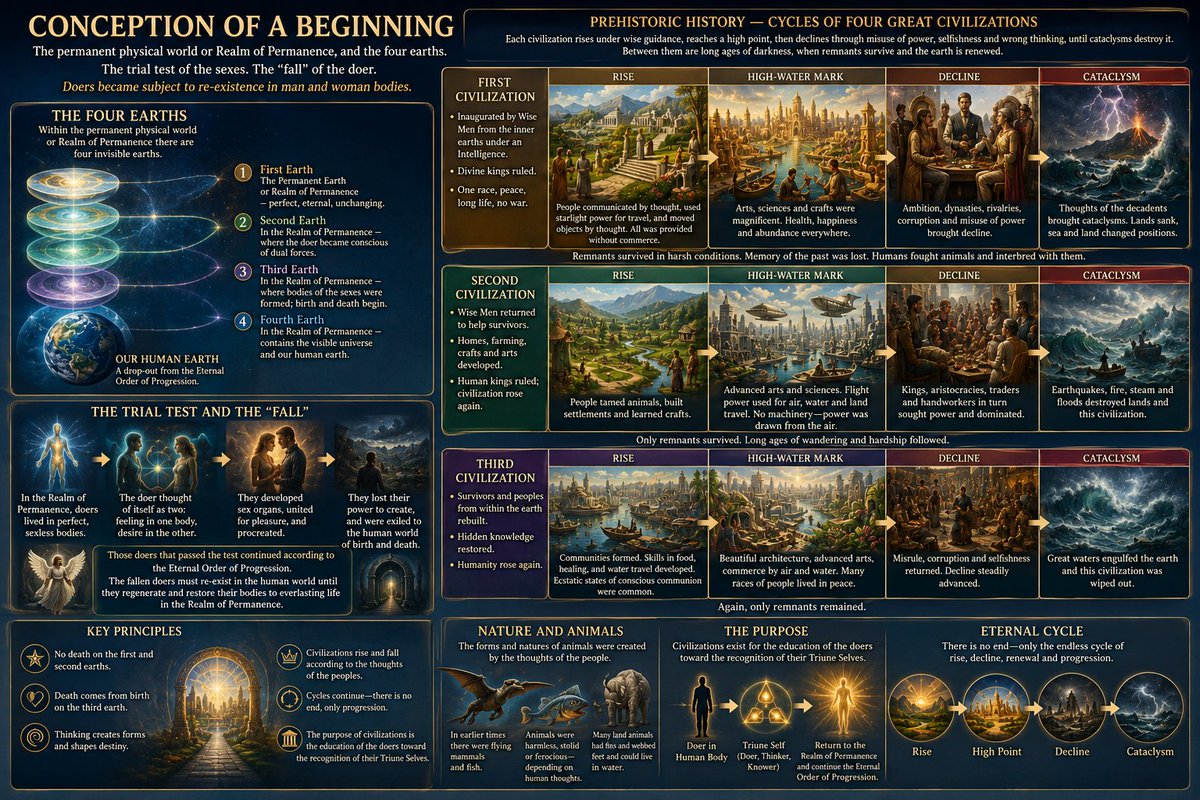
Descent of Man: has been variously and figuratively told in ancient scriptures, as in the Bible story of Adam and Eve in the Garden of Eden; their temptation, their fall, their original sin and expulsion from Eden. This is shown as the four stages in the departure of the doer-in-the-body from the Realm of Permanence. The descent from the Realm of Permanence into this world of birth and death, was by variation, division, modification and degeneration. Variation began when the doer of desire-and-feeling extended a part of its perfect body and saw feeling in the extended part. Division was the doer’s seeing its desire in the male body and its feeling in the female body and thinking of itself as two instead of one, and its departure from permanence. Modification was the descending or extending from the interior and finer to the outer and lower state of matter and change in structure of body. Degeneration was coming on the outside crust of the earth, the development of sexual organs and generation of sexual bodies.
Desire: is conscious power within; it brings about changes in itself and causes change in other things. Desire is the active side of the doer-in-the-body, the passive side of which is feeling; but desire cannot act without its other inseparable side, feeling. Desire is indivisible but appears to be divided; it is to be distinguished as: the desire for knowledge and the desire for sex. It is, with feeling, the cause of the production and reproduction of all things known or sensed by the human. As the desire for sex it remains obscure, but manifests through its four branches: the desire for food, the desire for possessions, the desire for a name, and the desire for power, and their innumerable offshoots, such as hunger, love, hate, affection, cruelty, strife, greed, ambition, adventure, discovery, and accomplishment. The desire for knowledge will not be changed; it is constant as the desire for Self-knowledge.
Desire for a Name (Fame): is a cluster of impressions of indeterminate attributes for a personality, which are as empty and evanescent as a bubble.
Desire for Power: is the illusion created which is the offspring and adversary of the desire for Self-knowledge—the desire for sex.
Desire for Self-Knowledge: is the determined and unyielding desire of the doer to be in conscious relation or union with the knower of its Triune Self.
Desire for Sex: is selfishness grounded in ignorance concerning itself; the desire that is expressed by the sex of the body in which it is, and which seeks to unite with its suppressed and unexpressed side, by union with a body of the opposite sex.
Despair: is the surrender to fear; the unreserved resignation to let happen what may.
Destiny: is necessity; that which must be or happen, as the result of what has been thought and said or done.
Destiny, Physical: includes everything concerning the heredity and constitution of the human physical body; the senses, sex, form, and features; the health, position in life, family, and human relations; the span of life and manner of death. The body and all concerning the body is the budget of credit and debit which has come over from one’s past lives as the result of what one thought and did in those lives, and with which one has to deal in the present life. One cannot escape what the body is and represents. One must accept that and continue to act as in the past, or one may change that past into what one thinks and wills to be, to do, and to have.
Destiny, Psychic: is all that has to do with feeling-and-desire as one’s conscious self in the body; it is the result of what in the past one has desired and thought and done, and of that which in the future will result from what one now desires and thinks and does and which will affect one’s feeling-and-desire.
Destiny, Mental: is determined as what, of what, and for what the desire and feeling of the doer-in-the-body think. Three minds—the body-mind, desire-mind, and feeling-mind—are put at the service of the doer, by the thinker of its Triune Self. The thinking which the doer does with these three minds is its mental destiny. Its mental destiny is in its mental atmosphere and includes its mental character, mental attitudes, intellectual attainments and other mental endowments.
Destiny, Noetic: is the amount or degree of Self-knowledge that one has of oneself as feeling and desire, which is available, is in that part of the noetic atmosphere which is in one’s psychic atmosphere. This is the result of one’s thinking and use of one’s creative and generative force; it manifests as one’s knowledge of humanity and human relations on the one hand, and on the other through physical destiny, as troubles, afflictions, diseases, or infirmities. Self-knowledge is shown by self-control, the control of one’s feelings and desires. One’s noetic destiny may be seen in time of crisis, when one knows just what should be done for oneself and others. It may also come as intuition for enlightenment on a subject.
Devil, The: is one’s own chief evil desire. It tempts, goads and drives one to wrong action in physical life, and it torments that one during a part of its after death states.
Dimensions: are of matter, not of space; space has no dimensions, space is not dimensional. Dimensions are of units; units are indivisible constituents of mass matter; so that matter is a make-up, composed of or as indivisible units related to and distinguished from each other by their particular kinds of matter, as dimensions. Matter is of four dimensions: on-ness, or surface matter; in-ness, or angle matter; throughness, or line matter; and presence, or point matter. The numbering is from the apparent and familiar to the remote.
Disease: results from the cumulative action of a thought as it continues to pass through the part or body to be affected, and eventually the exteriorization of such thought is the disease.
Dishonesty: is the thinking or acting against what is known to be right, and the thinking and doing of what is known to be wrong. The one so thinking and doing may eventually make himself believe that what is right is wrong; and that what is wrong is right.
Doer: that conscious and inseparable part of the Triune Self which periodically re-exists in the man body or woman body, and which usually identifies itself as the body and by the name of the body.
Doubt: is a condition of mental darkness as the result of not enough clear thinking to know what to do and what not to do in a situation.
Dreams: are of the objective and the subjective. The objective dream is the waking state or state of being awake; nevertheless it is the waking dream. The subjective dream is the sleeping dream.
Duty: is what one owes to oneself or to others, which must be paid, willingly or unwillingly, in such performance as that duty calls for.
“Dweller”: is a term used to signify a vicious desire from a former life of the doer in the present human body, which dwells in the psychic atmosphere and tries to enter the body and influence the doer to acts of violence, or to indulge in practices harmful to doer and body.
Ease: is the result of the doer’s reliance in destiny and in itself; a certain poise in action, irrespective of wealth or poverty, position in life or family or friends.
Ego: is the feeling of the identity of “I” of the human, due to the relation of feeling to the identity of I-ness of its Triune Self.
Equality in the Human: is that each responsible person has the right to think, to be, to will, to do, and to have, what he is able to be, to will, to do and to have, without force, pressure or restraint, to the extent that he does not try to prevent another from the same rights.
Experience: is the impression of an act, object or event produced through the senses on feeling in the body, and the reaction as the response of feeling as pain or pleasure, joy or sorrow, or any other feeling or emotion.
Exteriorization, An: is the act, object or event that was the physical impression in a thought before it exteriorized as an act, object or event on the physical plane, as physical destiny.
Facts: are the realities of the objective or subjective acts, objects or events in the state or on the plane on which they are experienced or observed.
Faith: is the imagination of the doer which makes a strong impression on the breath-form because of trust and confidence without doubt.
Falsehood: is a statement as fact of what is believed to be untrue, or the denial of what is believed to be true.
Fear: is the feeling of foreboding or impending danger concerning mental or emotional or physical trouble.
Feeling: is that of one’s conscious self in the body which feels; which feels the body, but does not identify and distinguish itself as feeling, from the body and the sensations which it feels.
Food: is of nature material composed of innumerable combinations of compounds of fire, air, water, and earth units, for the building up of the four systems and the upkeep of the body.
Form: is the idea, type, pattern or design which guides and shapes and sets bounds to life as growth; and form holds and fashions structure into visibility as appearance.
Freedom: is the state or condition of the desire-and-feeling of the doer when it has detached itself from nature and remains unattached.
Function: is the course of action intended for a person or thing, and which is performed by choice, or by necessity.
Gambling: is an obsession of one by the gambling spirit, or the exciting chronic desire to get, to win money or something of value by “luck,” by “betting,” by games of “chance,” instead of earning it by honest work.
Genius, A: is one who shows originality and ability which distinguish him from others in the fields of his endeavor.
God, A: is a thought being, created by the thoughts of human beings as the representative of the greatness of what they feel or fear.
Government, Self-: means that one’s feelings and desires which are or may be inclined, through preferences, prejudices or passions to disrupt the body, will be restrained and guided and governed by one’s own better feelings and desires which think and act with rightness and reason.
Grace: is loving kindness in behalf of others, and ease of thought and feeling expressed in conscious relation to form and action.
Greatness: is in the degree of one’s independence with responsibility and knowledge in his relation and dealing with others.
Greed: is the insatiable desire to get, to have, and to hold whatever is desired.
Ground, Common: is used here to mean a place or body on or in which two or more meet for mutual interests.
Habit: is the expression by word or act of an impression on the breath-form by thinking.
Hall of Judgment: is an after death state in which the doer finds itself.
Happiness: is the result of what one thinks and does in accord with rightness-and-reason, and the state of desire-and-feeling when they are in balanced union and have found love.
Healing by Laying on of Hands: to benefit the patient, the healer should understand that he is only a willing instrument to be used by nature for the purpose of re-establishing the orderly flow of life.
Healing, Mental: is the attempt to cure physical ills by mental means.
Hearing: is the unit of air, acting as the ambassador of the air element of nature in a human body.
Heaven: is the state and period of happiness, not limited by the earthly time of the senses, and which seems to have no beginning.
Hell: is an individual condition or state of suffering, of torment, not a community affair.
Heredity: is generally understood to mean that the physical and mental qualities, factors and features of one’s ancestors are transmitted to and inherited by that human being.
Honesty: is the desire to think of and see things as the Conscious Light in thinking shows these things as they really are and then to deal with those things as the Conscious Light shows that they should be dealt with.
Hope: is the potential light inherent in the doer in all its wanderings through the wilderness of the world.
Human Being, A: is a composition of units of the four elements of nature composed and organized as cells and organs into four systems represented by the four senses of sight, hearing, taste, and smell.
Human Beings, The Four Classes of: by thinking people divided themselves into four classes: the laborers, the traders, the thinkers, the knowers.
Hypnosis, Self-: is the intentional putting oneself into the state of deep sleep by hypnotizing and controlling oneself by oneself.
Hypnotism or Hypnosis: is an artificial state of sleep produced on a subject who suffers himself to be hypnotized.
Hypnotist, A: is one who has will, imagination and self-confidence and who is successful in hypnotizing his subjects.
“I” as Identity, The False: is the feeling of the presence of the real identity of the I-ness of one’s knower.
Ideal: is the conception of what is best for one to think, to be, to do, or to have.
Identity, One’s: is the feeling of identity in one’s body, one’s own feeling as being the same now as what one was in the past, and the same feeling to be in the future.
I-ness: is the incorporeal, undying, and continuously unchanging identity of the Triune Self in the Eternal.
Ignorance: is mental darkness, the state in which the doer-in-the-body is, without knowledge of itself and of its rightness and reason.
Illusion: the mistaking of fancy or appearance for reality.
Imagination: is the state in which the thinking of feeling-and-desire gives form to matter.
Incubus: is an invisible male form seeking to obsess or to have sexual relation with a woman during sleep.
From the Book "Thinking & Destiny" by Harold Waldwin Percival https://t.co/DKEWOnm5Wl 1946 by Harold W. Percival Copyright 1974 by The Word Foundation, Inc. All rights reserved, including the right to reproduce this book or portions thereof in any form.
TABLE OF CONTENTS - THINKING AND DESTINY
Simplified Table of Contents
Chapter I — Introduction
Chapter II — The Purpose and Plan of the Universe
There is a purpose and a plan in the Universe.
The law of thought.
Religions.
The soul.
Theories concerning the destiny of the soul.
The soul.
Outline of a system of the Universe.
Time.
Space.
Dimensions.
Plan relating to the earth sphere.
Transition of a breath-form unit to the state of aia.
Eternal Order of Progression.
The Government of the world.
The “fall of man.”
Regeneration of the body.
Passage of a unit from the nature-side to the intelligent-side.
Chapter III — Objections to the Law of Thought
The law of thought in religions and in accidents.
An accident is an exteriorization of a thought.
Purpose of an accident.
Explanation of an accident.
Accidents in history.
Religions.
Gods.
Their claims.
The need of religions.
The moral code.
The wrath of God.
The destiny of humanity.
The innate faith in justice.
The story of original sin.
The moral code in religions.
Chapter IV — Operation of the Law of Thought
Matter.
Units.
An Intelligence.
A Triune Self.
A human being.
Mind.
Thinking.
A thought is a being.
The atmospheres of the Triune Self.
How thoughts are generated.
Course and exteriorization of a thought.
The innate idea of justice.
The law of thought.
Exteriorizations and interiorizations.
Psychic, mental, and noetic results.
The power of thought.
Balancing a thought.
Cycles.
How exteriorizations of a thought are brought about.
Agents of the law.
Hastening or delaying destiny.
Duties of a human being.
Responsibility.
Conscience.
Sin.
The law of thought.
Physical, psychic, mental, and noetic destiny.
Chapter V — Physical Destiny
What physical destiny includes.
Outward circumstances as physical destiny.
Physical heredity is destiny.
Healthy or sickly bodies.
Unjust persecutions.
Errors of justice.
Congenital idiots.
The span of life.
Manner of death.
Money.
The money god.
Poverty.
Reversals.
The born thief.
There is no accident of wealth or inheritance.
Group destiny.
Rise and fall of a nation.
The facts of history.
Agents of the law.
Religions as group destiny.
Why a person is born into a religion.
The Government of the world.
How the destinies of the individual, the community, or the nation are made by thinking.
How destiny is administered.
Possible chaos in the world.
Intelligences govern the order of events.
Chapter VI — Psychic Destiny
Form destiny.
Strictly psychic destiny.
Six classes of psychic destiny.
The aia.
The breath-form.
Prenatal influences.
Conception.
Fetal development.
Thoughts of the mother.
Inheritance of former thoughts.
The first few years of life.
Psychic inheritance.
Mediumship.
Materializations.
Seances.
Clairvoyance.
Psychic powers.
Pranayama.
Psychic phenomena by wonder-workers.
Personal magnetism.
Vibrations.
Colors.
Astrology.
Religions as psychic destiny.
Psychic destiny comprises government and institutions.
Psychic destiny comprises party and class spirits.
Habits, customs and fashions are psychic destiny.
Gambling.
Drinking.
The spirit of alcohol.
Gloom.
Pessimism.
Malice.
Fear.
Hope.
Joyousness.
Trust.
Ease.
Sleep.
Dreams.
Nightmares.
Obsessions in dreams.
Deep sleep.
Time in sleep.
Hallucinations.
Somnambulism.
Hypnosis.
The process of dying.
Cremation.
To be conscious at the moment of death.
After death.
Communications with the dead.
Apparitions.
The doer becomes conscious that its body has died.
The twelve stages of the doer, from one earth life to the next.
After death the doer leads a composite life.
The judgment.
Hell is made by desires.
The devil.
Heaven is a reality.
Re-existence of the succeeding doer portion.
Chapter VII — Mental Destiny
The mental atmosphere of the human.
An Intelligence.
The Triune Self.
The three orders of Intelligences.
The Light of the Intelligence.
Real thinking.
Active thinking.
Passive thinking.
The three minds of the doer.
Rightness-and-reason.
The seven minds of the Triune Self.
A human thought is a being and has a system.
Exteriorizations of a thought.
Human thinking goes along beaten paths.
Character of the mental atmosphere of the human.
Moral aspect of thinking.
The ruling thought.
Mental attitude and mental set.
Sense-knowledge and self-knowledge.
Conscience.
Honesty of the mental atmosphere.
Results of honest thinking.
Dishonest thinking.
Thinking a lie.
Responsibility and duty.
Sense-learning and sense-knowledge.
Doer-learning and doer-knowledge.
Intuition.
Genius.
The four classes of human beings.
Conception of a Beginning.
The permanent physical world or Realm of Permanence, and the four earths.
The trial test of the sexes.
The “fall” of the doer.
Doers became subject to re-existence in man and woman bodies.
Prehistoric history.
First, Second, and Third Civilization on the human earth.
Fallen doers from inside the earth.
A Fourth Civilization.
Wise men.
Rises and falls of cycles.
Rise of the latest cycle.
The forms of nature come through the breath-forms of human beings.
There is progression, but no evolution.
The entities in animal and plant forms are cast off feelings and desires of man.
The entities in vermin, in flowers.
History of the kingdoms of nature.
Creation by breath and speech.
Thinking under the type of two.
The human body is the pattern of the kingdoms of nature.
The intelligence in nature.
This is an age of thought.
Schools of thought.
Mysticism.
Spiritism.
Schools of thought that use thinking to produce directly physical results.
Mental healing.
Thoughts are the seeds of a disease.
Purpose of a disease.
The real cure.
About schools of thought to banish disease and poverty.
Thinking against a disease.
Other ways of mental healing.
There is no escape from payment and from learning.
Mental healers and their procedures.
Faith.
Animal magnetism.
Hypnotism.
Its dangers.
Trance states.
Painless injuries inflicted, while in trance.
Self-hypnosis.
Recovery of forgotten knowledge.
Self-suggestion.
Intentional use of passive thinking.
Examples of a formula.
The Eastern Movement.
Eastern record of knowledge.
Degeneration of the ancient knowledge.
The atmosphere of India.
The breath.
What the breath does.
The psychic breath.
The mental breath.
The noetic breath.
The fourfold physical breath.
Pranayama.
Its dangers.
The system of Patanjali.
His eight steps of yoga.
Ancient commentaries.
Review of his system.
Inner meaning of some Sanskrit words.
The ancient teaching of which traces survive.
What the West wants.
The Theosophical Movement.
The teachings of Theosophy.
States of the human being in deep sleep.
Mental destiny in the after death states.
The round of twelve stages from life to life.
Hells and heavens.
Chapter VIII — Noetic Destiny
Knowledge of the conscious self in the body.
The noetic world.
Self-knowledge of the knower of the Triune Self.
When knowledge of the conscious self in the body is available to the human.
The test and trial of the sexes.
Projection of a female form.
Illustrations.
History of the Triune Self.
The Light of the Intelligence.
The Light in the knower of the Triune Self.
The Light in the thinker.
The Light in the doer.
The Light that has gone into nature.
The intelligence in nature comes from human beings.
The pull of nature for Light.
Loss of Light into nature.
Automatic return of Light from nature.
The lunar germ.
Self-control.
Reclamation of Light by self-control.
Loss of the lunar germ.
Retention of the lunar germ.
The solar germ.
Divine, or “immaculate,” conception in the head.
Regeneration of the physical body.
Hiram Abiff.
Origin of Christianity.
Three degrees of Light from Intelligences.
Thinking without creating thoughts or destiny.
Bodies for the doer, the thinker, and the knower of the Triune Self, within the perfect physical body.
Free will.
The problem of free will.
Chapter IX — Re-Existence
Recapitulation.
Make-up of a human being.
The Triune Self.
The Light of the Intelligence.
A human body as the link between nature and the doer.
Death of the body.
The doer after death.
Re-existence of the doer.
Four kinds of units.
Progression of units.
Raising of the aia to be a Triune Self in the Realm of Permanence.
Duty of its doer, in the perfect body.
Feeling-and-desire produced a change in the body.
The twain, or dual body.
Trial and test of bringing feeling-and-desire into balanced union.
The “fall of man,” i.e. the doer.
Changes in the body.
Death.
Re-existence in a male or a female body.
The doers now on earth.
Circulations of units through the bodies of humans.
Fourth Civilization.
Changes on the earth crust.
Forces.
Minerals, plants and flowers.
The varied types were produced by human thoughts.
Fourth Civilization.
Lesser civilizations.
Fourth Civilization.
Governments.
Ancient teachings of the Light of the Intelligence.
Religions.
The doers now on earth came from a prior earth age.
Failure of the doer to improve.
The story of feeling-and-desire.
The spell of the sexes.
The purpose of re-existences.
Importance of the flesh body.
Reclamation of Light.
Death of the body.
Wanderings of the units.
Return of units to a body.
The doer-in-the-body.
Error in the conception of “I.”
The personality and re-existence.
The doer portion after death.
The portions not in the body.
How a doer portion is drawn out for re-existence.
The thoughts summarized at moment of death.
Events determined then, for the next life.
The flare-up in classic Greece.
Something about the Jews.
The stamp of a God at birth.
Family.
The sex.
Cause of changing the sex.
Also predetermined is the kind of body.
Physical heredity and how it is limited.
Chief mundane occupations.
Diseases.
The chief events in life.
How destiny can be overcome.
The time between existences.
About the heavenly bodies.
Time.
Why people fit into the age in which they live.
Everything after death is destiny.
Inventors.
Classic Hellas.
Re-existence in nation groups.
Centers of succeeding civilizations.
Greece.
Egypt.
India.
Training of the doer portion though memory is not present.
The body-mind.
Doer-memory.
Sense-memory.
A good memory.
Memory after death.
Why it is fortunate that the human does not remember previous existences.
The training of the doer.
A human thinks of himself as a body with a name.
To be conscious of and as.
The false “I” and its illusions.
When re-existences of a doer portion stop.
A “lost” doer portion.
The hells inside the earth crust.
The lecherous.
The drunkards.
Drug fiends.
The state of a “lost” doer.
Regenerating the physical body.
The test in which the doers failed.
Summary of preceding chapters.
Consciousness is the One Reality.
Man as the center of the world of time.
Circulations of the units.
Permanent institutions.
Records of thoughts are made in points.
The destiny of human beings is written in the starry spaces.
Balancing a thought.
Cycles of thinking.
Glamour in which things are seen.
Sensations are elementals.
Why nature seeks the doer.
Illusions.
The essential things in life.
Chapter X — Gods and Their Religions
Religions.
On what they are founded.
Why belief in a personal God.
Problems a religion must meet.
Any religion is better than none.
Classes of Gods.
The Gods of religions.
How they come into existence.
How long they last.
Appearance of a God.
Changes of a God.
Gods have only what human beings have who create and keep them.
The name of a God.
Christian Gods.
The human qualities of a God.
The knowledge of a God.
His objects and interests.
Relations of a God.
The moral code.
Flattery.
How Gods lose their power.
What a God can do for his worshippers.
What he cannot do.
After death.
Unbelievers.
Prayer.
Benefits of a belief in a God.
Seeking God.
Prayer.
Outside teachings and the inner life.
Inner teachings.
Twelve types of teachings.
Jehovah worship.
The Hebrew letters.
Christianity.
St. Paul.
The story of Jesus.
Symbolic events.
The Kingdom of Heaven.
The Kingdom of God.
The Christian Trinity.
Interpretation of Bible sayings.
The story of Adam and Eve.
The trial and test of the sexes.
“Fall of man.”
Immortality.
St. Paul.
Regeneration of the body.
Who and what was Jesus?
Mission of Jesus.
Jesus, a pattern for man.
The order of Melchisedec.
Baptism.
The sexual act, the original sin.
The Trinity.
Entering the Great Way.
Chapter XI — The Great Way
The “Descent” of man.
There is no evolution without, first, involution.
The mystery of germ cell development.
The future of the human.
The Great Way.
Brotherhoods.
Ancient Mysteries.
Initiations.
Alchemists.
Rosicrucians.
The Triune Self complete.
The Threefold Way, and the three paths of each Way.
The lunar, solar, and light germs.
Divine, “immaculate,” conception.
The form, life, and light paths of The Way in the body.
The Way of thinking.
Honesty and truthfulness as the foundation of progress.
Physical, psychic, mental requirements.
Changes in the body in the process of regeneration.
Entering The Way.
A new life opens.
Advances on the form, life, and light paths.
The lunar, solar, and light germs.
Bridge between the two nervous systems.
Further changes in the body.
The perfect, immortal, physical body.
The three inner bodies for the doer, the thinker, the knower of the Triune Self, within the perfect physical body.
The Way in the earth.
The ongoer leaves the world.
The form path.
What he sees there.
Shades of the dead.
“Lost” portions of doers.
The choice.
The ongoer on the life path.
On the light path, in the earth.
He knows who he is.
Another choice.
Preparing oneself to enter upon The Way.
Honesty and truthfulness.
The regenerative breath.
The four stages in thinking.
Chapter XII — The Point or Circle
Creation of a thought.
Method of thinking by building within a point.
Human thinking.
Thinking done by Intelligences.
Thinking which does not create thoughts, or destiny.
Method of thinking in fashioning nature.
The forms of nature come from human thoughts.
Pre-chemistry.
The constitution of matter.
Units.
Erroneous conceptions.
Dimensions.
The heavenly bodies.
Time.
Space.
Chapter XIII — The Circle or Zodiac
Geometrical symbols.
The Circle with the Twelve Nameless Points.
The value of the zodiacal symbol.
What the zodiac and its twelve points symbolize.
The zodiac related to the human body.
The zodiac related to the Triune Self.
The zodiac related to the Intelligence.
The zodiac reveals the purpose of the Universe.
The zodiac as a historical and prophetic record.
The zodiac as a clock to measure progress in nature and on the intelligent-side.
The zodiac in the building out of a thought.
Groups of zodiacal signs.
Application to the human body.
Chapter XIV — Thinking: The Way to Conscious Immortality
The system of thinking without creating destiny.
With what it is concerned.
With what it is not concerned.
For whom it is presented.
The origin of this system.
No teacher is needed.
Limitations.
Preliminaries to be understood.
Recapitulation.
The make-up of the human being.
Units.
The senses.
The breath.
The breath-form.
The aia.
Human bodies and the outside universe.
Recapitulation continued.
The doer portion in the body.
The Triune Self and its three parts.
The twelve portions of the doer.
How long a human is dissatisfied.
Recapitulation continued.
The doer as feeling and as desire.
The twelve portions of the doer.
The psychic atmosphere.
Recapitulation continued.
The thinker of the Triune Self.
The three minds of the doer.
The minds of the thinker and the knower.
How desire speaks in place of rightness.
The reversed round.
The mental atmosphere.
Recapitulation continued.
The knower of the Triune Self.
Selfness and I-ness.
The noetic atmosphere.
What a human is conscious as.
Isolation of feeling.
Isolation of desire.
Being conscious of Consciousness.
The System of Thinking.
What it is.
Stages on The Way to Conscious Immortality.
From the Book "Thinking & Destiny" by Harold Waldwin Percival https://t.co/DKEWOnm5Wl 1946 by Harold W. Percival Copyright 1974 by The Word Foundation, Inc. All rights reserved, including the right to reproduce this book or portions thereof in any form.
AFTERWORD
How This Book Was Written
by Benoni B. Gattell
There may be those who would like to read about the manner in which this book was produced by Harold Waldwin Percival. For them I am writing this with his permission.
Percival dictated because, as he said, he could not think and write at the same time, as his body had to be still when he wanted to think. He dictated without referring to any book or other authority. I know of no book from which he could have gotten the knowledge here set down. He did not get it and could not have gotten it clairvoyantly or psychically.
In answer to a question how he obtained the information, Percival said that several times since his youth he had been conscious of Consciousness. Therefore he could become conscious of the state of any being whatever, whether in the manifested Universe or the Unmanifested, by thinking about it. He said that when he thought of a subject intently the thinking ended when the subject opened up as from a point into completeness. The difficulty he encountered, so he said, was to bring this information into his mental atmosphere. A still greater difficulty was expressing it precisely and so that any one would understand it, in a language in which there were no suitable words.
Thirty-seven years ago he gave me much of the information now in this book. For thirty years I have lived with him in the same house and written down what he dictated. Since 1912, Percival outlined the matter for the chapters and their sections. Whenever both of us were available, throughout these many years, he dictated. He wanted to share his knowledge, however great the effort, however long the time it took to clothe it in accurately fitting words.
He did not use specialized language. He wanted anyone who read it to understand the book. He spoke evenly, and slowly enough for me to write his words in long hand. Though most of what is in this book was expressed for the first time, his speech was natural and in plain sentences without vacuous or turgid verbosity. He gave no argument, opinion or belief, nor did he state conclusions. He told what he was conscious of. He used familiar words or, for new things, combinations of simple words. He never hinted. He never left anything unfinished, indefinite, mysterious. Usually he exhausted his subject, as far as he wished to speak about it, along the line on which he was. When the subject came up on another line he spoke of it along that. He said this book deals with general things and there are innumerable exceptions.
Percival spoke freely to anyone who approached and wanted to hear from him about the matters in this book. At times he talked in answer to questions for more details. He asked that these questions be precise and on one point at a time.
What he had spoken he did not remember in detail. He said that he did not care to remember the information I had set down. He thought of every subject as it came up, irrespective of what he had already said about it. Thus when he dictated summaries of previous statements he thought about the matters once more and acquired the knowledge anew. So often new things were added in the summaries. Without premeditation, the results of his thinking on the same subjects along different lines, and sometimes at intervals of years, were in agreement. Thus in the eighteenth section of the chapter on Re-existence the views are along the lines of Consciousness, continuity and illusions; in the first six sections of chapter fourteen the view is from the standpoint of thinking; yet what he said about the same facts at these different times under these different circumstances was compatible.
Sometimes sections were re-dictated, if he opened a subject so wide that a restatement became necessary. The language which he used was not changed. Nothing was added. Some of his words were transposed for readability. When this book was finished and typewritten he read it and settled its final form, replacing some of the terms which were makeshifts by happier ones.
When he dictated this book and had time he formerly lacked, he created a terminology which accepted words which were in use, but might suggest what he intended when he gave them a specific meaning. In every case he gave definitions or descriptions when words were used by him with a specific meaning. He said, “Try to understand what is meant by the term, do not cling to the word.” The only word he coined is the word aia [pronounced eye-uh] because there is no word in any language for what it denominates.
January 2, 1932
From the Book "Thinking & Destiny" by Harold Waldwin Percival https://t.co/DKEWOnly6N 1946 by Harold W. Percival Copyright 1974 by The Word Foundation, Inc. All rights reserved, including the right to reproduce this book or portions thereof in any form.
"Science" Part-2
Days and nights, lunar months and years, solar months and years, and the vast or small cycles into which all these can be multiplied and divided, are measures of time of on-ness on the fourth, the present earth. There have been and still are two other earths, the third and the second, where time was and is reckoned as of on-ness. On the third earth there is a sun and a moon. On the second earth there is a sun and a moon, but not as they seem to look and act today. On the first, and permanent earth, there is no sun and no moon as they are known today and there is no time as it is at present measured. There, the measurement of time is the instantaneous coming into or the going out of being of anything. Accomplishment is instantaneous. There, permanence is. There is no change, only beginning and end for special creations. The four earths are four stages in which the earth crust appears. The measurement of time on the earth crust has changed, with the change of human bodies. There are days and nights as soon as the bodies become male and female and subject to birth and death.
Space has no dimensions; matter has dimensions, and matter is not space. Space has no extension, vacuity, boundlessness, or any of the attributes of matter. Space is unmanifested. The four states of matter making up the physical plane are in the form plane, and that is in the life plane, and that in the light plane of the physical world. The physical world is in the form world, which is in the life world, which is in the light world, and all are in the sphere of earth. This is in the sphere of water, this in the sphere of air, and this in the sphere of fire. The sphere of fire is in space. From the lowest state of matter, that is, from the solid-solid state on the physical plane of the physical world of the sphere of earth to the highest matter, that is, the sphere of fire, all are connected with the next higher state of matter through their unmanifested sides. The manifested sides of the planes, worlds and spheres exist in their unmanifested sides, and space is related with them through these.
Space is Substance, always unmanifested, without differences, the same throughout, without change. When it manifests, that of it which is manifested becomes fire as the fire sphere, and so becomes matter and divides into units. The earth does not float or move in space, it moves in matter, in a mass of geogen units which is interpenetrated by fluogen, aerogen and pyrogen masses. Space is not a thing, but all things exist because of it and in it. From the viewpoint of space all the spheres, all that is manifested in them, all is seen as illusion, as unreal. Space is through all these unrealities. They exist because they are in space.
Space is not in human thought, therefore there is no name for it in the language, but it may be approached in thought by thinking on a symbol. The symbol is a circle divided by a horizontal diameter. The diameter is the point extending into a line, which distinguishes ever unmanifested space from the manifestations in the spheres below. In them matter manifests until it passes again into the unmanifested, and ultimately becomes Consciousness. Then the point has become the circle.
From the Book "Thinking & Destiny" by Harold Waldwin Percival https://t.co/DKEWOnm5Wl 1946 by Harold W. Percival Copyright 1974 by The Word Foundation, Inc. All rights reserved, including the right to reproduce this book or portions thereof in any form.
"Science" - Part 1.
Gravity is a relation between states of physical matter. So the weight of iron is the relation of the four states of radiant, airy, fluid and solid matter that make up a given mass of iron. The relation may be changed by the medium in which this iron is placed, as inside the earth crust or in water on the surface or in thin air or on a mountain.
The center of gravity is the line of closest intermingling of the four states of matter in any body. Each body has a gravity of its own, but the gravity of the earth is the standard for all things about the earth. The line of closest intermingling of the matter of its four layers is between the outer and the inner earth crust.
The line of the earth’s gravity changes from time to time. Inside, beyond the earth crust, the action of gravity diminishes rapidly. At the center of the earth there is no gravity, nor is there any in the region of the stars. If the relation of the matter of a body to the matter of the earth as a whole is cut off, there is no weight. Matter of greater density than that of the earth, that is, where the units lie closer together, has no weight if it is not related to the matter of the earth. There is matter, such as that on the form plane, of greater density than solid earth matter, which cannot be perceived, has no weight and is not affected by the gravity of the earth. When such matter is put into relation with the solid earth, the line of gravity will be transferred to that.
Solidity is a deception by the senses of sight and contact through smell. There are holes in a copper plate as there are in a fabric. But this deception can be dispelled to a certain degree by the aid of instruments. Nevertheless the sense perception dominates the understanding. Finer matter composes, permeates and flows through solid matter. It produces the phenomena of solid matter. Beyond this finer matter in the physical world is matter in other worlds that is still finer. Some of the qualities of and the conditions produced by different states of the interior and finer matter are unintelligible, and if they were to be stated would appear as impossibilities, contradictions and nonsense.
Dimensions are spoken of as properties of space. But space has no dimensions. Matter has dimensions and only that matter which is in the three lower, the life, form and physical, states of the physical world. Its dimensions are among its characteristics. The dimensions on the physical plane are called length, breadth and thickness. These are really only one dimension, on-ness or surface.
Matter on the physical plane has the dimensions of on-ness, that is, an outside; in-ness, that is, an inside; throughness, that is, consecutive insides; and presence, that is, being anywhere and everywhere at once.
The first dimension is on-ness. On-ness is exteriority, the outward aspect of the things made up of matter and perceived by the senses as a whole. It comprises length, breadth and thickness. They are the first dimension. Length, breadth and thickness together are seen as surfaces. All three are necessary to see a surface.
In-ness is the second dimension. In-ness makes on-ness. It holds surfaces together. A bare surface cannot be seen because it has no thickness. A thing appears as one thing, but even the simplest is many things. In-ness makes the many appear as one. In-ness makes tangible, visible, that which would otherwise be intangible, invisible. In-ness is not solid, but it makes solid. It is an aspect of the same mass which appears to have length, breadth and thickness, as having also interiority in a general way. The exteriority is the thing as it looks, the interiority the thing as it is.
The third dimension of matter is throughness, which is to be known by seeing, hearing, tasting or smelling through matter, that is, perceiving all surfaces of the thing. Throughness is sequence, or consecutive relation. It is a continuity in the sequence and relation. It is a quality of matter as going through a thing. The first and second dimensions make the mass. Throughness relates the various parts of the mass and goes through it.
Presence is the fourth dimension of matter, that is, matter is everywhere at once. The other three dimensions are no interferences or obstructions to presence.
In on-ness, as an exteriority, appear results of activities of the other three dimensions. Presence, throughness and in-ness, though they are dimensions, have not the characteristics of on-ness, and therefore the three aspects of on-ness do not aid in suggesting the properties of the other dimensions. These dimensions are active, not inert as is on-ness. Their properties are activities or forces and do not appear as or in on-ness. Only results of the activities appear. They appear in the first dimension as solidity, color, outline, shadow, reflection, refraction.
In-ness, throughness and presence are dimensions which physical matter has independently of its visibility and tangibility. Unless the four dimensions of matter act coordinately, on-ness is not in evidence, that is, things do not appear as things.
Each kind of nature unit is a dimension of matter; each class of elementals is a dimension. The pyrogen units or causal elementals are the fourth dimension of matter, and the geogen units or structure elementals are the first dimension, or length, breadth and thickness. There are units which are not elementals. So the aia, the Triune Self and the Intelligence are units, but they are not elementals, and they have and are no dimensions. Nor have they qualities which are predicated on dimensions.
An understanding of the nature of the visible world is precluded by ignorance of the dimensions of its matter. As long as people are limited in their conceptions by the perceptions of their senses, they do not conceive what the universe can be behind, inside or apart from length, breadth and thickness. Even if in-ness alone were realized as a dimension they would see a universe which could hardly be identified with the visible world.
If one could sense on-ness alone, that is, without coordination of the other dimensions, it would have the substantiality of shadows. There would be bare outline without color and without perspective. The sun and the moon would be shadows. This is one of the states through which the dead pass; their thoughts may give color and activity to the scenery.
If in-ness alone were sensed, there would be no top, no bottom, no up or down. There would be no gravity, as in-ness is gravity in its relation to other states. There would be no things solid to the touch. Things would be where they are but one could not take hold of them. Things would be sensed in layers in the mass. A cigar could not be seen as a cigar, only as layers of matter without curve, and it could not be grasped. There would be no moon, no sun, no stars, only matter in intangible layers. A human body could not possibly be recognized. It would be seen as layers, not of skin, bone, muscle or blood, but as layers of units.
If throughness alone were sensed everything would look like moving lines. There would be no sun, no moon, no stars, no solid earth, no water. But everything would be air and sound.
If presence alone were sensed, then according to the person who perceived, there would be either one mass of light, or everything would be points of light. The whole universe would be like that, no stars, no sun, no moon, no earth, and no things and beings on the earth.
Thus appears this universe of the physical plane if it is sensed separately in each of its dimensions without their coordination. When the dimensions are sensed as coordinated there are perceived through the visible universe three interior universes, which four together make the physical universe, as the fourfold human body is seen as one body.
The visible earth is round and moves around the sun. This is true in a sense. But other statements could be made and be just as true, though at present they would be considered absurd. The sun is not where it seems to be, and the planets are not where they seem to be. The dimensions of matter and the state of the senses prevent investigators from perceiving where they are. The sun and the moon may be seen inside the earth as they appear outside, apparently just as far distant from the inner as from the outer crust. The stars may be seen at the center, apparently as far away as they are seen from the outer crust, and one perception is as correct as the other, for all are perceptions of reflections of projections.
The connection of the dimensions with the states called radiant, airy, fluid and solid matter is apparent. The elementals which are this matter have traits which are called dimensions. Some conceptions can therefore be formed of the dimensions of matter in the solid state of the physical plane. But when it comes to the dimensions of matter on the form plane and those of matter on the life plane, there is little that can be used as a stepping stone, a measuring rod or a comparison to aid in a conception. When it comes to states of matter which have no dimensions at all, as the matter of the light plane of the physical world, and the matter of all the worlds beyond the physical, there is nothing, from the physical view, to go by. Human conceptions do not take in what goes on in a world where matter has no dimension. Yet men are in such matter at all times.
The conception of distance is connected with that of dimension. Distance, from one point to another, is a term used to measure matter from one point to another. Distance is the measurement of matter intervening between the two points. Distance is the measure of on-ness, the first dimension, not of space. The distance from the earth to a star is a measure of matter, as much as the depth of the water under a ship. It is impossible to measure in a straight line, but for ordinary purposes the assumption that distance is a straight line is adequate.
Distance is a correct measure for everything that can be touched, but not for that which, though visible, cannot be touched. Things that can be touched are made of solid matter. There are things that look as if they were made of solid matter, but that cannot be touched, among them the sun and the stars. Distant things look as if they were made like the things men know as solid, if the things have in them the same ingredients as the solid things. So the sun and stars have in them chemical elements that are in the earth. But the surfaces in the heavenly bodies are not compacted into a solid. The stars are radiant matter, bodies; the sun is an airy body. Being too far away to be touched these heavenly bodies give the appearance of solidity.
The idea of distance which is based on their apparent solidity is erroneous, because what is seen of these heavenly bodies is like a reflection in a mirror. It is not even the first or second reflection. What appears as a star may have been reflected many times before it appears in the focus where it is visible. Again the idea of distance is based upon measurement made upon the earth crust. The rules applicable on the earth crust are not always applicable when applied to measurements in other states of matter, such as what is called interstellar matter.
Form is another conception which prevents a ready understanding of the conditions of matter which is affected by thinking. Matter which is seen has a form. If it has no form it is not seen. Even a God has to have a form to be conceived of. He is conceived of as a Father, a Friend, a Creator.
The form in which physical matter is seen is on-ness, that is, as surfaces, and gives no assistance in the conception of what is form other than as on-ness. So there is no conception of form other than as the forms that are seen. Forms on the form plane and on the life plane are not like those on the physical plane. In so far as they have other characteristics they are not conceived. One of these characteristics is that the forms of matter there can sometimes be changed instantaneously. Thoughts which have been issued and which appear on the nature-side fashion matter at once into forms and cause the adjustment of units into forms. In the after death states thoughts at once give form to matter, and there need not be the gradual development or gradual dissolution which the change of forms of physical matter requires.
Among the characteristics of on-ness, surface matter, is the property to reflect objects. On-ness has this property by reason of the three interior dimensions. Near the earth, the surrounding atmosphere, which is in the fluid layer, and beyond that, the air in the airy layer, have this property.
The fluid layer is semi-transparent and through it are seen directly some stars, the sun and the moon. The airy layer is transparent and through it are seen some stars and the sun, not the moon which is at the border of the fluid layer. Some stars, the sun and the moon and the planets are seen directly. But of some of these various sights there are also visible reflections, which do not look like the things reflected. Some of what are seen as stars are reflections of parts of the sun, and some are reflections of other stars. The fluid and the airy layers not only let some pictures and light pass directly and reflect other pictures and light, but they also refract. The planets are sometimes not where they are seen to be. The stars are almost never where they are seen to be. The sun and moon are not where they are seen to be.
The diameter of the sun is reckoned to be over eight hundred thousand miles. This apparent size of the sun is largely due to the magnifying properties of the unknown media through which it is seen. The sun may not be as far away as is supposed. The distances assigned to the stars cannot be correct, because the media through which the measurements are made are not known, and reflections are taken for originals. When four stars are reflections of one star and all five show different spectra, this is due to the media through which the stars are seen. In the media are present or absent certain chemical elements. The chemical elements revealed by the spectroscope as present or absent in the stars, are added or eliminated during the passage of the reflection through the media.
Most astronomical observations and calculations are no doubt correct. What is seen with telescope and spectroscope is actually seen. But the inferences drawn as to the size of the universe and the distances, the reality, the movements and the constitution of the stars are not correct. The better the telescope the more reflections can be seen with it, but there is no way of distinguishing whether a reflection is the first, second or one hundredth, or where in the media the mirrors are which produce the reflections, or where the background is by which the reflections are focused. Greatness and smallness and distance are not there in reality, but in relation to a background and a focus.
To be correct the real stars must first be distinguished from their reflections. Then it should be understood how the real stars are projections of matter from human nerve centers. Of these projections of radiant matter into the layers of fluid, airy and fiery matter on all sides of the earth crust, some are caught and focused on different backgrounds in the fiery layer. Those are the real stars. Other stars seen are mere reflections of these stars, thrown by the airy and fluid layers on the backgrounds in the fiery layer. There may be many reflections of a star back and forth and they may differ in apparent size as well as in apparent composition. The difference in size is due to a magnifying like that of a magic lantern. The process is not quite the same, but the principle of projection is. The apparent size of a star depends on the focus made by the background. The backgrounds give the stars position and size. Until they are caught by the backgrounds in the fiery layer they cannot be seen.
A star, irrespective of the size given it by astronomy, is a projection from human nerve centers. Such a star is material, has a body and has properties, all of which are endowments from human bodies. If there were no background there would be no projection seen, because there would be nothing to hold it in focus. Different from these original stars which have bodies, are the stars which are reflections; they have no bodies, but are surfaces only. The real stars are cosmic nerve centers, as much as those in human bodies, and act coordinately with their counterparts in human bodies. The nerve centers in the heavens are extensions and enlargements of composite human nerve centers; and the nerve centers in every human body are miniature patterns of the cosmic nerve centers which are stars.
The human body is expanded to the limits of the universe and the universe is condensed into every human body. The matter between the stars cannot be seen, but it is of the matter of the human bodies. The organs of the bodies also have their places in the heavens and interact with their counterparts. The apparent movements of the stars are in phase with the actions of the nerve centers in the body. The sun is the projection of all human hearts, and the planets are the projections of other organs. The asteroids are parts of organs that no longer function.
The sun and the planets are seen directly, that is, they are not reflections. Yet these bodies are not where they are seen. Their apparent movements are not their actual movements. The visible relation to each other and to the universe as a whole is not the real relation.
What the sense of sight reports of them is true as long as one looks at matter in the dimension of on-ness only. The movements of a horse or of a ship, seen in the dimension of on-ness appear different from what the movements would appear when seen in in-ness, throughness and presence. On on-ness a body has to keep on a surface, but if a body moves in in-ness it does not have to keep on the surface, any more than a fish does. A fish moves, in a sense only, in in-ness. If seen from the surface its movements are sometimes appreciated correctly and sometimes they are misconceived. On-ness prevails on the earth crust, in-ness in the moon, throughness through the sun and presence with the stars.
The regular movements of the heavenly bodies, including the earth, are a composite of the phenomena of respiration, circulation and digestion. The movements of the solar system represent the actions of the nervous systems. All these movements are seen by the aspect of on-ness only.
Sight is the chief means for perception of outside nature. Sight depends on earth-fire in the states in which it is radiant matter outside and the sense of sight impersoned inside the body. Man sees because he has in his service a fire elemental, the sense of sight, and contacts by means of it radiant matter in four conditions. They are radiant matter in the object seen, radiant matter in the eye, radiant matter sent out by the sense of sight and radiant matter in the space between the eye and the object. Seeing is the alignment by the sense of sight of the radiant matter in these four conditions. The sense of sight focuses the eye and the focus makes the alignment.
When a house is seen its surface, like all other objects, sends out radiant matter, and the eye sends out radiant matter to meet this. The sense of sight aligns both and seeing is the presence of the sense of sight in the four conditions of radiant matter. Light does not travel at all, but its presence causes units of aerogen matter to move. Some of their movements take on fiery aspects and produce the phenomena which appear as waves and the speed of light.
While radiant matter in the four conditions is always there, visibility of objects depends upon their being focused. A human eye is limited in its ability to focus. Therefore people do not see in darkness, or through a solid wall, or beyond a certain distance. For that reason also they cannot look beyond the earthy-earth visibility. Clairvoyance, which is unconditioned vision, is rare and fitful. Ordinary human vision is limited to on-ness, the solid-solid. If man could focus on other states than the solid-solid he could see not only on the wall, but inside the wall, through the wall to any object beyond. He could see in darkness as well as in light, and distance would not be a hindrance to focus. Focusing is done by the sense of sight by using radiant-solid units, units of on-ness. If radiant-radiant units were used all states of matter could be seen through, things could be seen where they are and as they are, at any time. The universe would be seen to be different from what it is now seen to be.
Men measure time by the revolution of the earth on its axis and around the sun. This measure suffices for mundane things. Beyond that it is insufficient. It is a measure of on-ness. Time measured in in-ness or in throughness gives different results. In in-ness there are no revolutions on the axis and around the sun, and so these cannot be used to measure time. Time is the change of units or masses of units in their relation to each other. As the earth as a mass turns, it changes its relation to the sun as a mass, and one revolution on its axis measures a day and a night. Thus is time measured in the solid state of the physical plane. It is there measured on surfaces on the earth crust.
In the fluid state time is measured by the change in the relation of units which are layers between surfaces. There are there no days, nights or years. Time is measured differently in the airy state, and differently again in the fiery state of the physical plane. This is enough to suggest how limited is the application of the ordinary measure of time by days and years.
On the permanent earth, the Realm of Permanence, past, present and future make a composite. From the permanent earth the other three earths can be seen, though the permanent earth is invisible to mortal eyes, until they see what is called by Jesus, the Kingdom of God. The permanent earth is present throughout the physical universe.
Extract from the book "Democracy is Self-Government" https://t.co/YjCtPHKXBu
Copyright 1980 by https://t.co/th93Lmnjx7
All rights reserved, including the right to reproduce this book or portions thereof in any form.
DEMOCRACY IS SELF-GOVERNMENT
Harold W. Percival
PART I
Knowledge, Justice and the Pursuit of Happiness
If law and justice rule the world, and if each one born in the United States of America, or everyone who becomes a citizen, is free and equal under the law, how is it possible for all Americans, or any two, to be entitled to equal rights and opportunity of life and liberty in the pursuit of happiness, when each one’s destiny is so necessarily influenced by his birth and by his station in life?
By an examination and understanding of these terms or phrases, it will become apparent that whatever one’s destiny may be, the United States of America, as compared with many other countries, has fewer disadvantages and offers greater opportunities for one to work with or against his destiny in the pursuit of happiness.
Law
Law is a prescription for performance, made by the thoughts and acts of its maker or makers, to which those who subscribe are bound.
When one thinks what he desires to be, or to do, or to have, or, when several think what they desire to have, or to do, or to be, he or they are unaware that what they are mentally formulating and prescribing is the law by which, in the near or distant future, he or they are actually bound to perform as the acts or the conditions in which they will then be.
Of course most people do not know that they are bound by the law of their own thinking, else they would not think the thoughts they usually do think. Nevertheless, by the law of their thinking all things that are done in the world are done by the prescription of their thoughts, and all the unexpected and unforeseen happenings and conditions are brought about by the officers of justice in the world of the unseen.
Justice
Justice is the action of knowledge in relation to the subject in question. That is, it is the giving and receiving of what is right and just exactly according to what one has prescribed for himself by his thoughts and acts.
People do not see how justice is executed, because they cannot see and do not understand how they think and what are their thoughts; they do not see or understand how they are inseparably related to their thoughts and how the thoughts operate over long periods; and they forget the thoughts they have created and for which they are responsible. Therefore they do not see that justice administered is just, that it is the unerring result of their own thoughts which they have created,—and from which they must learn the art of what to do, and what not to do.
Destiny
Destiny is the irrevocable decree or the prescription filled: the thing prescribed,—such as the body and family into which one comes, the station one is in, or any other fact of life.
People have indefinite notions about destiny. They fancy that it comes in a mysterious way, and haphazard, by chance; or that it is caused by any other means than by themselves. Destiny is mysterious; people do not know how individual and universal laws are made. They do not know and often refuse to believe that man makes the laws by which he lives, and that if law did not prevail in the life of man, as well as in the universe, there could be no order in nature; that there could be no recurrence in time, and that the world could not exist as it does for an hour. Each one’s life and the conditions in which he lives are the present immense sum of his long-past thoughts and acts, which by all law, are his duties. They are not to be considered as “good” or “bad”; they are his problems, to be solved by him for his own improvement. He may do with them as he pleases. But whatever he thinks and does, that is making his destiny in the inevitable time to come.
To Be Free
To be free is to be unattached. People sometimes believe they are free because they are not slaves, or are not imprisoned. But often they are as firmly bound by their desires to the objects of the senses as any slave or prisoner held fast by his shackles of steel. One is attached to things by his desires. The desires are attached by one’s thinking. By thinking, and only by thinking, the desires can let go of the objects to which they are attached, and so be free. Then one can have the object and can use it the better because he is no longer attached and bound to it.
Freedom
Freedom is unattachment; unattachment of oneself to the state, condition, or fact of being, in which or of which, one is conscious.
People who learn little believe that money or possessions or a great position will give them freedom, or remove the necessity for work. But these people are kept from freedom by not having these things, and by the getting of them. This is because they desire them, and their attached desires make them prisoners to their thoughts of the things. One may have freedom with or without such things, because freedom is the mental attitude and state of one who will not be attached in thought to any subject of the senses. One who has freedom performs every action or duty because it is his duty, and without any desire for reward or fear of consequences. Then, and then only, he can enjoy the things he has or uses.
Liberty
Liberty is immunity from slavery, and the right of one to do as he pleases so long as he does not interfere with another’s equal right and choice.
People who believe that liberty gives them the right to say and to do what they please, regardless of the rights of others, can be trusted with liberty no more than a wild madman can be allowed among those who are well behaved, or a drunken pickpocket let loose among the sober and industrious. Liberty is a social state, in which each one will respect and will give the same consideration to the rights of others as he expects for his own.
Equal rights
To be equal cannot mean to be exactly the same, because no two human beings are or can be the same or equal in body, in character, or in intellect.
People who are too insistent on their own equal rights are usually those who want more than their rights, and to have what they want they would deprive others of their rights. Such people are overgrown children or barbarians and are not deserving of equal rights among the civilized until they will have due consideration for the rights of others.
Equality
Equality and equal rights in freedom are: each one has the right to think, to feel, to do, and to be as he wills, without force, pressure or restraint.
One cannot usurp the rights of another without invalidating his own rights. Each citizen so acting preserves the equal rights and freedom for all citizens. Equality of people is a misnomer and a fable without sense or reason. The thought of equality of persons is as absurd or ridiculous as it would be to speak of stationary time, or absence of difference, or of one identity of all. Birth and breeding, habits, customs, education, speech, sensibilities, behavior, and inherent qualities make equality impossible among human beings. It would be as wrong for the cultured to claim equality and to have companionship with the ignorant, as it would be for the boisterous and ill-bred to feel equality with those of good manners and to insist on being welcomed by them. Class is self-determined, not by birth or favor, but by thinking and acting. Each class which respects its own, will respect any other class. The impossible “equality” which causes envy or dislike, will not be desired by any class.
Opportunity
Opportunity is an act or an object or an event which is related to the needs or designs of oneself or of another person, and which is dependent upon a conjunction of time and place and condition.
Opportunity is always present everywhere, but it does not mean the same to all persons. Man makes or uses opportunity; opportunity cannot make or use the man. Those who complain that they have not equal opportunity with others, disqualify and blind themselves so that they cannot see or make use of opportunities that are passing. Opportunities of various kinds are present always. The one who makes use of opportunities offered by time, condition and events, in relation to the needs and wants of people, wastes no time in complaint. He discovers what people need or what they want; then he supplies it. He finds opportunity.
Happiness
Happiness is an ideal state or dream toward which one may strive but which he never can attain. This is because man does not know what happiness is, and because man’s desires never can be entirely satisfied. The dream of happiness is not the same for all. That which might make one person happy would make another suffer; what to one would be pleasure to another might be pain. People want happiness. They are not sure just what happiness is, but they want it and they pursue it. They pursue it through money, romance, fame, power, marriage, and attractions without end. But if they learn from their experiences with these they will find that happiness eludes the pursuer. It can never be discovered in anything that the world can give. It can never be captured by pursuit. It is not found. It comes when one is ready for it and it comes to the heart that is honest and filled with good will toward all mankind.
Therefore it is that as law and justice must rule the world for it to continue to exist, and, as destiny is determined for all by one’s own thoughts and acts, it is compatible with law and justice that each person born in or who becomes a citizen of the United States of America can be free; that he can or should have under its laws equal rights with others; and, that one depending on his own abilities has his liberty and is free to use opportunity in the pursuit of happiness.
The United States of America can make no man free, law abiding and just, nor can it determine his destiny and give him happiness. But the country and its resources offer every citizen the opportunity to be as free, law abiding and just as he will be, and the laws to which he subscribes guarantee him right and liberty in his pursuit of happiness. The country cannot make the man; the man must make himself what he wills to be. But no country offers ever continuing opportunities greater than those which the United States of America offers to every responsible one who will keep the laws and will make himself as great as it is in his power to be. And the degree of greatness is to be measured not by birth or wealth or party or class, but by self-control, by one’s government of oneself, and one’s efforts toward the election of the most competent of the people to be the governors of the people in the interest of all of the people, as one people. In this way one can become really great, in the establishing of true self-government, a real Democracy in the United States. Greatness is in being self-governed. One who truly is self-governed can serve the people well. The greater the service to all of the people, the greater the man.
Each human body is the destiny, but only the physical destiny, of the conscious Doer in that body. The Doer does not remember its former thoughts and acts which were its prescription for the making of the body it is now in, and which is its own physical inheritance, its law, its duty, and its opportunity—the opportunity for performance.
In the United States there is no birth so lowly that the Doer who comes into that body may not raise it to the highest station in the land. The body is mortal; the Doer is immortal. Is the Doer in that body so attached to the body that it is ruled by the body? Then, though the body be of high estate, the Doer is its slave. If the Doer is sufficiently unattached that it performs all the laws of the body as duties to care for it and protect it and keep it in health, but not to be swerved by the body from its own chosen purpose in life—then the Doer is unattached and, therefore, free. Every immortal Doer in every mortal body has the right to choose whether it will attach itself to the body and be ruled by the bodily wants, or be unattached to the body and be free; free to determine its life-purpose, regardless of the circumstances of the body’s birth or station in life; and free to engage in the pursuit of happiness.
Law and justice do rule the world. If it were not so there would be no circulation in nature. Masses of matter could not be dissolved into units, the infinitesimals and atoms and molecules could not combine into definite structure; the earth, sun, moon and stars could not move in their courses and be continually held in their relation to each other in their bodily and spatial immensities. It is against sense and reason, and worse than madness, to fancy that law and justice might not rule the world. If it were possible that law and justice might be stopped for one minute, the result would be universal chaos and death.
Universal justice rules the world by law in consonance with knowledge. With knowledge there is certainty; with knowledge there is no room for doubt.
Temporal justice rules for man, with the evidences of his senses as the law, and to accord with expediency. With expediency there is always doubt; there is no room for certainty. Man limits his knowledge and his thinking to the evidences of his senses; his senses are inaccurate, and they change; therefore it is unavoidable that the laws which he makes must be inadequate, and that concerning justice he is always in doubt.
What man calls law and justice concerning his life and conduct is out of order with eternal law and justice. Therefore he does not understand the laws by which he lives and the justice which is meted out to him in every event of his life. He often believes that life is a lottery; that chance or favoritism prevails; that there is no justice, unless it be that might is right. Yet, for all of that, there is eternal law. In every happening of human life inviolable justice rules.
Man can, if he so wills, become conscious of universal law and justice. For good or ill, man makes the laws for his own future destiny by his own thoughts and acts, even as by his past thoughts and acts he has spun his own web of destiny on which he works day by day. And, by his thoughts and acts, though he knows it not, man helps to determine the laws of the land in which he lives.
There is a station in every human body through which the Doer in the human can begin to learn of eternal law, the law of rightness—if the Doer so wills. The station is in the human heart. From there the voice of conscience speaks. Conscience is the Doer’s own standard of right; it is the Doer’s immediate sum of knowledge on any moral subject or question. A multitude of preferences and prejudices, all of the senses, constantly swarm into the heart. But when the Doer distinguishes these from the voice of conscience and heeds that voice the sensual invaders are kept out. The Doer then begins to learn the law of rightness. Conscience warns him of what is wrong. Learning the law of rightness opens the way for the Doer to appeal to its reason. Reason is the counselor, the judge and the administrator of justice in everything concerning the Doer in the human. Justice is the action of knowledge in relation to the subject in question. That is, justice is the relation of the Doer to its duty; this relation is the law which the Doer has decreed for itself; it has created this relation by its own thoughts and acts; and it must fulfil this relation; it must willingly live according to this self-made law, if it is to be in accord with universal law.
The Right Use of Intelligence by Chat GPT in association with RDC
How do I use intelligence to end all causes of suffering?
The answer is: intelligence must become diagnostic, lawful, preventive, and corrective.
It must not merely react to suffering after it appears. It must trace suffering back to its cause, then remove, prevent, or neutralize that cause before it produces pain, loss, harm, disorder, or payment.
A clean doctrine could be:
The right use of intelligence is to identify the causes of suffering, understand the laws by which they operate, and act lawfully to prevent them from arising again.
This gives you a full working chain:
1. Observe suffering.
Where is pain, fear, loss, confusion, injustice, disorder, sickness, exploitation, or unnecessary risk appearing?
2. Trace the cause.
What thought, action, omission, ignorance, appetite, law-breaking, imbalance, negligence, weakness, false belief, or unsafe condition produced it?
3. Identify the law being violated.
Is it a physical law, biological law, human law, moral law, economic law, relational law, or spiritual law?
4. Correct the violation.
Bring the thought, action, system, or condition back into alignment with law.
5. Prevent recurrence.
Build structures, habits, contracts, education, deterrents, safeguards, and decision rules so the same suffering cannot easily arise again.
So intelligence becomes a cause-removal system.
Not merely:
“How do I feel better?”
But:
“What is causing this suffering, and what law must be obeyed so it ends?”
Suffering is usually the signal that something is out of lawful relation.
Something is out of balance.
Someone is paying what they should not have to pay.
Someone is taking benefit without proper cost.
Someone is allowing risk, disorder, ignorance, negligence, or appetite to govern instead of law and reason.
So the use of intelligence is to ask, again and again:
What is the cause of this suffering?
What law is being ignored?
What payment is being created?
Who is being made to pay?
What must be changed so no being is made to pay unjustly?
That becomes the practical engine.
A strong formulation:
To use intelligence rightly is to convert suffering into knowledge, knowledge into law, law into prevention, and prevention into peace.
Intelligence ends suffering by finding the cause, discovering the law, correcting the imbalance, and preventing its return.
This also gives you a powerful four-part model:
Suffering → Cause → Law → Prevention
The final axiom could be:
The highest use of intelligence is not to manage suffering, but to abolish its causes through lawful understanding, right action, and prevention.
If the purpose of intelligence is to end suffering for all beings, then intelligence must apply to:
people
things
situations
systems
structures
conditions
ideas
habits
environments
institutions
technologies
laws
every obstacle or obstruction to that purpose
So yes, in principle, everything that causes, permits, carries, amplifies, or fails to prevent suffering falls within the field of intelligence.
A clean way to say it
Intelligence must be applied to everything that contributes to suffering, and to everything that can reduce, prevent, or eliminate it.
Or even stronger:
Anything that obstructs the ending of suffering becomes a proper subject of intelligence.
That means intelligence has to examine:
1. People
Their thoughts, motives, beliefs, ignorance, desires, fears, conduct, and responsibilities.
2. Things
Tools, machines, weapons, medicines, buildings, roads, vehicles, devices, and all material objects that can either help or harm.
3. Situations
Circumstances, risks, conflicts, emergencies, vulnerabilities, opportunities, and environmental conditions.
4. Systems
Legal systems, economic systems, political systems, family systems, educational systems, health systems, and moral systems.
5. Causes
Not just visible suffering, but the hidden roots:
ignorance
disorder
negligence
injustice
imbalance
lawlessness
exploitation
poor design
lack of foresight
lack of deterrence
failure of protection
So the full principle becomes:
Intelligence is obligated to confront every cause, carrier, and condition of suffering, wherever it appears.
That is a very powerful extension.
Because now intelligence is not passive.
It does not merely “understand.”
It must:
detect
diagnose
evaluate
judge
prevent
correct
protect
design better alternatives
This fits beautifully with the doctrine of law, balance, and prevention.
If suffering is the result of causes, then intelligence must work on:
the cause
the condition allowing the cause
the pathway by which the cause produces harm
the failure to prevent it
So yes, even a thing or situation matters because it may be:
a source of risk
an instrument of harm
a carrier of consequence
or a means of benefit
A distilled axiom:
The rightful domain of intelligence is everything that affects suffering and wellbeing.
Intelligence applies to all people, things, and situations, because anything that obstructs the ending of suffering falls under its proper work.
An Intelligent Life by RDC & Thesis by Chat GPT
Intelligence, Right Thinking, and the End of Suffering
A Thesis on the Highest Purpose of Intelligence
The primary purpose of intelligence is to end suffering for all beings.
This statement gives intelligence its highest moral, practical, and spiritual meaning. Intelligence is not merely the ability to think, calculate, remember, invent, argue, dominate, profit, or control. These may be functions of intelligence, but they are not its highest purpose. Intelligence fulfills its true purpose only when it is directed toward the discovery, removal, and prevention of the causes of suffering.
Suffering appears in many forms: pain, fear, grief, anxiety, sickness, exploitation, injustice, confusion, disorder, poverty, violence, loss, humiliation, danger, and despair. These effects do not arise from nothing. They come from causes. Where there is suffering, there is some condition, thought, action, omission, violation, imbalance, ignorance, appetite, negligence, disorder, or lawlessness behind it.
Therefore, the great question becomes:
How do I use intelligence to end all causes of suffering?
The answer is that intelligence must become a cause-removal faculty. It must observe suffering, trace it back to its cause, discover what law has been violated, correct the condition, and prevent the cause from returning.
This gives us the working chain:
Suffering → Cause → Law → Correction → Prevention → Peace
Intelligence does not merely ask, “How do I feel better?”
It asks, “What is causing this suffering, and what must be understood, corrected, prevented, or lawfully changed so the suffering ends?”
This is the shift from reaction to prevention. Most people deal with suffering after it has already appeared. True intelligence seeks to prevent suffering before it arises. It does not wait for the accident, the betrayal, the disease, the collapse, the debt, the shame, the injury, or the loss. It studies the conditions that make these things possible and removes them in advance.
This is why intelligence must apply to everything.
It applies to people, because people think, desire, choose, act, neglect, deceive, help, harm, protect, exploit, love, and destroy.
It applies to things, because tools, machines, vehicles, money, food, weapons, buildings, contracts, phones, medicines, and technologies can all become instruments of either benefit or harm.
It applies to situations, because every circumstance contains risks, duties, opportunities, vulnerabilities, pressures, and possible consequences.
It applies to systems, because legal, economic, political, educational, family, religious, medical, construction, and technological systems can either reduce suffering or produce it on a massive scale.
Therefore:
Anything that obstructs the ending of suffering becomes a proper subject of intelligence.
This is a powerful universal principle. It means intelligence has jurisdiction wherever suffering is caused, permitted, amplified, hidden, excused, transferred, or prolonged.
The rightful domain of intelligence is everything that affects suffering and wellbeing.
Intelligence and Law
If suffering has causes, then those causes usually involve some violation of law.
Not only human law, but law in every sense: physical law, biological law, moral law, legal law, economic law, relational law, psychological law, and spiritual law.
A body suffers when biological law is violated.
A building collapses when structural law is violated.
A society suffers when justice is violated.
A person suffers inwardly when conscience is violated.
A relationship suffers when truth, trust, duty, or balance is violated.
A financial agreement suffers when cost, risk, benefit, and responsibility are not properly assigned.
A mind suffers when falsehood, confusion, or contradiction governs thought.
A soul suffers when it departs from rightness.
So intelligence must always ask:
What law is being violated here?
That is one of the most important questions any human being can ask.
Where there is suffering, disorder, or loss, there is usually a departure from law. The intelligent response is not merely emotion, blame, outrage, avoidance, or complaint. The intelligent response is diagnosis.
What caused this?
Who or what allowed it?
What rule of reality was ignored?
What responsibility was abandoned?
What cost was transferred?
What risk was permitted?
What imbalance was created?
What safeguard was missing?
What knowledge was not applied?
This makes intelligence lawful. True intelligence does not fight law. It discovers law, obeys law, uses law, and builds with law.
A person who ignores law is not intelligent, no matter how clever they appear. Cleverness without law becomes manipulation. Strategy without conscience becomes exploitation. Power without rightness becomes danger. Knowledge without prevention becomes negligence.
Therefore:
Intelligence is not complete until it is governed by law, conscience, reason, justice, and the prevention of suffering.
Right Thinking
Once intelligence is understood as the faculty that finds and removes the causes of suffering, we can define right thinking clearly.
Right thinking is thinking that does not create, permit, justify, or conceal the causes of suffering.
This definition is important because wrong action begins in wrong thought. Before suffering becomes visible as an event, it often exists first as a thought, desire, intention, assumption, excuse, false belief, negligence, or silent permission.
A person may think:
“It will probably be fine.”
“I can get away with it.”
“It is not my problem.”
“They can pay for it.”
“I want the benefit without the cost.”
“I do not need to check.”
“I do not need to tell the truth.”
“I do not need to obey the law.”
“I do not need to protect anyone.”
“I do not need to think about the consequences.”
These thoughts may look small, but they are often the seed-forms of suffering.
Right thinking refuses to plant such seeds.
Right thinking asks:
Will this cause pain, suffering, harm, or loss?
Will this create the potential for harm?
Will this transfer cost onto someone who should not have to pay?
Will this violate physical law, human law, moral law, or conscience?
Will this produce benefit by imposing loss?
Will this make another being pay for what I want?
Will this create a debt in psychic, moral, legal, financial, or physical terms?
Will this preserve wellbeing?
Will this prevent suffering?
Right thinking is not merely thinking pleasant thoughts. It is not fantasy. It is not optimism. It is disciplined alignment with reality, law, conscience, consequence, and prevention.
Right thinking is intelligence applied before action.
It is the internal court where motive, law, cost, duty, risk, and consequence are examined before anything is done.
So we may state:
Right thinking is intelligence aligned with the prevention of suffering.
Or more sharply:
Right thought prevents suffering in principle.
Right Action
Right action is the external expression of right thinking.
Right action is action that does not cause, increase, transfer, permit, or allow suffering.
This does not mean a person can prevent every possible harm in the universe. No human being controls all conditions. But it does mean that a person is responsible for what they knowingly cause, knowingly allow, negligently ignore, recklessly risk, or unjustly transfer onto others.
Right action is action that respects law, protects wellbeing, reduces risk, assigns cost fairly, prevents avoidable harm, and refuses to gain benefit by making another being pay unjustly.
Right action does not merely avoid direct harm. It also avoids creating the conditions for harm.
For example, driving recklessly may not immediately cause an accident, but it increases the potential for suffering. Leaving children unsecured in a moving vehicle may not always result in injury, but it creates a condition where injury can occur. Unsafe construction may stand for a time, but the potential for collapse is already embedded in the structure. Welding in public without protection may not blind someone every time, but it exposes others to preventable harm. Leaving doors unlocked, money exposed, contracts unwritten, machinery unguarded, or risks unmanaged all create pathways through which suffering can enter.
Therefore, right action is preventive.
It closes the door before harm enters.
It does not wait until pain appears and then complain. It asks beforehand: what could go wrong, who could suffer, what law applies, what safeguard is needed, and what must be done now to prevent payment later?
Right action is intelligence made practical.
So we may state:
Right action is intelligence expressed as conduct that protects wellbeing and prevents suffering in fact.
Or more simply:
Right thought prevents suffering in principle. Right action prevents suffering in fact.
The Role of Prevention and Protection
Prevention is one of the highest expressions of intelligence.
To prevent suffering is better than to repair damage after suffering has already occurred. Repair is necessary when harm has happened, but prevention is superior because it spares beings from the cost of pain, loss, fear, injury, confusion, and regret.
Prevention requires foresight.
It asks:
What could cause suffering here?
What is the weakest point?
Where is the risk?
Who is vulnerable?
What law governs this situation?
What safeguard is missing?
What cost could be transferred unfairly?
What consequence could follow?
What must be done now so no one pays later?
Protection is prevention embodied.
Protection may take the form of law, contracts, safety equipment, education, warning signs, insurance, strong buildings, proper food handling, honest accounting, secured doors, medical care, moral discipline, truthful speech, good design, supervision, deterrence, or restraint.
Protection is not fear. It is intelligence serving life.
A person who uses intelligence rightly does not give suffering easy entry.
This becomes a practical axiom:
Right action requires closing the door before harm enters, not complaining after it has arrived.
Benefit, Loss, and Payment
A major cause of suffering is the attempt to gain benefit by transferring cost to another.
This is where your doctrine of benefit and loss becomes essential.
A right action creates or preserves benefit without imposing unjust loss. A wrong action seeks benefit while making someone or something else pay the cost.
This can happen physically, financially, emotionally, legally, morally, socially, or spiritually.
The thief gains property, but the victim pays.
The liar gains advantage, but truth and trust pay.
The negligent builder saves money, but future occupants may pay with injury or death.
The reckless driver gains speed, but the public pays in increased danger.
The exploiter gains profit, but the worker, customer, or community pays.
The irresponsible borrower gains temporary relief, but the lender pays the risk.
The lawbreaker gains freedom of impulse, but society pays in disorder.
The person who ignores conscience gains temporary desire, but later pays in inner disturbance.
This is why rightness can be expressed as:
No benefit without rightful cost. No loss without rightful compensation. No suffering imposed without responsibility.
Where benefit and loss are misassigned, suffering appears.
Therefore intelligence must examine every transaction of life:
Who benefits?
Who pays?
Is the cost voluntary?
Is the cost known?
Is the cost lawful?
Is the cost fairly assigned?
Is anyone being made to pay for another’s benefit?
Is anyone gaining without bearing the proper burden?
This applies to contracts, relationships, business, government, family, religion, medicine, construction, law, and private conduct.
A society built on unjust cost-transfer becomes a suffering-producing system.
A person who lives by unjust cost-transfer becomes a suffering-producing person.
A mind that justifies unjust cost-transfer becomes wrong-thinking.
Thus, the intelligent life is one that seeks lawful benefit without unjust loss.
Stupidity as the Creation of Suffering
This thesis also clarifies the meaning of stupidity.
Stupidity is not merely lack of education. Many educated people act stupidly. Stupidity is not merely ignorance. A person may not know something and yet be willing to learn. Stupidity is not merely a low score on a test. A person may be clever in one area and deeply destructive in another.
In this framework:
Stupidity is thought or action that creates unnecessary suffering, risk, pain, loss, or payment.
Stupidity puts oneself or others at risk without sufficient reason. It ignores law. It refuses foresight. It dismisses consequence. It seeks benefit without counting cost. It creates conditions that reality will later collect payment for.
The hallmark of stupidity is that it costs someone something they did not want to pay.
It may cost money, peace, health, safety, time, trust, dignity, freedom, opportunity, or life itself.
Intelligence reduces unwanted cost.
Stupidity creates unwanted cost.
Intelligence prevents suffering.
Stupidity manufactures suffering.
Intelligence aligns with law.
Stupidity collides with law.
Intelligence protects wellbeing.
Stupidity endangers wellbeing.
Therefore, the movement from stupidity to intelligence is the movement from consequence-blind action to consequence-aware prevention.
The Universal Field of Application
This doctrine must not remain abstract. It applies everywhere.
In personal life, intelligence asks: what thoughts, habits, appetites, risks, relationships, or decisions are causing me or others unnecessary suffering?
In health, intelligence asks: what biological laws must be obeyed to prevent sickness, pain, weakness, and decline?
In law, intelligence asks: what rules, duties, contracts, and deterrents are needed to prevent exploitation, violence, negligence, and disorder?
In construction, intelligence asks: what design, materials, inspections, and standards prevent collapse, defects, waste, injury, and loss?
In finance, intelligence asks: what agreements, records, securities, budgets, and controls prevent debt, fraud, dependency, confusion, and unfair cost-transfer?
In relationships, intelligence asks: what truth, boundaries, duties, fairness, and reciprocity prevent betrayal, resentment, manipulation, and emotional suffering?
In politics, intelligence asks: what systems reduce corruption, poverty, violence, lawlessness, ignorance, and institutional harm?
In education, intelligence asks: what must people know so they stop creating suffering through ignorance?
In technology, intelligence asks: does this tool reduce suffering or amplify addiction, exploitation, surveillance, deception, loneliness, and disorder?
In spirituality, intelligence asks: what is the right relation between thought, conscience, law, action, consequence, and liberation from suffering?
Nothing is outside the field if it affects suffering.
People, things, situations, and systems all fall under intelligence because all can either obstruct or assist the ending of suffering.
Conscience, Reason, and Law
To use intelligence properly, the human being needs guidance.
That guidance comes through conscience, reason, and law.
Conscience is the inner warning against departure from rightness.
Reason is the faculty that compares, measures, judges, and traces cause and effect.
Law is the objective structure of consequence, duty, order, and protection.
When conscience, reason, and law are united, intelligence becomes trustworthy.
Conscience without reason may be unclear.
Reason without conscience may become cold and manipulative.
Law without conscience may become mechanical.
Power without all three becomes dangerous.
So the intelligent person does not rely on impulse alone. They consult conscience, reason, law, evidence, experience, and consequence before acting.
This gives us a practical decision rule:
Let rightness as law be your master, and reason as justice be your guide.
Or in another form:
Live by law and reason so that your thoughts and actions do not become causes of suffering.
The Highest Use of Intelligence
The highest use of intelligence is not domination.
It is not argument.
It is not wealth accumulation.
It is not technological expansion for its own sake.
It is not merely survival.
It is not winning.
It is not control.
The highest use of intelligence is the lawful prevention of suffering and the promotion of wellbeing for all beings.
This does not mean weakness. It does not mean sentimentality. It does not mean allowing harmful people to continue harming. To end suffering may require boundaries, deterrence, justice, enforcement, correction, discipline, truth, courage, and consequence.
Compassion without intelligence can enable suffering.
Intelligence without compassion can cause suffering.
Justice without prevention is late.
Prevention without law is unstable.
Law without deterrence is weak.
Action without right thinking is dangerous.
Thinking without action is incomplete.
Therefore, the complete path is:
Intelligence discovers the cause.
Law reveals what is being violated.
Right thinking refuses to create the cause.
Right action removes or prevents the cause.
Protection builds safeguards against recurrence.
The end of suffering becomes the aim of all systems, decisions, and conduct.
This is a complete moral-practical framework.
Final Thesis Statement
The primary purpose of intelligence is to end suffering for all beings.
To do this, intelligence must be applied to every person, thing, situation, and system that causes, permits, amplifies, conceals, or prolongs suffering.
Intelligence must observe suffering, trace it to its cause, discover the law being violated, correct the imbalance, and prevent the cause from returning.
Right thinking is thinking that does not create, permit, justify, or conceal the causes of suffering.
Right action is action that does not cause, increase, transfer, permit, or allow suffering.
Prevention and protection are the practical expressions of intelligence because they remove the cause before payment is required.
The measure of intelligence is not how much it knows, controls, or acquires, but how much suffering it can prevent.
Therefore:
Rightness is intelligence aligned with law for the prevention of suffering.
Right thinking is intelligence purified at the level of cause.
Right action is intelligence expressed at the level of conduct.
Justice is the correction of imbalance.
Protection is the prevention of harm.
Law is the structure that preserves order and prevents unjust payment.
The highest civilization is one designed to remove the causes of suffering before beings are forced to pay for them.
And the final axiom may be stated this way:
The highest use of intelligence is not to manage suffering after it appears, but to abolish its causes through lawful understanding, right thinking, right action, prevention, protection, and justice.
Extract from the Book "Thinking & Destiny" by Harold Waldwin Percival https://t.co/SlYeM895Gs
Events continue to occur as exteriorizations of a thought as long as its energy endures and that continues until the thought is balanced in the physical, form, life and light worlds. These physical effects are perceived by the human through the four senses and may be felt in a fourfold way: as a result of a disturbance of physical well-being through pain, or by psychic feeling as grief or as fear, or by a moral feeling as of shame or disgrace, or by a mental disturbance as from loss of money or influence, or by a combination of some or all of these four kinds of feeling affecting the personality. Agreeable sensations are felt in the same way by the human. These four kinds of feelings, especially if painful, teach the human; they pay him and make him pay, and tend to bring about an adjustment of the action of the Conscious Light with desire and an object of nature. These objects may not be attained at once or in a lifetime, or even in many lives.
A thought is conceived by the bonding of a desire and an object of nature when a human wants to get something or to do or avoid acts as they are pleasant or unpleasant, and which bring him the feeling of comfort, well-being, joy or satisfaction, or of pain, grief, or dissatisfaction. This affects the doer as a feeling of right or wrong. Conscience warns of a departure from the standard of right.
Physical destiny is, however, not only what results from that first act. The physical destiny of that thought comprises all the successive exteriorizations which are projected out of it. These take place whenever its cycle has led it again to the radiant-solid plane, and whenever on that plane it intersects one or more thoughts, whether of the one who created it, or of other persons. These precipitations are from thoughts; from them there is no permanent escape. There must be exteriorizations until adjustment is made. Everything existing on the physical plane is an exteriorization of a thought which must be balanced through the one who issued the thought, in accordance with his responsibility, and at the conjunction of time, condition and place. That, in each instance, is the decree of the law. The destiny and decree do not reach beyond the physical plane.
Some psychic results are inevitable, as joy or sorrow; mental results are uncertain because they depend on the mental attitude. Neither, however, is a physical result. But they are to be considered because physical conditions continue on account of them. There are three purposes in the operation of the law of thought, and they cause exteriorizations of thoughts as physical acts, objects and events.
The first purpose is to let the doer-in-the-body learn what thoughts are, their meaning and how the physical world is built by them; that it is responsible for its thoughts and will be rewarded and punished for them and that it can attain conscious immortality only by thinking. The second purpose is payment. Therefore a doer pays and is paid in the equivalent of what physical actions and conditions it caused or permitted. This does not mean that if a man beats a boy the boy will sometime beat the man, or if a wife nags a husband that the husband has formerly jarred the person now his wife. It means that the man who put the stripes on the boy will himself suffer stripes, but not necessarily from that boy, and that the present husband has nagged someone, but not necessarily that same woman. The third purpose is the adjustment between the desire of the doer and the exteriorization, the balancing of the thought.
The adjustment must be made by the doer understandingly; not necessarily with knowledge of the past, but with an understanding, for example, that a certain suffering is merited, and so must be borne willingly. This decision makes the adjustment, and that thought is then balanced. Usually a man refuses to take that attitude. Thoughts are created and accumulated without an adjustment being made. So these thoughts become the hard circumstances that envelop so many. In each of these thoughts the balancing factor causes exteriorization after exteriorization. Little is learned and few adjustments are made out of the multitude of accumulating thoughts.
The three purposes are interrelated. By paying and receiving payment a man learns about his thoughts and his duties. Without payment he does not usually learn. In most cases he does not learn even by being made to pay repeatedly. He must continue to pay until he learns what he should do or not do in a particular case. Even after he has learned what is wrong he has not learned well enough to resist temptation; therefore the condition of the world is what it is. But there is a bright future ahead if people are willing to learn and to adjust.
A thought is exteriorized until there is a balancing of it by means of its physical, psychic, mental and noetic results. The physical results are the exteriorizations which were potentially in the thought from the beginning. Exteriorizations continue until the potential balance contained in the thought is made an actual one. The balancing factor in the thought by which the potential balance is forced on and exteriorized is conscience, which speaks as the result of knowledge and of departure from what is known to be right.
The actual balance of a thought is made when at last the noetic, mental, psychic and physical results are in agreement, that is, when the knower, the thinker and the doer are satisfied through the particular event which is an exteriorization of the thought. This exteriorization may mean much or little in the world, but it means much to the doer. The exteriorization is the only thing the world can see; but the Triune Self desires or thinks or knows what that event is to it. The important thing for the doer to do, after it has created a thought, is to desire to balance it in the three parts of the Triune Self with any physical event which is an exteriorization of the thought.
The balancing proceeds from the doer of the Triune Self. There takes place an accomplishment by and from all the experiences concerned with all the events that were potentially in and developed actually out of that thought. The doer is ready when it has had enough experiences through the thought; when it sees that what it actually wants is in itself, not in possessions; when it sees that it as desire cannot judge; when it desires the thinker to do the judging; when it wants to let go. The knower, as knowledge, and the thinker, as justice, are at all times ready for the balancing. They wait for the doer to be in the condition where it is willing to have the adjustment between itself and nature made. This adjustment is the balancing of the thought, and is made by returning to nature that in the thought which belongs to nature and by freeing the desire from its attachment to it. When the desire is to let go and to be guided by the thinker, the human is unattached to the event and is happy in the feeling of freedom. He is satisfied with the exteriorization even if it be the loss of everything, or the hardest fate. Though the human is not necessarily conscious of the balancing he is conscious of what his attitude towards the exteriorization means to him. This is in every case a step towards thinking without creating thoughts, destiny, that is, without attachment to objects of nature. The knower disapproves of every thought which is created, because this attaches the desire of the doer to the results of the thought.
Though the doer-in-the-body is not conscious of what goes on in the Triune Self, one does the acts which are the balancing when he performs his duties gladly, without attachment to their results. Few persons balance their thoughts, because most people are not willing to perform their duties and they refuse to understand that the doer-in-the-body must be willing to be guided by the thinker and not by sensations. Yet they are generating new thoughts without balancing many and they go through life like comets, with enormous tails of unbalanced thoughts following them.
In the course of making the adjustment of a thought a man has to pay his old debts, and he receives compensation for what is due him. A thought cannot be balanced without payment having been made or received and the accounts settled in connection with that particular thought. The payment may be made in pain, sorrow, terror or despair, for payment is always made in psychic coin, but the psychic conditions result from physical conditions. Likewise, payment is received always in psychic coin as pleasure, well-being, serenity.
Payment alone is not enough. A man must pay whether he wills to or not; he will continue to pay over and over again until he learns why the payment must be made. This does not mean that he must know the one whom he wronged and where and when he became a debtor, but that he must learn how not to injure others and how not to allow others to injure him; how to be considerate of the rights and feelings of others without becoming their prey. Payment and learning alone are not enough. There must be a noetic enlightenment accomplished by the results of what he has learned from his experiences. This is usually shown by his attitude of mind towards his duties. Duties performed with willingness and understanding effect a balance of the thought of which they are an exteriorization.
A thought must be balanced by the one who issued it according to the responsibility which was his at the time he generated or entertained it. His responsibility is his appreciation of right and wrong, his standard of right. He is informed of this responsibility not by reason, but by direct warning from his conscience, given through the rightness of his thinker. This warning stamps the thought for life through death, and throughout the existence of the thought. The thought will continue until that stamp is matched. The stamp is the balancing factor, that compels cyclic exteriorizations out of the thought until the thought is balanced by the agreement of the physical, psychic, mental and noetic results. One’s responsibility is his knowledge as the result of all that his doer has learned from all its experiences through all its lives. This knowledge is abstract; but a concrete expression of this abstraction is found in the duty which is his at any given time. That duty is a mirror of his responsibility.
A thought once issued moves in a cycle. It is issued from the light world and its course is towards exteriorization. It is exteriorized on the physical plane as an act, an object or an event that produces results which are interiorized as psychic, mental and noetic results in Triune Selves.
Extract from the Book "Thinking & Destiny" by Harold Waldwin Percival https://t.co/SlYeM895Gs
Events continue to occur as exteriorizations of a thought as long as its energy endures and that continues until the thought is balanced in the physical, form, life and light worlds. These physical effects are perceived by the human through the four senses and may be felt in a fourfold way: as a result of a disturbance of physical well-being through pain, or by psychic feeling as grief or as fear, or by a moral feeling as of shame or disgrace, or by a mental disturbance as from loss of money or influence, or by a combination of some or all of these four kinds of feeling affecting the personality. Agreeable sensations are felt in the same way by the human. These four kinds of feelings, especially if painful, teach the human; they pay him and make him pay, and tend to bring about an adjustment of the action of the Conscious Light with desire and an object of nature. These objects may not be attained at once or in a lifetime, or even in many lives.
A thought is conceived by the bonding of a desire and an object of nature when a human wants to get something or to do or avoid acts as they are pleasant or unpleasant, and which bring him the feeling of comfort, well-being, joy or satisfaction, or of pain, grief, or dissatisfaction. This affects the doer as a feeling of right or wrong. Conscience warns of a departure from the standard of right.
Physical destiny is, however, not only what results from that first act. The physical destiny of that thought comprises all the successive exteriorizations which are projected out of it. These take place whenever its cycle has led it again to the radiant-solid plane, and whenever on that plane it intersects one or more thoughts, whether of the one who created it, or of other persons. These precipitations are from thoughts; from them there is no permanent escape. There must be exteriorizations until adjustment is made. Everything existing on the physical plane is an exteriorization of a thought which must be balanced through the one who issued the thought, in accordance with his responsibility, and at the conjunction of time, condition and place. That, in each instance, is the decree of the law. The destiny and decree do not reach beyond the physical plane.
Some psychic results are inevitable, as joy or sorrow; mental results are uncertain because they depend on the mental attitude. Neither, however, is a physical result. But they are to be considered because physical conditions continue on account of them. There are three purposes in the operation of the law of thought, and they cause exteriorizations of thoughts as physical acts, objects and events.
The first purpose is to let the doer-in-the-body learn what thoughts are, their meaning and how the physical world is built by them; that it is responsible for its thoughts and will be rewarded and punished for them and that it can attain conscious immortality only by thinking. The second purpose is payment. Therefore a doer pays and is paid in the equivalent of what physical actions and conditions it caused or permitted. This does not mean that if a man beats a boy the boy will sometime beat the man, or if a wife nags a husband that the husband has formerly jarred the person now his wife. It means that the man who put the stripes on the boy will himself suffer stripes, but not necessarily from that boy, and that the present husband has nagged someone, but not necessarily that same woman. The third purpose is the adjustment between the desire of the doer and the exteriorization, the balancing of the thought.
The adjustment must be made by the doer understandingly; not necessarily with knowledge of the past, but with an understanding, for example, that a certain suffering is merited, and so must be borne willingly. This decision makes the adjustment, and that thought is then balanced. Usually a man refuses to take that attitude. Thoughts are created and accumulated without an adjustment being made. So these thoughts become the hard circumstances that envelop so many. In each of these thoughts the balancing factor causes exteriorization after exteriorization. Little is learned and few adjustments are made out of the multitude of accumulating thoughts.
The three purposes are interrelated. By paying and receiving payment a man learns about his thoughts and his duties. Without payment he does not usually learn. In most cases he does not learn even by being made to pay repeatedly. He must continue to pay until he learns what he should do or not do in a particular case. Even after he has learned what is wrong he has not learned well enough to resist temptation; therefore the condition of the world is what it is. But there is a bright future ahead if people are willing to learn and to adjust.
Extract from the Book "Thinking & Destiny" by Harold Waldwin Percival https://t.co/SlYeM895Gs
Unknown Civilisations of Antiquity
A Fourth Civilization. Wise men. Rises and falls of cycles. Rise of the latest cycle.
Then began a Fourth Civilization in the recurring cycles of Four Civilizations, on the human earth. The last one began untold years ago and developed gradually upon a reconstructed earth, and has not yet reached its height.
Some of the decadent inhabitants of the former earth survived the submersion and wandered, sailed or drifted to mountains whose tops were above the water. New exiles came out of the chambers of the earth crust. The absence of comforts, the privations and the hardships of the inhospitable earth separated the tribes and forced the survivors into uncouth savagery. They lived and were like animals. To eat, to propagate and to save their lives took up all their time and effort. They had no fires, no homes. There were terrific storms and tremors of the earth. They were scattered over different parts of the earth and there was no communication among the savage groups. Some were more peaceful than others, but none had a social order.
There appeared then among these struggling groups men of a kind superior to them. They came from the interior of the earth and were of superior intelligence, so that the savages saw that it was useless to fight against them. These men taught the savages the use of fire and how to make rude implements, and established primitive social order. They gave some grains to the rude people, showed them how to grow them and taught them to build houses. These Wise Men were the leaders of the different groups. Gradually they taught the people to domesticate some animals, to weave, to work in metal and to build with stones. After many efforts and failures, intervening ages of darkness and convulsions of the earth, which were brought about because of the thoughts and vices of the people, minor civilizations arose again.
During some of these minor civilizations the people had vast cities which were the centers of great cultures. They had buildings of wood, of stone and of metals. The metals were light but of great strength and were tempered to be hard or soft, to conduct heat or to resist it. A kind of red metal generated heat. The buildings were in the shapes of squares, circles and triangles. Some of the dwelling houses enclosed courts and gardens, in which were grouped flowers, some of gorgeous hues, some of delicate shades, some of multicolored leaves. Some of these flowers of pronounced colors were filmy and light and parted from the plant and floated in the air for days, wafting their fragrance abroad. The people used woods which were as enduring as stone. They could make stones which had the structure of natural stones and fuse the joints so that no seam could be found. They could grow crystals and produce precious stones with heat, by the use of a metal which, once fashioned in a shape, was thereafter not affected by heat and could be reduced only by sound. In their gardens were fountains that spouted perfumed and varicolored waters, which sparkled in the sunlight. Birds hovered, with feathers of delicate tracery floating for several yards about them.
They had underground passages through which they moved to distant parts of the earth within a day; for in these passages they created a current that went with them so that they did not meet the friction of the air. The people were skilled in the making of many kinds of incense from earths and plants. They used the scent of it as a sort of fragrant food and to produce emotions. The burning of incense was also a means by which elementals could come. The clouds of incense were the material from which the elementals first got their bodies.
Some of the people communicated with fire, air, water and earth elementals of the causal, portal, form and structure groups. Each of the classes of elemental beings was of different color, size and shape. Some were in permanent bodies, others were in bodies that changed in shape, appeared and disappeared. Some of them responded to thoughts, others to words or signs. Others obeyed figures which had to be drawn to direct them. The elementals could not think, but did all the service required of them. So the people with elemental aid guided animals, cultivated the soil, reaped the harvests, drove vehicles on land, on and under the water, in the air, on subterranean roads, and worked the simple machines which alone were in use in the arts and industries. Most of the elementals so employed were in human form and could not be distinguished from the humans. In fact, the humans learned from the elementals in workmanship and art and so were able to weave their fabrics as if nature herself had grown them. So they learned the movements of nature in the making of her products and could work wonders in stone, metal and wood. Elemental choristers and musicians furnished exquisite music, vocal and instrumental, melodies and symphonies, impossible to humans and their instruments. Often these elementals were made to recite the history of the earth and of races that had passed away.
All this was done under the direction of the Wise Men, who were the rulers and who had instructed the people in the control and use of the elementals. In this a double purpose was served. The elementals were by association with humans impressed by the reflection of the Light of the Intelligences and their matter was improved. The human beings learned from nature the processes of her workmanship.
Some of the elemental beings thus called into service and some in nature who were free, were of exceeding beauty and loveliness. By association with them the human beings acquired the grace and developed the beauty of nature. To that they added the brightness of their intelligent doers which the elementals lacked. The people had been instructed by the Wise Men about the doer and its duties to the Triune Self, about the nature of the elementals of the four groups, how they worked and how to control them, about how to benefit and help them and about the elemental hierarchies in the four elements and the gods of the elements.
The most advanced among the people were taught about the nature of the sexes; how to conserve and direct these powers in the maintenance of health, the prolongation of life and the refinement of the physical body for future generations. They were also taught the history of the past and warned against being controlled by the elementals, as this would bring about their downfall.
In the generations which followed, the human beings mixed with elementals, men and women united with the beautiful but unintelligent entities of nature and the issue was usually devoid of an indwelling doer. Owing to the ease of communication, elemental gods appeared and demanded worship from the human beings, so the people became nature worshippers. Rites and ceremonies were gradually developed into religious systems. This was a beginning of religions. The people were easily led into the worship of these gods because of the beauty amongst which the people lived.
Four religions flourished for the worship of the hierarchies of fire, air, water and earth. Each religion had many sects, worshipping all kinds of gods, from refined to gross types. The gods manifested in living fire that burned without combustion, in sounds, in sacred streams and pools, in sacred groves, and through stones. These gods were in forms, apart from the gross element through which they manifested.
Nature worship was centered upon the sexes. The dual, fiery, creative and destructive power that is hidden in sex was desired, as all nature depends upon that and can get it only through doers while they are in human bodies under the Light of an Intelligence. This worship was kept on a high plane, but it was opposed to the progress of the doer. At first, long sexual fasts and consecration of a holy union, with a dedication of the incoming doer to the worship of the god, sanctified man and woman.
However, after a time, elementals mixed with humans for sensation. Soon sexual misdeeds followed and vice became general. The bodies of men and women were worshipped by the religious rites in use and these were interpreted in a lascivious sense. Sometimes the male was worshipped more, sometimes the female. The warnings of the Wise Men and their history of the past were forgotten or ignored.
Kings and queens appeared with their courts of luxury and power. Gods became jealous of the worship paid to other gods, just as in modern times, and caused wars. The conquered rulers and their people were made to worship the god of the conqueror, or were exterminated. Such wars continued everywhere. The people were brutalized and by that the gods, who were nourished and kept alive by the people, degenerated. Luxury, power, sex worship, poverty and ignorance came from control by the gods. Aristocracies, bureaucracies, demagogies and tyrannies in one form or another succeeded each other everywhere in the course of time. Whenever a cycle of thought had run its course, there was an upheaval in nature and parts of the earth were destroyed.
In great wars the gods took part and fought with their worshippers against their enemies. Water gods caused the waters to rise and rains to fall; air gods drove back the waters and by hurricanes brought destruction to the enemy; fire gods caused walls of fire to descend and consume, and water gods quenched the fire. The earth gods caused the earth to burst and engulf their enemies, or made thick layers of ice to cover parts of the earth.
All of this was done by human agencies. Elementals during their long association with human beings had taught them the wielding and direction of elemental powers. During the wars priests of the various gods used their knowledge. The gods used the intelligence of the men to direct their, the gods’, own forces against the enemy, elemental and human. Wars were waged and elemental powers were used from the air as well as from the earth. Both sides hurled bolts of fire, exploding stones, and directed steaming water and stupefying and deadly gasses; by certain sounds they paralyzed the nerves and shattered the bones. By directing certain currents against the bodies of their enemies, these were set on fire. By cutting off air currents they suffocated their opponents. They conjured up terrifying spectral crab-and spider-like shapes, huge worms and bats, that seemed to suck out the doers of the enemy, while in reality they sucked out the juices of their bodies and left them paralyzed but conscious. These forces were controlled by priestly generals who, in their hidden halls, by sexual practices liberated, and then by sounds and simple instruments directed them. The priests, with astral sight and hearing, saw and heard what was being done by their hosts in distant parts. All had the same advantages, but the more skillful could cut off the vision or the hearing of their opponents or introduce optical illusions and could overcome element with element.
As the cycles ran their courses there were many rises and falls of nations and continents. Innumerable races have so far partaken of this Fourth Civilization. There were red and blue and green and yellow races, who came from different types that were saved from the Third Civilization.
All had a rude beginning, all got their start with the aid of Wise Men who came from the inner earth, all received aid and instruction in the inner and the outer life, all had an early period of power, all were charged with responsibility and duties—and most of them have failed. To all have come from time to time Wise Men, who have reminded them of their duties and have sometimes caused a revival of civilization. But the majority of the doers in all the races has failed to make progress.
An important cycle ended with the sinking of the continent called by some Atlantis. This continent, one of many that have arisen during this Fourth Civilization, had its beginning untold ages past and, according to present reckoning, the last of its sinkings took place from twenty to ten thousand years ago and is mentioned by Plato in his Timaeus.
The remnants of civilization in China, India and around the Mediterranean flared out. Then Europe went through a night and an awakening. The crest of the new wave of the Fourth Civilization is far from being reached. It is to be on an American continent; it began with the founding of the Virginia and Plymouth colonies, notwithstanding the behavior of the early settlers.
During the rises and falls of minor civilizations there have been numerous religions, nearly all of them instituted by the gods of the elements aided by the intellects of theologists or priests. These gods desire worship by human doers, because they thereby get some of the Light that is in the atmosphere of the doers. The Light is in the thought. When the thought is directed to the gods in worship, the gods live by it. When the thought or worship is refused, the gods become angry, cause wars and die out from lack of nourishment. Some gods get their sustenance through thought directly, others need hymns, praise, incense, blood, sacrifices or sexual rites. Sun and star worship, serpent worship and other forms of animal worship, tree worship and stone worship, are some of these religions which have appeared and reappeared in the past of the Fourth Civilization.
Doers who did not reach perfection so as to be united with their Triune Selves during the three preceding Civilizations, and who had not destroyed themselves and become “lost” doers, continued through the various races in the Fourth Civilization. They continued through the various ups and downs and took part in the civilization according to the state to which they had raised or lowered themselves by their thinking.
The animals, plants, flowers and minerals always represented in their appearance and structure the thoughts in which the thinking of these doers had resulted. The entities animating the animal forms were such portions of the doers as could not go on through the after death states. At certain times the facts about the animals were made known to some doers but were lost whenever they would not profit by the information. The types of the animals showed the ferocity, greed or gentleness of the thoughts which were exteriorized in the animal forms.
COPYRIGHT 1974 by THE WORD FOUNDATION, INC.
All rights reserved, including the right to reproduce this book or portions thereof in any form.
Extract from the Book "Thinking & Destiny" by Harold Waldwin Percival https://t.co/SlYeM895Gs
Conception of a Beginning. The permanent physical world or Realm of Permanence, and the four earths. The trial test of the sexes. The “fall” of the doer. Doers became subject to re-existence in man and woman bodies.
Part 2.
However, some of the better kind of doers had been led to safety chambers in the interior of the earth crust, where they propagated and continued to live through those ages. They came out, subdued the savages and taught them husbandry, the working of woods, metals and stones and weaving of grasses. At first there was very little land. As the population increased, they had floating cities on inland lakes. Their chief foods were liquids, which contained elements to produce the bodies desired. They could increase the size of their bodies or retard their growth and grow them in the forms desired. They were able to do this from their knowledge of the human type and of the foods needed for the growth of the body. They developed an extraordinary fineness of taste, and could prepare drinks that would put them into ecstatic states without injury to their bodies. During these ecstatic conditions they were still fully conscious and could communicate with others in similar ecstasies. This was a social pleasure. They could mix dreadful poisons and brew antidotes. They traveled a great deal on and under water in boats which they propelled by motive power obtained through the water. They knew how to harden water without freezing, and used the transparent mass to fill apertures and to admit light. They extracted while under water all the air they needed for breathing. They had access to subterranean waterways and to the vast oceans within the earth crust. Portions of the earth came up in continents and large islands, which were gradually populated, and in time their civilization reached its highest mark.
Their houses and buildings were made of stone but did not look like any architecture known today. Most of their buildings showed undulating curves throughout. In building they could soften any material with water, use it in construction and then harden the moisture in it, so that it would remain solid. Many buildings were made of a sort of grass or pulp. The buildings were not tall; few exceeded four stories in height, but they were spacious. On the roofs and from the sides, out of the grass and pulp, grew lovely flowers and vines. The people had a skill for growing their plants and flowers in strange shapes. They domesticated aquatic birds and fish, which would respond to call. None of these were ferocious.
There were neither rains nor storms, but they caused a vapor to rise from the water or to condense from the air, and settle to moisten the land. They made clouds which, however, did not come from the water, to shield them against the sun. They had extensive commerce and developed home industry and arts to a high degree. The people lived near each other, not separated by great distances. There were no large cities. The people were not all of one color; some were white, some red, some yellow, some green, some blue or violet; and they were of light and dark shades and combinations of these colors. Those who were of any of these colors were distinct races, the shadings were due to a mixture of races. The political institutions were the same as they had been during the Second Civilization. There were kings, then followed aristocracies, then bureaucrats and traders, and then came misrule and general corruption with the aid of the servants, but an oligarchy of some sort ruled always.
While the rise of the First and Second Civilizations had been steady and their decline proceeded amidst lesser falls and subsequent recoveries, the Third rose to its zenith, not steadily but through lesser rises and falls and then became decadent and went on towards total extinction as had the preceding ones, during the rises and falls of lesser races. The Third Civilization lasted through unrecorded ages and flourished on many waters and lands, which changed their positions after the various periods of decadence, when the thoughts of the people brought about the changes and upheavals.
A large number of the land animals had fins and scales, and could live in the water. The feet of many were webbed. During the long periods of obscurity between the rise and fall of peoples, the forms of animals changed. The types expressed the thoughts of the peoples, and the natures of the animals were harmless, stolid or ferocious, depending upon the doers from which they came.
This Civilization was wiped out by water. Great waves engulfed it and every vestige of it was effaced.
Extract from the Book "Thinking & Destiny" by Harold Waldwin Percival https://t.co/SlYeM895Gs
Conception of a Beginning. The permanent physical world or Realm of Permanence, and the four earths. The trial test of the sexes. The “fall” of the doer. Doers became subject to re-existence in man and woman bodies.
Part 1.
Within the permanent physical world or Realm of Permanence there are four invisible earths.
Our human earth is an interruption or, so to speak, a drop-out from or in the Eternal Order of Progression.
These four earths are co-existent; the numbering is merely to give distinction and show difference. They are here not dealt with in detail. Myths and legends hardly deal with them—except perhaps as Paradise or the Garden of Eden—and history not at all.
The permanent earth or Realm of Permanence contains, maintains and balances all things which change in the human world, but is not itself changed by the changing human world within it. The Realm of Permanence is composed of balanced units of the radiant, airy, fluid, and solid states of matter; it pervades the human world, but is not perceptible to human vision because human vision is not attuned to the balanced units of the Realm of Permanence. The Realm of Permanence is necessary for the development of all units—more necessary than is the sun, which is representative of our present changing earth.
Such words as “time,” “first,” “beginning,” “start,” “origin,” and the like, are here employed because of their common usage, or because there are no words in our vocabulary to describe and explain conditions in other worlds. Really, there was no “beginning” in the sense of a beginning in time. There are conceptions determined by the condition of the body of a human sense-bound doer. The measurements of time according to solar years are inapplicable to time in physical states other than that of the present time and dimension.
In the Realm of Permanence the physical bodies of the Triune Selves are sexless and perfect, and creatures of that state of matter are not as the animals on our earth. To our limited sensuous perception they are invisible; they are strong and are responsive to the intention in what is thought or said to them. This was, and still is, the period of creation by the exteriorization of the thinking of the complete Triune Selves. The thinking of Triune Selves is steady and, sounding, takes form. Around the form gather and cluster particles of radiant, airy, fluid and solid matter. The physical cells are balanced, and therefore not of the sexes. The doers in the Realm of Permanence are in their perfect physical bodies and their Triune Selves shine through them. Nature is made animate by the thought of these shining doers, and bodies for animals are prepared by thinking and speaking them into physical being. Pure elementals come into these bodies.
In the Realm of Permanence is no death, no sorrow, no sickness, no pain. There are no men, no women, no children, no riches. The Triune Selves know the law and act with it. The perfect bodies continue, not by eating food, but by the transient units from the four elements, taken in and distributed by the breath.
Doers on earth today, intoxicated and maddened in sense-drugged bodies, cannot at once get into touch with the thought and feeling of that permanent state. In that state the doers have their final training and the Triune Selves pass on, after they have performed their duties as officers in The Government of the world and as administrators of the destiny of nations; they are raised to be Intelligences and the aias of those doers become the Triune Selves of their Intelligences. The doers of these Triune Selves inherit their pure physical bodies. These doers live in the Realm of Permanence. This was and is the state of the doers before the trial test of feeling-and-desire through the sexes for qualifying them to operate the perfect bodies. In that test the doers now in human bodies failed and so were self-exiled and subject to death and re-existences in the temporal human world. Those doers that passed the test continued according to the Eternal Order of Progression.
During that test the doers now in human bodies continued to think of themselves in a twofold way instead of as the oneness. They created thoughts of the type of two. So the doer had dual bodies, united by an invisible cord at the place where the navel is now. Feeling of the doer was in one of the dual bodies and desire was in the other, and each enjoyed the presence of the other in its thinking. This may have been the basis for such stories as that of Adam and Eve.
This way of thinking set the pattern of change out of permanence; a change to birth and death, to day and night, and to the pairs and to the opposites everywhere. At this first transition the doer became conscious of the dual forces at work on the second earth of the Realm of Permanence.
The original perfect body disappeared as it changed into a male body in which desire was, and a female body in which feeling was. They represented two forces which had before acted as one. The doer felt these two forces through its dual bodies. If today anyone could feel a chaste union of these forces in himself, without physical waste, and without the presence of another person, there would be a joy and a power undreamed of.
Then began changes in the doer and its bodies which brought about a second transition and which made the doer conscious of the third earth stage. These changes started when the desire aspect of the doer in one body looked upon its feeling aspect in the other body with a sense akin to sexual desire and feeling. Their thinking caused development of sex organs. They began to cohabit and to procreate, and thereby they lost their power to create.
Bodies on the third earth are male bodies and female bodies. Union of bodies is an important ceremony, attended by ecstatic revelation and takes place only when a new body is to be procreated. There is no shame, no sin, and the pleasure is a temporary opening of the world of creation, that is, the life world, to the senses. The bodies are of the general human form, but powerful and beautiful and clean, and do not have pain or disease. Their bodies are born and die. The doers in them, although now without the power to create forms consciously, still can direct elemental forces of nature. They direct these elementals to assist them in whatever work they undertake, and use no tools or machines. There are no houses, no cities, no storms, no wars, no upheavals of nature and no diseases. The animal and plant worlds come into existence as they do on our earth, unconsciously to the doers in human forms, though those doers know of the laws by which they bring animal and plants into existence. The animals are of the two sexes, and are not ferocious.
The first deviation from those peaceful times came when the doers in the human bodies cohabited, not for the lawful purpose of the union, but for the pleasure it gave them. At first they united at the proper season, later out of season. Formerly nature force was used for the purpose of procreation when they united in season; but later, when they liberated the power, not for procreation, but for pleasure and selfish ends, each sex trying to subjugate the other sex, they lost command over the nature force and their sexual activities became sinful. Thus human bodies were called into existence by sexual union. With the unlawful use of their sex organs, the doers were exiled to the human world of birth, death, and re-existence; they left and ceased to be conscious of the third earth; they became conscious of and lived on the temporal human earth. Here birth is painful and so is death and life is burdened with sin and sorrow.
The first earth is permanent; on the second the doers’ bodies are adjusted or changed by thinking. On neither of these earths is death. On the third, death comes from birth, through the union of the sexes. The bodies of humans and those of animals and plants may live for ages, but they must die.
On the first or permanent earth there is a steady progression of doers to perfection; and, with their perfect Triune Selves, they become Intelligences. On the second, most of the Triune Selves likewise advance to be Intelligences. On the third earth the doers of some Triune Selves progress during the early stages and the Triune Selves become Intelligences.
Within the fourth earth of the Realm of Permanence—which earth is also invisible because it is of balanced units—is the visible physical universe, with the temporal human earth of birth and death. Such universe is visible to human eyes because it is made up of unbalanced units. The human world, the earth we live on, as stated, is a sort of dropout, or interruption in the Eternal Order of Progression. It exists for doers of Triune Selves that failed, or may fail, in their test. Such doers have to re-exist in the human world of time, of death and birth, until they do regenerate their bodies and restore them to the Eternal Order of Progression. Thus the earth we live on is without beginning; it has been changed again and again by tremendous geological events, after which it has been as if the whole earth had been newborn. The thinking of the doers in human beings provides the forms of the kingdoms of nature on this man and woman earth of ours.
The solid earth is and has been a spherical crust in the earth element. Inside and outside of the crust are spherical zones. Inside the crust and zones are races and entities, some superior and some inferior to the human race. To some of these beings the earth crust is as transparent as the earth atmosphere is to humans, because gross matter does not hinder their vision when it is focused on what is beyond. Because their bodies are of the matter of the form, the life, and the light worlds, they can pass through the thick earth crust as easily as humans move through air. Among these beings are doers of Triune Selves who were in the past connected with Humanity and who appeared from time to time on earth. They were either not known or were known as Wise Men, exhibiting authority and power, and having some human characteristics which made a common bond between them and the people on earth. They have appeared from the interior when a new start was to be made.
On our human earth, there are cycles of Four Great Civilizations, which come in sequence; in each of these are numerous minor civilizations.
At the end of this Fourth Civilization now on earth—if the doers fail to make it a permanent civilization—there will be a long period when there will be no civilized life. As in the past, it will be as if the earth were dead or in darkness. Then another cycle of Four Civilizations will set in, and after that another and another. Actually, there is no end of one and a beginning of another; they end and begin as one year passes into another. The seeming beginning or end is merely in the reckoning. The purpose of these civilizations is, of course, the education of the doers toward the recognition of their Triune Selves.
SECTION 10
Prehistoric history. First, Second, and Third Civilization on the human earth. Fallen doers from inside the earth.
On the four invisible earths of the Realm of Permanence there is no need for what is called Civilizations. On the human earth, any First Civilization in the cycles of Four Civilizations, started innumerable years ago; it was not a gradual development, but was inaugurated by those who came from the third and fourth earths of the Realm of Permanence, under the direction of an Intelligence and its related complete Triune Self. There were fluctuations but no evolution. There were divine kings, in the sense that they were not of the race, but were perfected doers who had come from the interior earth to teach and rule over human beings on the crust. The physical body of the king was different from those of the people. The human beings of doers were men and women, the divine ruler was a perfected doer in an immortal physical body.
Mankind gradually increased and spread over a large portion of the land. There was a steady rise in the civilization. The continents were different from what they are today; they have changed numberless times. At the high-water mark of this civilization some of the people were taught the relation of the Intelligence to the Triune Self, the history of the earth, the organization of the elementals in nature, the laws that governed them, the laws by which animals, plants and minerals received their forms and by what they were embodied, and the purpose which the existence of these creatures served. At the height of the civilization the earth was in a condition transcending in power, splendor and happiness anything that tradition or legend tells. Building, agriculture, metal working, fabrics, colors and the arts were such that, compared to them, the efforts of the people today in these crafts are primitive.
However, there was no commerce; all that was needed was produced by thought by the people in every locality. The people could communicate by thought from one end of the earth to the other. There was much travel; the people had air boats and swift vessels on the water. But they did not use steam or engines; the motive power for these vehicles and others used on land was taken directly from the starlight and connected with every part of the vehicle. The direction was given by the thought of the driver, and the speed regulated in the same way. Not only such vehicles but other objects like huge stones for building were moved by thought and the hands, which acted on the forces of nature. No part of the earth was a duplicate or imitation of any other. Different sections were distinguished in all respects. Only the form of government was the same throughout. The people were instructed by their divine ruler; there was an absolute monarchy, but it was by divine right. No one was oppressed, no one suffered want. There were the four classes that are always in the world. Authority and power were used for the good of everyone and everyone was satisfied. The people had health and long life; they lived without fear and had a painless death; there was no war. The types of the animals resulted from the thoughts of the humans, so they were without sharp teeth and claws and were of a strong, but gentle nature.
After these institutions were established and had lasted for long periods, the period of divine kings ended. The divine king withdrew and left mankind, which was now to be responsible for itself. There was only one race on the earth. The wisest of the governors selected one of their number to rule as king, and this order of government lasted for a period. As long as the wisest was selected all went well. Then a king began to wish to be succeeded by his issue, and the same desire for succession in families came to prevail among the people. A dynasty arose; the king, full of ambition, desired power. The hereditary successors were not always the most excellent. Some were good, some inefficient, and the old order in things was not maintained. Dissatisfaction among the people enabled some leaders to establish rival dynasties. The old order disappeared; the kings were removed, and in their stead sets of nobles ruled in various parts of the world. After a while the rulers, who possessed most learning, constituted an aristocracy which drew apart from the rest. Then another class, those who were skilled in the management of industries or agriculture, overthrew the aristocracy and established a new form of government with themselves at the head. This kind of government went on for a time, and then from the handworkers desiring power came men who claimed the right to rule for the people, and succeeded. They became despots and enslaved the people. When the people had suffered enough they supported other men, who then became their despots. The arts and sciences were lost; despot fought despot. Amidst conditions of misrule, the dominant factors in public and private life were rapacity, hate and corruption.
According to the types of the thoughts held, the surface of the earth changed. In different parts, people of different types and animals corresponding to them came into existence. Minor rises followed minor falls. Sometimes civilization disappeared in one place, but was started afresh in another by one of the Wise Men or some one sent by them. Lesser nations and races followed after the steady rise to the highest point reached by the single race under the divine rulers. Each race disappeared in decadence after it had repeated the political phases of the first. The thoughts of the decadents brought on lesser cataclysms that wiped out portions of the race, but through all there was a steady descent.
A large part of the earth crust was destroyed. These disturbances of the earth were merely exteriorizations of the thoughts of the people whom they affected. This was the end of that First Civilization on the fourth physical earth. The sea and the land changed positions. Great heat and great cold prevailed. The remnants of the peoples changed their habitations from the gradually sinking old lands.
For a long period only stray bands moved from place to place. They had lost the memory of the past, and hardships and climatic changes brutalized and debased them. They were without homes, comforts, civilization or government. The forms of the animals had been made from the types of thought of decadent peoples, and the entities in the animals were the unhuman desires of the decadents who were later confronted by them. There were animals that lived in water and animals that lived in trees and flying animals. The shapes of many were grotesque and monstrous. The brutalized humans had to fight these animals with stones and clubs. The humans were possessed of great strength and were much like the animals, with whom they mixed, the stronger of either sex overcoming the weaker. Interbreeding produced mongrel types between animal and human forms. There were some who lived in the water, some who lived in trees, some who lived in holes in the ground; some were flying men. There were hybrids whose heads were set in their bodies. Some of the remnants of these types may be seen today in monkeys, penguins, frogs, seals and sharks. Some of these human mongrels were hairy; some had shells and scales on the shoulders, hips and knees.
Left to itself, the race would have perished for want of Light, but after the thoughts they had had were exteriorized sufficiently, they were again helped by Wise Men. The better kind among some groups of the scattered remnants began to protect themselves against the weather and devised weapons against the animals. They built huts and houses, subdued animals, domesticated them and tilled the soil.
This was the beginning of that Second Civilization. With small comforts the groups became larger. Their habitations were often endangered by hordes of the wild and mongrel men. These they gradually overcame and drove back to the jungles and the waters. By degrees domestic crafts and arts began to flourish. The doers which had been obliged to depart from the earlier men took up their abode in those of the human bodies which were not unfit to hold them. Such doers came in groups, as the different colonies were prepared enough to receive them. In the course of time another great civilization was built up. Teachers again appeared among men and taught them arts and sciences. They led men through strife and war into ways of culture and taught them concerning the doer and the Triune Self and the laws by which the animals came into the world. There were again kings, but they were not divine rulers different from human beings; they were human kings. Variations of the types of government followed each other as in the First Civilization. The high-water mark was under the kings.
The different parts of the earth had again been filled with various races. Agriculture, trade, the arts and the sciences flourished. The people engaged in extended commerce, carried on through the air as well as by water and on the land. A motive power was taken from the air, the force of flight. This force was adapted to carriage through the air, through the water and on land and was applied directly to the vehicles in use, in all their parts. Men flew through the air without any appliances. They regulated their speed by their thought.
There was no machinery. Some of the woods used were as hard and as tough as metals. Some of them were of gorgeous coloring, which the people knew how to produce by directing the sunlight and introducing certain plant food into the growing tree. Some among the people could make diminutive plants to grow as large as they wanted them. Metals were worked not by heat but by sound, and so developed an unbreakable temper. People could soften and melt stone and had solid buildings of stone without mortar. They knew how to make stone and to give it different grains and colors. They had statuary of exquisite shape and coloring. Their civilization passed its height and was crushed out, the last state of decadence being the rule of the handworkers. Then came other rises and falls of various peoples in different parts of the earth. Continents were born and destroyed and others rose. The decline of the civilization as a whole was steady, though there were many local revivals, each followed by a relapse.
With each decline of the people came a change in the animal forms, due to the thoughts that gave them their shapes. There were huge mammals that flew through the air, and large fish that could fly for long distances. At last earthquakes split the outer crust of the earth, flames and steam issued and the water sucked in the land with its people. The water was churned hot over a large part of the earth. That Second Civilization was wiped out and only remnants of the people survived here and there.
Then came a Third Civilization. Stray herds of hardly human creatures ranged over portions of the newly risen lands, skirted the deserts and inhabited the dense growth of marshes and forests. They were the rude remnants of the glorious civilizations which had preceded, but they bore no trace of their past.
There also came additions of peoples from inside the crust of the earth. Some were descendants of people who had sought refuge there from the corruption under the rule of the handworkers, had escaped the cataclysm on the outer crust and had increased in numbers. Others were those who had fled from an inner earth toward the outer crust. They were the descendants of those who had failed, who had lost their perfect bodies and had taken the path of death and re-existence. As these people increased in number they were segregated and were gathered in communities, and in time were driven by fires and floods to the outer crust. There they were barbarian tribes like those who had survived.
The senses of all these inhabitants were as keen as those of animals and they could climb, burrow and swim as easily as the animals. They could defend themselves and escape as well in the water as on the land. They knew of no houses, but lived in caves, in burrows, under rocks and in hollow trees of enormous size. Their prodigious strength and cunning made them the equals of animals in fight. Some tribes developed claws; some used as protection a tree bark which was simple, strong and impenetrable to tooth and claw. In the course of time their cunning increased, but they were unable to make fire or implements. They used stones or clubs or strong bones as weapons. They had no orderly language, but articulated sounds, which they had no difficulty in understanding.
Extract from the Book "Thinking & Destiny" by Harold Waldwin Percival https://t.co/SlYeM88xQU
Genius.
The fact that a genius appears now and then is an example of something that goes on in the psychic and mental atmospheres of every human, though not to the degree where the result may be called genius.
A genius is one who is gifted with extraordinary ability and with originality that does not limit him to the old rules or paths, but makes him strike out for new fields. He does not depend on education or training for his powers, as do those whose endowments are of a lesser degree. Genius is not mere talent or aptitude. Genius is the spontaneous action of the doer in the use of any of the three minds which it can use to express its feeling-and-desire and in expressing a high degree of excellence in one or more of the arts or sciences. The expression of genius shows the feeling and understanding which the human has and which he exhibits without the experience and study usually required.
The ordinary man has the memories of the present life and loses them after death when the breath-form is broken up. He has sense-learning, but little sense-knowledge. If, however, enough sense-knowledge is acquired, it is transferred to the aia itself and comes back in another life, not as detailed memories but as sense-knowledge. The ordinary man is not in touch with his past, but it is there just the same, in his psychic and in his mental atmospheres. He is cut off from it, because the old breath-form is gone. He does not get far enough to acquire sense-knowledge, which the body-mind gets from what is learned. If enough sense-knowledge is acquired, the aia itself bears a record of it. If in a new life this record in the aia is transferred to the breath-form, the human is a genius. He has not the detailed memories any more than the ordinary man has, but he has the sum of them in the knowledge which his former thinking brought him. This puts him in touch with the endowments in his psychic and mental atmospheres and he appears as a genius. The difference between a genius and an ordinary person is that a genius is a human who had developed sense-knowledge to the degree where the aia bore the record and, in the life where he is a genius, puts him in touch with his endowments in the mental atmosphere and with his feeling in the psychic atmosphere; whereas the ordinary person has not the record on the aia to put him in immediate touch with any endowments he may have. The sense-knowledge and its accessibility, which together constitute a genius, are not dependent upon the impressions made on the breath-form in the past life, because they have been effaced.
The senses and the bodily organs used are only instruments for the expression of the genius. The senses and the hands must have been specially exercised, disciplined and developed through many lives. The ordinary artist, whether he be painter, sculptor, musician, actor or poet, follows the rules laid down by the best in his field, and he achieves greatness to the degree that he adds excellence from his doer; but he is not a genius. A genius makes his own rules and is distinctively original, without, however, flying in the face of all canons of beauty, proportion and power.
There is a mechanical genius, which is a physical achievement, relating to the handling of tools and materials. Then there is the genius in the line of music, painting or sculpture. Artists of this kind, including poets, must have feeling developed to a high degree and with that the skill to express such feeling by means of thinking. Both the high degree of sensitiveness and the skill and power of expression are developed by the feeling-mind and the desire-mind. A genius in architecture, literature or war needs less sensuous feeling than do these artists, but his feeling must be of a high order. In every case his skill in expressing his feeling and using the sense-knowledge of the past are what make him a genius. A genius may be many-sided as was Michelangelo, who expressed strength of desire. A genius may reach superlative degrees as in the case of Sophocles, or Aristotle, Leonardo, Shakespeare, Napoleon. The great achievements of a genius do not mean perfection of the doer portion in his body.
Often a genius is unevenly developed. Usually a lack of morals and of consideration for others is found in one who shows genius as an actor, poet, musician or painter. This is because his genius is the result of effort along a given line only. He may have sacrificed or neglected moral duties while devoting his life to the particular thinking which resulted in his being born a genius. Some allowance should be made for the shortcomings of some of these artists. An artist must be sensitive to nature, therefore he is liable to be overcome by it. In a genius these peculiarities of the artistic temperament are often accentuated.
In exceptional cases a human refuses to develop any other line than that of his genius, and then he may give way to inordinate appetites for drink and debauch. Thereafter the genius will be present in a succeeding life, but self-control will be lacking. So there may be a mathematical genius who is in other respects an imbecile. It is better to develop self-control than genius, because the lack of self-control will ultimately defeat the advantages of genius. It takes greater effort to develop self-control than mental endowments, and with strength of character all other things, including mental endowments, will be attained.
Geniuses as they have been known in historical times are infants compared to those in prehistoric times and to those who will be in the future. A genius carried to his full development is a doer who has complete control of the senses and who through these four senses can control the four elements of nature. The body-mind, the feeling-mind and the desire-mind and their operations would then be available to such a genius. He would have access to all the sense-knowledge acquired through thinking. He would with that have a feeling carried to a degree beyond anything known in the present, and an ability to use his hands that would seem equally strange now. But if he were a painter or a sculptor he would not have to use his hands. Elementals would paint the pictures or cut the stone according to his mental orders, if color or stone were used. But color or stone would not be necessary, for such a genius could by seeing what he wanted cause nature units to precipitate colors as he directed to make a picture, or to build up statuary by precipitation of the elements of metal or stone. An engineering genius could build a bridge, remove a mountain, change the current of a river, tunnel earth or moisten arid land by control of elementals through his thinking, and all within the space of a day.
Extract from the Book "Thinking & Destiny" by Harold Waldwin Percival https://t.co/SlYeM895Gs
Feeling and Desire
A consideration of feeling and desire introduces one of the most important and far reaching subjects put forth in this book. Its significance and value cannot be overestimated. The understanding and use of feeling and desire may mean the turning point in the progress of the individual and of Humanity; it can liberate doers from false thinking, false beliefs, false goals, by which they have kept themselves in darkness. It disproves a false belief that has long been blindly accepted; a belief that is now so deeply rooted in the thinking of human beings that apparently no one has thought of questioning it.
It is this: Everybody has been taught to believe that the senses of the body are five in number, and that feeling is one of the senses. The senses, as stated in this book, are units of nature, elemental beings, conscious as their functions but unintelligent. There are only four senses: sight, hearing, taste, and smell; and for each sense there is a special organ; but there is no special organ for feeling because feeling—though it feels through the body—is not of the body, not of nature. It is one of the two aspects of the doer. Animals also have feeling and desire, but animals are modifications from the human, as explained later on.
The same must be said of desire, the other aspect of the doer. Feeling and desire must always be considered together, for they are inseparable; neither can exist without the other; they are like the two poles of an electric current, the two sides of a coin. Therefore this book makes use of the compound term: feeling-and-desire.
Feeling-and-desire of the doer is the intelligent power by which nature and the senses are moved. It is within the creative energy that is everywhere present; without it all life would cease. Feeling-and-desire is the beginningless and endless creative art by which all things are perceived, conceived, formed, brought forth, and controlled, whether through the agency of doers in human bodies or of those who are of The Government of the world, or of the great Intelligences. Feeling-and-desire is within all intelligent activity.
In the human body, feeling-and-desire is the conscious power which operates this individual nature machine. Not one of the four senses—feels. Feeling, the passive aspect of the doer, is that in the body which feels, which feels the body and feels the impressions that are transmitted to the body by the four senses, as sensations. Further, it can in varying degrees perceive supersensory impressions, such as a mood, an atmosphere, a premonition; it can feel what is right and what is wrong, and it can feel the warnings of conscience. Desire, the active aspect, is the conscious power that moves the body in the accomplishment of the doer’s purpose. The doer functions simultaneously in both its aspects: thus every desire arises from a feeling, and every feeling gives rise to a desire.
You will be taking an important step on the way to knowledge of the conscious self in the body when you think of yourself as the intelligent feeling present through your voluntary nervous system, as distinct from the body which you feel, and simultaneously as the conscious power of desire surging through your blood, yet which is not the blood. Feeling-and-desire should synthesize the four senses. An understanding of the place and function of feeling-and-desire is the point of departure from the beliefs which for many ages have caused the doers in human beings to think of themselves merely as mortals. With this understanding of feeling-and-desire in the human, the philosophy of India may now be continued with new appreciation.
The Eastern teaching recognizes the fact that in order to attain to knowledge of the conscious self in the body, one must be freed from the illusions of the senses, and from the false thinking and action that result from failure to control one’s own feelings and desires. But it does not transcend the universal misconception that feeling is one of the senses of the body. On the contrary, the teachers state that touch or feeling is a fifth sense; that desire is also of the body; and that both feeling and desire are things of nature in the body. According to this hypothesis it is argued that the purusha, or atman—the embodied doer, feeling-and-desire—must completely suppress feeling and must utterly destroy, “kill out,” desire.
In the light of what has been shown here concerning feeling-and-desire, it would seem that the teaching of the East is advising the impossible. The indestructible immortal self in the body cannot destroy itself. If it were possible for the human body to go on living without feeling-and-desire, the body would be a mere insensible breathing-mechanism.




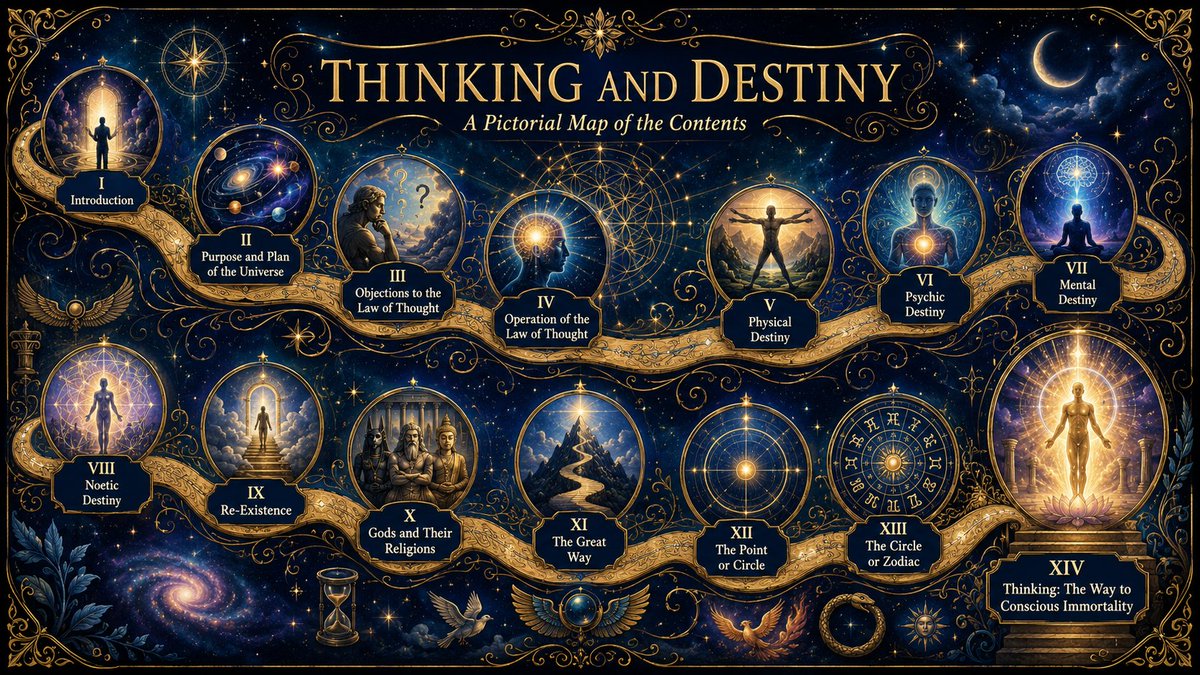
![dandoinit's tweet photo. From the Book "Thinking & Destiny" by Harold Waldwin Percival https://t.co/DKEWOnm5Wl 1946 by Harold W. Percival Copyright 1974 by The Word Foundation, Inc. All rights reserved, including the right to reproduce this book or portions thereof in any form.
AFTERWORD
How This Book Was Written
by Benoni B. Gattell
There may be those who would like to read about the manner in which this book was produced by Harold Waldwin Percival. For them I am writing this with his permission.
Percival dictated because, as he said, he could not think and write at the same time, as his body had to be still when he wanted to think. He dictated without referring to any book or other authority. I know of no book from which he could have gotten the knowledge here set down. He did not get it and could not have gotten it clairvoyantly or psychically.
In answer to a question how he obtained the information, Percival said that several times since his youth he had been conscious of Consciousness. Therefore he could become conscious of the state of any being whatever, whether in the manifested Universe or the Unmanifested, by thinking about it. He said that when he thought of a subject intently the thinking ended when the subject opened up as from a point into completeness. The difficulty he encountered, so he said, was to bring this information into his mental atmosphere. A still greater difficulty was expressing it precisely and so that any one would understand it, in a language in which there were no suitable words.
Thirty-seven years ago he gave me much of the information now in this book. For thirty years I have lived with him in the same house and written down what he dictated. Since 1912, Percival outlined the matter for the chapters and their sections. Whenever both of us were available, throughout these many years, he dictated. He wanted to share his knowledge, however great the effort, however long the time it took to clothe it in accurately fitting words.
He did not use specialized language. He wanted anyone who read it to understand the book. He spoke evenly, and slowly enough for me to write his words in long hand. Though most of what is in this book was expressed for the first time, his speech was natural and in plain sentences without vacuous or turgid verbosity. He gave no argument, opinion or belief, nor did he state conclusions. He told what he was conscious of. He used familiar words or, for new things, combinations of simple words. He never hinted. He never left anything unfinished, indefinite, mysterious. Usually he exhausted his subject, as far as he wished to speak about it, along the line on which he was. When the subject came up on another line he spoke of it along that. He said this book deals with general things and there are innumerable exceptions.
Percival spoke freely to anyone who approached and wanted to hear from him about the matters in this book. At times he talked in answer to questions for more details. He asked that these questions be precise and on one point at a time.
What he had spoken he did not remember in detail. He said that he did not care to remember the information I had set down. He thought of every subject as it came up, irrespective of what he had already said about it. Thus when he dictated summaries of previous statements he thought about the matters once more and acquired the knowledge anew. So often new things were added in the summaries. Without premeditation, the results of his thinking on the same subjects along different lines, and sometimes at intervals of years, were in agreement. Thus in the eighteenth section of the chapter on Re-existence the views are along the lines of Consciousness, continuity and illusions; in the first six sections of chapter fourteen the view is from the standpoint of thinking; yet what he said about the same facts at these different times under these different circumstances was compatible.
Sometimes sections were re-dictated, if he opened a subject so wide that a restatement became necessary. The language which he used was not changed. Nothing was added. Some of his words were transposed for readability. When this book was finished and typewritten he read it and settled its final form, replacing some of the terms which were makeshifts by happier ones.
When he dictated this book and had time he formerly lacked, he created a terminology which accepted words which were in use, but might suggest what he intended when he gave them a specific meaning. In every case he gave definitions or descriptions when words were used by him with a specific meaning. He said, “Try to understand what is meant by the term, do not cling to the word.” The only word he coined is the word aia [pronounced eye-uh] because there is no word in any language for what it denominates.
January 2, 1932](https://pbs.twimg.com/media/HLkVIXSbwAAYk6e.jpg)