A physicist put 22 cars on a circular track and asked every driver to hold a steady 30 km/h, about 19 mph. No lights, no lanes, no obstacles. Within a minute the cars started bunching, and soon a full stop appeared out of nowhere, then drifted backward around the loop.
This was Yuki Sugiyama at Nagoya University in 2008. His team spaced the cars evenly on a 230-meter ring and filmed them from overhead. For a while the flow stayed smooth. Then the tiny differences no human can avoid, one driver a hair slower, the next a hair too close, began to feed on themselves.
One car eases off slightly. The driver behind sees the brake lights, reacts a fraction of a second late, and brakes a little harder to be safe. The next driver brakes harder still. A dozen cars back, someone is stopping dead. The squeeze rolls backward through the line like a compression running down a Slinky, and it keeps going long after the first driver has sped up again.
Car count was the tipping point. With fewer than 22 on that track, the bunching sorted itself out. At 22, a jam formed every time. Engineers call that a critical density, the point where a road holds just enough cars that one small tap can snowball into a standstill.
These waves are eerily consistent. Measured on highways around the world, the jam rolls backward against the traffic at roughly 20 km/h, and that speed barely shifts from one country to the next. Different drivers, different roads, same number.
The same setup later became the cure. In 2017, a US team rebuilt Sugiyama's ring with 22 cars and turned just one of them into a self-driving car running a program to smooth its own speed. That single car soaked up the small slowdowns instead of passing them back, and the waves died. Fuel use across every car fell by up to 40 percent. Fewer than 5 percent of the vehicles had to be automated to steady the whole group.
In 2022 the idea moved onto a live highway. Researchers ran 100 cars with cruise control guided by AI into the morning rush on Interstate 24 near Nashville, mixed into normal traffic. Early numbers pointed the same way: a small share of smoother-driving cars, up to 40 percent less fuel for everyone around them.
The jam you sat in this morning likely had no crash and no cause you could see. It was a few hundred drivers, each braking a moment too late.
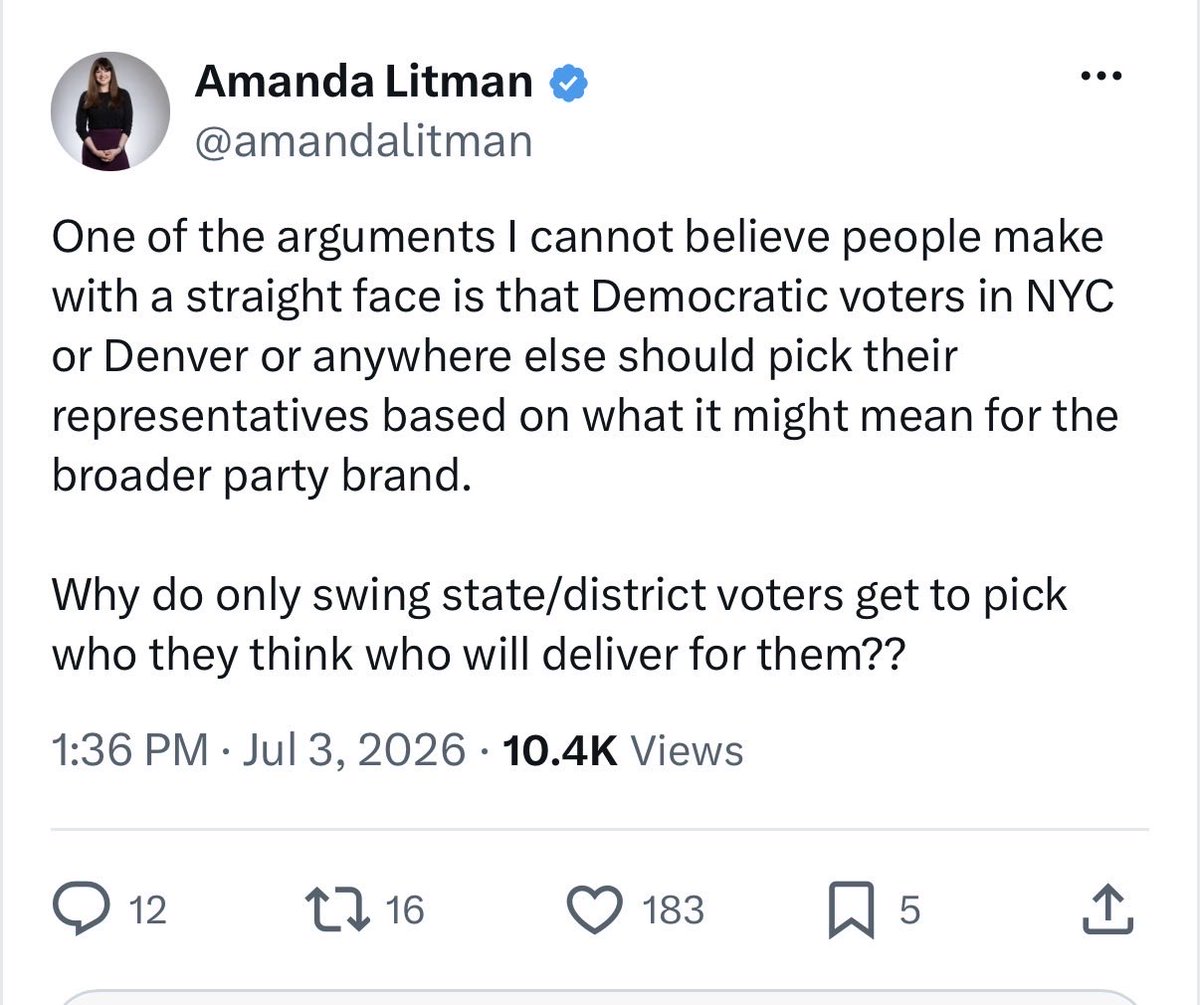
That people should be able to vote for the candidates they like in the places they live seems to go without saying, but here we are. The party should adapt its through line to its members rather than vice versa.
Indifference to national implications is fine, but then you can’t claim the banner of being the ones who are truly fighting Trump.
You fight Trump by winning in swing states and frontline districts. If you don’t care about that, you’re not fighting!
@jaycaspiankang Personally, I’d love to see less money in politics i.e. this is a winning message. That it’s a vulnerability for many/most Dems doesn’t mean it’s not good politics.
The premise of this piece seems to be that DSA candidates must contest Dem seats held by moderates in order to fulfill their death-to-moderates oaths. Seems much more reasonable to gain a seat first, scorch the earth later.
@RajaKorman@Brad_Setser@jonsindreu@SanderTordoir okay, so your take is a similar outcome unlikely absent a similar response on the part of China? which also seems unlikely given the nature of Chinese currency intervention?
@RajaKorman@Brad_Setser@jonsindreu@SanderTordoir Doesn't the story of Japan's decline -- assuming it's agreed to have downstream of Plaza reval -- as an export-led economy then argue for the potential salience of reval for CNY?
A relevant consideration when evaluating apparently inefficient policies like rent control is whether the distortions introduced exceed the losses generated by prevailing market failures or whether the set of distortionary policies are welfare enhancing relative to the status quo
Seems completely reasonable to fund capacity expansion via taxation of the relevant good — what am i missing? How does this differ from a fuel tax used to fund roads?
I do not like the idea of taxing industrial electricity use, especially because *growing industrial electricity use* is a good thing. There are other ways to ensure data centers pay their fair share, protect ratepayers, and get revenue from these guys to fund social goods.
Doing well with Rs by undermining one’s colleagues doesn’t seem like a strategy for party success. That Ds are focused on internal positioning speaks to a lack of leadership in the party.