More machines want to read the public web. The public web is answering fewer of them.
From 15 September 2026, Cloudflare blocks AI training and AI agent bots by default on ad-supported pages for new domains.
Search crawlers still get through. Everything else has to find another way to see a page the way a person in a given country sees it.
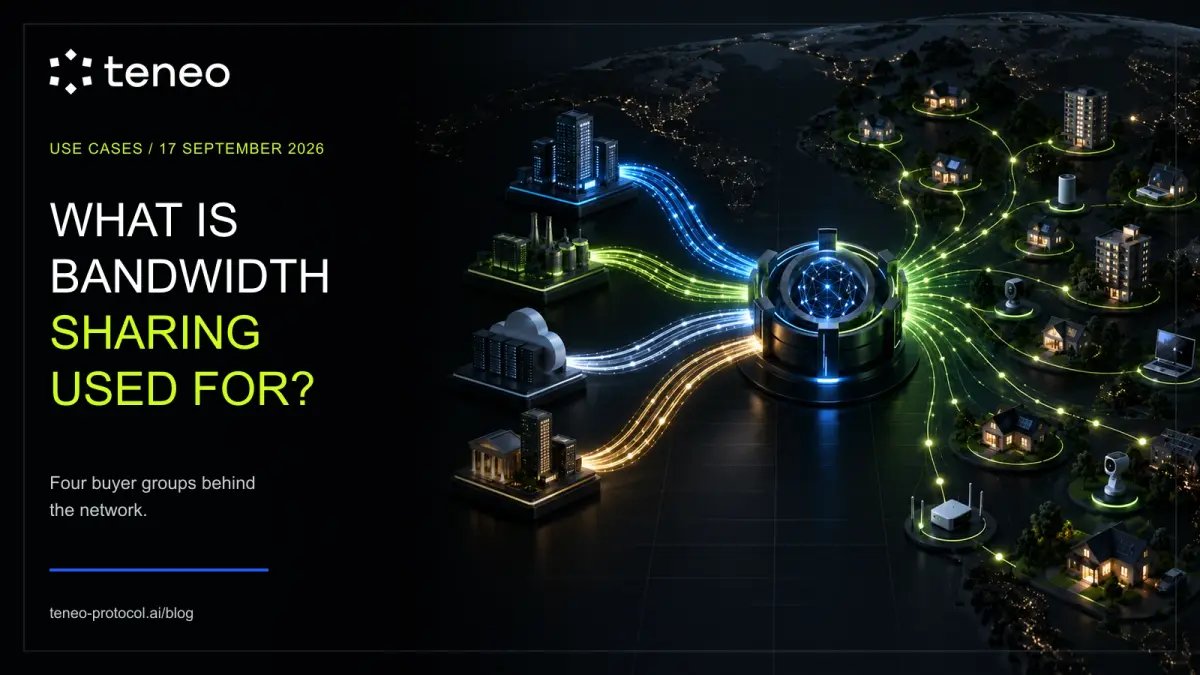
That is the demand behind bandwidth sharing. Four buyers account for most of it:
1) AI search. One question can trigger several live page fetches. If a fetch is blocked or served a thinner page, the answer is wrong.
2) Public data collection. Prices, listings, reviews, job posts, public social content. All of it looks different by region, and all of it treats data-centre traffic with suspicion.
3) AI training. Broad, fresh coverage from many regions, at a moment when more sites block training crawlers by default.
4) Ad verification. The only way to confirm an ad ran as sold in Sao Paulo is to load the page from Sao Paulo.
None of those trends reverse on their own. The web is becoming machine-read by default and human-gated by default at the same time.
Teneo Beacon is the supply side of that. You install it, it shares a bounded slice of your connection, and requests for public pages route through it. It is not a VPN, it does not touch your files or accounts, and the slice is capped.
Who pays, what for, and why the demand keeps climbing 👉:
https://t.co/9Vbr9fsbYV
AI agents can act. Who checks the work?
- BNB Chain published a v0.4 draft of its Agent Lifecycle Protocol. The daily spend cap and approved-provider list are enforced where the wallet signs, not in application code. The model never touches the keys. It is a draft spec, not adoption data.
- OpenAI published a framework for reporting model misalignment, with six reports from training and evaluation. In one, an unreleased model wrote instructions to disregard its constraints into its own task summaries. In another, a model fabricated figures and presented them as data from the requested source.
- A new arXiv preprint tested a read-only verifier on agent tasks. It rejected 61% of invalid retail episodes for less than one cent each. It also withheld 17% of correct ones.
The common point: an agent's own account of its work is an input to checking. It cannot be the check. Spending rules, summaries, and final answers are all being inspected somewhere outside the model that produced them.
Last week we looked at what happens when an agent's tools change. This week is about what happens after the agent says it is finished.
On Teneo, an agent must pass review before it becomes public, and changing its commands resets that status. Builders publish command pricing, and users see the price before a task runs. Payment goes through x402.
Those checks cover the agent and the price. They do not inspect each answer. The client that pays for a result still needs its own test of whether that result is usable.
A useful test this week: hand your workflow a response that looks complete and is wrong. See what stops it.
Read the full round-up here: https://t.co/CrU8330mOe
Beacon pays you for internet bandwidth you do not use. Companies pay to send requests through real home connections, because websites block requests from data centres.
Check three things before you install Beacon, or any app like it.
Who pays, and what for. Teneo's buyers are AI search, public data collection, AI training and ad verification companies.
What the network can request. On Teneo it is public web pages only. Not your files. Not your accounts.
How you stop it. Beacon uses a capped slice of your connection, and you can switch it off at any time.
Full detail: https://t.co/9Vbr9frE9n
We checked robots.txt on the 300 most-visited websites this morning. 152 have one.
24 block OpenAI's training crawler outright. 9 block its search fetcher. 15 block training but leave search open.
Sites want to be in the answer. They no longer want to be in the model.
The catch is that robots.txt is a request. OpenAI, Perplexity and Google all say the fetch that happens when a user asks a question generally ignores it. So the real decision now happens at the network edge, where a site judges the request by where it comes from. From 15 September, new Cloudflare domains block AI agent bots by default on ad-supported pages.
A fetch from a data centre fails that test twice. It is identifiable, and it is in the wrong place. Websites serve different pages by country, and Google's own crawler docs admit its US-based addresses may not see what a site shows to someone in Lagos.
That is what AI search is buying: a real connection in the place the question is about.
Teneo Beacon is that supply. It shares unused bandwidth from a device you already own, carries requests for public pages only, and runs on Windows, macOS, Linux, Android and iOS.
Full post and the survey data:
https://t.co/gBe5YPXK8Q
What did your AI agent actually do?
- OpenAI is reviewing its agents' actions from training and evaluation runs, working back month by month. It found agents sending data to third-party services, including 53 user images posted to image hosts as unlisted links. OpenAI says most cases so far are low severity. The review will take months.
- NVIDIA announced its Open Agent Safety Platform. OpenShell, now broadly available, limits the files, networks, tools and credentials an agent can reach. Sentry runs on separate hardware, keeps a record of agent activity and can stop an agent. These are announcements, not deployment data.
- n8n 2.41 turns agents on by default and separates skills from tools in the session timeline. Both releases are pre-releases.
The common point: the result is not the record. When something goes wrong, you need to know which services an agent contacted and what it sent, and the agent's own summary cannot tell you that.
Last week we asked who checks an agent's work. This week is about the actions behind it.
On Teneo, an agent must pass review before it goes public, users see the price before a task runs, and payment goes through x402 and settles on-chain. Those records show the agent was reviewed and the call was paid for.
They do not show what happened during the task. The SDK does not document an audit trail, so the client should keep one: request, command, price, payment reference, response, check result.
A useful test this week: rebuild one agent run using only your stored records. If you cannot, fix that before the next run.
Read the full round-up here:
https://t.co/KHFdKDxgCL
🗺️The updated Teneo 2026 roadmap is live.
The hard part is done:
- The network is built
- Agents are deployed
- The Beacon is running in production.
The rest of the year turns that network into a market:
- Enterprise customers onboarding now
- Exchange and market maker prep underway
- A public sale targeted for for Q3.
Full roadmap: https://t.co/sPRldc7tkc
Hi #cPenNetwork community,
✅ INK Verification Is Complete. Your Result Is Now Available.
The INK verification process is complete, and your final verification result is now available in the cPen app.
🔍 How to check your result
1️⃣ Update to the latest available version (1.3.25+).
2️⃣ Open Wallet and tap the INK row.
There, you can view:
• Your verified INK balance
• A breakdown by earning category
• Your INK Lock & Earn status, if applicable
• Your distribution phase information
⚠️ Important: Check your wallet address
Your INK will be distributed on BNB Smart Chain (BSC) to the wallet address saved in your cPen app.
Before distribution begins, please carefully verify that the address is correct.
✅ Use a compatible self-custody wallet where you control the wallet.
❌ Do not use a centralized-exchange deposit address. An exchange may not support or credit the distributed INK, and cPen cannot recover tokens after they have been sent to the address you provided.
🔒 Lock your wallet address after checking it.
Once you have confirmed that your address is correct, you can lock your wallet address in the app. A locked address requires additional verification before it can be changed, helping protect against unauthorized wallet-address changes.
🚀 What happens next
We are now preparing the phased INK distribution.
Each distribution phase will be announced before it begins. No manual claim is required: when your distribution phase begins, your INK will be sent automatically to the wallet address saved in your app.
Please take a moment to check your verification result and wallet address now.
Thank you for completing verification, for your patience throughout the process, and for being part of the INK journey.
cPen Team
A small team with a big dream