Make your agent smarter.
The II-Commons skill gives your agent reliable knowledge from arxiv, PubMed & more, plug it in
Repo: https://t.co/JdV84AMPuv
Add it to II-Agent: https://t.co/OWH1dFkwc4
20 years ago, my first startup was all about enterprise search. Two decades later, we’re still building search engines. The technology has shifted from NLP to NN and the users from humans to agents. but searching is still the core. opensource the fastest bm25 engine:
DS4 is geart!
I made a temporary fork with my weekend patches while the PRs are under review
- unlock q4 on 192GB MAC
- llama.cpp-style raw completions endpoint: enable Pre-filling and custom templates in SillyTaverns etc.
Pre-merge convenience fork only :)
Welcome to DS4, a specialized inference engine for DeepSeek v4 Flash. https://t.co/UrUJz5I2R1
This project would have been impossible without the existence of llama.cpp and GGML and the work of @ggerganov and all the other contributors. Thanks!
Unstructured intelligence = chaos
Most agent frameworks ship without a nervous system: deadlocks, context loss, vacuum hallucinations.
We built Common Ground to fix this, agents coordinate on a shared protocol.
Our state of the art open source general purpose agent hits V1
Feature equivalent to Replit / Manus / Genspark etc, to make websites to presentations and more connected to all your other tools
Readying open repo update in a week or two, give it a try and give feedback!
II-Agent V1 is here.
The AI agent built for real work is finally out of beta.
Faster, smarter, and production-ready. It’s time to change how you build.
👇 Let’s see what’s new.
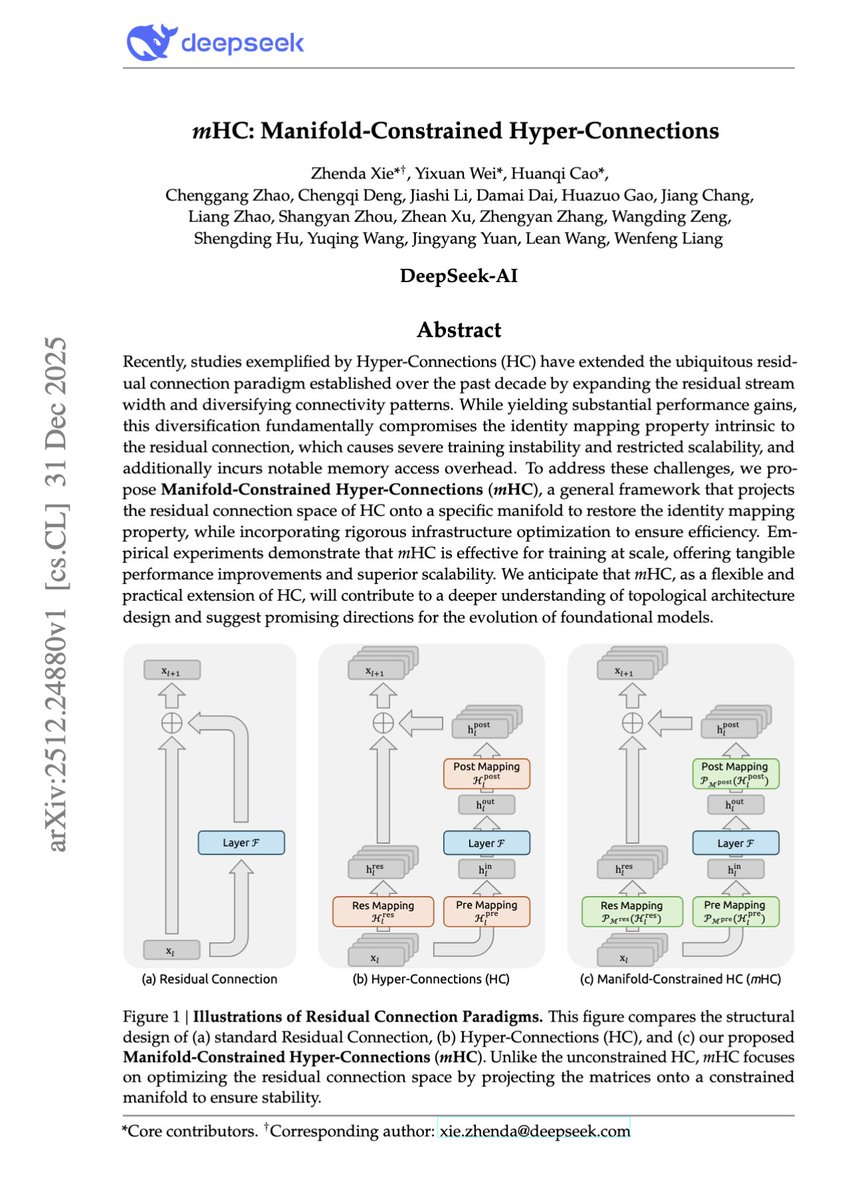
DeepSeek just dropped a banger paper to wrap up 2025
"mHC: Manifold-Constrained Hyper-Connections"
Hyper-Connections turn the single residual “highway” in transformers into n parallel lanes, and each layer learns how to shuffle and share signal between lanes.
But if each layer can arbitrarily amplify or shrink lanes, the product of those shuffles across depth makes signals/gradients blow up or fade out.
So they force each shuffle to be mass-conserving: a doubly stochastic matrix (nonnegative, every row/column sums to 1). Each layer can only redistribute signal across lanes, not create or destroy it, so the deep skip-path stays stable while features still mix!
with n=4 it adds ~6.7% training time, but cuts final loss by ~0.02, and keeps worst-case backward gain ~1.6 (vs ~3000 without the constraint), with consistent benchmark wins across the board