"Tam zamanlı ev hanımı" ideali, sanayi devrimi sonrası ortaya çıkmış modern bir fenomendir.
Tarih öncesi kadınlar o kadar çok çalışıyordu ki, kol kemikleri günümüz sporcu kadınlardan bile daha sağlamdı.
Every World Cup has that one completely random striker who turns into prime Ronaldo Nazário for exactly two weeks, has a great tournament, signs a £60M contract with a top club, and then disappears from football forever.
I wonder who it's going to be this month
Scientists shut off the dopamine in some rats and they stopped eating. Food everywhere. They starved in a full cage, not because they hated it. Put sugar on their tongue and they licked their lips. They still liked it. They just lost the drive to go get it.
This is one of the strangest things we know about the brain, and it traces back to a researcher named Kent Berridge at the University of Michigan. Your head runs two different systems. One is wanting, the push that gets you off the couch and moving. The other is liking, the good feeling once you are in it. Dopamine runs the wanting. The enjoyment runs on separate wiring. So you can be sure you will love something and still feel almost no pull to start it.
That is the man in the cartoon, swinging at rock with diamonds all around him. He could see the good stuff. He just could not make himself dig toward it.
Once you see why, the usual story about procrastination stops making sense. We say lazy, or bad with time. Mostly, it is neither. Two psychologists, Fuschia Sirois and Tim Pychyl, argued back in 2013 that it runs on emotion. A task makes you feel something you would rather not feel, even just the small dread of starting, and putting it off makes that feeling vanish on the spot. So you scroll, or you suddenly need to clean the kitchen. Dodging the task is a quick hit of relief, and your brain grabs it. The bill goes straight to future-you, who is left holding the guilt and the deadline.
You can even see it on a brain scan. In 2018, a team in Germany scanned 264 people and matched the scans against how much each person put things off. The big procrastinators had a larger amygdala, the little alarm bell deep in the brain that flags anything risky. They also had a weaker link to the part meant to quiet that alarm and get you moving, a region called the dorsal anterior cingulate cortex. Loud alarm, weak off-switch.
And if this is you, you have plenty of company. A big 2007 review found that 80 to 95 percent of college students procrastinate, that roughly one in five adults does it long-term, and that more than 95 percent of them wish they could quit. Students alone burn about a third of their day on it.
The fix falls out of that same split. If wanting and liking are two different systems, then waiting to "feel like it" is waiting for a bus that may never come. The main treatment for the severe version, called behavioral activation, flips the order. You start first, as small as you can stand, before any motivation shows up. The wanting tends to arrive a few minutes after you begin. The diamonds were there the whole time. You just have to swing the pick before you feel ready.
Aside from this confirming that the US is a global gangster, haven’t crypto freaks been telling us for ages that cryptos are beyond the reach of government?
In a footnote to Capital, Marx brought up a testimony of a French worker. In France, he assumed he could do just one specific type of job (= printing). In California, he discovered that he in fact can do anything & all the constraints he faced in Europe were purely artificial
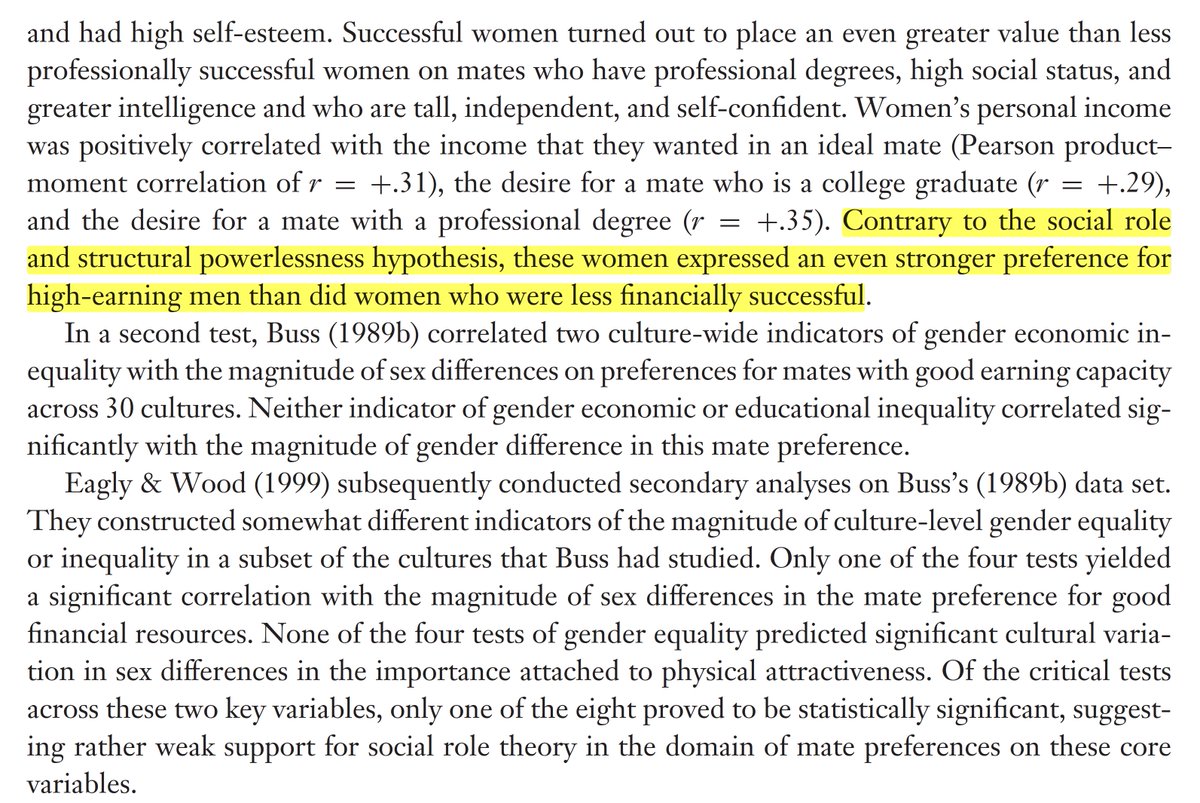
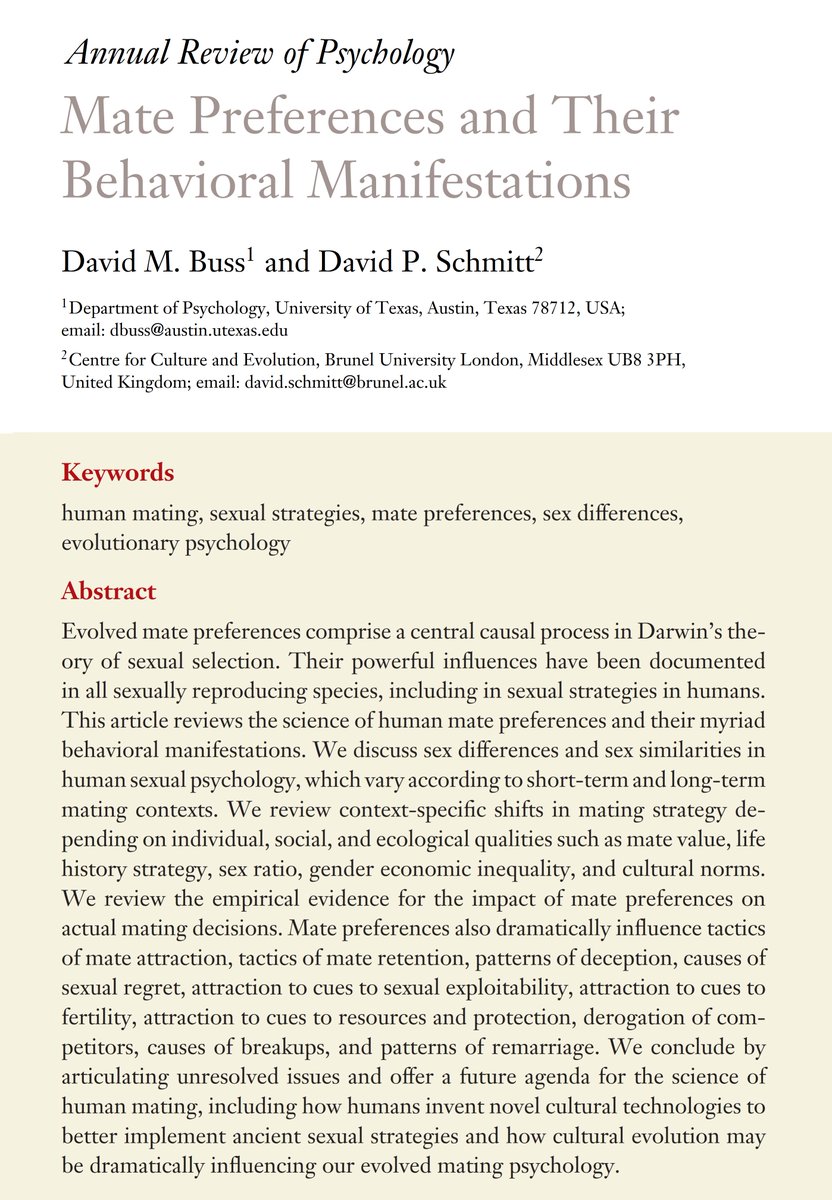
Kendi parası ve gücü olan başarılı kadınlar bile maddi durumu daha iyi olan bir erkeği tercih etme eğilimindedir.
Bu durum, kadınların "toplum onları kısıtladığı için güçlü erkek aradığını" öne süren sosyal rol teorisini çürütür.
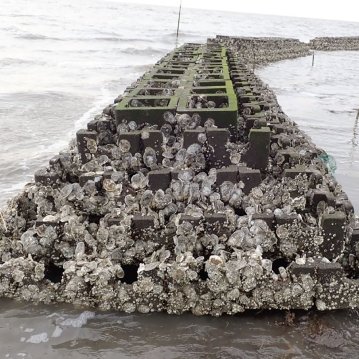
Coastal cities are replacing concrete seawalls with oyster reefs. The oysters are better at the job.
Seawalls start degrading the day they're installed. Waves chew them up, storms crack them, and the repairs never stop.
An oyster reef, on the other hand, doesn't break down. It actually grows. The oysters stack, reproduce, and fuse into living rock that gets stronger every year. A mature reef can cut incoming wave height by up to 83%, trap sediment, rebuild the shoreline behind it, and shelter fish, crabs, and shrimp while it does the work.
A hectare of reef provides up to $85,000 a year in shoreline protection. Concrete costs over a million dollars a hectare to build and only weakens.
Once again, working with nature instead of against it is the answer.
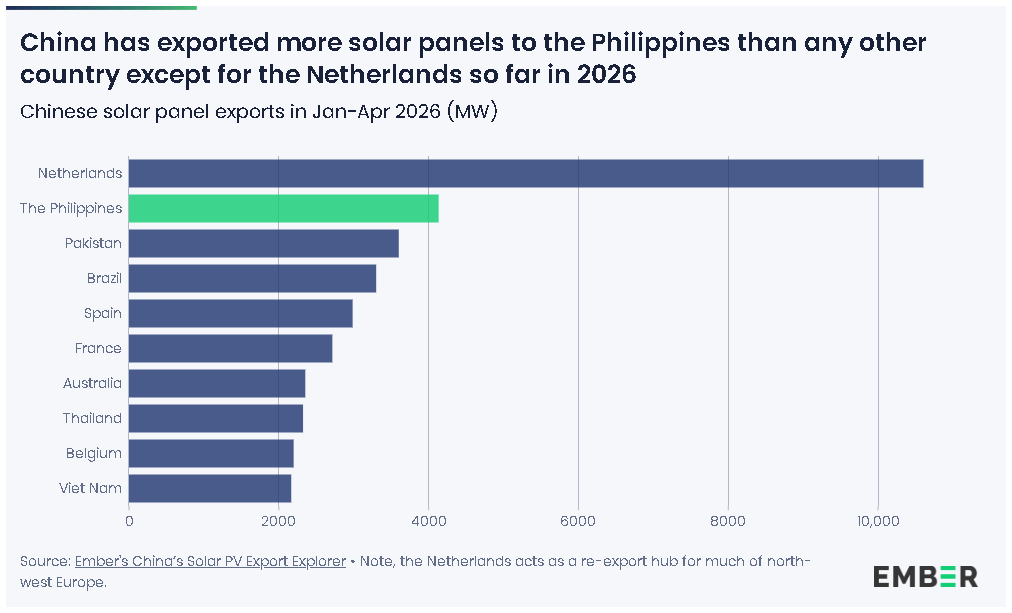
This is really remarkable: the Philippines is undergoing a huge grassroots-led green revolution, with millions of ordinary Filipinos installing Chinese solar panels on their rooftops.
So much so that the Philippines just became, so far in 2026, China's #2 solar export market on Earth 👇
A lot of it is driven by the current energy crisis and the fact the Philippines now has the most expensive residential electricity in Southeast Asia.
This makes the economics of solar panels a complete no-brainer: as per the Ember report (https://t.co/U0UBrnyAhL) a Chinese solar panel - given cost of electricity in the Philippines - now has a payback period of only 3.1 years for households and 2.3 years for businesses.
Given that the average lifespan of a solar panel is roughly 30 years (panels from the big Chinese makers - Longi, JA Solar, Trina - now come with 30-year performance warranties as standard), it means that when you install one on your rooftop you essentially get free electricity for about a quarter of a century!
We're used to thinking of green energy as something top-down, the government imposing on reluctant citizens, but increasingly - in large parts of the world - it's becoming the exact opposite: a bottom-up movement of ordinary people who simply want cheaper energy.
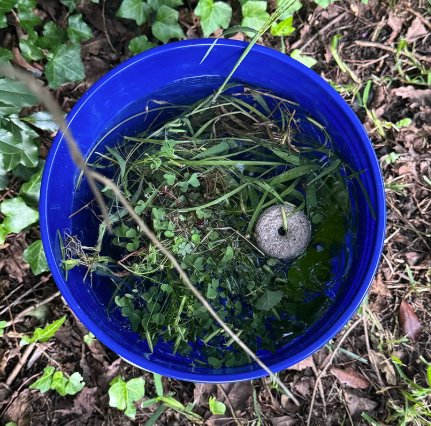
You can crash your yard's mosquito population without spraying a single chemical with a Mosquito Bucket of Doom.
Fill a 5-gallon bucket about two-thirds with water. Drop in a handful of grass clippings, leaves, or hay. Let it sit for a day, then drop in a Bti dunk (also called Bacillus thuringiensis israelensis, sold at any hardware store as "mosquito dunks," about $10 for six).
Mosquitoes are powerfully attracted to fermenting water and will lay their eggs in your bucket. Bti is a naturally occurring soil bacterium that produces a toxin that kills mosquito, blackfly, and fungus gnat larvae only.
This method doesn't harm bees, butterflies, fireflies, fish, frogs, birds, pets, or people. BTI dunks are EPA-approved for organic use and safe in animal water troughs and birdbaths.
One dunk lasts about 30 days. Top off the water as it evaporates. Cover with 1/2-in Mesh Hardware Cloth to prevent animals from getting trapped and put the bucket somewhere shady where pets and kids won't get into it.
The bucket becomes a mosquito magnet and a dead end. Compare that to fogging the entire yard with pyrethroids, which kills every insect in it, including the predators that eat mosquitoes.
Doug Tallamy's Homegrown National Park has been running the "Mosquito Bucket Challenge" since 2021. The more buckets in a neighborhood, the bigger the dent. One bucket per yard is a great start.
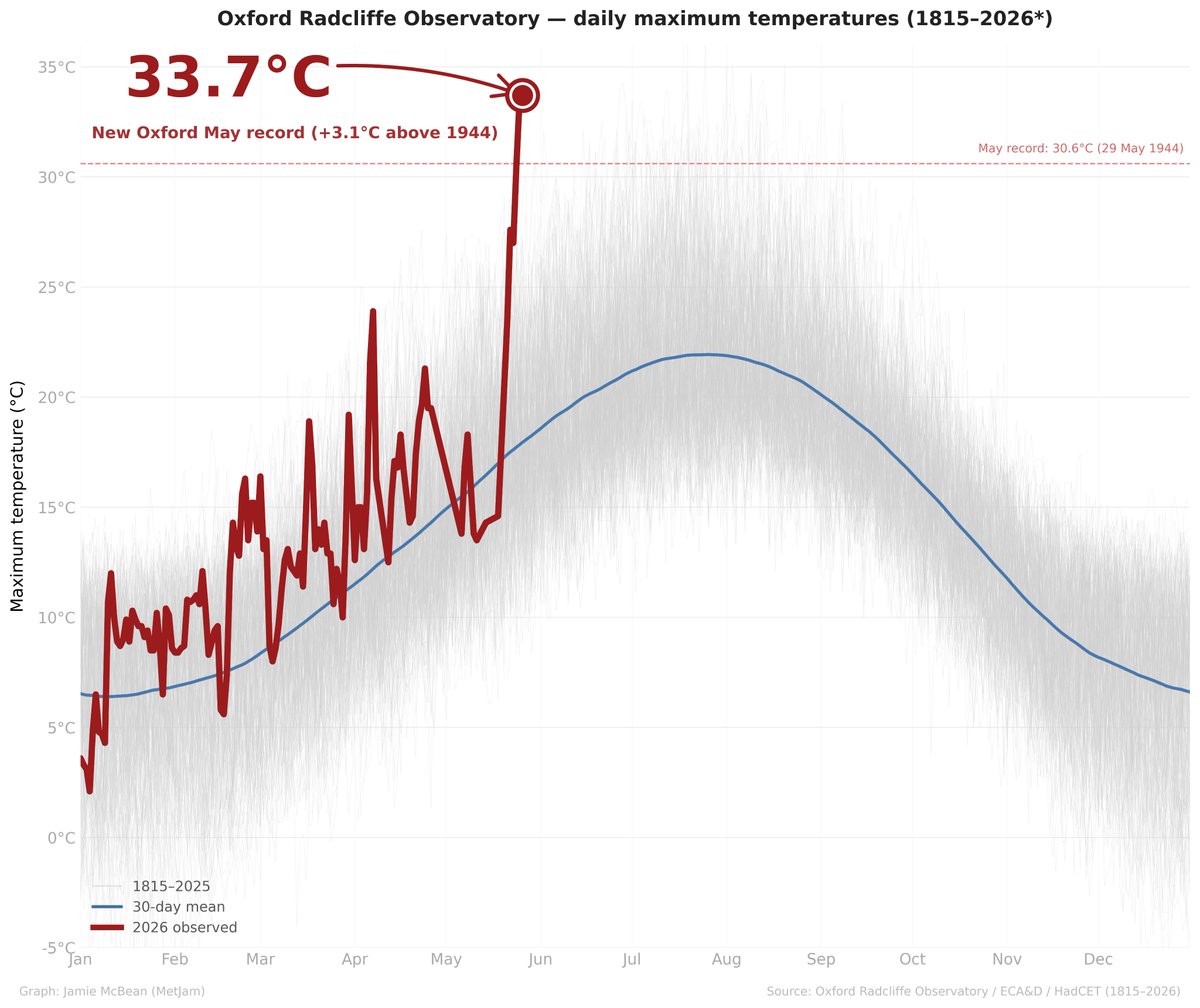
Oxford, the longest running continuous weather station in UK history, with temperature observations stretching back to 1815, has preliminarily broken its maximum temperature record for May yesterday by OVER 3ºC with a temperature of 33.7ºC. Unprecedented in its 211-year history.
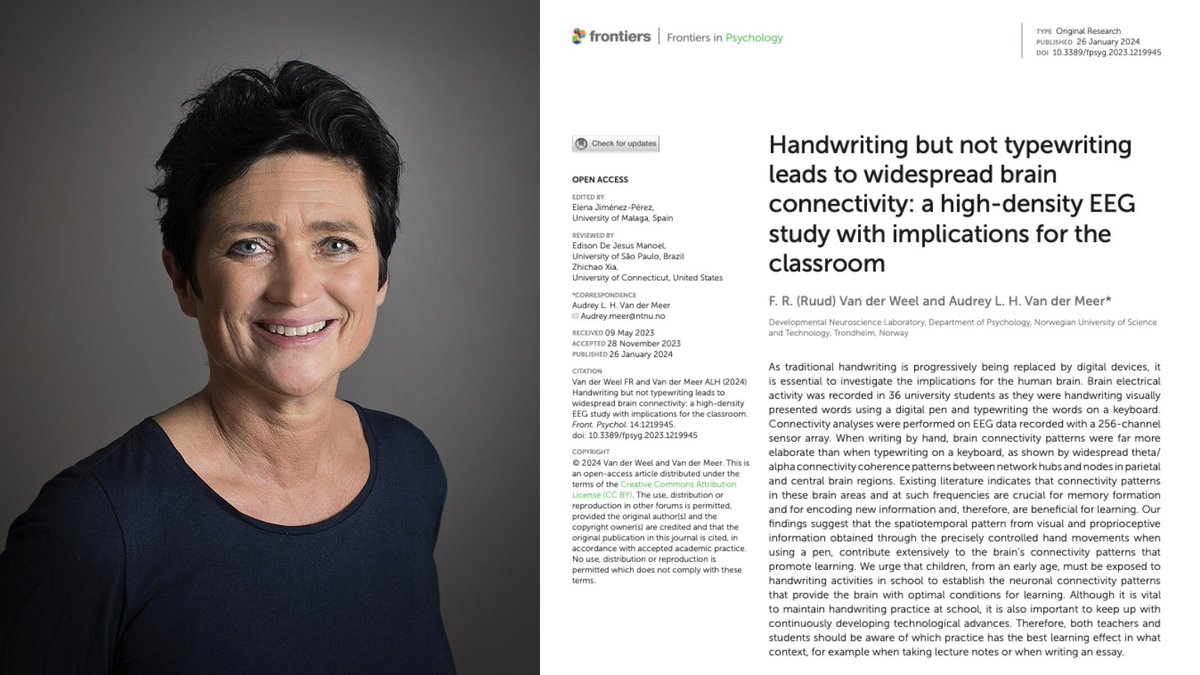
A Norwegian neuroscientist spent 20 years proving that the act of writing by hand changes the human brain in ways typing physically cannot, and almost nobody outside her field has read the paper.
Her name is Audrey van der Meer.
She runs a brain research lab in Trondheim, and the paper that closed the argument was published in 2024 in a journal called Frontiers in Psychology. The finding is brutal enough that it should have changed every classroom on Earth.
The experiment was simple. She recruited 36 university students and put each one in a cap with 256 sensors pressed against their scalp to record brain activity. Words flashed on a screen one at a time.
Sometimes the students wrote the word by hand on a touchscreen using a digital pen, and sometimes they typed the same word on a keyboard. Every neural response was recorded for the full five seconds the word stayed on screen.
Then her team looked at the part of the data most researchers had ignored for years, which is how different parts of the brain were communicating with each other during the task.
When the students wrote by hand, the brain lit up everywhere at once.
The regions responsible for memory, sensory integration, and the encoding of new information were all firing together in a coordinated pattern that spread across the entire cortex. The whole network was awake and connected.
When the same students typed the same word, that pattern collapsed almost completely.
Most of the brain went quiet, and the connections between regions that had been alive seconds earlier were nowhere to be found on the EEG.
Same word, same brain, same person, and two completely different neurological events.
The reason turned out to be something nobody had really paid attention to before her work. Writing by hand is not one motion but a sequence of thousands of tiny micro-movements coordinated with your eyes in real time, where each letter is a different shape that requires the brain to solve a slightly different spatial problem.
Your fingers, wrist, vision, and the parts of your brain that track position in space are all working together to produce one letter, then the next, then the next.
Typing throws all of that away. Every key on a keyboard requires the exact same finger motion regardless of which letter you are pressing, which means the brain has almost nothing to integrate and almost no problem to solve.
Van der Meer said it plainly in her interviews.
Pressing the same key with the same finger over and over does not stimulate the brain in any meaningful way, and she pointed out something that should scare every parent who handed their kid an iPad.
Children who learn to read and write on tablets often cannot tell letters like b and d apart, because they have never physically felt with their bodies what it takes to actually produce those letters on a page.
A decade before her, two researchers at Princeton ran the same fight using a completely different method and ended up at the same answer. Pam Mueller and Daniel Oppenheimer tested 327 students across three experiments, where half took notes on laptops with the internet disabled and half took notes by hand, before testing everyone on what they actually understood from the lectures they had watched.
The handwriting group won by a wide margin on every question that required real understanding rather than surface recall.
The reason was hiding in the transcripts of what the two groups had actually written down.
The laptop students typed almost word for word, capturing more total content but processing almost none of it as they went, while the handwriting students physically could not write fast enough to transcribe a lecture in real time, which forced them to listen carefully, decide what actually mattered, and put it in their own words on the page.
That single act of choosing what to keep was the learning itself, and the keyboard had quietly skipped the choosing and skipped the learning along with it.
Two studies. Two countries. Same answer.
Handwriting makes the brain work. Typing lets it coast.
Every note you have ever typed instead of written went into your brain through a thinner pipe. Every meeting, every book highlight, every idea you captured on your phone instead of on paper was processed at half depth.
You did not forget those things because your memory is bad. You forgot them because typing never woke the part of the brain that would have made them stick.
The fix is the thing your grandmother already knew.
Pick up a pen. Write the thing down. The slower road is the faster one.
Pouca gente sabe mas a Fuji não faz apenas câmeras e filmes. Ela também domina o mercado de máquinas para circuitos integrados. Esse modelo clássico CP-643 com 20 cabeças trabalha em um ritmo insano de 40 mil componentes por hora para criar as placas de circuito dos eletrônicos.
🚨 The real masterminds and backstage geniuses behind the rose petals falling from the Pantheon’s oculus on Pentecost Sunday?
The Rome firefighters!
Italy at its finest 🇮🇹🔥
.@PalmerLuckey: American companies don't actually have engineers anymore.
"American companies have been hollowed out."
"We're not teaching engineers how to be engineers anymore."
"We're not teaching designers how to actually design things to be manufactured."
"We're teaching them how to be high-level design shops that put together a design package, that gets sent to the real engineers in China—and they actually figure out how to do the work."
"People are turning into architecture astronauts."
"They pick components, and they put them in a nominal layout."
"But the real work of—how am I actually going to put this together? How am I going to build a manufacturing line to make this? How am I going to need to figure out how to do the one, two, three, four, five different revisions of this board to pass radio emissions and interference standards? That's all done in China. So they are the real engineers."
Via @HooverInst