Lauby, NERC’s chief engineer, pointed out that although energy represents only 7% of the economy “it’s the first 7%, because nothing else works after."
Incredible line in this NYT report on grid vulnerabilities
- 75% of distribution transformers beyond their rated 50 year life
- Only 20% of US demand manufactured domestically
- Avg wait for a large transformer 2.5 years
- Lack of skilled labor: components are assembled by hand, a process that can take weeks. Master welders required for the oil tanks + the transformer case
- “If all of the business for transformers across the globe shifted back into the United States, I don’t think we could staff it.”
- Siemens was training some of its workers by sending them to Germany
- Central Moloney has invested almost a million dollars in the welding programs of local high schools
- Virginia Transformer grown to 6,000 employees, from 1,800 in the past 4 years
- Risk capital flowing to alternative solid state transformers including 2 startups by Tesla alums
Been warning about this for months now
The cost to upgrade a data center (new chips) etc is about 2/3 the cost to build new
The perpetual maintenance/upgrade costs of this AI infrastructure is going to be far more expensive than previous tech infrastructure buildouts (railroad rails, fiber optic cable, etc)
Order a large gas turbine today and the slot you're quoted runs into 2029 or 2030. GE Vernova has 100 GW on contract, because data centers booked the factory dates first.
That changes how a power plant gets built. The schedule no longer starts with the permit or the construction, it starts with the slot the manufacturer gives you. That date is the fixed bar on the Gantt chart, and everything else is scheduled backward from it.
https://t.co/3QGzC6L9wm
A utility industry schism -- FirstEnergy breaks with its peers and tells FERC that data centers should pay for transmission upgrades they impose and be billed the standard transmission rate paid by everyone.
@alex_fasulo I've been following you for a while just watching the outlandish stuff you post but just FYI, every municipality in NY requires decommissioning bonds being posted before site approvals.
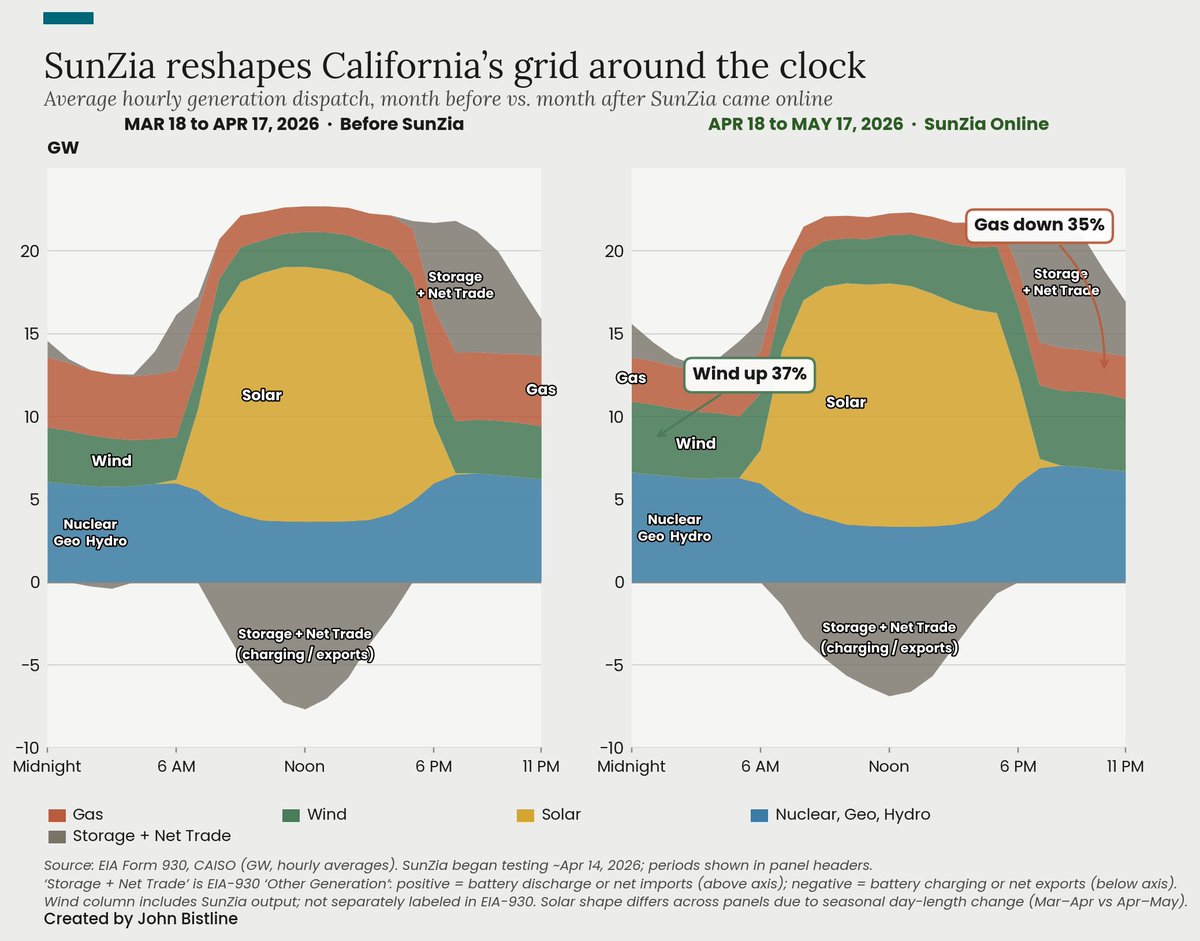
Does new transmission actually move the needle on clean energy? Here's a month of California data before and after SunZia came online. Wind is up by a third, and gas down by a third. Judge for yourself.
@SlBrandin Alright if we keep adding variable production shouldn't there be a long runway before merchant storage facilities keep eating their own margins?
The Electricity Grid
I post a lot of stuff about the electricity grid, here the CEO of the largest grid in America (PJM) lays it out pretty clearly.
• What worked for 2 decades… no longer works
• This is structurally different from history
• You are facing an era of scarcity
• The situation is not tenable
PJM are facing a demand explosion. Now a demand explosion in some industries is +500% demand. But this is infrastructure, this is tens of trillions of dollars of assets and it takes time to mobilise and deploy things at this scale.
In infrastructure, when demand growth shifts from +1-2%/yr to +8%/yr, then you suddenly need to be building 4-8 times more assets per year, than you previously did.
If you were deploying $1 trillion / yr to grow at 1%, you now need to deploy $8 trillion / yr to grow at 8%.
Suddenly you need to deploy many trillions of dollars per year to meet this growth. If you cannot get it done, prices will rocket for everyone. Failure leads to inflation.
This is not a PJM problem, this is not even a US problem, this is a global problem. PJM are formally validating what some people have been saying for a while now.
This is not temporary, we cannot uninvent the technologies that have precipitated this change. The world has changed and we must adapt.
Global retail electricity sales are about $3.6 trillion per year, of that, around $900 billion goes to transmission and about $2.7 trillion goes to wholesale generation.
The transmission system many developed countries have is the wrong system going forward. Our transmission systems in the West are built for transporting power from big coal plants to power big towns. That’s not what we are doing now.
We have replaced most of the coal plants with two largely decentralised but highly correlated fleets of intermittent generators (wind and solar), that are growing like fracking wells because they are also quick to deploy.
Their quickness to deploy new generation projects is massively destabilising for the grid. The grid was designed for coal plants. The grid is a $50 trillion machine. It is by far the biggest asset in any country. It isn’t something you can toss away, it isn’t something you can swap out overnight.
We also have new categories of industrial demand (hyperscalers) that will capture an increasing share of GDP. This new demand category is going to set the marginal price of electricity for everyone else, and these guys are not as price sensitive as your widowed grandmother.
This is a difficult problem to address because of:
i) the scale
ii) the capital intensity
It’s also a global problem, because it’s born out of a new technological paradigm. It will not spread around the world at equal pace, but everywhere is going to eventually face it down.
Some people are fleeing to space for solutions to avoid this snafu, but that’s only a temporary fix.
Once the hyperscalers have their demand satisfied, the next demand explosion immediately follows, and this second wave is 20x the scale of the current problem.
The second wave is how do you power billions and billions of robots and billions of autonomous machines, doing work that currently can’t be done?
This industrial revolution is very much a two stage revolution, first you power up the chips, then you power up the actuators.
Chips scale down, actuators scale up.
There’s no Moore’s Law for actuators, they obey Newton’s Laws of motion instead.
This is the crux of the energy problem facing our civilisation. The energy system we have today is the one we wanted 20 years ago. The energy system we will have in 20 years from now, is the one we start building today.
It’s time to build this solution.
Shapiro calls for utilities to use public financing, which can be much cheaper than what utilities usually seek, to reduce the cost of building infrastructure for the grid.
@ShanuMathew93 If electrical capacity is the constraint and Blackwell does 10-15x the work per watt vs A100, every rack still running A100s is wasting 90-93% of its potential output.
Wait until they have to swap these out. The depreciation write-downs are going to be brutal.
@fredstaffordcs You asked why ConEd's 9.5% ROE is the problem but NRG's 12-15% isn't. I answered. One is guaranteed on a monopoly, the other is earned in a competitive market. What am I misunderstanding?
@fredstaffordcs Unbelievable you don't understand the difference between competitive and non-competitive markets and you regularly pontificate on energy twitter?
There is ZERO value add a publicly traded utility company offers that a non-profit utility financed with tax-exempt bonds doesn't
@fredstaffordcs I can't buy power from anyone else in NYC. ConEd is making a double digit rate of ROE with no risk with a fucking monopoly.
NextEra delivers that IRR selling into a competitive market. If their power is too expensive their investors get smoked. How are you not understanding this?