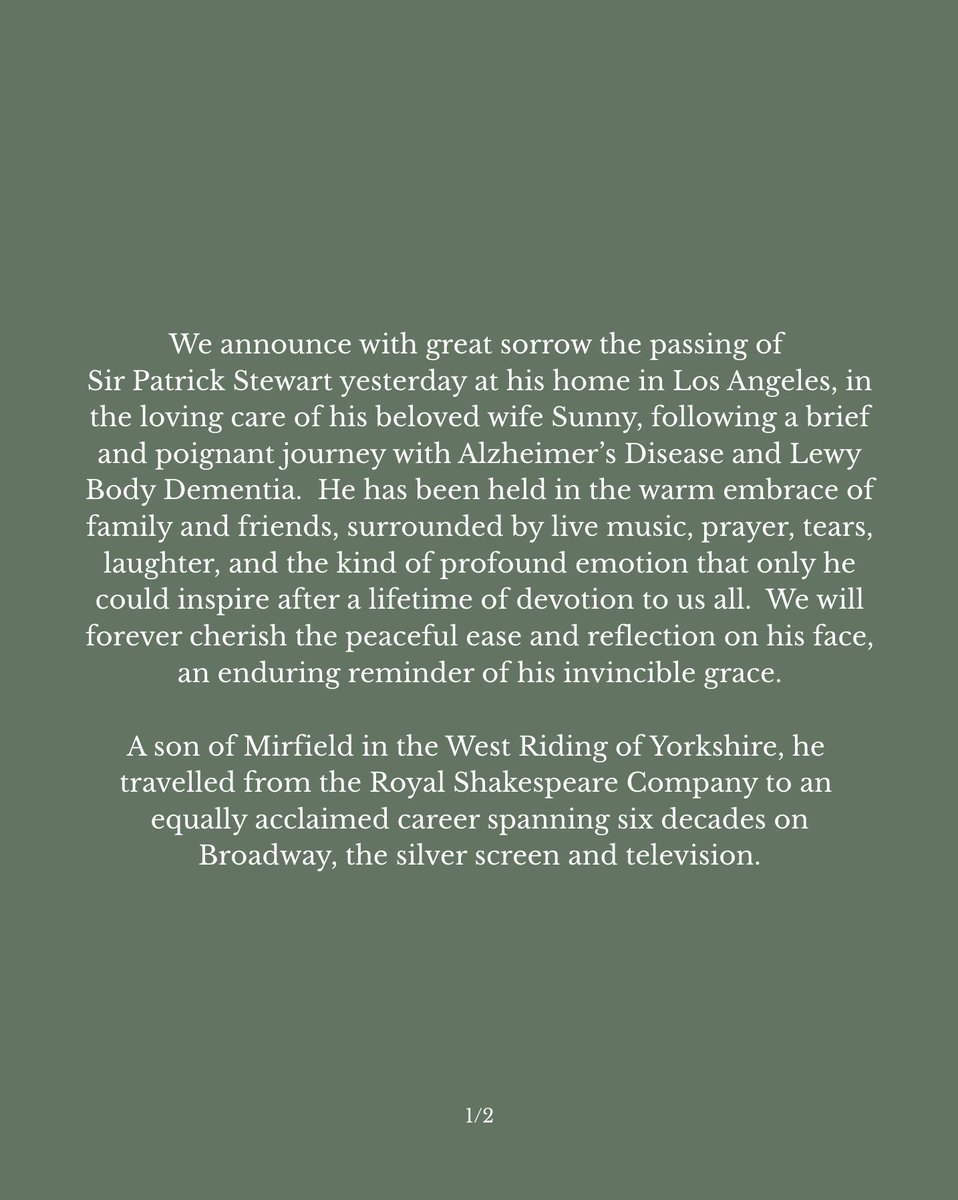
SIR PATRICK STEWART (1940-2026)
Before everything else, Patrick was defined by being born and bred in Yorkshire, the proud county in the north of England which he loved to the end. You could hear it in his accented voice and in the stern honesty with which he told you what he thought and felt. Yorkshiremen have no truck with half-truths or avoidance of big issues. He wore his heart on his sleeve, which made him a man to rely on, to admire and in my case, love.
We first met as ambitious young actors with the Royal Shakespeare Company half a century ago but we weren’t in the same productions. My first strong memory was a few years later, meeting him in the street in central London when he told me about an offer to take over a leading part in 'Star Trek'. “But Patrick think of your stage career in the UK. Do you really want to risk—getting lost in Hollywood for years and years?”. Well, he took the risk and thank goodness for us all that he did for not just his devoted Trekkies but film and theatre audiences, who marvelled at his using international celebrity to star in a string of cinema successes ('X-Men' of course) and in great classical plays by Shakespeare, Ibsen, Arthur Miller, Peter Shaffer, Pinter and Beckett at Stratford-upon-Avon, in London’s West End and on Broadway.
America was his adopted home, where he met his adored Sunny who has cared for him through sickness and health, through thick and thin. But he never forsook his origins: and the proudest achievement of the most respected and beloved actor of his generation on either side of the Atlantic, was his appointment as Chancellor of Huddersfield University in Yorkshire.
His farewell performance in 'Avengers: Doomsday' is yet to be seen.
Ian McKellen 29 October 2026
Photo: University of Huddersfield
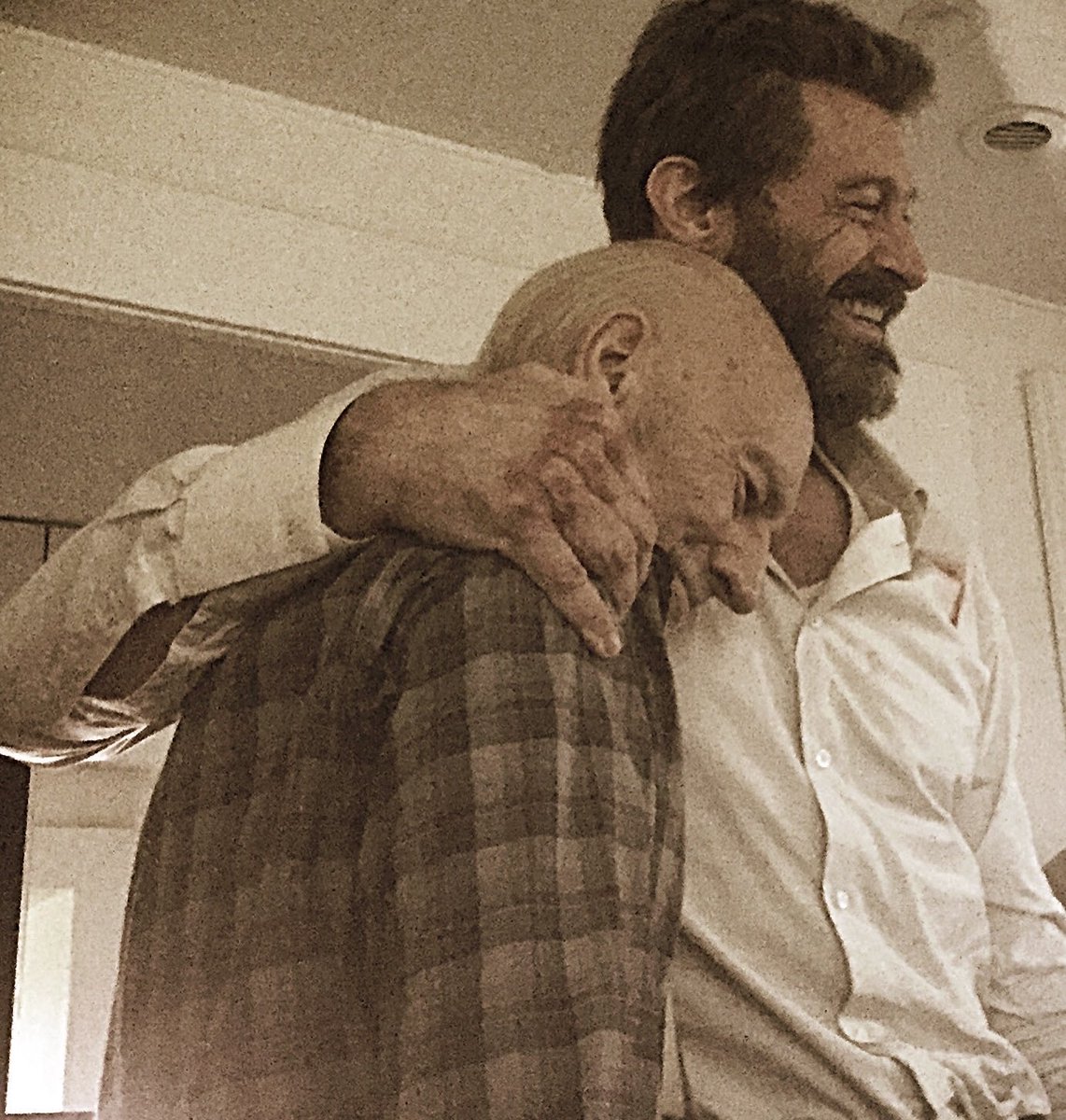
We lost one of the greats of stage and screen today. And, in my book, a tremendous friend and man. I learned so much from him. I will miss you, Patrick Stewart, all of my days. @mang0ld
All of us at Marvel Studios are deeply saddened by the passing of Sir Patrick Stewart. Sir Patrick brought Professor Charles Xavier to life with extraordinary grace, intelligence, and humanity, defining the character for generations of fans, from "X-Men" to "Logan" to "Avengers: Doomsday." He was a singular talent, a generous collaborator, and a true gentleman. Our hearts go out to his wife Sunny, his children, his friends, and the countless fans around the world whose lives he touched with his art.
In lieu of flowers, memorial contributions may be made to:
Johns Hopkins Alzheimer’s Disease Research Center Fund
https://t.co/luC5CdcWDy
Alzheimer’s Foundation of America Caregiver Resources
https://t.co/zvNptfyuNd
Photo Credit: Tommy Garcia
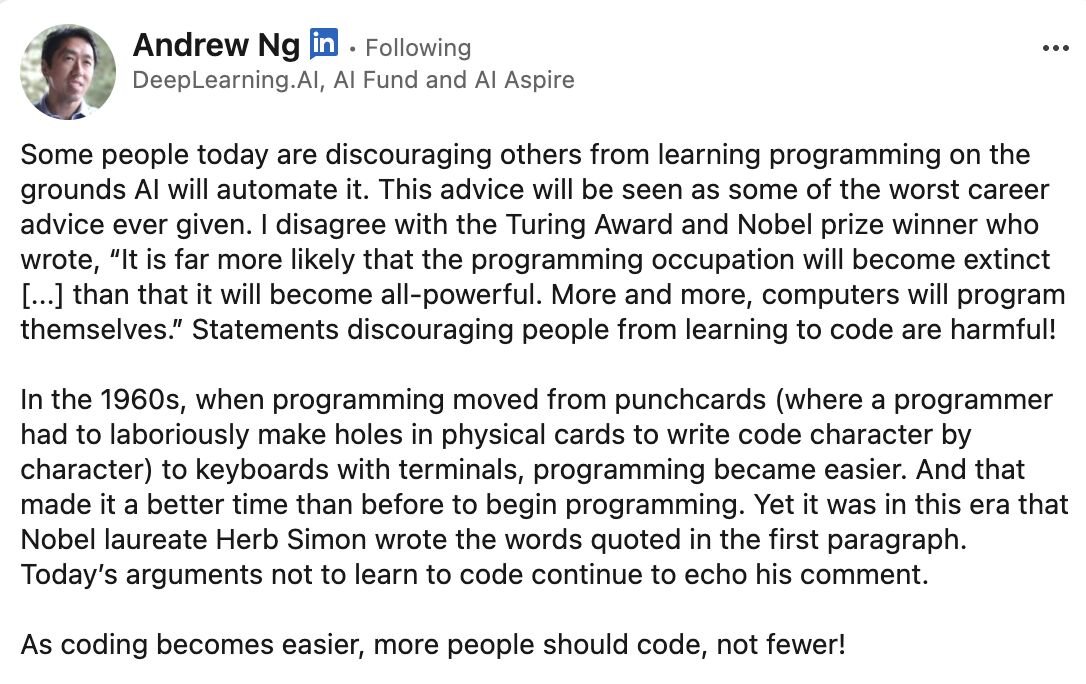
"Do not learn to code" is the worst career advice of the decade.
People are telling college students to skip Computer Science because AI will just automate it all. Andrew Ng just killed this myth at Stanford with a brilliant analogy.
When he tried to generate images with Midjourney, he typed: "make pretty pictures of robots" and got garbage.
His collaborator, however, understood Art History. He knew the exact vocabulary of lighting, genre, and palette. He spoke the "language of art," and generated masterpieces.
Andrew Ng is seeing the exact same thing happen in software engineering right now.
AI didn't replace the need to understand Computer Science. It made Computer Science the required vocabulary to control the AI.
If you don't understand how computers actually work, you are just typing "make a pretty app" into Cursor and shipping fragile, unscalable logic.
Here is Andrew Ng's exact hiring hierarchy today:
Level 1: 10 years of experience, but codes by hand (He won't hire them).
Level 2: Fresh college grad, but highly fluent in AI-assisted coding (He hires them over the 10-year veteran).
Level 3 (God Tier): Deeply understands CS fundamentals AND uses AI-assisted coding.
When humanity went from punch cards to keyboards, coding got easier, and more people coded. We are at that exact inflection point again.
AI doesn't replace fundamentals. It multiplies them.
Ojalá algún chico de la ‘Generación dorada’ haya visto lo que hizo Argentina y entienda lo que es tener personalidad para jugar esta clase de partido.
Pero bueno, en este país los periodistas les celebran que bailan Salsa Choke bien bonito 😅
¡¡UNA NACIÓN EMOCIONADA CON LA ECUADOR DE BECCACECE!! ¡LA TRI ESCRIBE HISTORIA!
⚽ #ESPNMundial
📺 Mirá los mejores partidos de la #FIFAWorldCup por ESPN, en el Plan Premium de #DisneyPlus
¡GOOOOOOOL DE ECUADOR Y CRECE LA ILUSIÓN EN LA COPA DEL MUNDO!
Un córner cerrado se la dejó en la puerta del área al infaltable Gonzalo Plata, que puso el segundo de la Tri ante Alemania para que explote el MetLife Stadium.
¿Cómo no vamos a creer?
Si somos los primeros campeones, la casa de los que más veces levantaron la copa y los últimos en besarla.
Arranca una nueva campaña para un continente que #CreeEnGrande.
We don't spend enough time thinking about strategic planning around the actual cost of using an LLM. The AI companies are effectively borrowing $1,000 for every $1 of revenue. That's clearly not sustainable, and we need to be thinking strategically about how to handle the inevitable adjustment.
Of course, the market may treat AI stocks like Crypto—something with zero intrinsic value and a market value determined entirely by speculation. But somebody's got to pay for all those data centers and GPUs eventually, so I doubt things will entirely go that way.
The practical problem is that the actual cost of the $2,000/programmer/month some are paying for AI services is $2,000,000/programmer/month. That pays for about 60 programmers/month if I've done the math right. If we were paying full cost for tokens, nobody could afford AI. Humans are more cost-effective.
Unless you are betting that we'll move to a Star Trek economy or that LLMs will become sentient and take over the banking system, we need to plan for a price hike.
One alternative is to dump all AI providers and use only local models, but if we all did that, the models would rot over time. Somebody's got to pay for building them, and somebody's got to pay for data-center build-outs. That "somebody" could be a government, as is the case with the high-quality Chinese models, but I don't expect to ever see that happening outside of China. It wouldn't surprise me if, as is the case with high-quality and inexpensive electric cars, the US will ban their use to "protect" US companies' inferior products at the consumer's expense.
The bottom line is that, as LLM costs ramp up and become less cost-effective when compared to humans, we need to plan for humans to take over more of the coding.
If your code is "AI slop" that no programmer has ever looked at, you're in deep trouble. It's not cost-effective for "the AI to fix it" when tokens cost what they're actually worth—loading a context with a vast number of tokens to make a small change will break the bank. One LLM testing another's output (as compared to a static set of automated tests) becomes prohibitively expensive.
So, "what's a mother to do?" We need to impose a solid underlying architecture on the LLM—the prompt needs to specify not just what to build, but how to build it. We need to know enough about architecture to know what to ask for. We need small components with impermeable boundaries that break the code into human-manageable chunks with a limited blast radius. We need to rigorously test with an automated test suite and not rely on the LLM to find and fix all problems. (The best way to start down that road is to develop using TDD.)
We should be doing this now, even if we're using the LLM to produce 100% of the code. Nontechnical people who imagine they can vibe code their way to a product are in for a world of hurt.
I saw a junior developer create a microservice using ChatGPT in 30 seconds.
I asked one question:
What happens to the data if the other service is down for 10 minutes?
He didnt know.
The AI didnt explain backpressure.
It didnt explain idempotency.
It didnt explain dead letter queues.
Writing code is easy now.
But
Engineering is still hard.
El 80% de los devs no sabe construir software. Solo sabe copiar arquitecturas de empresas de 10,000 empleados para apps que tienen 200 usuarios, sin entender porque funcionan en ese contexto y no en otro.
Un cliente nuestro pagaba $3-4K/mes en AWS. Kubernetes, microservicios, caches, multi-repo, alta disponibilidad... para un servicio que no lo necesitaba.
Lo migramos a un VPS + Supabase + monolito y monorepo.
Costo de infra se redujo a $200/mes.
Y no solo es mas barato, tambien es más rápido, más estable, los deployments suceden en minutos en vez de horas.
La IA no reemplaza a quien piensa. Reemplaza a quien sigue tutoriales y pica teclas. Por simple distribución estadística, la mayoría de los devs no está del lado que cree estar
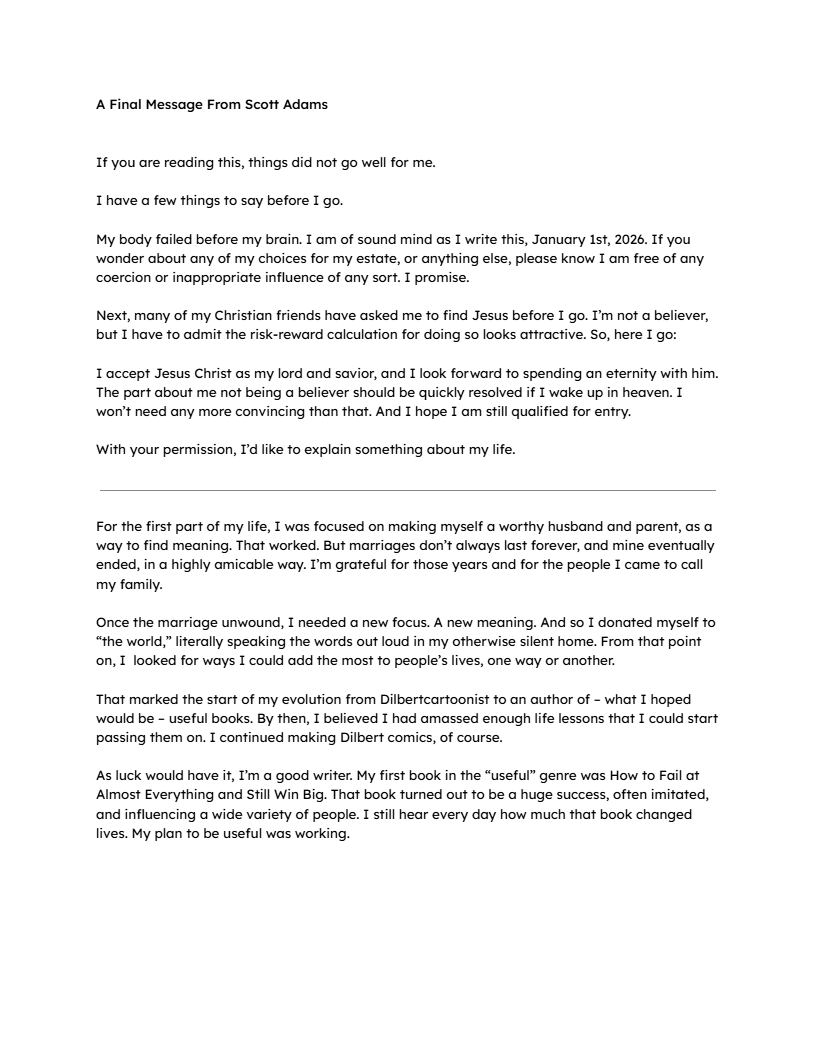
Scott Adams, creator of the “Dilbert” comic strip, has died following a battle with metastatic prostate cancer. He was 68.
Adams revealed his cancer diagnosis in May, the same day former President Joe Biden announced he had an “aggressive” form of prostate cancer. “I have the same cancer that Joe Biden has. I also have prostate cancer that has also spread to my bones, but I’ve had it longer than he’s had it — well, longer than he’s admitted having it,” Adams said. “I expect to be checking out from this domain sometime this summer.”
https://t.co/f2MPcuLdUX