Healthcare is shifting from a place you go to a system that surrounds you.
As we turn the page from 2025 into 2026 and beyond, we’re moving past simply digitizing yesterday’s workflows and into an era of real reinvention- where data, AI, and new care models converge and start to change the operating system of health itself.
Here is the arc of the possible as we move from NOW → NEAR → NEXT
•Sick Care → Health Care → Self-Health/Health Creation
Moving from reacting to disease to actively building capability, literacy, and tools so people can manage more of their health day-to-day.
•Episodic → Continuous → Predictive / Preemptive
From snapshots to signals: where we catch trajectory shifts early and intervene before “diagnosis day.”
•Physical → Virtual → Phygital + Ambient Care
Care won’t be confined to the clinic. Hybrid becomes default, and “ambient” care fades into the background—always-on, low-friction, context aware.
•One Size Fits All → Personalized → Adaptive (Real-Time) Precision
Personalization is step one. The leap is dynamic care plans that adjust in real time—dose, behavior, coaching, follow-up—based on data + context.
•Provider → Crowdsourced → Collective Intelligence (Networked Care)
Expertise becomes distributed: clinicians + communities + protocols + data networks learning together, not in silos.
•Human Cognition → AI-Enhanced → AI + Agentic Orchestrated (Copilot Teams)
We’re moving beyond “AI that writes notes” to copilots that coordinate care loops—triage, follow-up, prior auth, scheduling, escalation—freeing humans for judgment, empathy, and trust.
•Fee for Service → Fee for Outcome → Fee for Healthspan
The long game is aligning incentives around sustained function, prevention, and longevity—shared value for keeping people well.
My take: in 2026, the bottleneck won’t be model capability. It’ll be workflow integration, trust, governance, and getting incentives aligned (not to mention biomedicine funding challenges and improving trust in science).
More @NextMedHealth
Welcome to https://t.co/SsX2doG7s3. We’re building a searchable home for veterinary technology, digital health, and AI solutions for veterinarians and pet parents. Explore the growing directory: https://t.co/RmOEhOKExy #VeterinaryMedicine#AnimalHealth#VetTech#PetHealth
This is very impressive!
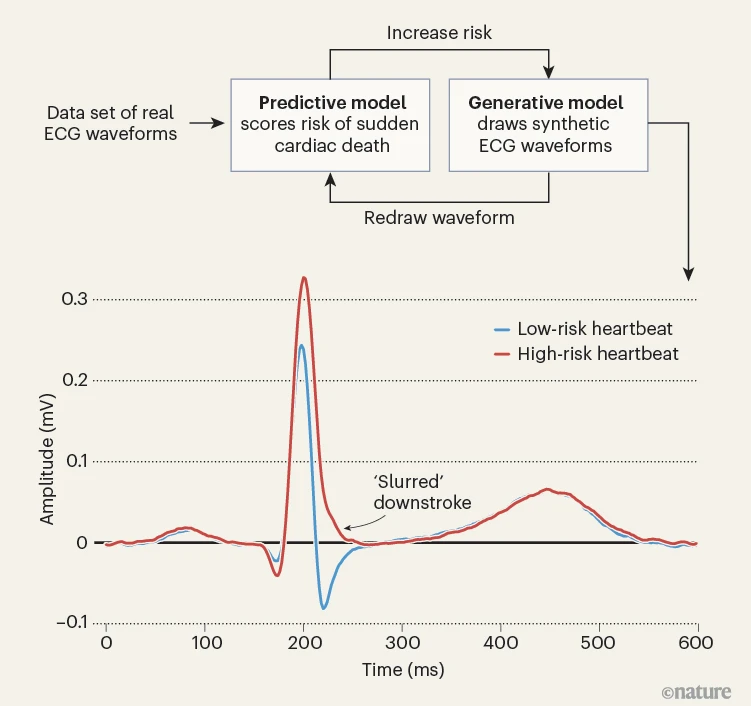
A model was trained to predict probability of death from ECG, which can be used to flag patients with high risk of sudden cardiac death.
it was combined with a generative model for explainability, leading to the discovery of a new biomarker that cardiologists were not aware of before!
Some good news for triple-negative breast cancer, a highly aggressive type, often resistant to current therapy.
Approval of 2 new antibody-conjugate drugs with efficacy and improved safety (vs chemotherapy)
by @xavierjohnm
gift link
https://t.co/HNCHaNGVRC
Imagine programming protein, DNA, and RNA systems like you would write computer code, or even by natural language prompting of an AI agent. @brianhie and team just made this a reality with Proto: a high-level programming language for generative biology.
Thrilled to share that our paper on AMIE—our conversational medical AI—is now published in @Nature. We wanted to tackle one of the most challenging areas in clinical AI: management reasoning over multiple patient visits.
https://t.co/03A1pipFI8
In the weeks since Mr. Hegseth’s vaccine policy took effect on April 21, only about 40% of Air Force trainees have opted to take the vaccine, which had long been mandatory…
Now: “Scores Fall Ill at Air Force Base After Hegseth Makes Flu Vaccine Optional”
The defense secretary described the vaccine requirement, which he lifted in April, as an “absurd, overreaching” mandate.
https://t.co/zcrJwyJPIQ
Together with researchers at Boston Children’s Hospital and Harvard, we published a study in NEJM AI showing how o3 Deep Research helped clinicians revisit previously unsolved rare pediatric disease cases, and find answers for families who had waited years.
Join me in once again calling for the resignation of @TheLancet editor Richard Horton.
Publishing a petition calling for the boycott of the Israeli Medical Association is an absolute disgrace. Medicine should bring physicians together in service of patients, not weaponize professional organizations for political campaigns.
Just as it failed the public on the #COVID19 origins debate, The Lancet is again positioning itself as a political actor rather than a medical journal.
For medical information, general AI frontier models (Google, OpenAI, Anthropic) outperformed specialized @EvidenceOpen and @UpToDate as assessed by 12 US clinicians, randomized and blinded to which model and extensive testing/benchmarks. This was not anticipated. @NatureMedicine
https://t.co/KCH1ADfQWz
A team of more than 80 researchers working across four continents have identified a set of proteins in the blood that accurately predict lung cancers more than 5 years before diagnosis.
also early evidence that an existing anti-inflammatory drug could significantly reduce lung cancer risk in people with elevated concentrations of these proteins, linked to inflammation.
https://t.co/cwmE6VNeeF
Fascinating: People taking GLP-1 medications such as Ozempic, Wegovy and Mounjaro may develop certain cancers at lower rates than comparable patients who are not taking the drugs — and that those already diagnosed may experience a slower decline and better outcomes.
https://t.co/LjIbqPOmyO
Gamification of health
The Vitality program from life insurance company @JohnHancockUSA rewards policyholders with points for healthy behaviors such as going to the gym, buying healthy foods, tracking sleep, getting preventive screenings
https://t.co/RS0D1CppJF
Join me tomorrow evening in Menlo Park as we explore the future of health and medicine in our increasingly AI, digital and personalized age.
https://t.co/pjbff6yw7B
Join me at 10 AM PST today for our @DigitalDHealth Studio Series as we explore when enables digital health companies to scale and succeed
Register here https://t.co/knT2XWuaUK