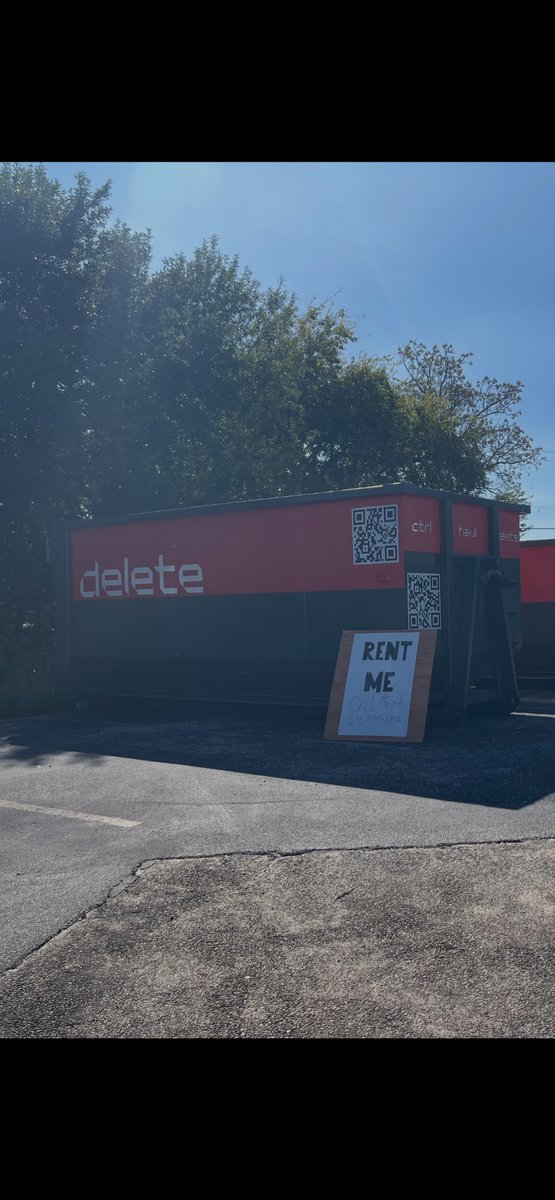
I would love just once in my life to own a business that isn’t negatively impacted by the weather/rain 😂
(concrete, sand & gravel mining, landfill, junk removal, dumpsters)
I wouldn’t even know what to do with myself.
Finance/MBA crowd: How do you view EMBAs vs. traditional/Full-time MBAs?
Say someone earns a Wharton EMBA at 40 vs. a full-time Wharton MBA at 27. Do they carry the same prestige?
Is saying “I have a Wharton MBA” without specifying EMBA cringe at all or totally ok?
Digging this dumpster branding!
(Although brand has ~very little~ to do with any repeat/commercial work in dumpsters IMO)
But I’d rather see this than another generic box with just a phone number!
Great read. Articulates something I’ve been thinking for the last 3 years far better than I could.
I think a lot of young people optimizing for the IB → PE ladder are in for a rude awakening. It was a money/prestige glitch the last 30 years. Likely not anymore.
The herd probably shifts to AI for a few years, then who knows. ( it was Real Estate, VC, Oil & Gas before… something always comes next).
Maybe everyone ends up buying a blue-collar business from Codie. IDK
PE was a path to guaranteed money for long enough that people assumed it would always be a path to guaranteed money, making it increasingly prestigious.
But prestige is a indicator of where the world went, not a forecast for where the world is going.
https://t.co/e8Xi6oR5Gg
I’ve been reading a bunch of architecture books lately because I want to build a really cool house one day.
What I did NOT expect was to be constantly blown away by how much of it applies almost directly to building businesses/organizations.
The parallels are everywhere. Vision, constraints, context, the relationship between the parts and the whole, and how you take a thousand competing needs and decisions and turn them into something coherent.
I guess in hindsight, no duh. I feel like an idiot for not studying this stuff sooner.
But I swear I’ve gotten more out of the last couple architecture books than the last 20 generic business books I’ve read.
A few things that have really stuck with me:
Parti- The central organizing idea behind a building. It gives the whole thing coherence and informs a thousand smaller decisions. Without one, you get a McMansion. Expensive materials, beautiful windows, six rooflines, maybe a turret for no apparent reason. Every decision individually defensible, but the whole thing is hideous. Businesses do this all the time.
What I particularly love is that the parti can (and often should) change during the build. Unexpected site conditions, budget overruns, ideas that don’t work in reality. Stubbornly defending the original concept is a mistake. So is abandoning it every time you encounter an obstacle and ending up with a bunch of random additions. The parti can morph. It just can’t disappear.
————
Site repair- Say you’ve got a piece of property. 20% is beautiful, maybe a great hill or grove of trees. The other 80% is nothing special. Our instinct is to build right on top of the beautiful 20%. Now you’ve consumed the best part of the property and are surrounded by mediocre land. What if instead you built on the lousy 80% and designed the house to frame and accentuate the beautiful part? You’ve improved the whole property rather than just occupying its best feature. I see so many parallels here with how we build teams, allocate resources, and sometimes inadvertently destroy what’s already working.
——-
The design brief- Go look at a typical six-month house flip. Now look at a Frank Lloyd Wright house. They’re not even remotely the same thing. Why would they be? The owners have entirely different objectives, time horizons, and definitions of success. Same with businesses. A company built around a five-year PE mandate is naturally going to look different from one whose owner intends to build and hold it for 30 years. Neither is inherently wrong, but the goals of the owner inevitably shape what gets built.
———
Program and circulation- Architects think about how people actually live and move through a building, not just how many rooms it needs. In business we often draw the org chart first and figure out the relationships later. You can have wonderful individual departments and terrible hallways between them.
———
Served and servant spaces- Louis Kahn’s distinction. The mechanical room is essential, but it’s not why the building exists. Seems like a useful way to think about overhead, corporate functions, and who is supposed to be serving whom.
———-
Pattern language- Christopher Alexander’s idea of identifying recurring problems and the principles behind their solutions. Not a blueprint to copy, but accumulated knowledge you can adapt to different circumstances. Really interesting implications for standardization, franchising, and scaling organizations. You want to accumulate judgment, not just manuals.
Patterns > exact playbooks/formulas
———
And finally, the architect as generalist. Not the best engineer, contractor, or designer of every individual element. But someone who understands enough of each to synthesize the whole. Sounds an awful lot like the job of an entrepreneur.
Any other architect lovers out there that have felt the same way? I feel left out I’m only just discovering this awesome world.
I’m sure the ReTwit community has known this stuff for awhile.
I recommend the book below as a great first read for all entrepreneurs.
You’ll get a ton out of it, I promise.
Ya I don’t exactly know right now either. I can see a world where you’re trying to sell your business and there would be issues potentially.
I think most businesses without a lot of proprietary or super complex workflow and not trying to exit for some huge 9 figure exit to institutional capital, I think it might be a great, once in a lifetime deal for “Free” money.
PPP felt weird to me and like too good to be true, but that was basically free money. Maybe this will be the same.
But if you are trying to have a idk 50, 100mm exit one day, I think the risk reward isn’t there. But for most local businesses I mean I totally get doing it right now!
I think “they are going to get this data anyways from someone else, you might as well get paid for it�� is a good sales pitch.
Idk, we’ll see! We aren’t going to do it.
Any chance we can make SMB Twitter interesting again? (Genuinely asking)
I used to come on here and get actually energized about entrepreneurship. Seeing what people were building, different ideas, big ambitions, people trying things. I’d leave excited to go build something myself.
Now I feel like it drains me more than anything.
Did everyone fail? Did the people actually building things get tired of the relentless online smarter-than-thou reply guy stuff and stop posting?
Was SMB Twitter just some euphoric ZIRP/post-Covid bubble? Now that money isn’t free and we’re in a different part of the cycle, is that excitement just gone?
I don’t know.
I keep hearing the X algo is better, but maybe my feed is broken.
Feels like we’re stuck in a loop of SEO/add a third GBP agency guys (no offense, love you guys), offshore talent, AI build-your-own-CRM stuff, dunking on Crumbl/same handful of bad home service franchises.
Tactics are great, and I enjoy learning from people who are good at them. But man, we can get so bogged down in the tactical stuff here. Surely there’s more interesting stuff going on out there?
Who’s building cool shit? Trying roll-ups, expanding into new markets, experimenting with business models, etc.
I’d love more conversations about strategy, building enduring businesses, durable competitive advantages, where industries are headed, and what the next 10-20 years might look like.
Maybe I’m just not following the right people? I’m certainly not currently helping the situation either (rarely engage anymore).
Anyone else feeling this? Who should I be following? What’s interesting that I’m missing?
Can we do something here and re-energize the community?