NIGERIANS, GO AND VERIFY (7)
LIFTING THE VULNERABLE : ANAMBRA’S BLUEPRINT FOR POVERTY ALLEVIATION AND SUSTAINABLE EMPOWERMENT (2006–2014)
Economic growth that does not translate into improved living conditions for ordinary citizens is incomplete. This is one of our fundamental concerns with President Bola Ahmed Tinubu's government. Development must ultimately be measured by its impact on human lives, particularly those of the poor and vulnerable. This was underpinned by the Anambra Integrated Development Strategy (ANIDS). We believed that infrastructure, education, healthcare, agriculture, and social protection must reinforce one another. Poverty was not merely a shortage of money; it was also a lack of access to opportunities, productive resources, and the basic conditions necessary for a decent life.
Our poverty alleviation strategy, therefore, went beyond temporary handouts. It focused on restoring dignity, creating economic opportunities, and equipping vulnerable citizens with the means to become self-reliant.
Our approach attracted recognition beyond Anambra. In May 2010, Magnus Kpakol, then National Coordinator of the National Poverty Eradication Programme (NAPEP), commended our commitment to poverty reduction, declaring: “We are prepared to support you in the excellent work you are doing in Anambra State.”
1. POVERTY MAPPING: KNOWING WHERE POVERTY LIVES
We recognised that poverty could not be effectively addressed without knowing where it was concentrated and what caused it. We, therefore, undertook a poverty-mapping exercise to identify the most deprived local government areas and communities.
The exercise revealed that some of our poorest communities were also important food-producing areas. Their challenges included poor access to markets, agricultural inputs, electricity, water, and other economic opportunities.
Areas including Anambra West, Orumba South, Awka North, and Ogbaru required particular attention. The findings informed our development priorities, enabling us to direct roads, agricultural support, and social interventions toward neglected communities.
2. EMPOWERING WOMEN, WIDOWS, AND COOPERATIVES
We recognised that rural women, widows, and indigent households bore a disproportionate burden of poverty. Across the 21 local government areas, we provided financial assistance and productive support to thousands of beneficiaries.
Our administration provided financial assistance to support the establishment and expansion of small businesses and farming activities. We also introduced revolving loan schemes to promote enterprise development, economic self-reliance, and improved livelihoods.
We distributed productive equipment, including sewing machines, generators, ovens, cookers, hair dryers, shoe-making machines, and welding equipment. The objective was to help beneficiaries establish sustainable livelihoods rather than remain dependent on government assistance.
We also promoted access to microcredit and cooperative financing to enable small entrepreneurs to expand their businesses, improve their incomes, and create employment.
Our philosophy was simple: rather than merely giving people money to survive today, the government should help them acquire the means to earn a living tomorrow.
3. AGRICULTURE AND FADAMA: MAKING RURAL COMMUNITIES PRODUCTIVE
Agriculture was central to our poverty-reduction strategy because many rural households depended on farming.
Through partnerships with the Federal Government, the World Bank, and other development partners, particularly under the FADAMA programme, we supported farmers with finance and productive assets.
In November 2009, our administration disbursed millions to FADAMA Community Associations across the state. By October 2010, the National FADAMA office was commending Anambra’s commitment. Its National Project Coordinator, Buka Tijjani, represented by Charles Ugwuona, described Anambra as the leading state in the programme.
NIGERIANS, GO AND VERIFY (5)
CONNECTING COMMUNITIES, UNLOCKING PROSPERITY: OUR ROAD INFRASTRUCTURE RECORD
Peter Obi
Another critical foundation of development is infrastructure, particularly road construction and maintenance.
Infrastructure is not just about constructing roads, bridges, and buildings. It is about connecting people, opening up economic opportunities, reducing poverty, and enhancing the well-being of ordinary citizens. A road that connects a farmer to a market, a patient to a hospital, a child to a school, or a manufacturer to a distribution centre is an investment in economic and human development.
This thinking informed our approach under the Anambra Integrated Development Strategy (ANIDS). We set out to connect all 177 communities in the State with motorable roads, paying particular attention to rural communities that had suffered years of neglect. Our objective was to build an interconnected road network that served the entire State, rather than concentrate projects in major cities or politically important locations.
I. The Road Revolution: Over 900 Kilometres of Road Projects
Between March 2006 and March 2014, during my two-term tenure in office, my administration asphalted over 900 kilometers of roads. These projects were deliberately distributed across the three senatorial zones of Anambra State to connect communities, facilitate commerce, and enhance transportation.
I acknowledge that Dr. Chris Ngige started the road revolution in Anambra State, and I commend the efforts his administration made in initiating several road projects. When we assumed office in 2006, we recognised the importance of continuing worthwhile projects rather than abandoning them simply because they had been initiated by a previous administration.
Among the roads we inherited from Ngige and completed were the Owerri–Ezukala–Umunze–Umuchu–Amesi–Uga–Igboukwu Road, where his administration stopped around Umuchu and we continued through Amesi, Uga, and onward to Igboukwu; the Iseke–Orsumoghu–Ukpor–Utu–Nnewi–Awka-Etiti Road, where his administration stopped at Ukpor and we continued towards Awka-Etiti; and the Ideani-Otuocha where work stopped around Awkuzu before our administration continued the project from Nteje to Otuocha.
There were also roads, such as Mmili John and Nkwelle Ezunaka bypass, which had been awarded before we took over, but on which no payment had been made by the time we assumed office. We took over these projects, assessed their status, and proceeded with the work. This was our approach to continuity in governance: acknowledging what had been started, distinguishing between projects merely awarded and those on which work and payment had actually commenced, and ensuring that important infrastructure projects were carried forward.
Some of the major roads and corridors included Amansea–Ebenebe Road; Aguleri–Umueze Anam–Mmiata Road; Nnewi–Ozubulu–Okija Road; and the Old Onitsha–Awka Road.
Other important projects included:
Awka and its Environs: Zik’s Avenue, Awka; Adazi-Nnukwu–Obeledu–Neni Road; 33 Junction–Nwafor Orizu College of Education Road; roads within the Awka Government Reserved Area (GRA); and the Old Nkpor–Amawbia Road.
Nnewi and Surrounding Communities: Nnobi–Nnewi Road; roads within Nnewi town; Akwaeze–Oraeri–Igboukwu Road; and Ekwulobia–Nkpologwu–Akpo–Achina–Umuchu Road.
Onitsha and its Environs: Bridge Head–Umunya Road; over 30 roads in other parts of Onitsha; more than 25 roads within the Onitsha GRA; over 20 stone-based roads within Harbour Industrial Estate, Onitsha; and the Nkwele Ezunaka Bypass.
Other Communities and Strategic Corridors: Awgbu–Amaokpala Road, with the Odor Bridge; Aguluezechukwu–Ogboji–Ajalli Road; Awkuzu–Igbariam Road, passing through the university; Owerri–Ezukala–Umuchukwu Road; Ugwuoba–Obosi Road; and Lilu Road.
“Light no Dey - go buy solar
Country hard - japa now
School is expensive- go and collect nelfund
The rent is too high - go and collect the Tinubu mortgage house now”
No be lie
I'm genuinely confused.
So after the inflation.
After the kidnappings.
After months of no light.
After tax and fuel hikes.
After terrible healthcare.
After salaries can't even keep up with feeding.
Election Day comes then:
You dress up, You leave your house, You queue under the hot sun, You vote for the same person again.
You are not normal.
Hi Everyone, please I need your help.
I’ve battled Keloid since I was 2 as a result of the first ear piercing which was done at birth and was done wrongly.
My parents have gone through several options given to them and it keeps reoccurring.
I’ve done several surgical removal that I can’t even keep count both in general hospitals and private hospitals and they always finish up with kenalog as usual, I did cryotherapy for 2years with a popular Bumps clinic and the pain from the procedure almost paralyzed the left part of my body as it became weaker and I couldn’t use it, still it resurfaced.
Since 2015 I’ve been in and out of the hospital over this keloid, one general hospital suggested removing the whole ear which might cause another issue as it could still grow again.
I’ve been going through excruciating pains, every single day of my life I’m in pains, I’ve been popping painkillers like who’s taking candy, I barely sleep at night
Most days I’m awake till morning, once it’s night I get scared cos the pains becomes unbearable.
Sometimes I take sleeping pills just to get through the night.
I can’t go out, I can’t even show up for my business, my parents and siblings have had to give up their finances every single year because of me. Last year November, my sister single-handedly took care of the bills for the procedure I did.
At some point the Keloid started to accumulate abscess, it becomes so much that I’ve had to go through drainage process, I did one last year as well.
And all of these have made the keloid very aggressive and it grows faster by the day, the last removal procedure I did was in April of last year, the growth you’re seeing in frame 1 is just 1year and 7months growth which is unusually fast.
Since I finished my service year I’ve been at home because I couldn’t work with this condition, I even had to let go of a few job opportunities I was recommended for with the hope of getting this done before I fully commit.
A doctor I met recommended LASUTH earlier this year and since May I’ve been trying to get booked for surgery, initially I was booked for surgery but I wasn’t told everything it entailed, my first surgery date was September 11th and it was moved later on due to the strike.
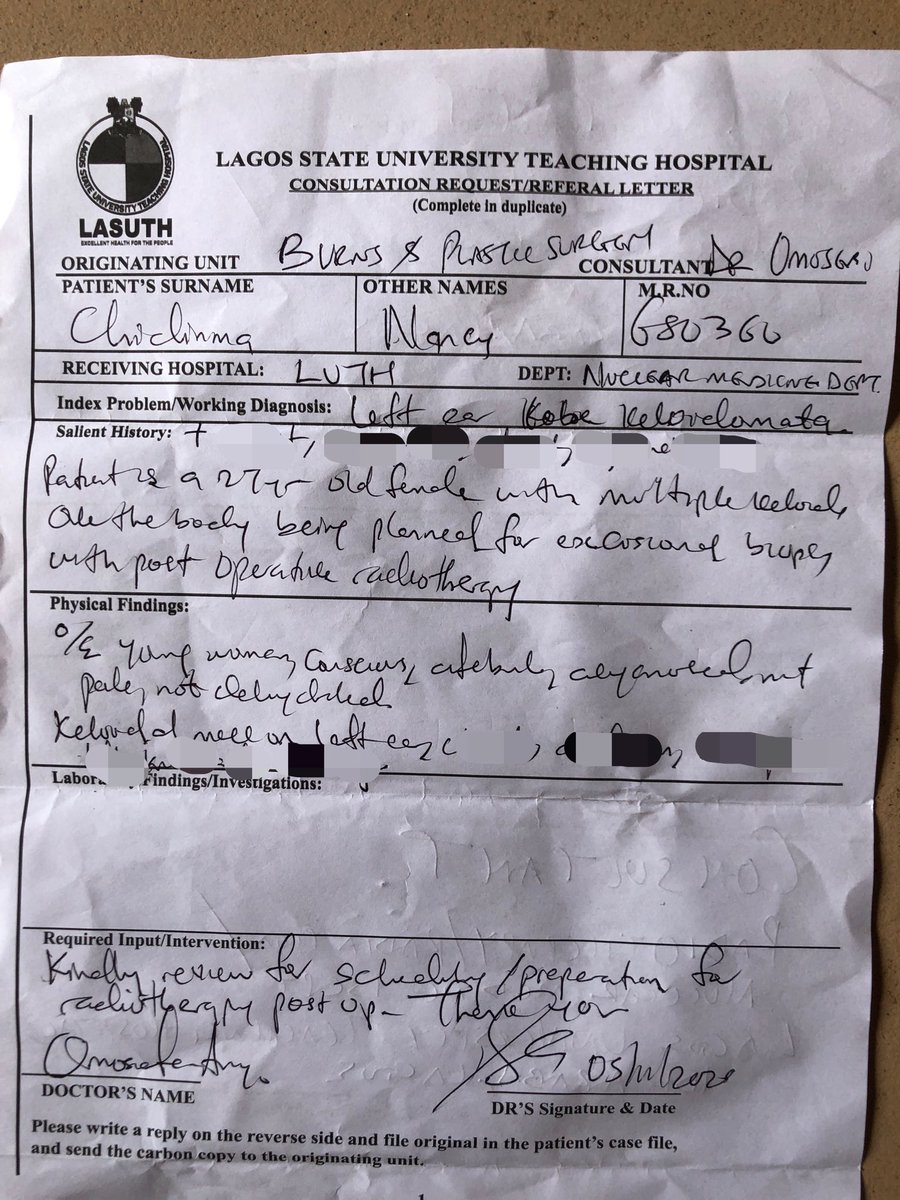
I was opportuned to secure a consultation again with the Burns and Plastic unit (BPSU) yesterday in LASUTH and the consultant put me through everything I needed for the keloid to not reoccur.
He said I needed at least 2 Radiotherapy sessions of which one has to be done exactly 24hrs after the surgical removal and then another few weeks after.
After which I have to undergo chemotherapy and then post op care which includes injections, drugs,silicone creams, and any other recommended care.
The Radiotherapy is to be done in LUTH (I was given a reference letter for it) after making enquiries in LUTH, the estimate of one radiotherapy session was given at 2.5m, and I’ll be needing 2sessions which sums up to 5m. Then the surgery for the removal of the Keloid costs 1.2m and I’ve been able to come up with that. Then after the surgery I’m to undergo chemotherapy and post op care but I have not been told how much that would cost, so I am unsure of the entire cost of that but the estimation according to what I’ve researched is about 2m.
LASUTH have given me November 19th for my next and last consultation before the removal and this simply means I have to come up with the money for everything before then.
So in total what will be needed for the successful surgery and post op care is 8.2m of which I’ve already raised 1.2m and I’m left to source for 7m before the 19th of November.
This was really really hard for me to do as I have never done this before but this is my last resort as I have exhausted all my options and I have spent more than 6months alone trying to get booked with LASUTH.
Please help me get my life back together 🙏
Any amount will go a long way🙏
0427940035
Nancy Chidinma
Wema Bank
If, at this stage, with everything going on in Nigeria; bad roads, poor electricity, and widespread unemployment; you still need someone to convince you why you should vote right in 2027, I'm sorry to say this, but something might just be wrong with you.