My new piece on data centers is up:
1. Water use concerns are overblown.
2. Fossil gas generation will be a serious climate threat if we don't stop it.
3. Forcing the hyperscalers to pay for T&D upgrades is a massive decarb oppportunity.
https://t.co/T8SKBZNzIL
I understand the visceral reaction of climate activists to legislation that increases fossil fuel production.
But we can't let the perfect be the enemy of the good. The transmission changes alone will ensure the bill is net-positive for climate.
This graph should sink home for all of us. And keep in mind: 2010-2018 was a period when solar and wind growth was far slower than it is now. Solar was a miniscule part of new electricity capacity in this period, for example, yet a major share of all federal studies under the National Environmental Policy Act. That's insane.
This is one of several startups using robotics and standardized designs to vastly accelerate installation of utility-scale solar. Modules are so cheap, they're only a fraction of solar capex now. Attacking installation costs is a huge lever. Innovation to make clean energy cheaper hasn't stopped.
I know she means this sarcastically—but it is interesting to think about.
Human beings are not fruit flys. We have enormously complex brains that permit an astonishing range of behaviours.
We're too complex to have a single "destiny".
Another very normal comment to receive on a bee video.
Mind you, the bee in question spends her time karate-kicking away males to continue going about her business uninterrupted.
Much to think about.
The only way to make SMRs work is to build ~100 of a single design.
Not impossible. But it requires a level of state coordination not seen since the French buildout in the '70s and '80s.
Some thoughts on new nuclear (SMR or large) in the US:
tl;dr: First or early units of any nuclear design will be incredibly expensive. We need a way to drive the demand side to get the repeatable scale flywheel turning again. That's what will bring down costs.
1. DOE and the Trump admin have done good work. The current policy landscape is the best for nuclear that we've had in decades.
On top of that, the data center surge is in principle (and clearly to investors) a great demand driver for new nuclear, and in particular SMRs.
2. If we can get the flywheel of building nuclear at scale turning, there's good reason to believe nuclear fission can once again become affordable, clean, baseload power.
Nuclear will never rival solar in raw per MWh cost. It can't. But it has attributes - such as compactness, winter operation, and (in some designs) industrial heat production - that make it a very important tech, if we can get costs down.
3. The problem is starting that flywheel. Things you build frequently, repeatably, and of the same design get cheap. Things you build infrequently or hardly ever remain expensive or even become more expensive.
4. Early units of any design - including building additional AP1000s - are going to be incredibly expensive (see below) and have very high risk of schedule slippage and cost overruns. That is the nature of the beast of first of a kind or early-of-a-kind physical tech, and even moreso for nuclear. Yes, this applies to SMRs also.
5. You can ameliorate the above by building a large orderbook, expecting costs to decline as you build more at scale, and finding a way to share risk over that oderbook.
6. That orderbook building and risk sharing over an entire fleet is the single piece that I see as most absent in the current market and policy landscape. I'm aware of multiple efforts to address this in the private sector, which I applaud. If I had a policy magic wand, this is the one piece I'd attempt to bolster from the policy side.
We simply cannot label every catastryevdnt as climate change.
The 2026 Nepal floods were triggered by a massive glacier collapse and subsequent landslide in the Himalayas, which sent water, ice, and debris rushing into the Bhote Koshi and Trishuli river systems.
Large solar projects drive down costs for the entire industry, increasing solar deployment globally.
Would you rather these data centers be powered by gas?
AI data centers are out-bidding utilities on clean energy projects, driving up their prices and reducing their availability.
Clean energy that once would have been used to retire fossil fuel power plants and benefit people is now being wasted on energy-guzzling AI slop machines.
The moment disaster struck. Video from Immigration office at Nepal border just before 11 am today shows the flash flood.
PM Modi has spoken to his Nepal counterpart and extended humanitarian and relief assistance.
So far 384 travellers, including 105 Indians reported missing
The EU is targeting an increase electricity's share of Final Energy from 24% to 46% by 2040. The arithmetic of the Final Energy Fallacy makes this entirely unachievable. We need a course correction.
https://t.co/djKBQbTz4C
This is exactly right.
When the Breakthrough Bros tell us to "focus on the hard-to-abate" what they really mean is "don't phase-out oil and gas with EVs and renewables just yet because that would fuck our donors".
Nobody contests that getting to 100% decarbonization will eventually involve some technical challenges. We contest that this provides any justification (as Big Oil has argued for decades) for not doing the vast amounts of low-hanging fruit decarb we easily could be doing now. It’s like someone saying “we should ban pig gestation crates” and someone else who’s shilling for Tyson’s saying “ah but it will be difficult to get every American to completely zero out their entire meat diet.”
No one contests decarb has many technical challenges.
They do contest the Breakthrough theology that fossil and nuclear are the only viable solutions to those challenges.
I’m glad Regunberg agrees there are difficult technical challenges, my point is that this is contested and many green groups deny that it’s the case.
https://t.co/r87OfNtEXY
I’m sorry if I sound like a soulless economist type but if electricity is free for a few hours a day then that might be a sign it’s not providing a lot of value…
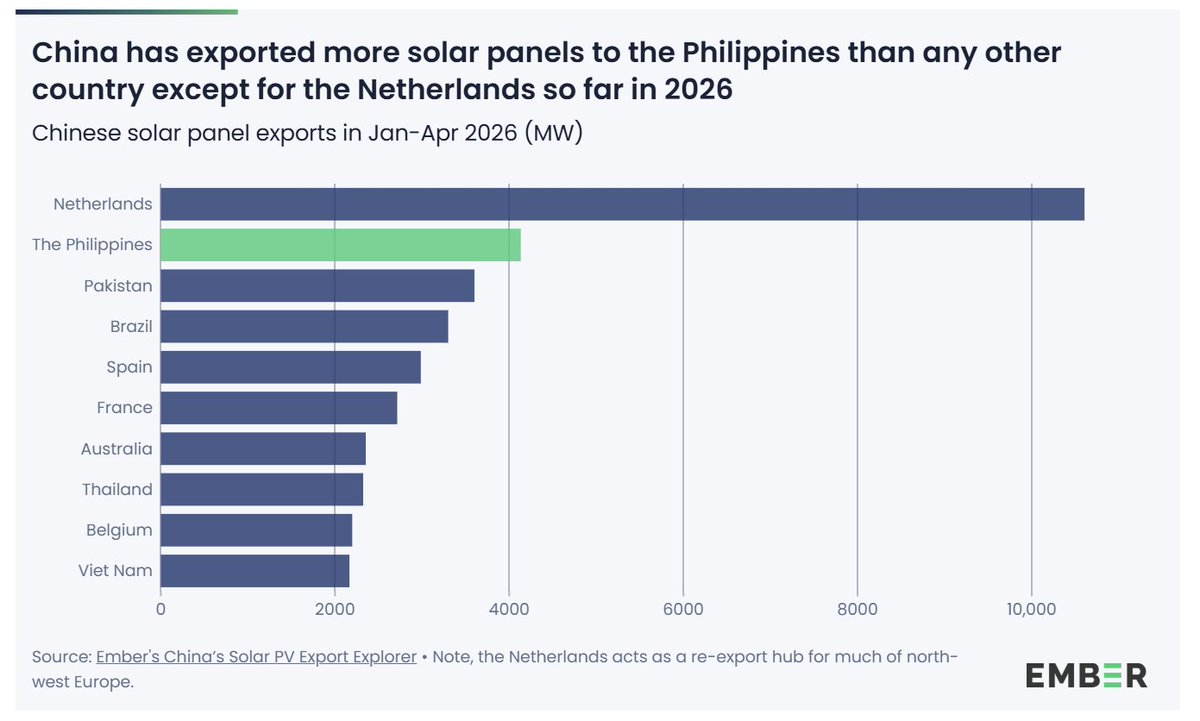
The Philippines abruptly became China's 2nd-largest solar panel export market in 2026, eclipsing Pakistan. In March and April alone, 3,000MW of solar panels were exported to the country
The Philippines has Southeast Asia's costliest residential power. So the people staged a revolt, having figured out that solar payback collapsed to 3.1 years for homes and 2.3 for businesses - because:
a) the grids was addicted to volatile, USD-denominated imported fossil fuels (like LNG), leading to an explosion of retail electricity prices up 17% or more for homes; and,
b) solar costs plunged 10% over the past 12 months
Wire chewing pipelines - everywhere, all at once
This is a 24/7/365 solar + battery project delivering a minimum of 500MW at any given time. 2.5GW of solar and 14GWh of batteries. In UAE one is being built for a constant 1GW output. Similar 24/7 projects are possible in the US SW, Mexico, and most of MENA. Costs will drop as battery prices in particular decline.
This is not accurate. There is no direct trade-off between WUE and carbon emissions at data centers.
Liquid-to-chip is energy efficient. So are geothermal heat pumps. And data centers should be powered by low-carbon sources anyway.
Forcing data centers to use "water more efficiently" often means a direct trade-off where they use more energy as a result, which means more emissions. I think in most places it's preferable for them to use more water than energy, so I worry this kind of thing can really backfire.