The average national constitution lasts about 19 years. The United States has used the same one since 1789, which makes it the oldest working national constitution on Earth.
That gap is the anomaly the original post is talking about. Since 1789 the world has produced close to 800 national constitutions, and only about half of them lasted past 19 years. France is the sharpest contrast. It started at the same line as America, and since then it has gone through five separate republics, two empires, a couple of monarchies, and at least fourteen constitutions. It is on version five right now, written back in 1958. The next-oldest national constitution still in use belongs to Norway, and it only dates to 1814, a full 25 years behind.
Most attempts at a lasting written government fall apart inside a single generation. America's has held through a civil war, two world wars, a depression that put about a quarter of workers out of a job, and 27 amendments, without ever being thrown out and started over.
About 4% of humanity lives inside US borders, and they produce close to a quarter of the world's economic output measured at market prices. The American economy is bigger than the next three put together, China and Germany and Japan combined. Eight of the ten biggest public companies on the planet, ranked by market value, are American. US stock markets alone hold a little over 40% of all the equity value on Earth.
None of that was ever the default setting for human societies. For most of recorded history the normal ending was collapse, conquest, coup, or a slow decline into something you would not recognize. Stable money, peaceful handovers of power, and courts that last longer than the people who built them are the rare exception, not the normal starting point.
When a system runs this smoothly for this long, the stability starts to feel like gravity, like the normal way things are. The historical record says the opposite. What looks completely ordinary from inside America is one of the least likely things a large group of people has ever built and kept going.
Since we are “One Nation Under God”, let us continue to think and praise his holy name for all the blessings he has bestowed upon America. Amen thank you Jesus. #USA#HappyFourthofJuly.
Happy Independence Day 🇺🇸
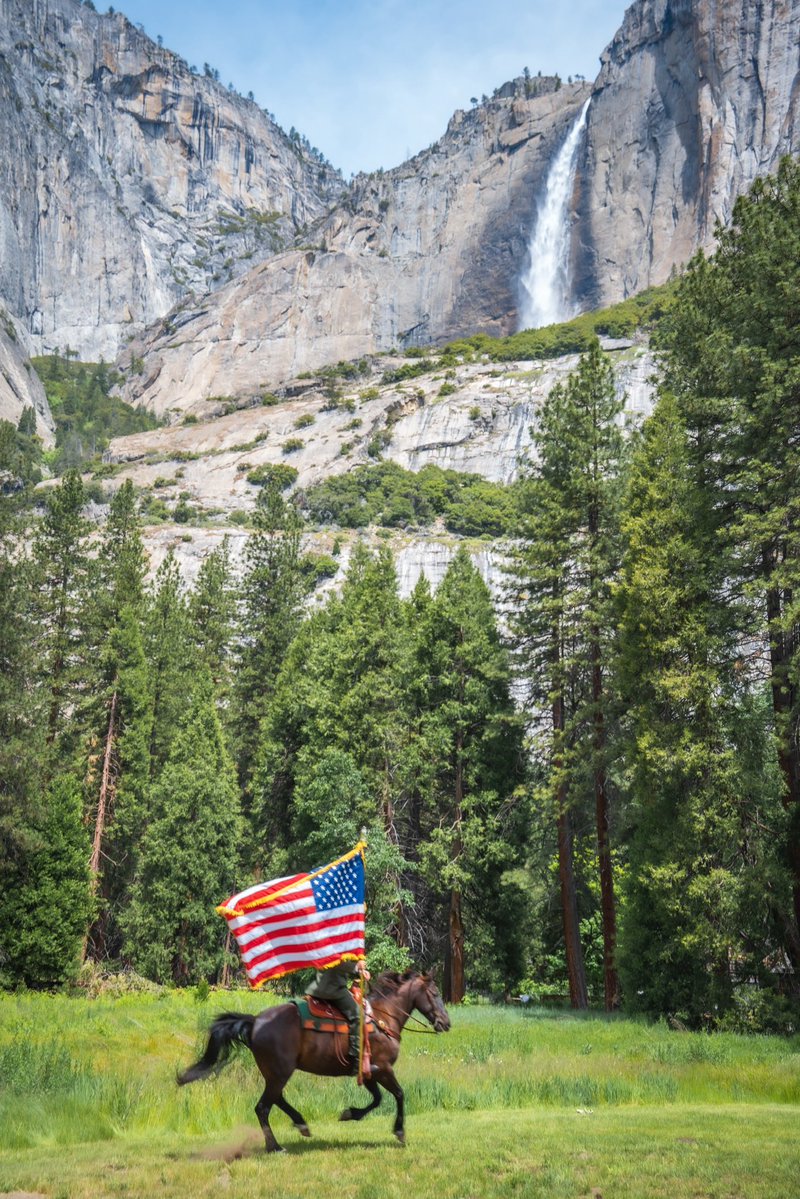
From battlefields and memorials to parks and protected landscapes, the places cared for by the National Park Service help bring our shared history to life.
America burned Japan's first gift of cherry trees. All 2,000 of them, on President Taft's direct order.
The 1910 shipment arrived in DC crawling with insects and nematodes. Agriculture inspectors condemned the lot, Taft signed off on the bonfire, and the State Department braced for a diplomatic disaster. Tokyo's mayor, Yukio Ozaki, responded by sending 3,020 more, grafted from the famous grove along the Arakawa River.
Those trees have spent a century paying the friendship back.
Four days after Pearl Harbor, vandals chopped down four of them. Park officials renamed the survivors "Oriental" cherry trees for the rest of the war to protect them from axes.
Then came the twist. By 1952 the original Arakawa grove in Tokyo, the parent stock, had nearly died from wartime neglect. Japan asked Washington for help. The Park Service shipped budwood from DC's trees back across the Pacific and restored the grove that created them. When a flood wiped out more Japanese trees in 1982, horticulturists took 800 fresh cuttings from the Tidal Basin.
These 250 new trees solve a real problem too. The Tidal Basin is sinking, and a $133 million seawall rebuild forced crews to rip out roughly 150 trees. Japan offered replacements before anyone asked, timed to America's 250th birthday.
So the genetics run in a loop. Tokyo's grove seeded Washington's. Washington's saved Tokyo's. The saplings going in this spring descend from both.
114 years of diplomacy, running on grafted branches.
Happy Independence Day!
There’s a story from the end of the Revolutionary War I want to tell as we celebrate America’s 250th Birthday, and it’s one everyone in the world can learn from.
George Washington, at that moment, after commanding the American forces to victory, was the most powerful man in the new country. Many people talked about making him King of America.
Across the ocean, King George was sitting with an American painter, and asked what he thought Washington would do now that the war was ending. The painter said he believed he would go back to his farm.
The King said, “If he does that, he will be the greatest man in the world.”
As the war officially ended, Washington came to speak to Congress and said, “Having now finished the work assigned me, I retire from the great theater of Action.” He returned his commission they’d given him in 1775 - after more than 8 years of leading the Americans to victory without pay, and he was home at Mount Vernon for Christmas.
Of course, he was elected as our first President a few years later, and after two terms, showed the same selflessness again when he willingly gave up his power and went back to Mount Vernon again.
That’s true greatness. He had all the power in the world. But power, alone, does not make you great.
Washington’s greatness came from being a true servant - to a cause much bigger than himself. His greatness was his complete lack of selfishness.
The whole story of American Independence is a story of selflessness. It’s a story of people who set their self-interest aside and worked for each other.
We’ve all heard the line about “We must all hang together, or, most assuredly, we shall all hang separately.”
Apparently, Ben Franklin might have actually never said that.
But that’s fine, because the same mentality is right there in the last line of the Declaration of Independence, published on this day 250 years ago:
“And for the support of this Declaration, with a firm reliance on the protection of divine Providence, we mutually pledge to each other our Lives, our Fortunes and our sacred Honor.”
We mutually pledge to each other.
No one was in this alone. No one was in it for themselves. This was a group of people with different backgrounds who were in it for each other.
Today is a reminder: greatness comes from what we do for each other, never what we do for ourselves.
That’s a lesson that applies no matter what country you call home.
It’s a lesson that doesn’t require any law passed by a politician, because, let’s be honest, if you’re waiting for selfless politicians, I really hope you are not holding your breath.
All of us have the power to be there for the people around us. For our families and friends. For our neighbors. For everyone.
All of us can reach for greatness.
It’s as simple as looking beyond yourself, seeing past the mirror, picking your eyes up from your phone, and pledging to be there for each other.
Happy Fourth. May you all find your own version of greatness today by lifting each other up.
Lift up your neighborhood. Lift up America. Lift up the World.
I pledge allegiance to the flag of the United States of America, and to the republic for which it stands, one nation under God, indivisible, with liberty and justice for all.
Celebrate America’s 250th birthday at the box office!!! There’s a lot of great choices this weekend. But considering it’s July 4 weekend I humbly suggest “Young, Washington.” I was actually blown away. The movie is incredible. Like Braveheart for Americans. Jon Erwin crushed it. William Franklin Miller did a great job as young Washington. Remember the name! A star is born! The movie is awesome! Way to go!!
🇺🇸 America’s 250th is here and we want to know how you're celebrating 250 years of America. 🎆
Share your celebrations, favorite traditions, and the stories that make you proud to be American!
📲 https://t.co/8WHSzWgbIB