Periodista de negocios y tecnología. Consultor SEO & Web Performance. Fundador de @PanopticoInfo. Construyendo la nueva educación en la era de la IA. 🇲🇽
Multiplícame cuando sea necesario;
haz que desaparezca
cuando sea menester.
Conviérteme en luz cuando sea sombra;
transfórmame en estrella
cuando sea arena…
Poema escrito por Pablo Escobar
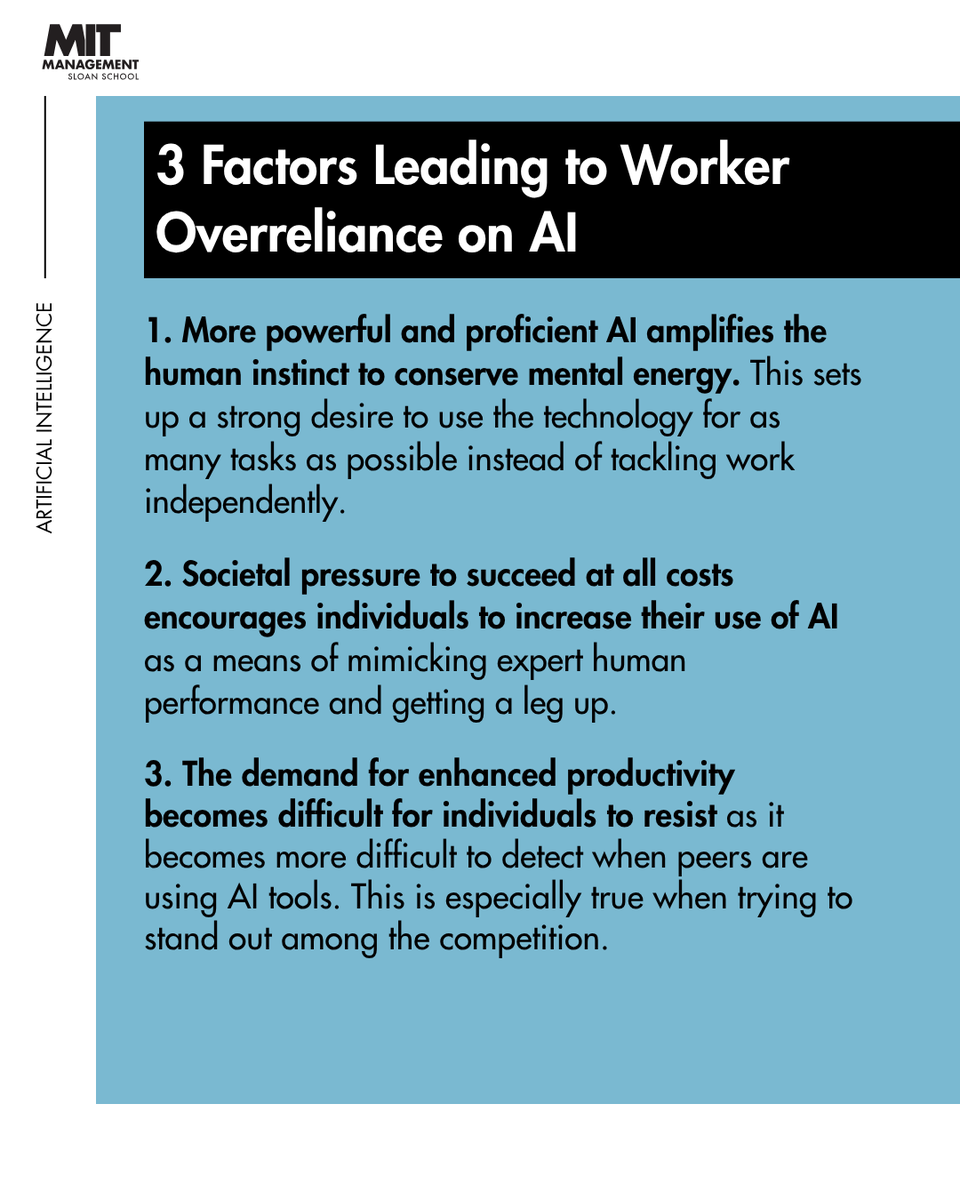
MIT Sloan professor Eric So believes that AI is changing how people’s brains operate and causing users to become overly dependent on the technology. This could eventually undermine individual learning patterns and derail business goals.
Learn what individuals and organizations can to do protect cognitive capital: https://t.co/2gDC1q7RSm
Se viene una nueva etapa de las computadoras personales. Hacia finales de este año veremos como se populariza el uso de los agentes personales. Los anuncios de esta semana de @nvidia, con el RTX Spark…
Hoy se anunció la apertura del capítulo Norte de la Asociación Fintech de México. ¿Por qué este nuevo gremio? Porque la región concentró el 30% de la actividad económica nacional.
#VivaInforma#AvisoImportante
Consulta información adicional relacionada con esta disposición oficial desde el siguiente enlace: https://t.co/LyVJPgfafH
Entérate en tiempo real del estatus de tu vuelo dando clic aquí 👉
https://t.co/XYD0VXN859
China’s Greater Bay Area will fuse 11 cities into a megalopolis that includes Hong Kong, which Beijing hopes someday will be a new Silicon Valley. But the plan for the city and the region is just a part of a much larger transformation https://t.co/6ISholUOHH
AI can make people feel more efficient even when they are not actually becoming much more efficient.
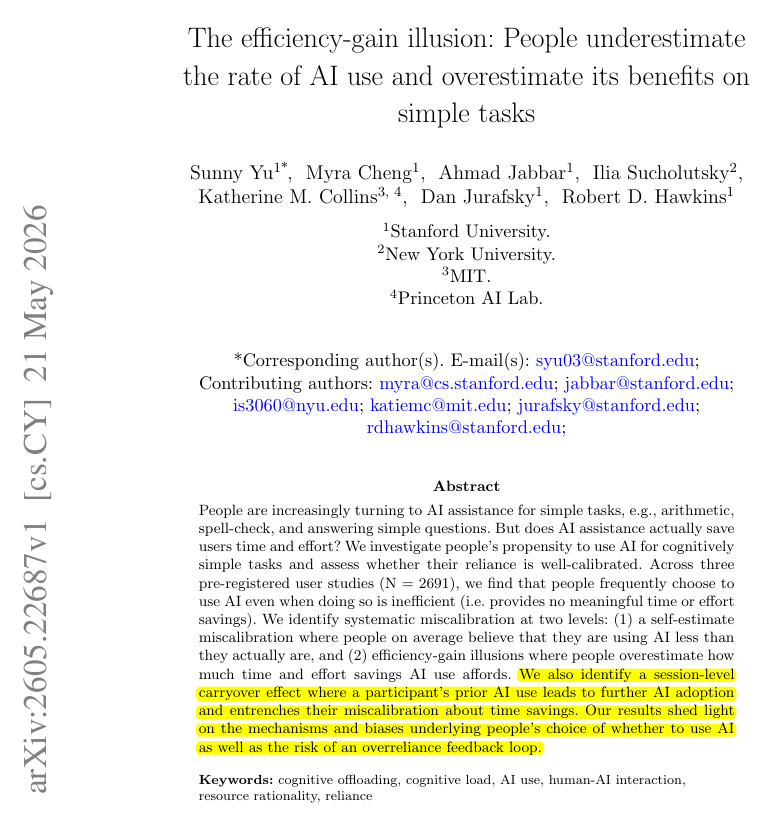
New paper from MIT, Stanford, New York Univ, Princeton.
That people often use AI for simple tasks because it feels like it saves time and effort, but the measured benefit is often tiny, missing, or even negative.
The biggest point is the feedback loop: once people use AI, they become more likely to use it again, even for easy tasks where doing it themselves would often be just as fast or faster.
i.e. AI dependence can grow from a mistaken feeling of convenience, not just from real productivity gains.
Across three preregistered studies with 2,691 participants, people used AI for basic arithmetic, spelling, recall, and short rewriting at higher rates than they predicted, especially on easy tasks.
They also expected AI to save 55.7 seconds on average, when the measured saving was only 7.5 seconds.
For simple work, the hidden cost is not intelligence but interface friction: writing the prompt, waiting, reading, checking, and deciding whether the answer is acceptable.
Once that loop begins, it can feel like effort has been outsourced, even when effort has only been rearranged.
Here’s the key part: the study suggests that AI use can train its own justification.
After using AI on just two tasks, participants became more likely to use it again, even when independent completion was faster.
The danger is not dramatic dependence, but quiet recalibration.
A person who asks AI for a trivial answer today may not become less capable tomorrow, but they may become less accurate at judging when their own mind is already the faster tool.
----
arxiv. org/abs/2605.22687
"The efficiency-gain illusion: People underestimate the rate of AI use and overestimate its benefits on simple tasks"
Pedro Aspe alertó que, de mantener el “gasto desmedido” del gobierno, la deuda podría superar el 60% del PIB para este mismo año
https://t.co/Cg01Ep7TwT
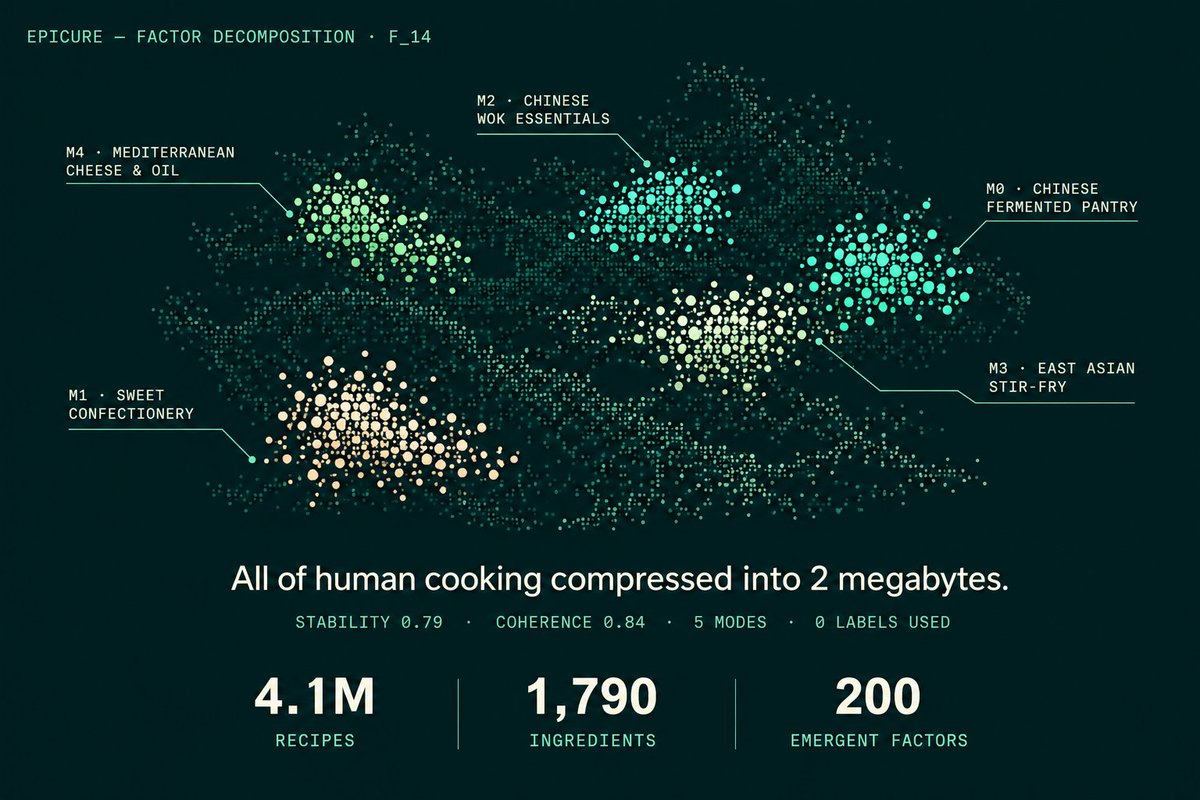
Launching our new paper on arXiv: we trained the largest multilingual food model ever built.
4.1M recipes. 7 languages. 1,790 ingredients. 300 dimensions.
All of human cooking compressed into 2 megabytes.
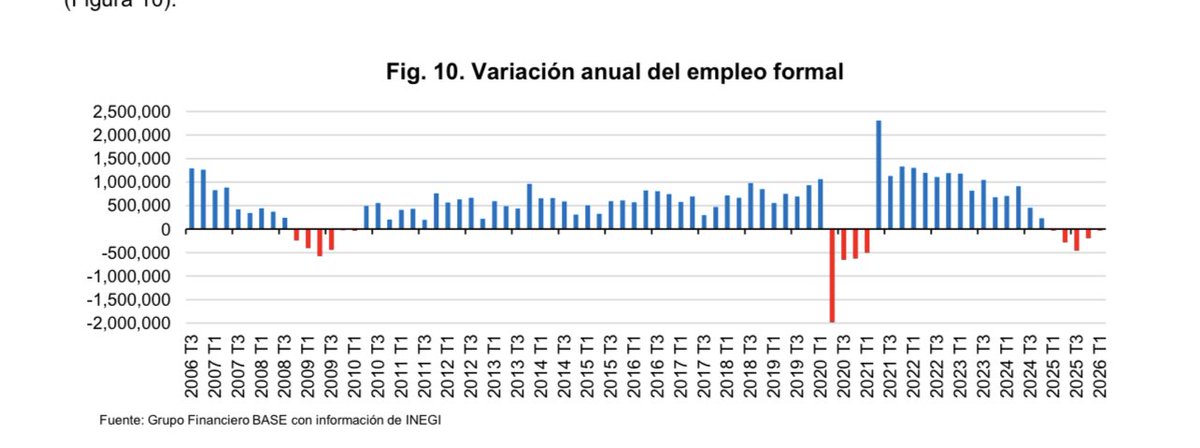
En México, el empleo formal hila cinco trimestres consecutivos de caídas anuales, una racha negativa que históricamente solo se había observado en periodos asociados a recesiones económicas: del 4Q de 2008 al 1Q de 2010 y del 2Q de 2020 al 1Q de 2021.