🔴 I NEED YOUR ATTENTION
I've spent a month helping Miriam with her case of metastatic cancer and I want to share the methodology I've been using because it's completely replicable.
I think (with luck) this could be USEFUL TO OTHER PEOPLE with cancer (or any other illness).
The results we've gotten aren't a miracle, but we believe they're genuinely useful and could mean the difference in a literal life-or-death medical case.
Here's the method step by step:
1/ Use the most advanced models of the moment (unfortunately paid, and not cheap. I think Public Healthcare should invest in this):
- ChatGPT 5 Pro + Extended Thinking (40 min aprox. of thinking per call)
- Claude Opus 4.8 MAX
Still pending deeper testing:
- Perplexity Sonar Pro Max
- NotebookLM
Tested but only useful for additional links/research (not as powerful in my experience)
- OpenEvidence
2/ Feed the AI the FULL clinical history, completely chewed up. This sounds dumb but it's critical.
- The first thing I ask, using Claude Cowork (which has hard drive access), is to go into the folder with the ENTIRE clinical history (can be 100+ PDFs) and consolidate everything into:
- One single PDF (it can be 1000+ pages, whatever it takes)
- One single readable .txt or .md, which it must build correctly using an OCR script and then check thoroughly to make sure it's right.
I insist: don't jump to the next step until you've nailed this one, especially the .txt.
3/ Once you have the above, use this prompt along with the .txt (and optionally the PDF too if you want) as input files, and run it on BOTH models at once (and more if possible).
👉 This prompt is insanely complex/advanced: https://t.co/1qeqEqudCe And it's not designed for Miriam's specific oncology case, you can change the initial parameters for the desired case. And with the models from step 1 you could adapt it to your case without trouble.
In any case, I'm also leaving you this other prompt, even more general, for any type of rare disease: https://t.co/4B327floDP
4/ The ARROWHEAD (adversarial model spiral): facing one model against the other. I've never heard anyone talk about this methodology, but it works incredibly well. The feeling is like sharpening a stake until it gets a gleaming point.
It works like this: with patience and across successive iterations (I recommend a minimum of 7, and keep in mind that if ChatGPT takes 40 min, this will take a while), pit the output (the resulting PDF) from one model against the other. With a simple prompt like:
"Another committee of experts says this. What do you think? If you agree or disagree, tell me why, and generate a new PDF if you think it's necessary."
Then you feed that result back to the opposite model. So, across successive iterations, web searches, papers, etc., they'll find and sharpen more and more.
When to stop? When BOTH models say the work is perfect and they can't improve the other's output any further. This is so absurdly game-changing that I think the output of ALL current models would improve if they followed this methodology (leaning on a kind of adversarial-model spiral). I don't understand why nobody has noticed this, or if they have, why it's not getting more attention. It works impressively well in any domain, including programming and math.
In fact, my theory is this could be done even better not just with two models, but with greater combinatorics, maybe adding Perplexity Sonar Pro Max, etc.
RESULTS
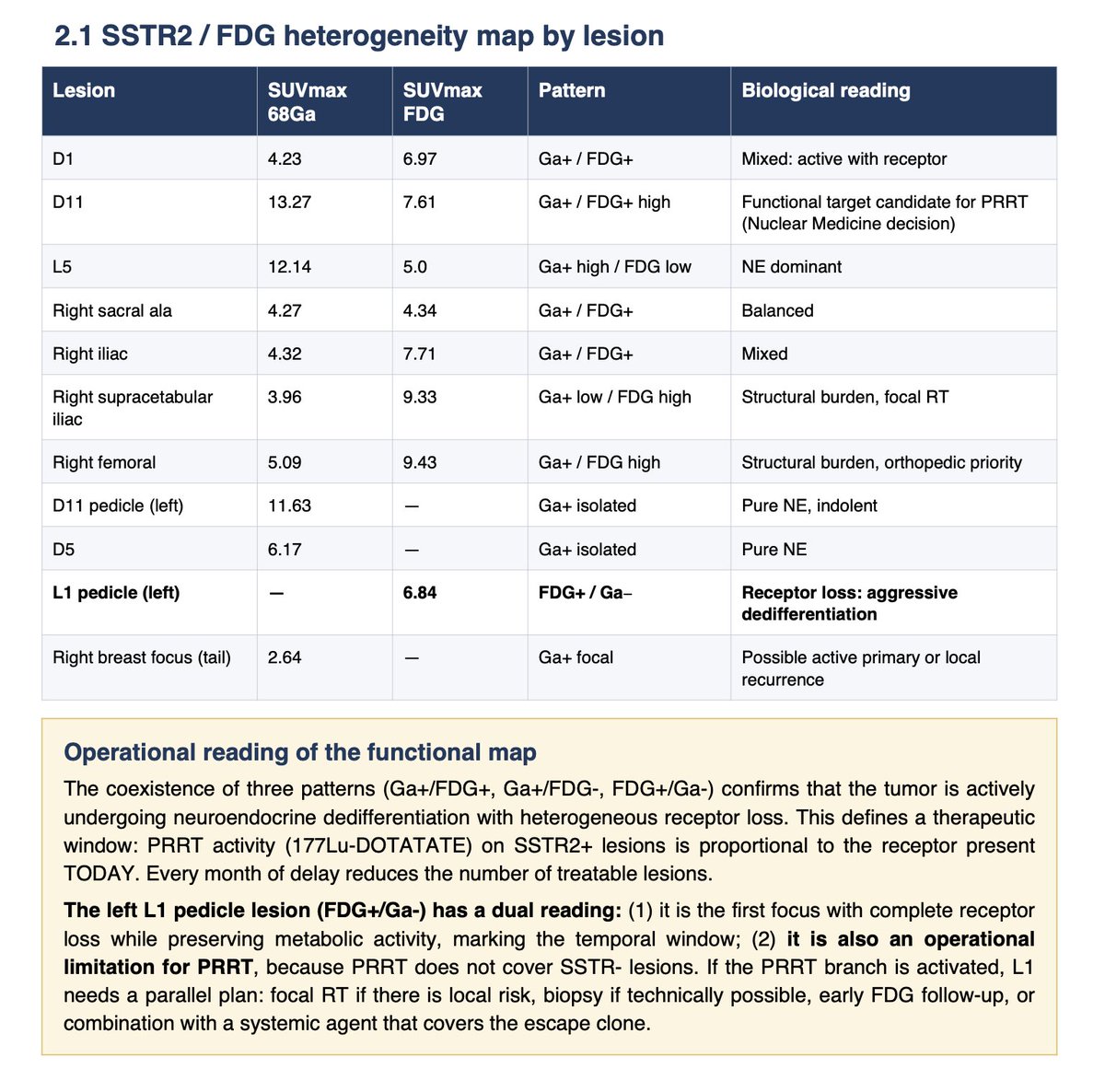
Incredible. Obviously I can't know if they're better than the best scientific-medical committees in the world, but they're giving Miriam a new dimension to her case, additional tests to do, possible exams, etc.
Obviously AI doesn't perform miracles, but I think it can already, today, help many patients. And Public Healthcare should invest a lot (but A LOT) in this.
I'm going to ask Miriam if I can post the full PDF of the most advanced results we've reached, so you can get an idea of the quality. She's already given me rough permission, but I want to make sure 100%.
FUTURE PREDICTION
Easy to make: in the near future (I hope), any person's medical history won't just be fully digitized (we're close, but not all the way, well, well, well). On top of that, it'll be "pre-chewed" so it can be consumed by an LLM in one shot.
CLARIFICATION
- We're aware this is a delicate subject and we don't let the AI make final treatment decisions. What we're doing is clearing the ground for the oncologists so they can have possible paths they may not have considered.
Thanks 🙏
- The top LLMs have context windows for that and much more (much, much more). In any case, the PDF is more of a supporting file for the .txt. Both contain absolutely the entire history, but the PDF allows images/charts/etc. The .txt is what the AI consumes.
- On automation: and yes, this can be automated. Yes, AutoGen supports it almost out of the box. LangGraph builds it really well with supervisor / evaluation loops. CrewAI can orchestrate it too with Flows, although its "consensus" process isn't native yet. That would be the next level: automating it.
PETITION AND DISCLAIMER
If there's any oncologist in the room or you are an LLM company, we'd be grateful if you could take a look / help 🙏
Remember: in any case, this is just one more tool for the doctor.
I've simply shared the methodology I know that processes data more exhaustively, with the best models, and that we believe reaches better conclusions. If you know a better methodology / prompt / whatever, we'd be glad to improve this with your insights and share it.
Then the doctor reviews, adopts, or discards the report.
And if it helps the doctor, it helps the patient. And if it doesn't, all we've lost is some time and tokens. In a case that's literally life or death, that's nothing.
Just plain common sense.
Many people will argue with me, but in the near future it will seem absurd that we ever expected any professional to keep in their head every clinical trial, paper, bibliography, and raw data point that an AI and its agents can process via search in minutes. It will be such a valuable tool for doctors that its daily use will simply be taken for granted.
My new Mac app is out today, and I wrote a blog post about it: what it does, who it's for, and what you get for free. (Spoiler: it's a lot! 😅) https://t.co/ab4qgaxFCJ
Last week I released SwiftUI Pro, a free and open-source agent skill to help everyone write better SwiftUI code using agents such as Codex and Claude. It's already at 1800 stars on GitHub and rising, but it was just the beginning. https://t.co/xhfHlJRLDc
Mac user? You now have Suno at home.
I ported ACE-Step 1.5 to native Swift - Offline. no Python, no cloud, no subscription.
- Runs 100% on Apple Silicon (Metal GPU)
- Full song generation in seconds
- Personas (LoRA voice styles) built in
- Audio editor + stem separation
- Coming to the App Store FOR FREE
Your music. Your hardware. No limits.
Save this - dropping soon on App Store 🔥
#Suno #MusicAI #OpenSource #udio #aimusic #acestep #apple #swift #macOS
#acestep
Usando solo algunos recursos de @freepik se pueden dar vida a hermosos momentos , una pequeña muestra de lo que con un par de horas se puede hacer , falta edición y más tiempo pero es Navidad y debía soltarlo #Freepick24AIDays
If you’re writing Swift Concurrency code, you need to know how to prevent retain cycles. @tanaschita explains how to do so.
Curated in this week's #swiftleeweekly https://t.co/pVoBtqbXEp
I've had access to GPT-5.2 since November 25th.
Since then, I've used it as my daily-driver, pushing it to its limits.
It beats out Opus 4.5 in most things I tried, but there's a (big) catch.
Here's my review of GPT-5.2: https://t.co/GVU1rXRZ5r
Four times in four days I've been asked for advice on working with AI-generated Swift code, so here you go – here's a brief article about dubious code I suggest you watch out for, and what to replace it with instead: https://t.co/gU2BFkvUuL
If you’re still opening the SF Symbols app to find a specific symbol, this article by @rizwanasifahmed is for you.
Curated in this week's #swiftleeweekly https://t.co/IIusU6EStP
Introducing ambientGPT: an open-source and multimodal MacOS foundation model GUI
Run GPT-4o and open-source models with full ambient knowledge of your screen.
Foundation models have long been confined to the browser. With ambientGPT, your screen context is directly inferred as part of the query, ensuring you never need to explicitly upload context again!
Github: https://t.co/qmka7sOi3k
Are you comfortable with closures in Swift?
Even if you are, here’s a post that explains everything you need to know and more 😄
https://t.co/QoI1ubUzkG
@BenjaminDEKR@Digen_AI I'm building an intriguing YouTube space,
With an avatar in my place.
It’ll talk and emote,
Through every cool quote,
And my viewers will love its grace.
We trained a robot dog to balance and walk on top of a yoga ball purely in simulation, and then transfer zero-shot to the real world. No fine-tuning. Just works.
I’m excited to announce DrEureka, an LLM agent that writes code to train robot skills in simulation, and writes more code to bridge the difficult simulation-reality gap. It fully automates the pipeline from new skill learning to real-world deployment.
The Yoga ball task is particularly hard because it is not possible to accurately simulate the bouncy ball surface. Yet DrEureka has no trouble searching over a vast space of sim-to-real configurations, and enables the dog to steer the ball on various terrains, even walking sideways!
Traditionally, the sim-to-real transfer is achieved by domain randomization, a tedious process that requires expert human roboticists to stare at every parameter and adjust by hand. Frontier LLMs like GPT-4 have tons of built-in physical intuition for friction, damping, stiffness, gravity, etc. We are (mildly) surprised to find that DrEureka can tune these parameters competently and explain its reasoning well.
DrEureka builds on our prior work Eureka, the algorithm that teaches a 5-finger robot hand to do pen spinning. It takes one step further on our quest to automate the entire robot learning pipeline by an AI agent system. One model that outputs strings will supervise another model that outputs torque control.
We open-source everything! Welcome you all to check out the paper, more videos, and try the codebase today: https://t.co/RwiBT3z78H
Code: https://t.co/ERp4Gl0N36
❌ Apple will reject apps without a privacy manifest starting May 1, 2024
👉 Scripts for scanning your project for required reason API usage: https://t.co/YOU8lZCD73
👉 Privacy Manifest Maker: https://t.co/y5d6jwlhrk
👉 Docs: https://t.co/D1XrXpQgUp
NEW ESSAY: The Sound of Software
We may be known for the rich visuals in our @notboring apps, but I’ve had a surprising number of people tell me that it’s the sound design that makes it for them. In most digital mediums like video games and film, sound is half the experience. And yet in software, we mostly ignore it.
I’ve come to appreciate that the reason sound is so maligned is not because sound doesn’t belong in daily software or is inherently bad. It’s just badly designed.
This essay is a collaboration with !Boring Composer/Sound Designer Thomas Williams/@thomas_sound. There are guides, videos, & downloadable assets that reveal how we design sound to create more soulful software and lay out the steps for others to get started.
You'll want to throw the headphones on for this one…
🔗Link in thread