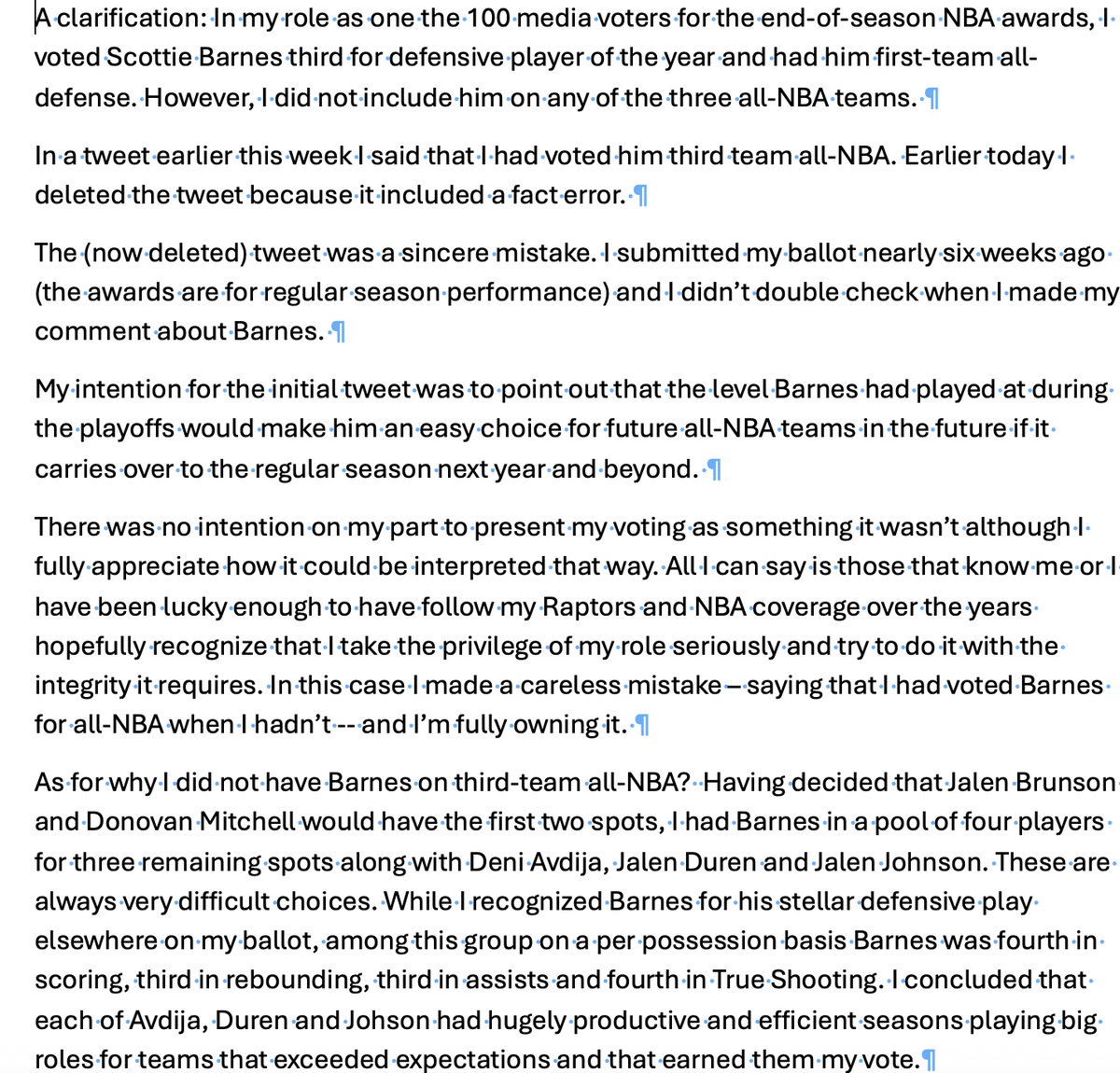
I want to explain and hopefully shed some light on what happened with regard to my all-NBA ballot. The short version: Apologies for a sincere mistake and for any subsequent confusion. A more detailed explanation is here ⬇️:
I will soon be introducing a bill to give the public a 50% ownership stake in the largest AI companies in America.
This would guarantee that the trillions created by AI are used to improve the lives of all of us — and block oligarch decisions that harm the American people.
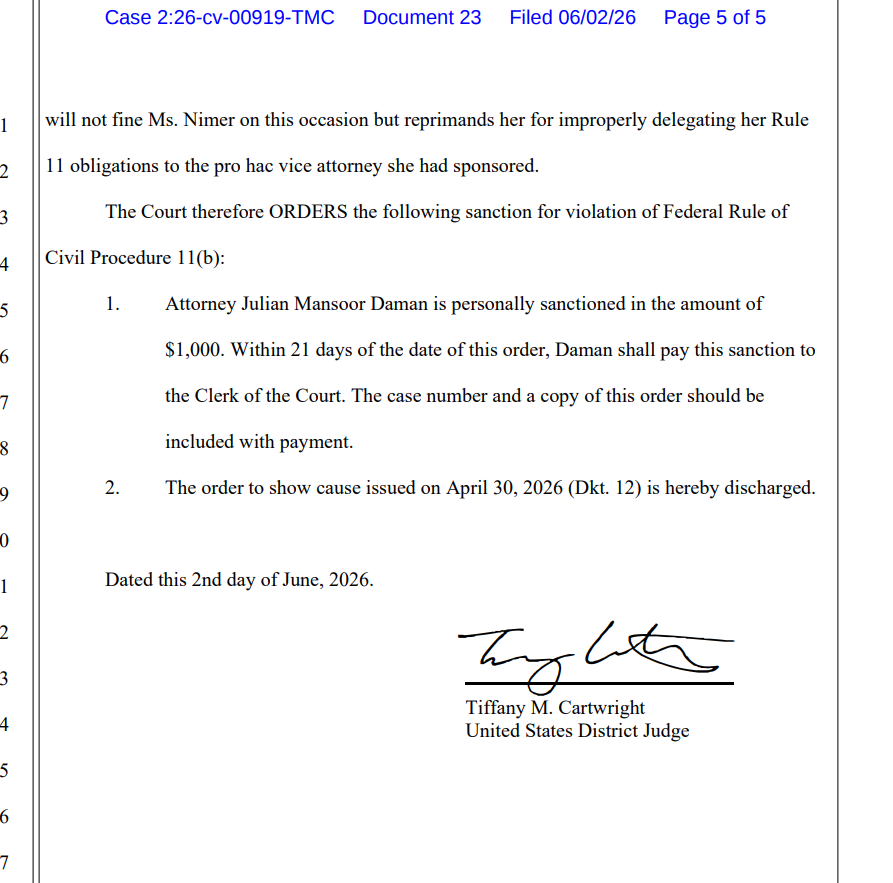
Another lawyer in trouble for AI misuse:
This lawyer filed a habeas petition that cited irrelevant cases and included quotations that did not exist.
Lawyer explained that "a group of legal interns ... used Google Gemini to generate text used in the filings."
He said Gemini "fabricated the quotes and confidently presented this information as binding Ninth Circuit precedent."
The lawyer said the interns "failed to mention this," he fired them, and he apologized.
Sanctions: $1,000.
One Card. That’s it.
Starting July 2, Albertans can get a new driver’s licence or ID card that includes their healthcare number and proof of citizenship, all on one secure card at no additional cost.
No more flimsy paper cards. No more carrying multiple pieces of ID. Just a common-sense change that makes life easier.
some thoughts on kirkland building its own harvey
1) kirkland is spending $500m over four years in order to build its own internal ai legal tools; kirkland intends to spend $100m this year
2) i suspect that kirkland is doing this because they have told themselves that they have valuable data and because they want to appear differentiated
3) i think the first issue is that kirkland probably does not have differentiated data from other elite law firms; at least, not at the level a harvey would absorb
4) all the elite firms probably have similar internal workflow data and so long as some of them defect, that is enough to commoditize the data kirkland wants to use for its platform
5) and, to the extent that they do have different internal workflows, harvey and legora will end up representing a better version of them and this will put kirkland at a disadvantage
6) moreover, companies like kirkland will have difficulty building their internal legal platforms because they do not have experience with software development
7) and, there are both cultural and structural issues with them managing software developers, like they cannot give non-lawyers equity in the firm due to regulation
8) so, i think firms like kirkland are better off using tools like harvey and legora and then looking to focus on where their value really is now: client relationships, local knowledge (litigation, regulation) and legal r&d (novel structures, etc...)
9) anyway, this seems to me like a phenomenon that ai creates across a lot of industries, where firms that were previously vertically integrated become unbundled due to ai because part of the intelligence gets moved to the labs or otherwise gets commoditized
10) and so, a new set of companies are created whose job it is in order to provide services complementary to the labs: forward deployed like harvey and legora and data providers like mercor, surge and handshake
There are some decent reasons for model routing, model capability being one.
But framing it as a competitive or product advantage is very strange because,
1. Is extremely easy to implement so it is neither competitive nor differentiating
2. As @scottastevenson points out, it’s usually slower, less performant, and provides a worse “feel” for the overall experience
3. Is often paired with products that are not transparent to routing decisions
The third point is the most significant because many AI companies outside of the frontier are making a great deal of their money by selling inference at 10x markup. They want you to believe they are always using the best and most performant models so they often hide model choice and, in turn, hide using cheaper models from the end-user.
This is a short term token arbitrage that won’t work once frontier providers stop subsidizing their own tokens and when more local models use becomes the norm in enterprise.
Enterprise AI business models will beed to adapt to off-loading between local and remote inference.
Dynamic model routing products have largely been snake oil so far. We’ve seen many come and go since 2022.
The story of model routing has a simple, legible quality that magnetizes capital.
@Alfred_Lin’s “Beware of Simple Narratives” speaks to the danger of this: https://t.co/STqtEeQP0z
I’m an engineer who has been working on genAI applications since 2022. The nuanced reality is very different from the simple story:
1. As @sqs points out below, frontier models are often better, faster AND cheaper—because they don’t have to retry or get stuck in reasoning loops. The gains of cost-optimized routing are often minimal. Also: people generally want the best possible output. People want to pay 20% more for 5% better.
2. Many projects take a concert of tightly bound models and prompts to complete well. You don’t want individual tasks being routed to different models, as it makes a system unpredictable and unstable. You care about the performance of the aggregate system much more than individual task performance. Dynamic task routing makes it hard to measure the system as a whole.
3. As a user, I dislike how model routing makes software feel opaque. I want to be able to get a “feel” for each model and how to best use it. I don’t want to use a system where changing one word of my prompt might cause me to get routed to a different model, getting wildly different results.
4. Foundation model APIs are already doing model routing to some extent. If there is a significant model arbitrage opportunity which can save costs, they can close the arbitrage themselves.
Closed harness is not a moat.
It’s easy to replicate and easier to build. We built ours over the weekend.
@willchen500 built the core app layer to Harvey in 2 weeks and could build his own harness even more quickly than that.
the entire ai discourse (closed vs OS model/harness) in legal-tech will produce a barbell; under ai large firms only become larger (a testament to the recent acquisition spree by H & L)
I feel like I'm missing something.
I use Claude Code like mf all day and it is absolutely incredible.
Every time I open up Claude Cowork to do stuff with documents (legal, marketing, etc.) I end up frustrated. Like, I'm probably holding it wrong, but it just seems much less obviously good than Claude Code...
You should expect to see M&A heat up between @harvey and @WeAreLegora especially around practice-area workflow products. Exclusive content-licensing deals will also be important.
One problem for them is that older incumbents are also racing to take these chips off the table while they themselves figure out how to protect against entrenchment of Harvey and Legora.
Today, I'm excited to announce that @WeAreLegora has acquired Cadastral.
Cadastral is an AI agent platform built specifically for commercial real estate, trusted by JLL, AvalonBay, Equity Residential, and Empire State Realty Trust. In just over a year, they've signed 50+ firms and grown revenues by 40% per month on average.
Why CRE? Because it may be the most legally intensive industry on earth. Acquisitions. Leases. Refinancings. Disputes. Every deal produces a wall of documents that demands precision. Legal teams here have never had AI built for them, until Cadastral.
Co-founders Abe Somani and Aman Dhesi and their NYC engineering team are joining Legora, and planting the flag for our first major US engineering hub. We're building toward 200+ people in New York and 300+ across North America by end of 2026.
This is our fourth acquisition this year. The thesis is consistent: Legora is an agentic operating system for legal work wherever that work happens. Law firms. In-house teams. And now the industries that create the most complex legal work in the world.
CRE is next. It won't be the last.
Welcome, Abe, Aman, and the Cadastral team.
Full story:
https://t.co/OIHu0DWPqR